

Designer Thomas Sing had a few games published in the early-to-mid 2010s, but most gamers became aware of him in 2019 when German publisher KOSMOS released The Crew: The Quest for Planet Nine.
Suiting Up for a Journey
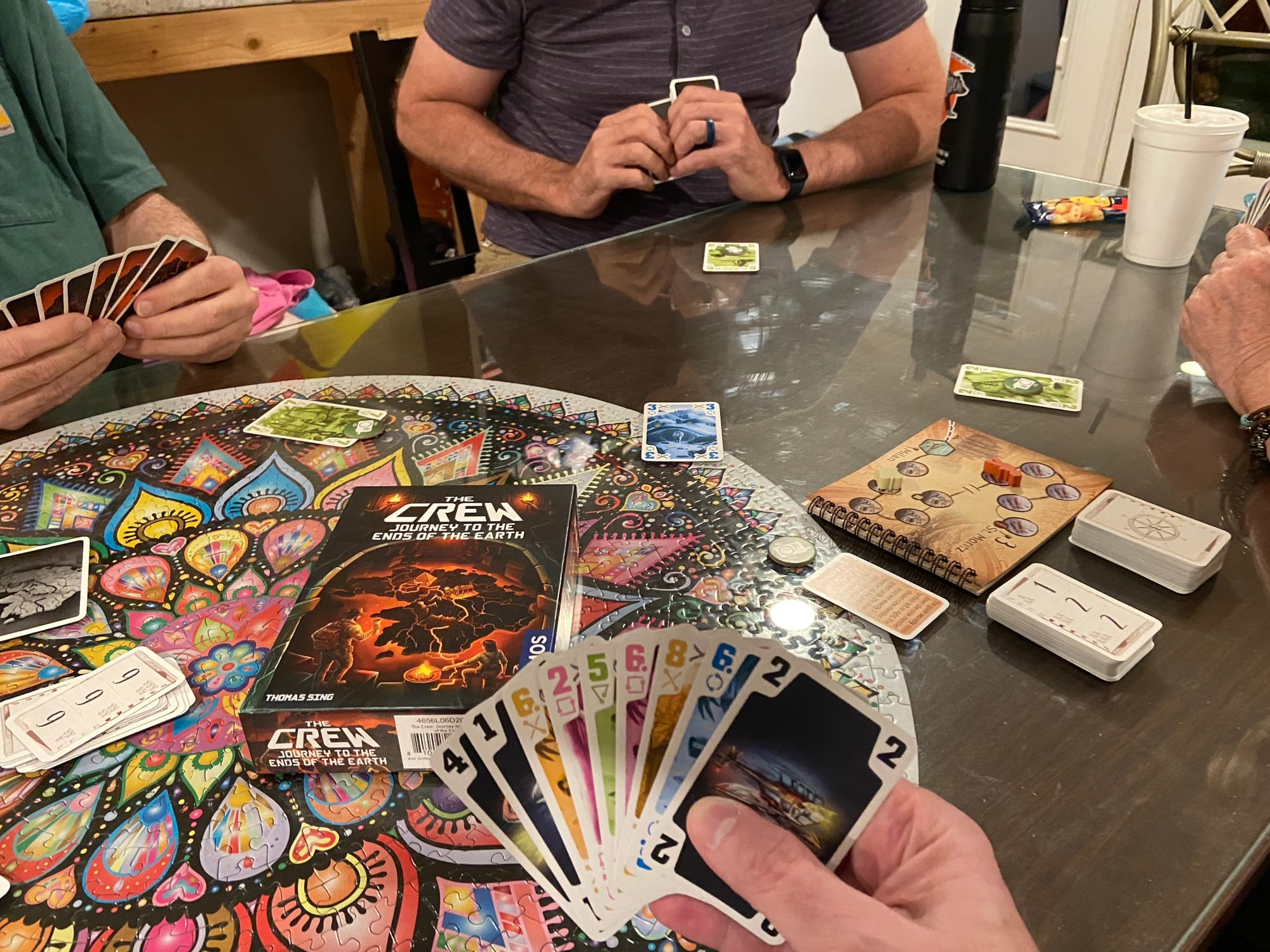
Crew 1 — to use Sing's shorthand for the game series in a designer diary about Crew 3 — is a co-operative trick-taking game in which players undergo missions that typically challenge them to collect randomly determined cards, e.g. I need to capture the blue 2, while you need to capture the yellow 9. If I have lots of blue cards in hand, that challenge will be easy for me; if you don't have trump cards to take the highest-valued yellow card, well, we'll try to figure out how to make that happen.
As you progress through fifty missions, new challenges are added: This random card must be the first one collected; you cannot use a 9 to win a trick; no one can "communicate" a card in hand, with this communication being the sole way to share information about your hand; and so on. Players typically draft tasks within a mission, with you getting a personal goal that's simultaneously a group challenge since you can rarely achieve a task on your own.
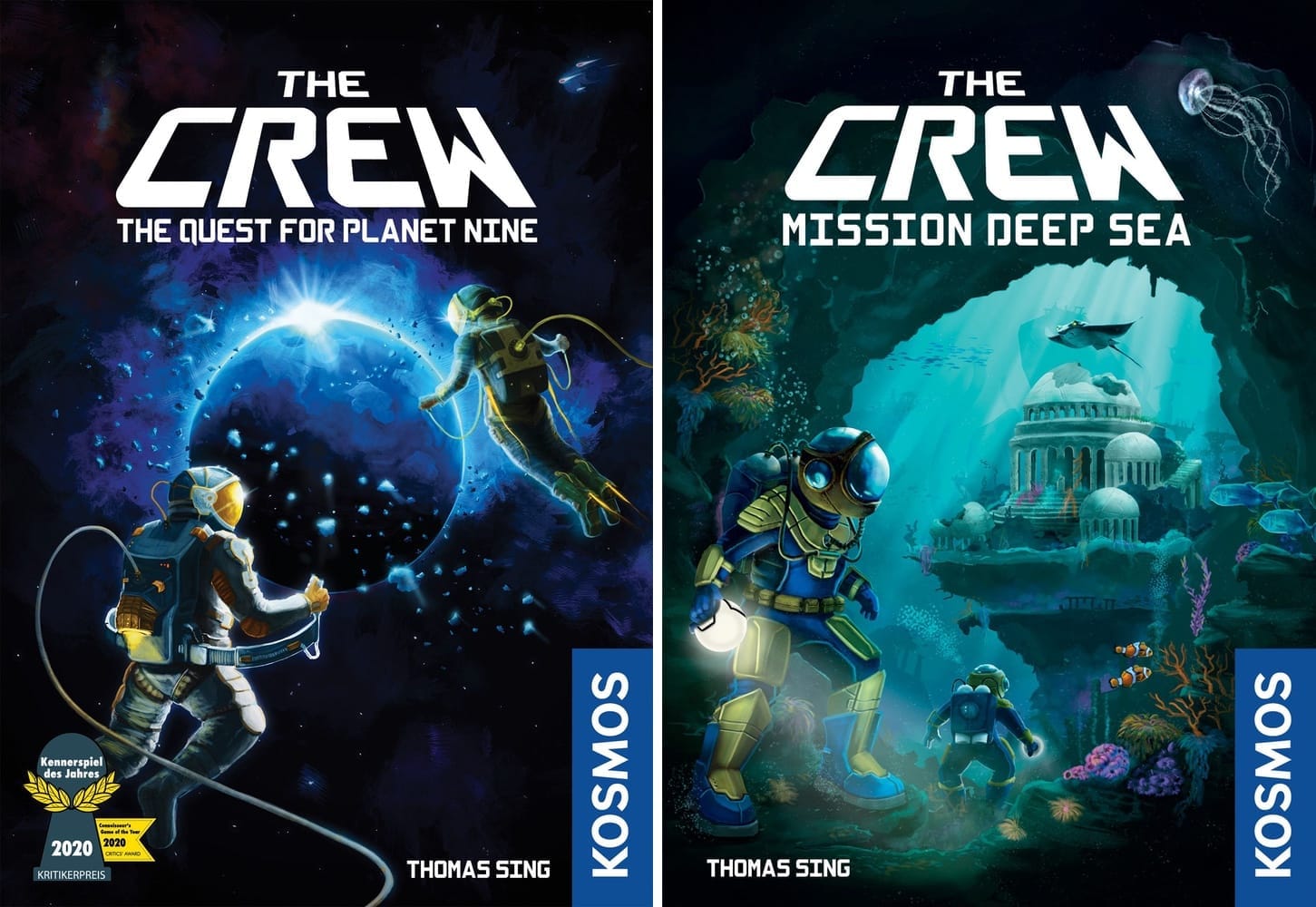
From Outer Space to Under Water
I loved Crew 1 — here's my review from December 2019 — then was surprised to discover that I liked the sequel game, The Crew: Mission Deep Sea, a.k.a., Crew 2, even better.
This 2021 release keeps the same trick-taking structure as Crew 1, with four colored suits numbered 1-9 and four trump cards numbered 1-4 (thus giving you five types of cards), but now the tasks have their own unique deck, with each individual task having a difficulty rank on the backside. Missions have a difficulty value as well, with you revealing task cards until they add up to the mission value. Sometimes a mission will consist of one high-difficulty task, and sometimes you'll have a handful of simple tasks, with their interaction in that particular mission setting up a unique challenge.
One big change in Crew 2 is that tasks are usually not about players taking particular cards from the deck. As I wrote in my September 2021 review:
[H]ere are the two cards we had in a four-player game for mission #7, which has a difficulty level of 6:
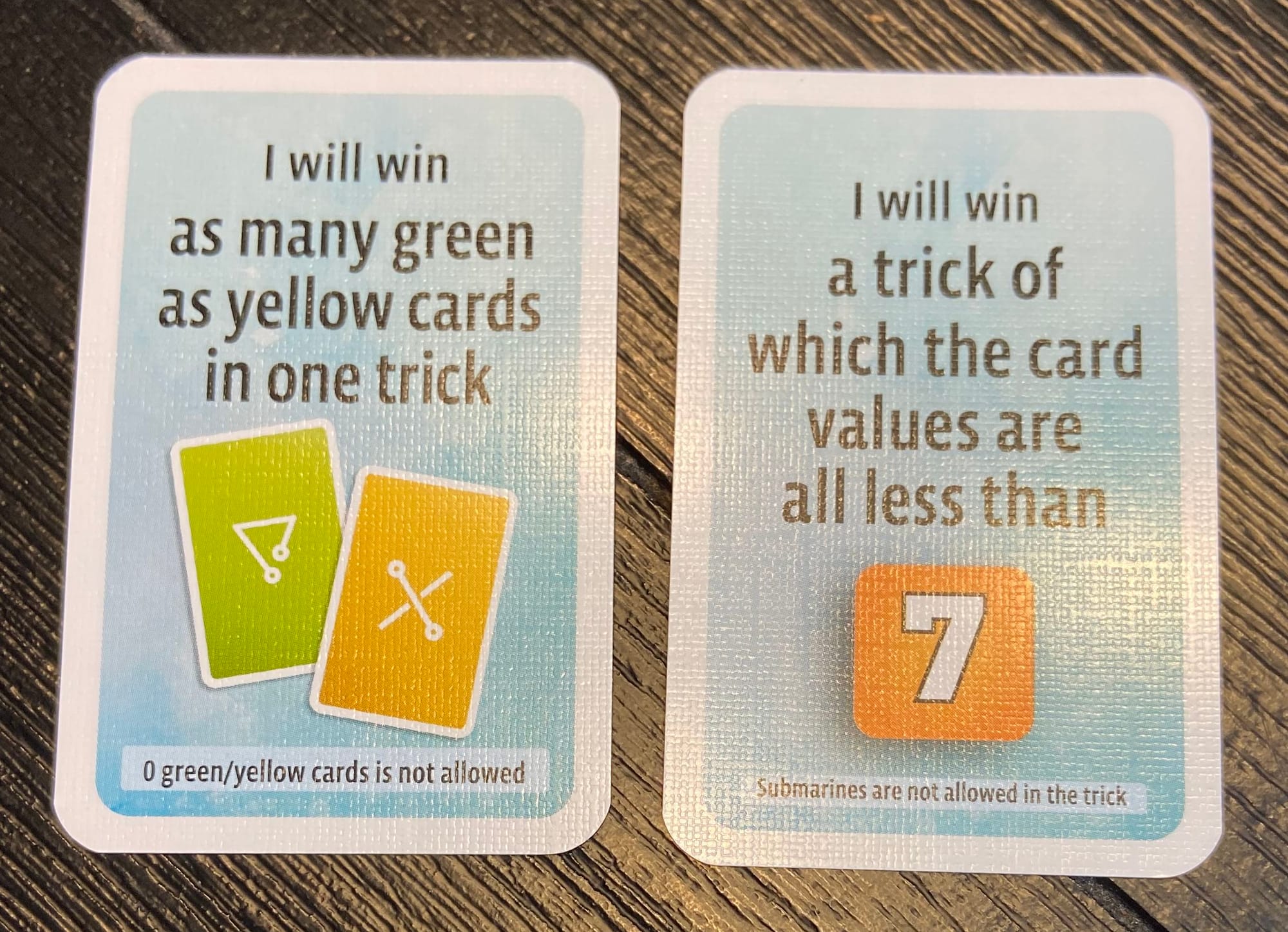
These two tasks differ a lot from those in [Crew 1], and they are representative of many of the tasks in [Crew 2] in that they present the table with a challenge that plays out over the entire hand instead of being something that is mostly the concern of a single person. I was commander for this game, and my hand had only three cards that weren't yellow or green, so I took the "win a trick with all cards <7" task as I thought I'd be able to contribute better to the completion of the other task by voiding the non-green, non-yellow cards from my hand, then throwing in yellow or green as needed.
The challenge of that "green=yellow" task, of course, comes from four players needing to void themselves in various suits — which will differ for each player — so that we can end up with 2 green/2 yellow OR 1 green/1 yellow/2 other stuff in a single trick that is won by the player holding the task. That's a lot of hoops! And along the way we need to ensure that I can win a trick that completes my task, so we need to play out high cards and submarines at the same time that we're trying to get the colors in the right arrangement.
In general, the tasks in Crew 2 are more holistic than those in Crew 1. In the former game, you'd play until you collected certain cards, which sometimes took only a few tricks, then you'd bag the rest of the cards in your hand and move on to the next mission. Crew 2 often requires you to play out the entire hand before you can guarantee that, say, you won more yellow cards than blue cards or you won as many tricks as the commander, that is, the player who starts with the 4 trump.
Tricking Our Way Across the World
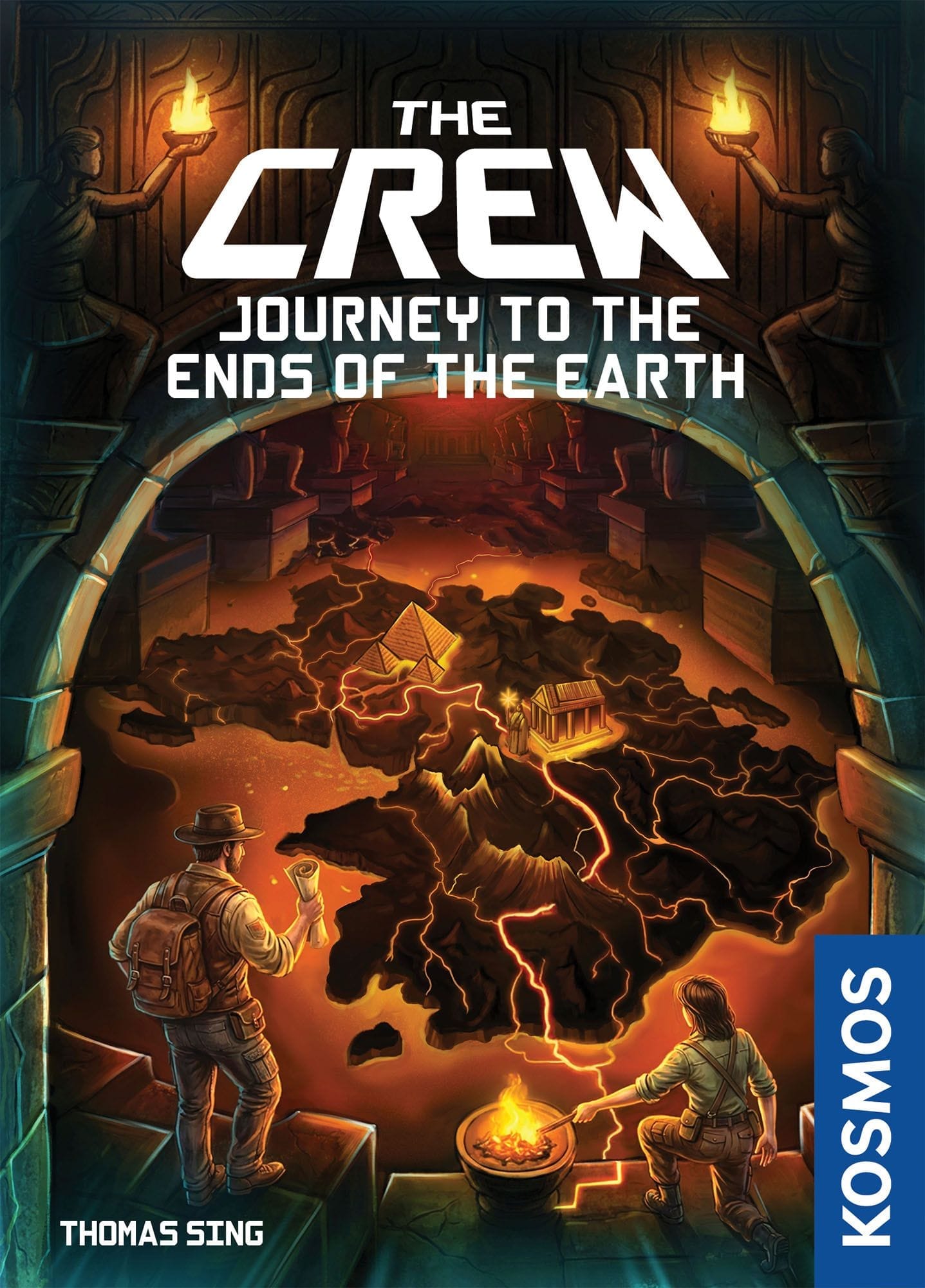
In The Crew: Journey to the Ends of the Earth, which U.S. publisher Thames & Kosmos will debut at Gen Con 2026, Thomas Sing takes the holistic nature of tasks even further, with many of the tasks being not an individual challenge, but something the entire team must tackle. [Disclosure: Thames & Kosmos is an advertiser on Board Game Beat and supplied a review copy of this game.]
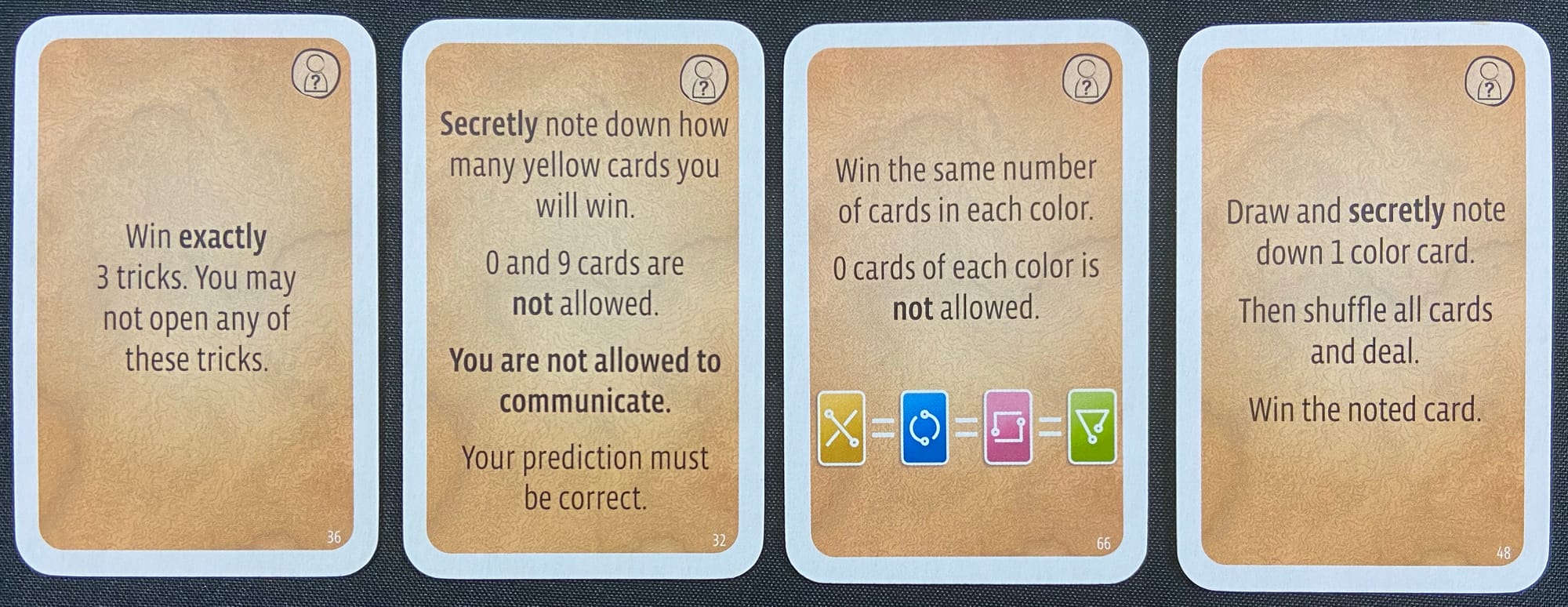
Here are a few of the 104 task cards in Crew 3, with these cards coming in three categories:
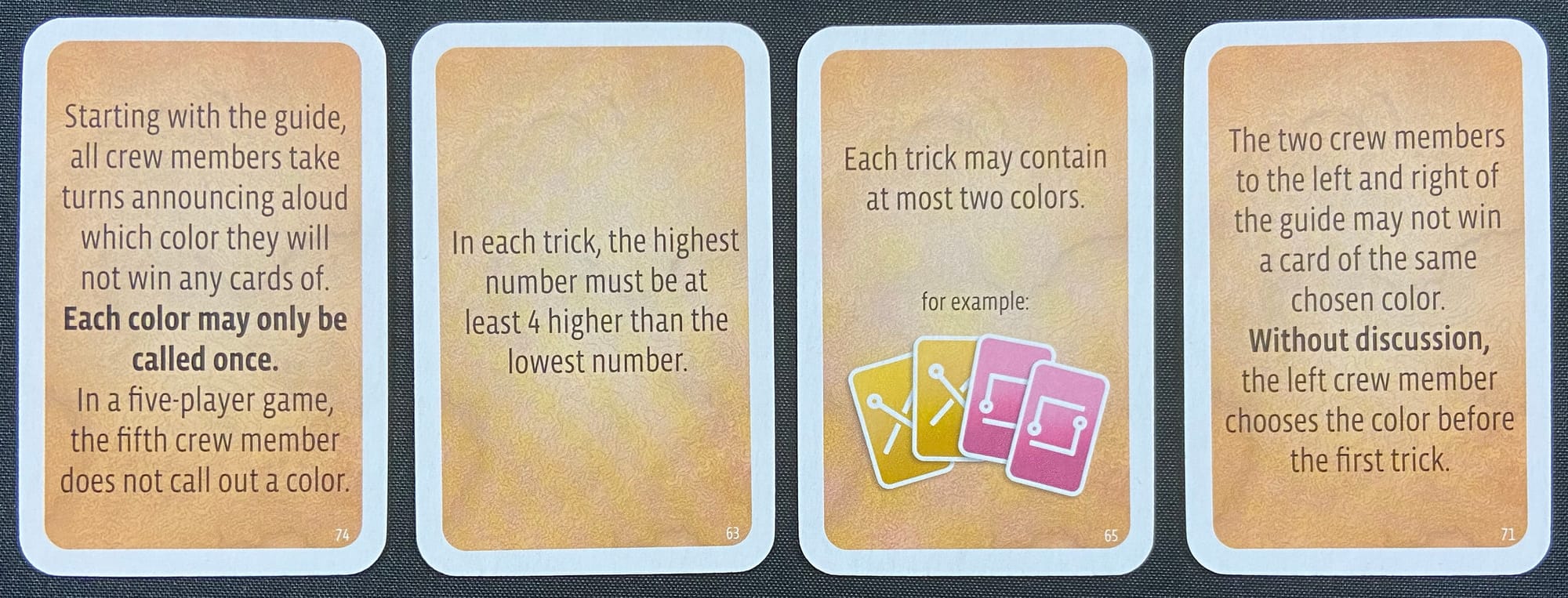
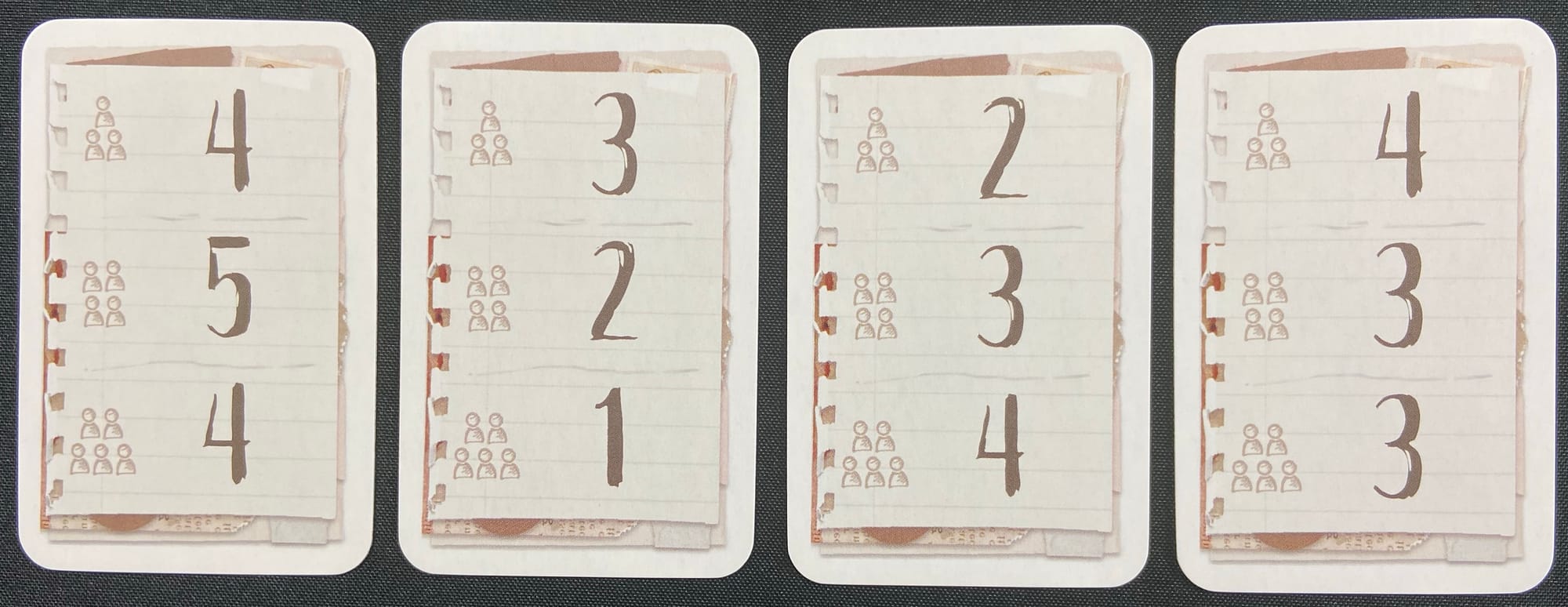
Standard tasks: As in Crew 2, these tasks have a difficulty value on the back that varies depending on the player count, but unlike in Crew 2, no matter what's happening in Crew 3 (as least as far as I have seen), you will draw only one task for a round of play.
When I read "only one task" in the rulebook, I was initially disappointed as the interaction created by random tasks in Crew 1 and (especially) in Crew 2 was one of the most delightful parts of gameplay. After all, the difficulty of winning the same number of green and yellow cards in a trick will depend on the other tasks in play.
In practice, though, these single tasks have proved highly satisfying as they feel even more holistic than Crew 2 tasks. Imagine tackling the task demanding that "Each trick may contain at most two colors"? Everyone needs to pay attention to every card played in order for this to succeed. The same is true for "In each trick, the highest number must be at least 4 higher than the lowest number." You're not thinking only of one color or certain values, but all the cards in play. You don't necessarily have to track all played cards to complete a task, but doing so would improve your chances of success.
Look at another standard task: "Starting with the guide [the player with the 4 trump], all crew members take turns announcing aloud which color they will not take any cards of. Each color may only be called once." Everyone is responsible for making this task happen, and success starts with choosing the right colors...but with the fourth player on the hook for whatever color they've been given. Ideally the previous three players have assessed their hands well!
In the standard task above, I was the guide and had to secretly choose whether my left- or right-hand neighbor would have to win exactly three green cards, with the other neighbor being forbidden from winning exactly three green cards. The other three players had to intuit how they would approach this task, then based on my plays in each trick, figure out who should win what and how to make that happen.
In Crew 3, you can communicate cards in hand the same as in earlier games: Place a non-trump card face up on the table, then place a communication token on it to indicate whether it's the highest card you hold in that color, the lowest one, or the only one. What's new in Crew 3 is that you use as many communication tokens as the number of players, and whenever you want to communicate, grab one and use it. You can grab them all if needed!
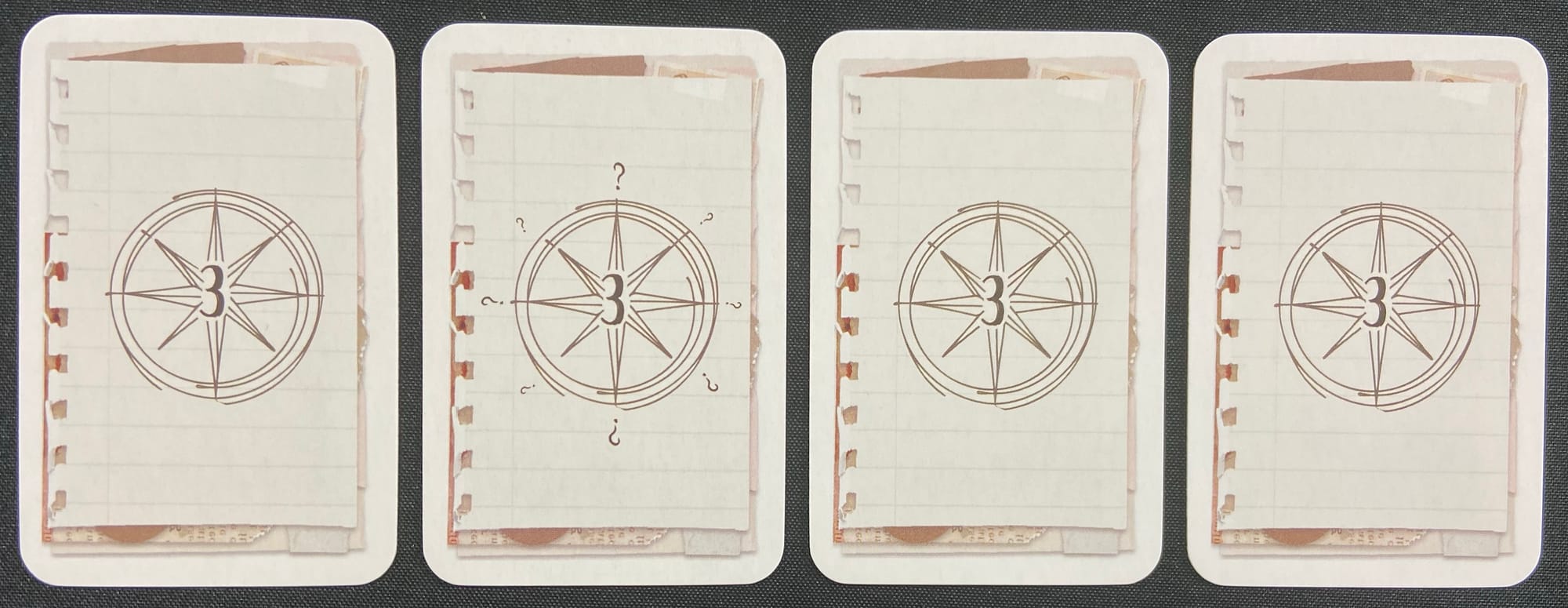
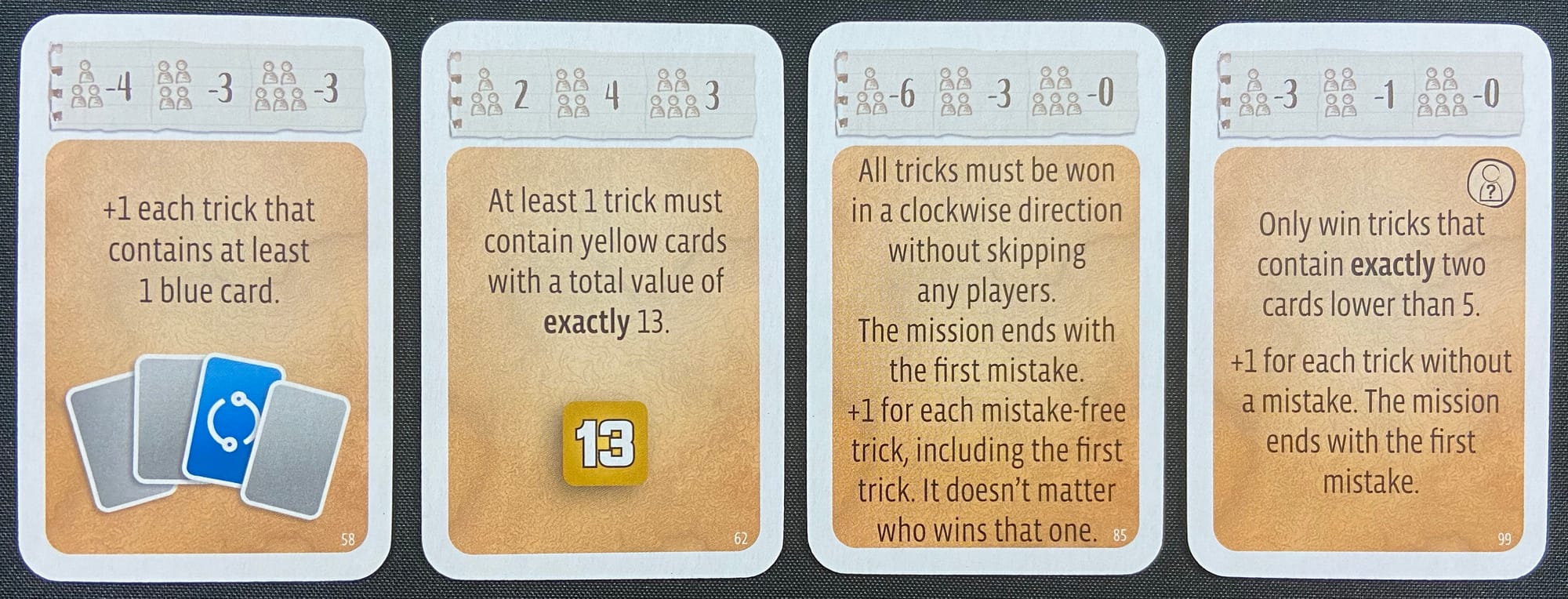
Secret tasks: The difficulty value of these tasks is estimated at 3, but the actual value will depend on how well you do at them. (The secrets with ??? on the back are more variable than the others.) As with the standard tasks above, all players have a role in maximizing the value of secret tasks.
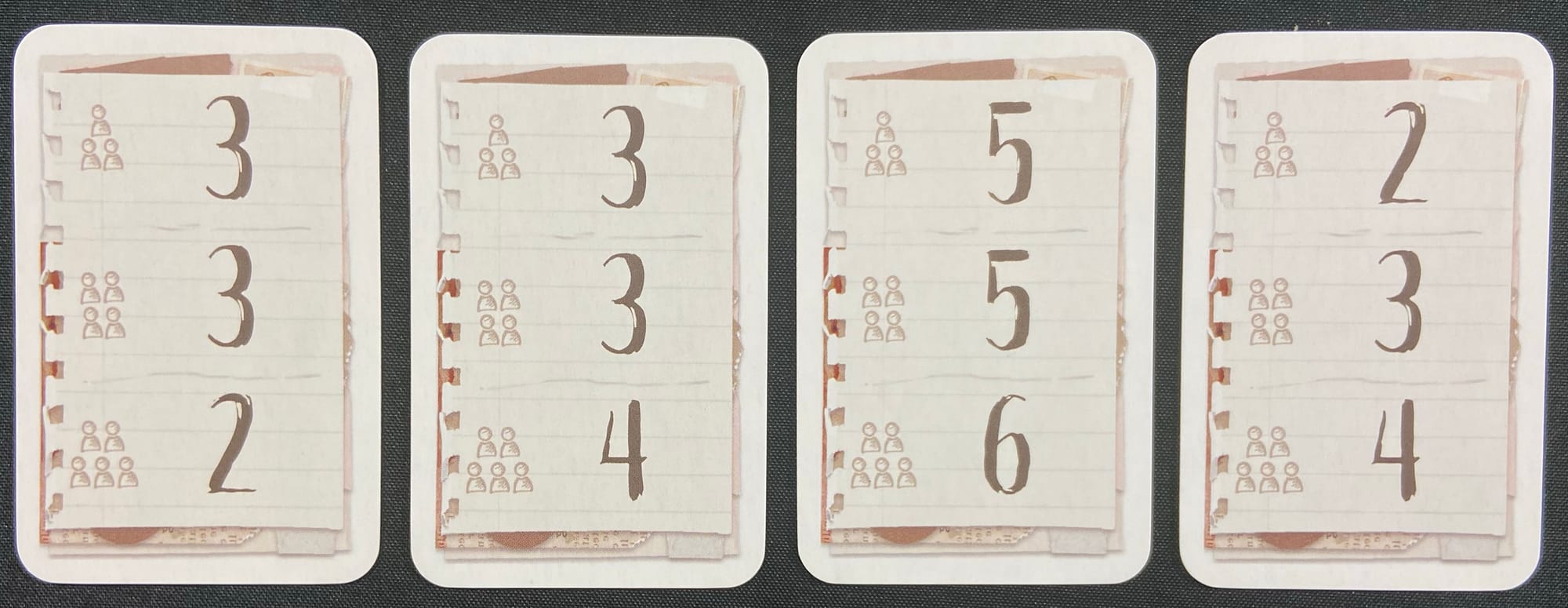
The leftmost task, for example, says "+1 each trick that contains at least 1 blue card", so in a three- or four-player game you'll score 3-9 points since each hand has at least ten tricks in which to play out the nine blue cards. However, to that final score you will add the listed number at the top of the task card based on player count, which means in a three-player game you'll score 0-5 points.
The second task is a one-shot challenge that can net you 2, 4, or 3 points should you succeed, and you'll have at most three shots to make it happen. Fail to collect 13 yellow even once, though, and you score nothing.
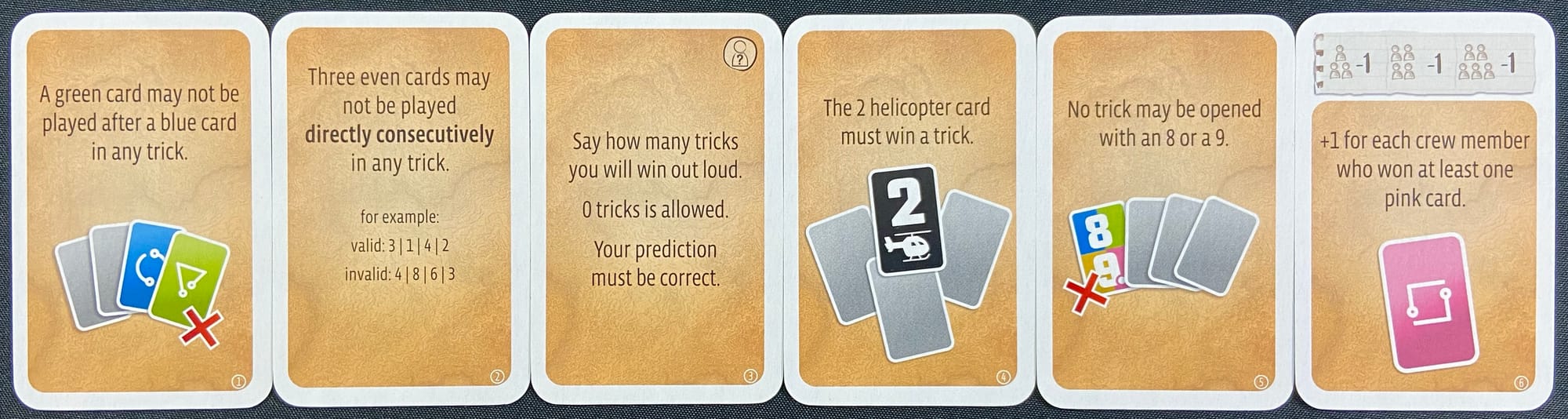
The third and fourth tasks above highlight an aspect of some secret tasks: One mistake ends the round. In the third task, for example, if the players are in order A-B-C-D and B wins the first trick, then C must win the second, D the third, and so on. If the wrong person wins, stop playing.
The fourth task above is an individual task, and that gives you an out sometimes. One player will have this task, and if someone else wins a trick without exactly two cards lower than 5, then you're still playing — and often you'll want to step in to keep the taskmaster from winning a trick that will hurt the team.
Individual tasks: These tasks work a bit differently than the others. For an individual task, each player simultaneously reveals a communication token. If they think they can do the task, they show the green side; otherwise, they show red. If only one player shows green, great — they've got the job! If multiple players show green, the guide chooses one of them with no other information.
And if everyone shows red, then you take back the token and do the reveal again. Surely if everyone thinks their hand sucks, one more player will now think their hand sucks less than the others?
But while one player is charged with the task, once again all players must step up to, say, help that one player win a trick three times, then keep them from winning again when they lead the next trick. The rest of the team must watch the task holder and play to enable them to make the moves they need to win a mystery card or an unknown number of yellow cards.
So far, I've played 58 rounds (i.e., hands) of Crew 3, which coincidentally matches how many times I had played Crew 1 when I reviewed it. Those rounds have taken place over three sessions with three or four players, with each session lasting 3-4 hours. I kept saying, "You guys want to play another hand?" and everyone kept saying, "Absolutely!"
Stepping on Stage
The structure of the rounds in Crew 3 differs from those in Crew 1 and 2. In those games, you are presented with a mission, then you reveal tasks, and if you complete those tasks, you advance to the next mission. If not, you repeat the mission.
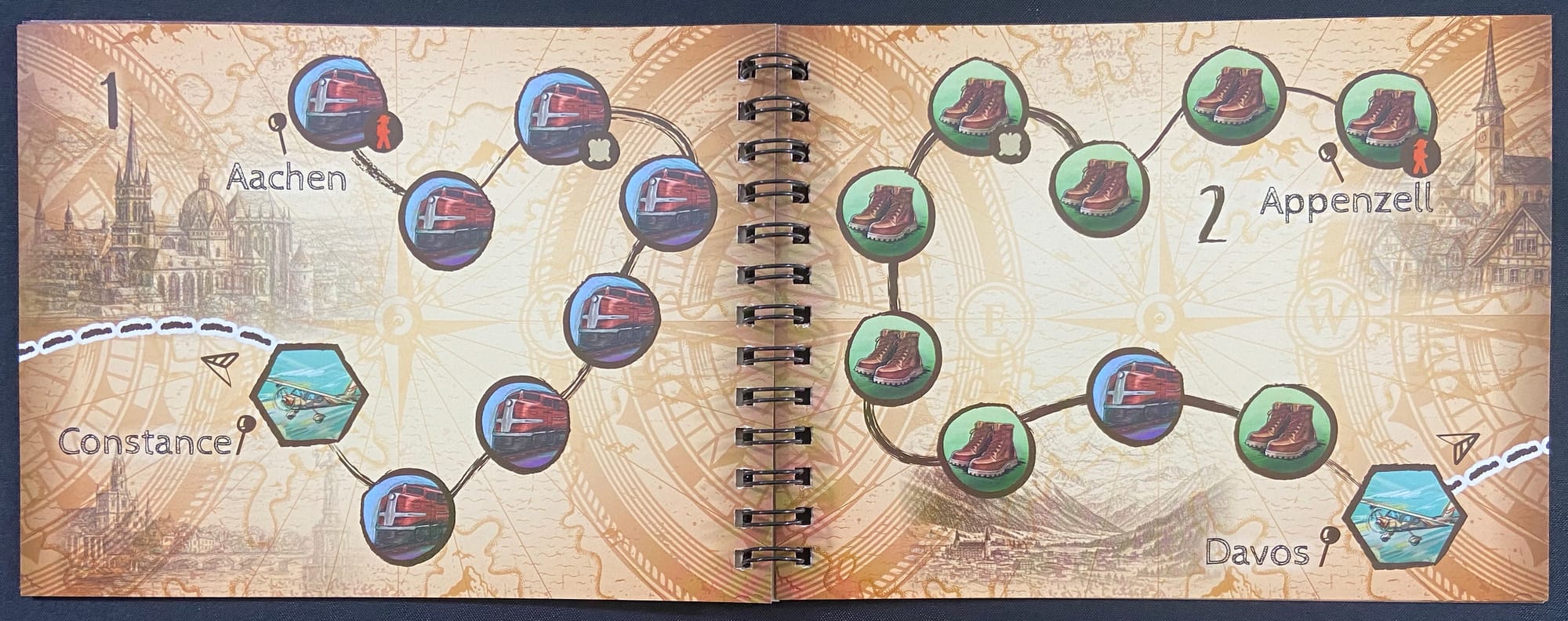
Crew 3 is presented to players as a quest — a journey to the ends of the earth, one might say — and this quest consists of 25 stages, with each stage being printed on a page in a logbook. For most stages, you place a crew marker at one end of a path and a time marker on an indicated space. Each round, you advance the time marker one space, while advancing the crew marker a number of spaces equal to the task's difficulty...but only if you succeed. Your goal is to reach the plane in the hexagon before time runs out.
The tasks are split into two stacks, and each round you choose one of the top tasks based on the back of the cards. You know the point values of these tasks (maybe), but not what you're trying to do. Twice during a stage, you can discard a task, which keeps you from getting stuck with a 1-value task when you need a 3 or vice versa.
Instead of simply trying to get through all of the missions, in Crew 3 you're trying to complete each stage as quickly as possible, scoring points based on the distance between the crew and time markers at the end of the stage. If they both hit the plane the same round, 0 points for you; if the crew marker gets their first, you score negative points equal to the distance between the markers; if the time marker "wins", you score positive points equal to the number of tasks needed to reach the plane. Your final score is the sum of points earned in stages 2-25, with stage 1 being the introductory learning stage.
I've talked with others who have played Crew 3, and they find the score a drawback as they just want to work through missions, viewing that progress as their "score". In our group, we've ignored the score and just cheered or booed when we reach the end of a stage. What's more, we ignore the directive to skip a task we've failed and draw a new task, instead choosing to tackle a task repeatedly until we complete it.
Are we still playing the same game? Does it matter? The joy that we've found in the game is confronting a constant flow of challenging tasks and figuring out how to defeat them. If we play two pink cards consecutively in a trick and fail a task that tells us not to do that, then we're going to shuffle the cards and try again. (That task took us four attempts!) For us, satisfaction comes not from a score, but from success, from solving the problem presented — and sometimes you need a few practice rounds to get there.
Around the World in 80 Bicycles
One other aspect of stages is that each non-train space your crew marker is on introduces a twist to task selection, communication, scoring, or cardplay. If you're traveling by foot — that is, your crew marker is standing on boots — you must choose the task with the lower value. If you're on bicycles, you can't communicate as long as you have one of the six bicycle cards in hand. (Six color cards have a bicycle icon near their number. Other colored cards have a scooter, a machete, or skis.)
Aside from the bicycles, other stages affect communication in an interesting way. If you're in fog — which features the pink boat — you deal only the listed number of cards to each player, with everyone drawing a new card after each trick. The helicopter stage has you pass one card left after any trick with a helicopter — that is, a trump card. You might have previously communicated that you had only one blue card, then you played it to void that suit and throw off...only to find new blue cards showing up in your hand.
These twists are overlaid on whatever your current task is, with the main challenge being that we sometimes forgot the twist until we're shuffling the cards at the end of the round: "Oh, we forgot about the helicopter pass. Ah, well, let's move on."
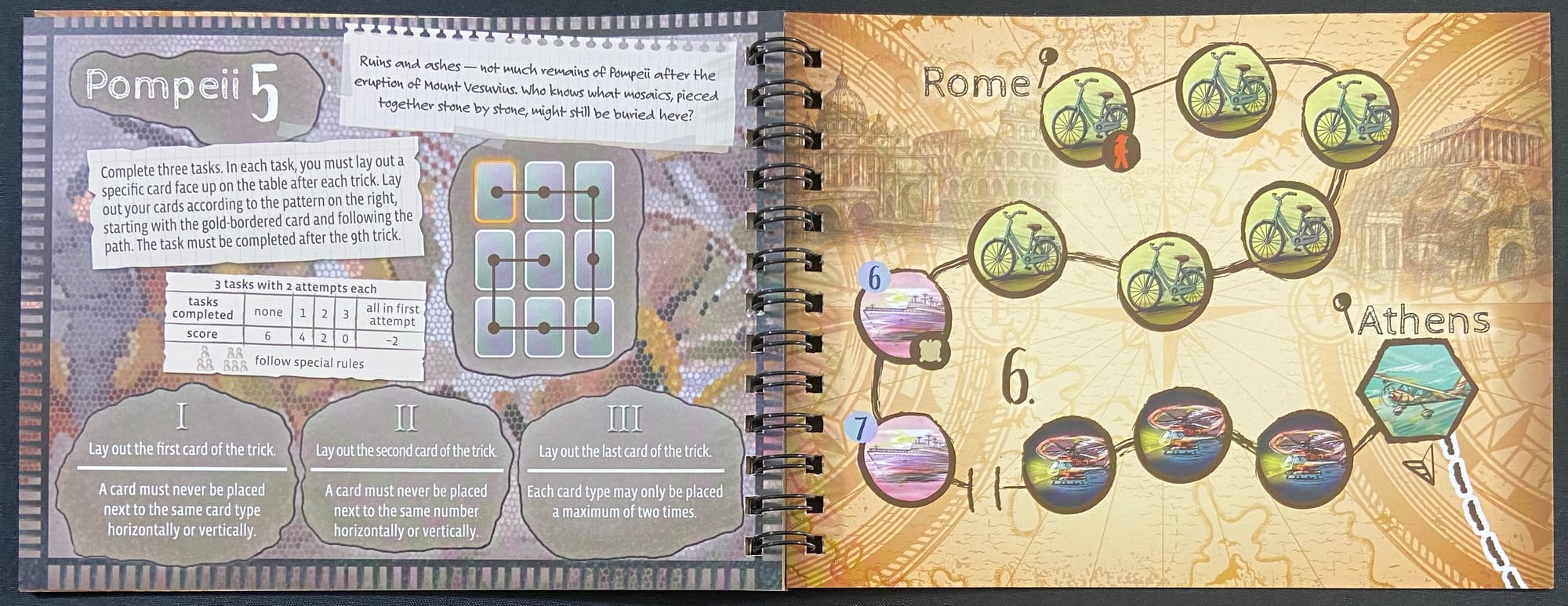
Some stages present unique tasks, as with Pompeii above. You don't draw a task card, but instead do the presented tasks in the order depicted. That said, I initially missed the rulebook pages on special stages, so we mistakenly tackled all three of these tasks at once. For each of these tasks, you create a 3x3 grid with a particular card from the trick, building the grid in a spiraling order:
- In the first task, you place the first card played in each trick into the grid, trying not to place card types adjacent to one another.
- The second task has you place the second card in each trick, not placing the same numbers adjacently.
- The third task has you place each trick's final card, and you can use each of the five card types at most twice.
Amazingly, in a four-player game, we managed to complete all three tasks at once on our second attempt!
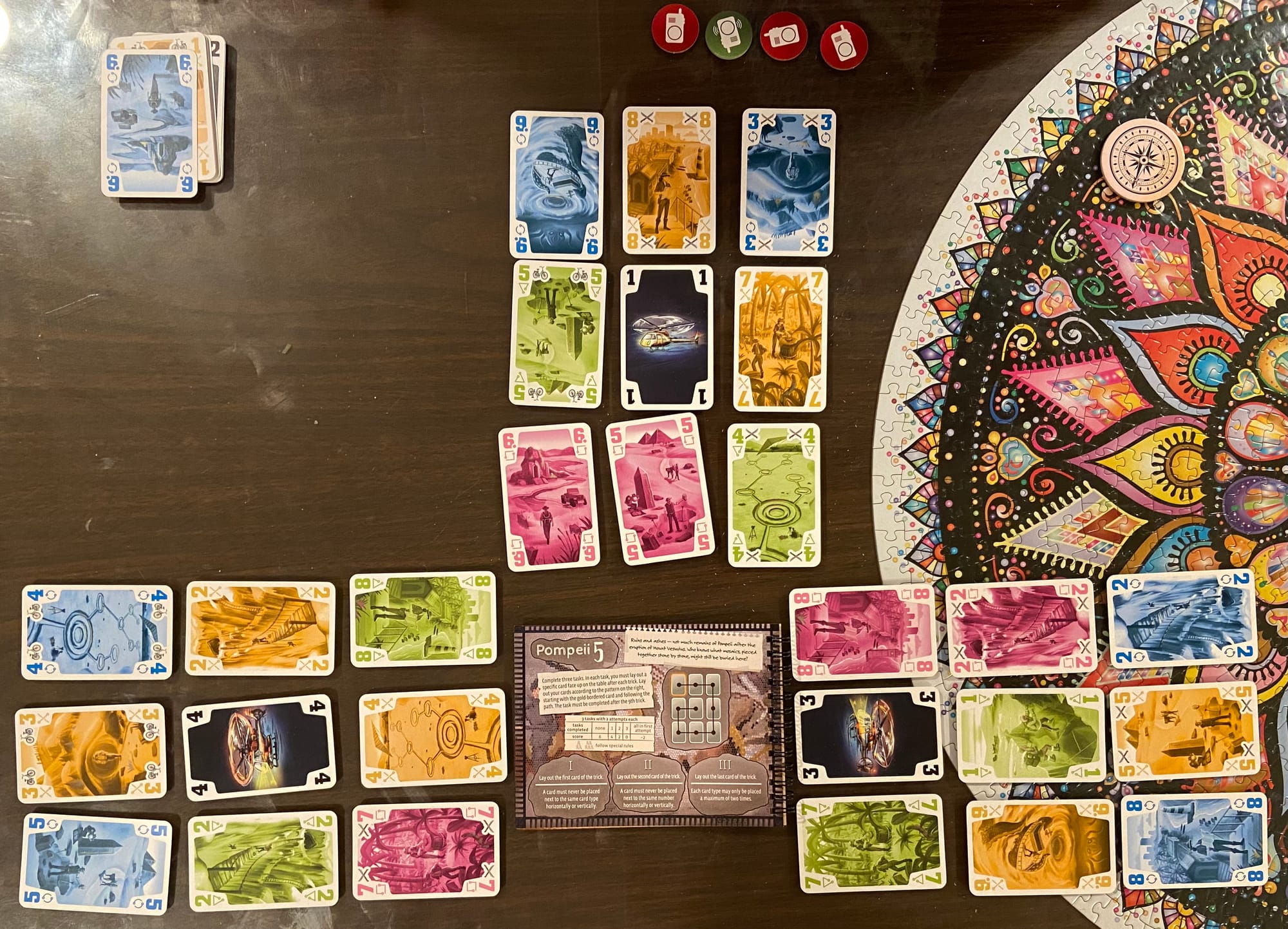
We were probably prouder of this accomplishment than any other...even though (or perhaps because) we had made the task(s) immensely more difficult by smashing them together. I guess we're treating Crew 3 as a sandbox of sorts by ditching the stage score, repeating tasks, and not worrying too much about stage space restrictions. No matter — we've been having a blast!
Again, for me the brilliance of the design is the strength of the tasks. You can look at each one in the abstract and think, okay, I understand this challenge...then you receive your hand of cards and that abstractness needs to solidify into a plan, but without saying a word about what that plan is, speaking solely through a few communication tokens and cardplay, yet somehow this card conversation flows around the table, creating a story with twists and turns when the cards aren't where you need them to be.
Travel Advice
Unfortunately, Crew 3 repeats one problem seen in earlier Crew releases: The cards in the main deck are relatively thin, smooth cardstock, so after the first play session of 18 hands, the cards were already getting gummy from the oils in players' hands. Thus, I sleeved the cards ahead of the next play sessions to keep them from getting worse. (I prefer unsleeved cards for their feel and shuffleability, but not handling gummy cards is of higher priority here.)
This cardstock feels the same as what was used in Crew 1. As I wrote in my review of that game, "The game was produced with a price point of €13, and the cards suffer as a result of that, with mine getting gummy after only a couple dozen plays." History repeats!
Thames & Kosmos has a US$15 MSRP on Crew 3, but given that the core of this game involves shuffling a forty-card deck over and over again, I wish the company had bumped up the card stock to one that would endure hundreds of shuffles before wear, similar to cards found in German releases by NSV, as a US$20 MSRP would not be out of line with the market.
The other main issue with Crew 3 is that the rulebook and the task cards could have used another pass or two by an editor — along with dozens or hundreds of blind playtests — to ensure that everything would be clear to the game's players. You can kind of muddle along when writing the rulebook as you have room to rephrase what you're saying and include an example or two, but the tasks stand alone, and all too often we would have to read a task card a few times before the challenge was clear.
One example of this is the rightmost standard task above. The first sentence in that task — "The two crew members to the left and right of the guide may not win a card of the same chosen color" — is baffling because I feel like I should know what "the same chosen color" means, but that phrase is explained only in the next sentence. I would have instead written the task as follows: "Without discussion, the crew member to the left of the guide chooses a color before the first trick. The two crew members to the left and right of the guide may not win a card of this color."
We read one task four or five times, yet still couldn't figure out what was intended, so we threw it in the box and moved on, which is disappointing given that the tasks are what drive player activity, what motivates your actions, so you want them to be absorbed as easily as possible. Boiling the game down to its essentials, you have a deck of forty cards and a pile of 104 tasks — and both of those elements could have been presented in a more appealing manner.
Like this kind of coverage?
Get Board Game Beat’s free posts by email — original reporting, designer interviews, and industry news, with no tracking, no ads, and no spam.


