

As an aside in a recent post, I mentioned that I've now played Steffen Benndorf and Reinhard Staupe's The Game: Extreme three hundred times since its debut from German publisher NSV in 2016. (That play count is now 301.) Here's the pic I shared from that game:
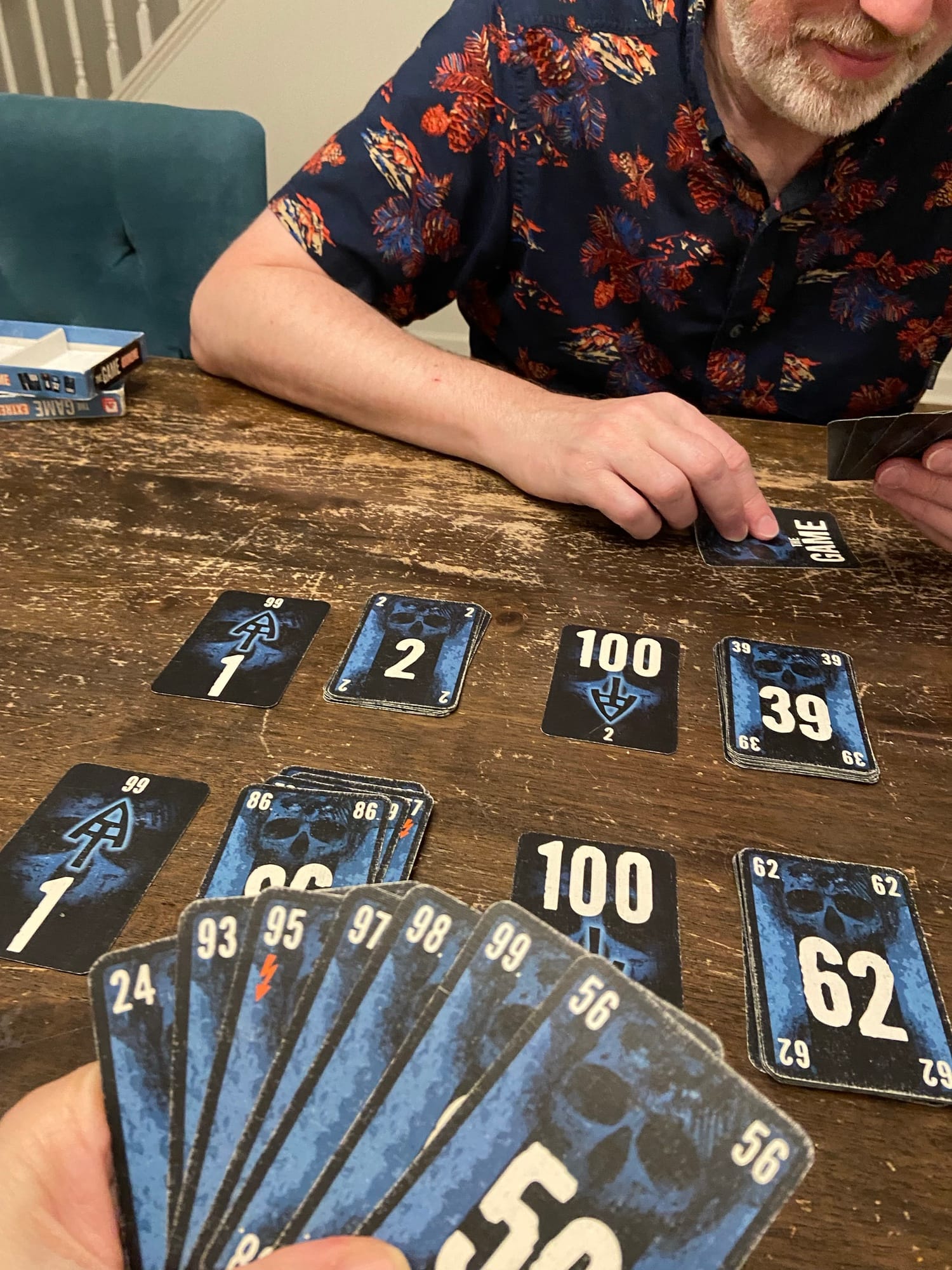
If you're not familiar with The Game: Extreme and how much I love it, you can check out this post and video I published in June 2023 after my 200th game. In short, players co-operatively try to play all cards numbered 2-99 on four discard piles, two of which you can play on in ascending order and two in descending order, although you can "jump" in the opposite direction with a card exactly 10 lower/higher than the top card. You're working with others to succeed, "talking" mostly through gameplay to make that happen.
All 300+ plays of The Game: Extreme have taken place with the same deck, which I received as a review copy in 2016. I bought a back-up copy at SPIEL Essen 24 as I was worried that the deck might finally be wearing out, but as of today that back-up copy remains unopened on my shelf because this deck is still going strong...which reminded me of a topic I meant to write about years ago:
Card sleeves are wasteful and largely unnecessary.
In the 1990s and early 2000s, I played Magic: The Gathering somewhat frequently. Seeing as MTG launched the collectible card game craze in 1993, card sleeves did not exist for the CCG market until the mid-to-late 1990s once players realized that they were beating their cards to shit through non-stop shuffling — particularly cards like Black Lotus, Moxen, dual lands, and others that you would move from deck to deck since they were auto-adds.
Card sleeves helped you avoid wear on cards, and black-backed card sleeves allowed you to use those beat-to-shit cards without being accused of playing with a marked deck. Without sleeves, you could look at your deck or an opponent's deck edge on and spot where all of the awesome cards are located because they were darker or more frayed than the surrounding cards. Card sleeves make sense in a CCG environment in which some cards are played more frequently than others and risk being marked through wear.
Outside of CCGs, I think card sleeves are costly and pointless, and I use them following this one rule: If I wear out cards through play and need to buy a replacement copy of a game, I will then sleeve the cards in that new copy.
Following this rule, I have sleeved exactly three* games over the past fifteen years, with one of those three being an exception to the above rule based on experience. The first such game was Carl Chudyk's Innovation, which I discovered in April 2010 and which I played more than 130 times within a year. At one point I realized that I could barely shuffle the cards — at least in the lower ages — because they were sticky from accumulated hand oils, so I bought a replacement copy of the game, then sleeved the cards since I knew that I loved the game enough to justify the cost.
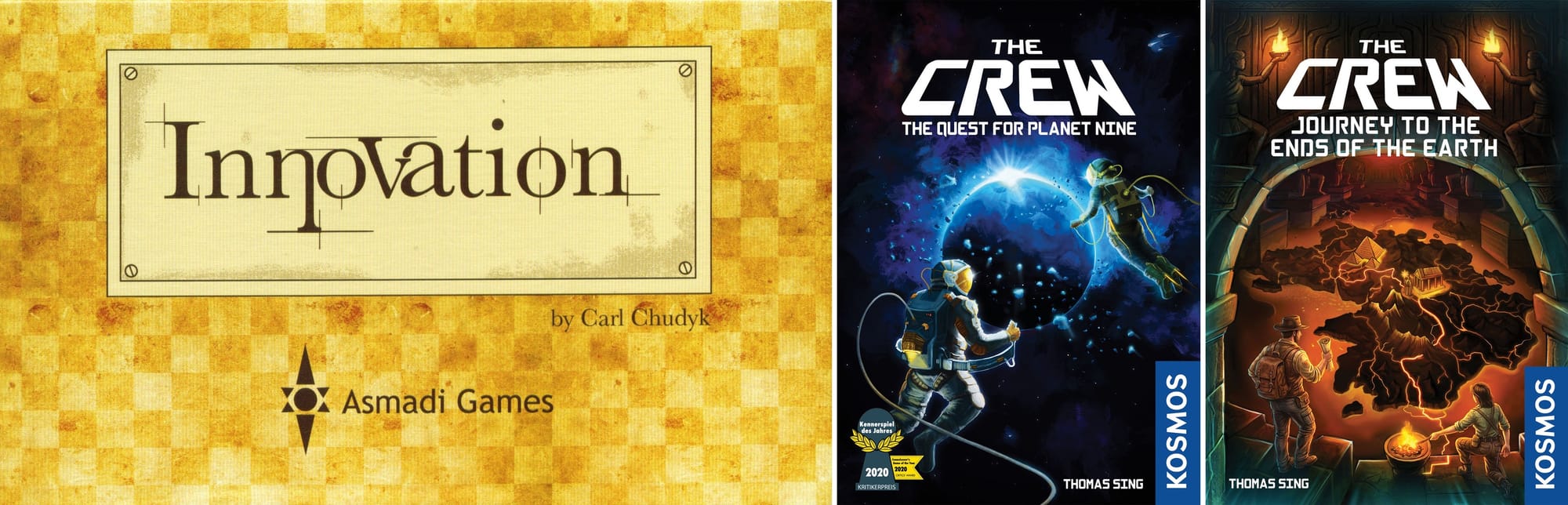
The second such game was Thomas Sing's The Crew: The Quest for Planet Nine, which I played 58 times on a purchased copy within a span of four days. As with Innovation, the cards were somewhat low quality, with a smooth finish that tended to make them gummy through handling, so after I bought a replacement copy, I sleeved the deck ahead of future plays.
For a lark, I did create an ASMR video in which I sleeved the cards in Ark Nova, punched out the game components, and boxed everything...after which I de-sleeved the game because I prefer to play games without sleeves, so this was kind of the third game I sleeved, but not really.
The third game, which is the exception, was Sing's The Crew: Journey to the Ends of the Earth. After eighteen hands of play on a review copy, the cards were already getting gummy, so I sleeved the deck ahead of the next play session using leftover sleeves from the earlier Crew sleeving. Thus, I haven't purchased a replacement copy of this game and have pre-emptively taken action to avoid needing to do so.
I realize that this latter situation is why so many people sleeve the cards in their games, but I think they're wasting time and money because few games require this kind of care. In my experience, few card games wear out to the point of unplayability, so instead of spending hundreds of dollars sleeving every game that's passed through my hands in the past fifteen years, I've spent approximately US$20 on sleeves, along with US$45 to buy two replacement games.
Well, I also spent €10 to buy a replacement copy of The Game: Extreme, but I haven't even opened it yet — and when I do, I'm unlikely to sleeve it since (1) the cost to buy sleeves is one-third the cost of the game itself and (2) I'll likely get 300+ plays out of the next deck, assuming I live that long.
I will note that one big difference between The Game: Extreme and the games mentioned above is the quality of the cards themselves. Here's a close-up of cards in this deck:
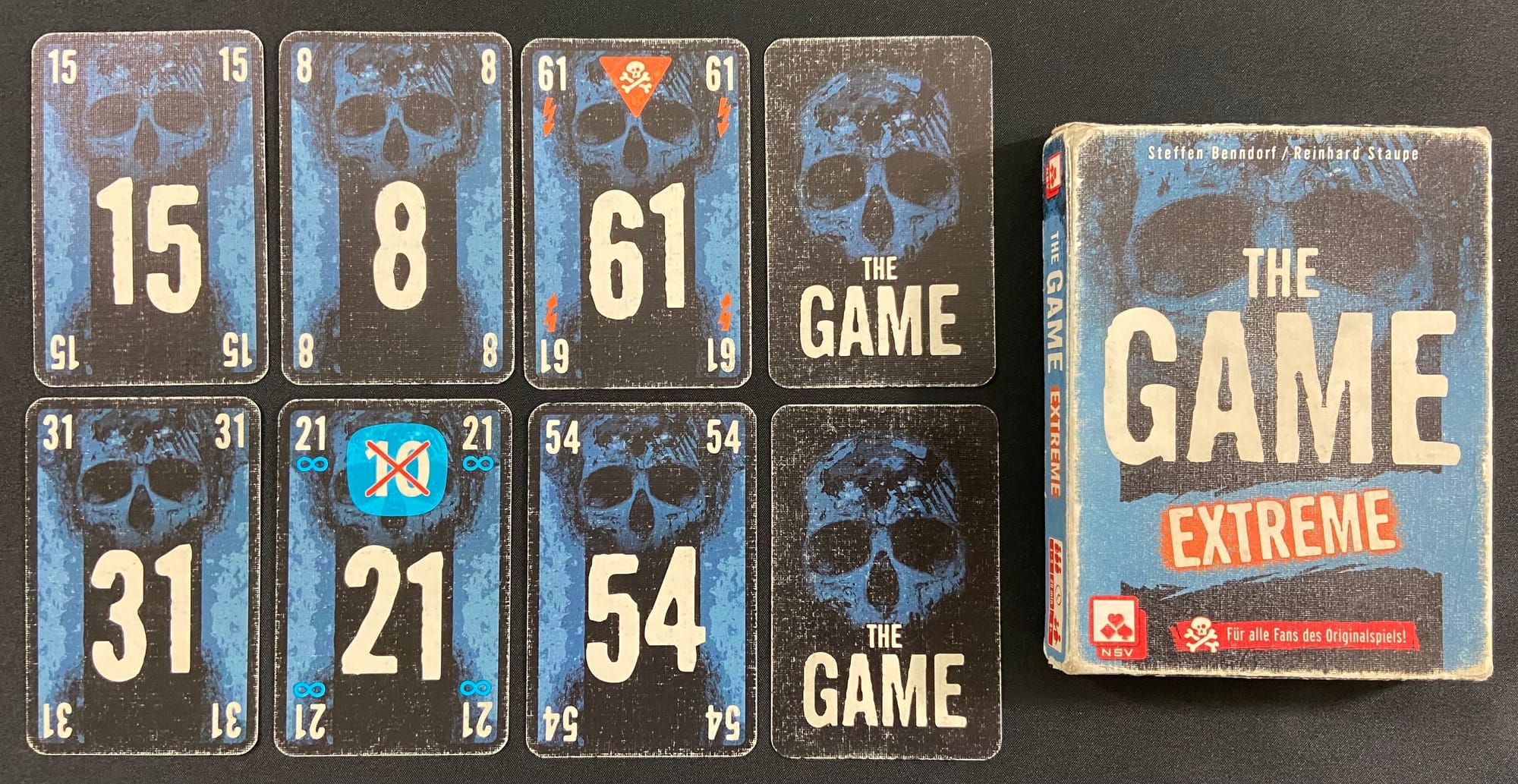
Yes, these cards are extremely worn, but for its German productions NSV uses high-quality, linen-finish cards that can take a lot of wear, yet still riffle shuffle smoothly. Here's a more zoomed-in image of two cards:
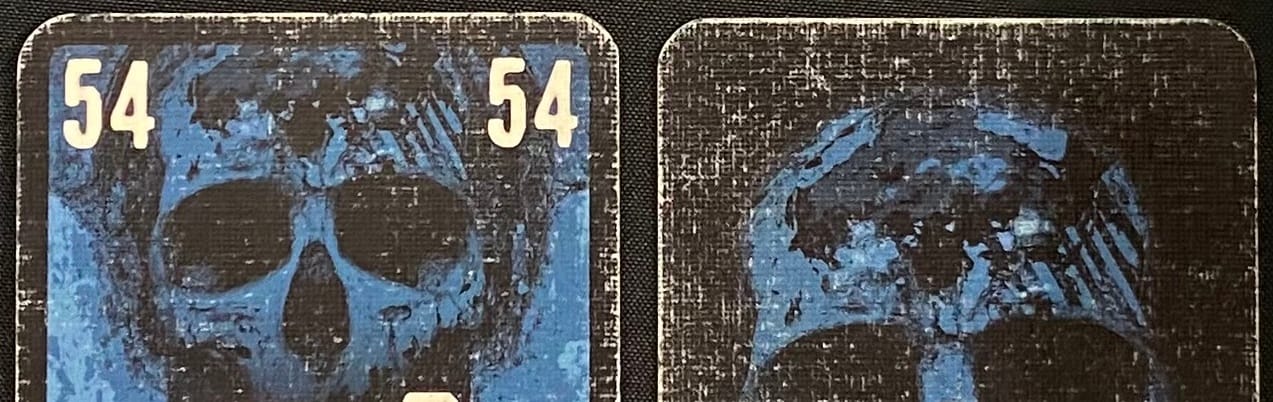
Wear matters less in this game (and in most games) than in CCGs because all of the cards get worn at the same rate. If someone creases a card, then yes, that would be visible, but a crease would also be visible inside a sleeve.
What's more, I'm not thinking about a game's resale value while I'm playing it, not that I plan to sell this game, of course. Instead, each time I pull out The Game: Extreme, I marvel at and appreciate the evidence of wear on these cards, which serve as a record of how much time my wife and I have spent playing this game together. If Innovation and The Crew used higher-quality cards, I wouldn't have needed to buy replacements in the first place because the cards would have lasted far longer, similarly reflecting this history of play, while still being playable.
I know that some gamers worry about the re-sale value of their games, and for this reason they sleeve cards in advance of play to ensure that everything remains pristine, but given the quantity of games on the market and the rate at which I see games sold off on BGG, Facebook, and elsewhere, the re-sale value of most games seems minimal. The used market is flooded with games played a handful of times — or even just once — alongside NIS (new in shrink) games frequently selling for one-quarter the publisher's MSRP, so the amount of money "gained" from selling a more pristine used game doesn't seem worth the time spent sleeving (then un-sleeving) that game, or the cost of the sleeves should those be included with the sold game.
Instead of thinking about future re-sales, I'm focusing on the present: Am I playing this game enough that it is becoming unplayable through wear? If so, then maybe I should buy a replacement copy and sleeve it to prepare for more plays in the future. Maybe. If not, then why worry about it? Let any potential wear be someone else's concern down the line, should they care about such things.
As for me, let me focus less on futzing around with games to preserve them, similar to how I've stopped worrying about bagging game components (other than cards) when those components are unlikely to be damaged or lost. Use games, and let them bear evidence of wear and enjoyment. After all, I marvel at used games when they show a lot of wear, when they show evidence that someone loved a game and played it repeatedly, so let me contribute something similar by not thinking about preservation and instead by demonstrating my passion.
Enjoy this kind of board game journalism?
Get new Board Game Beat reporting, previews, interviews, and industry news delivered by email—free, private, no tracking.


