

At Origins Game Fair 2026, asmodee had a decent-sized booth inside the exhibit hall, but it also had a media event space elsewhere in the Greater Columbus Convention Center to give folks like me a peek at what's coming in the second half of 2026.
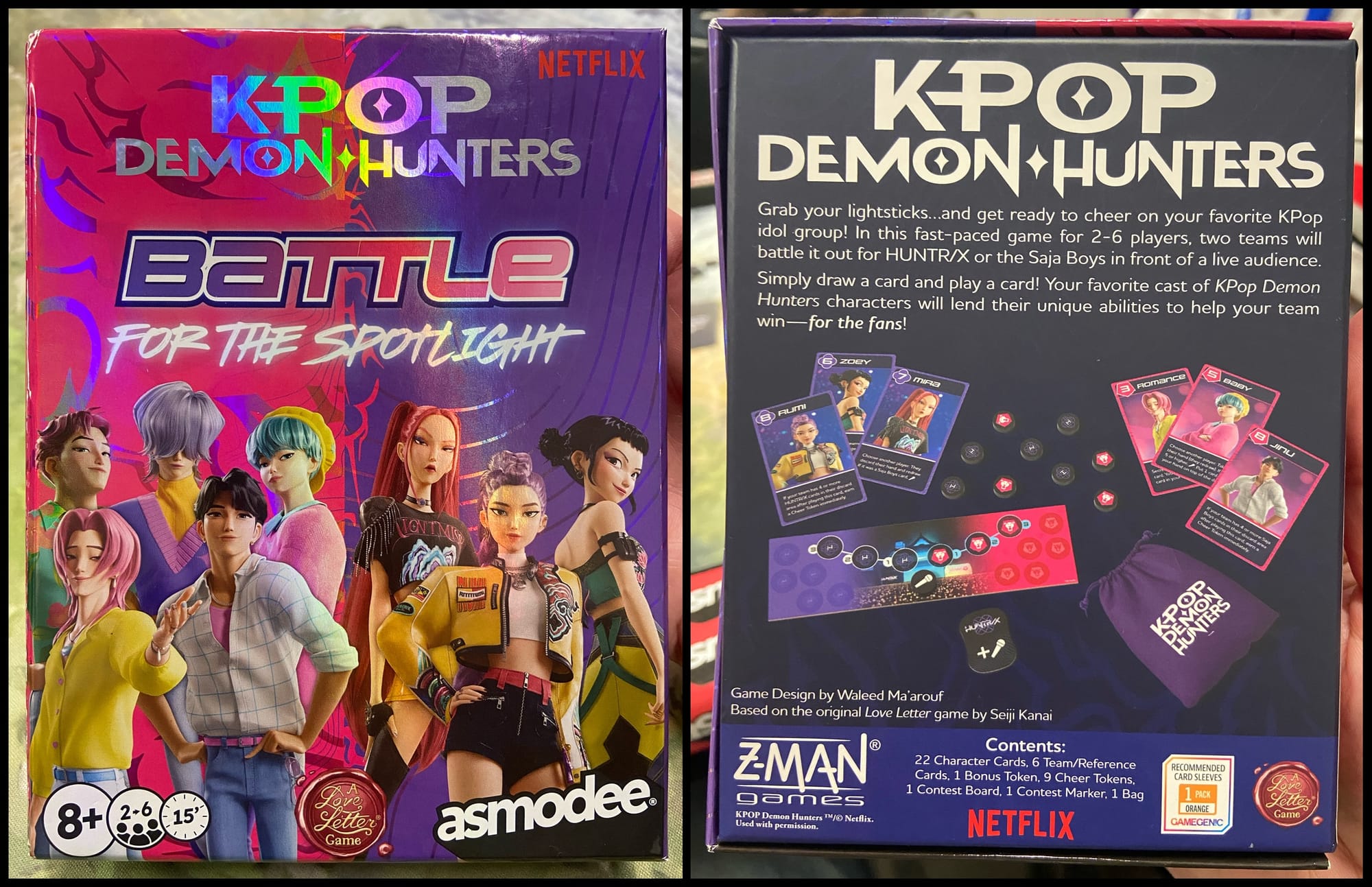
Let's start with KPop Demon Hunters: Battle for the Spotlight, which is based on Seiji Kanai's Love Letter with design by Waleed Ma'arouf and which is due out in October 2026 in English and in February 2027 in an international edition. While you can play individually at small player counts, ideally you have 4-6 players and compete in teams, with players representing either the HUNTR/X or the Saja Boys.
Gameplay is the familiar "draw a card, play a card" of Love Letter, but the cards typically "belong" to one of the two teams, although you can play any card.
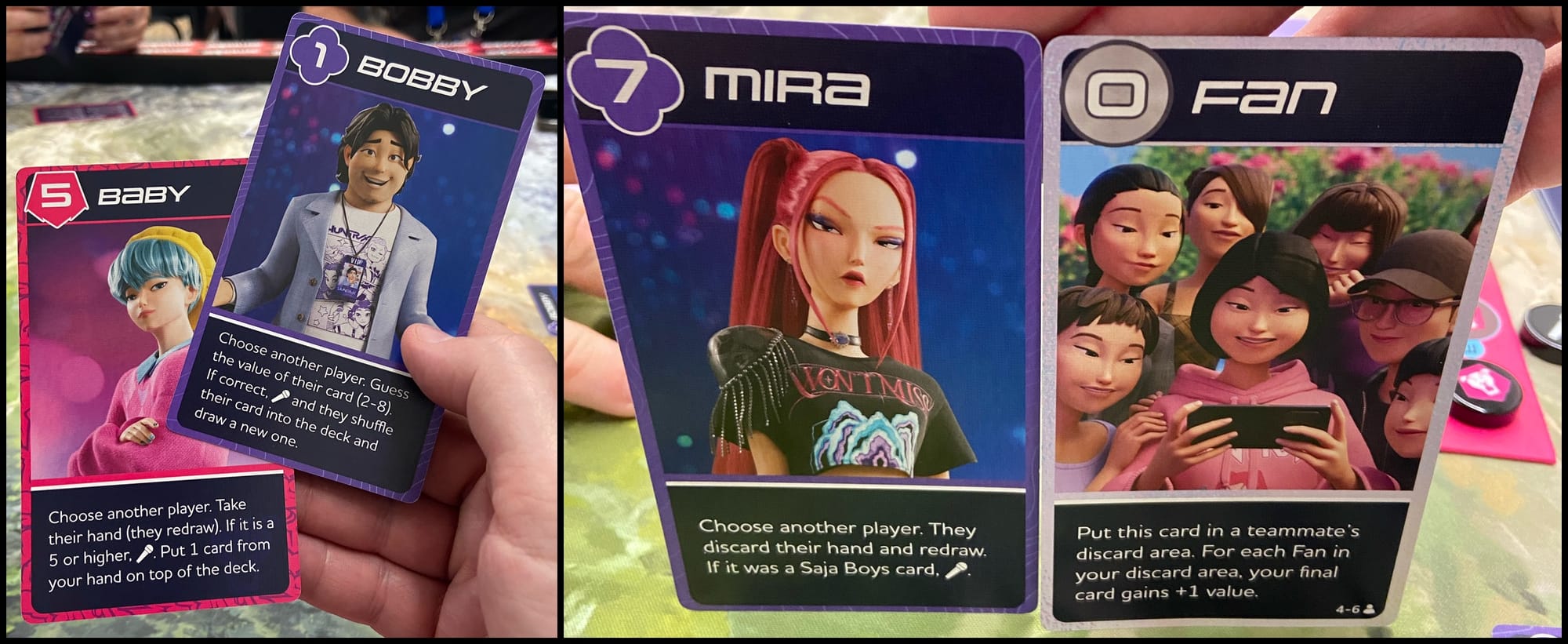
Many of the cards affect the microphone meter that players fight over, while also doing standard Love Letter-style attacks. Baby (#5) reads, "Choose another player. Take their hand (they redraw). If it is a 5 or higher, [microphone, which we naturally read as "MIC Drop"]. Put 1 card from your hand on top of the deck." If you use Baby on the next player, for example, you get to set up what they draw, ideally giving your teammate something they can use positively on you or hosing the enemy.
If the microphone meter is on 3 and then that team MIC Drops again, the round ends and that team scores 3 points.
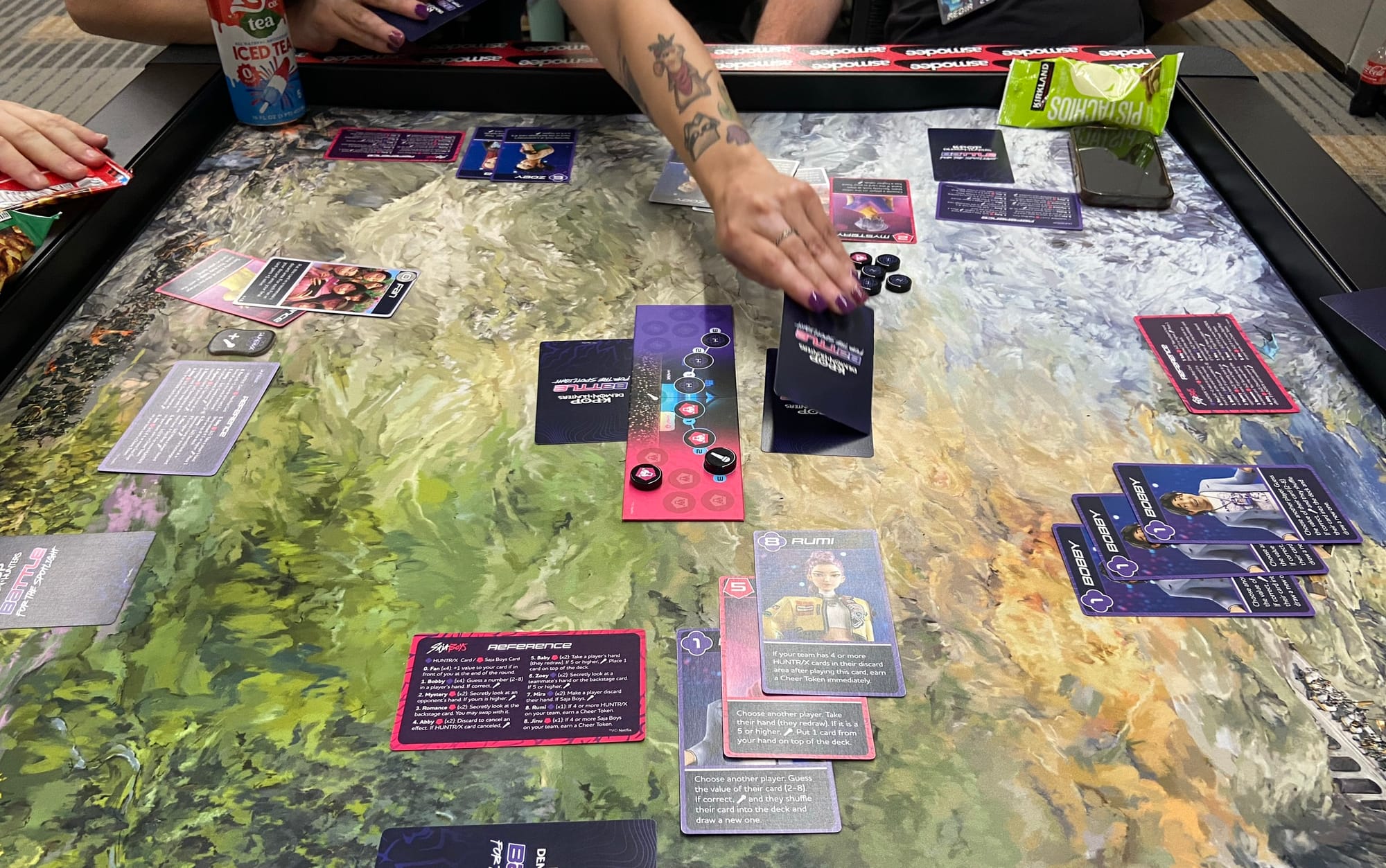
If the deck runs out, players compare the value of their card in hand to determine who wins the round, and fans — which are included in the deck only with 4-6 players — boost that card value.
Play multiple rounds until one team scores 5+ points and wins the game. In a game with five players, one player on the smaller team takes a microphone bonus tile and whenever they MIC Drop, they move the microphone two spaces instead of one.
Like this kind of board game coverage?
Get Board Game Beat’s free posts by email—original reporting, designer interviews, and industry news, with no tracking, no ads, and no spam.
We'll move to another long-lived game being released in a new incarnation: Citadels Duel, a two-player-only version of Bruno Faidutti's Citadels, which debuted in 2000.
This game, which is due out on October 23, 2026, carries over the main elements of Citadels: Each round, you secretly choose character cards to carry out their powers, which focus on you building a city, but now the two of you are building a city together instead of each doing it on your own.
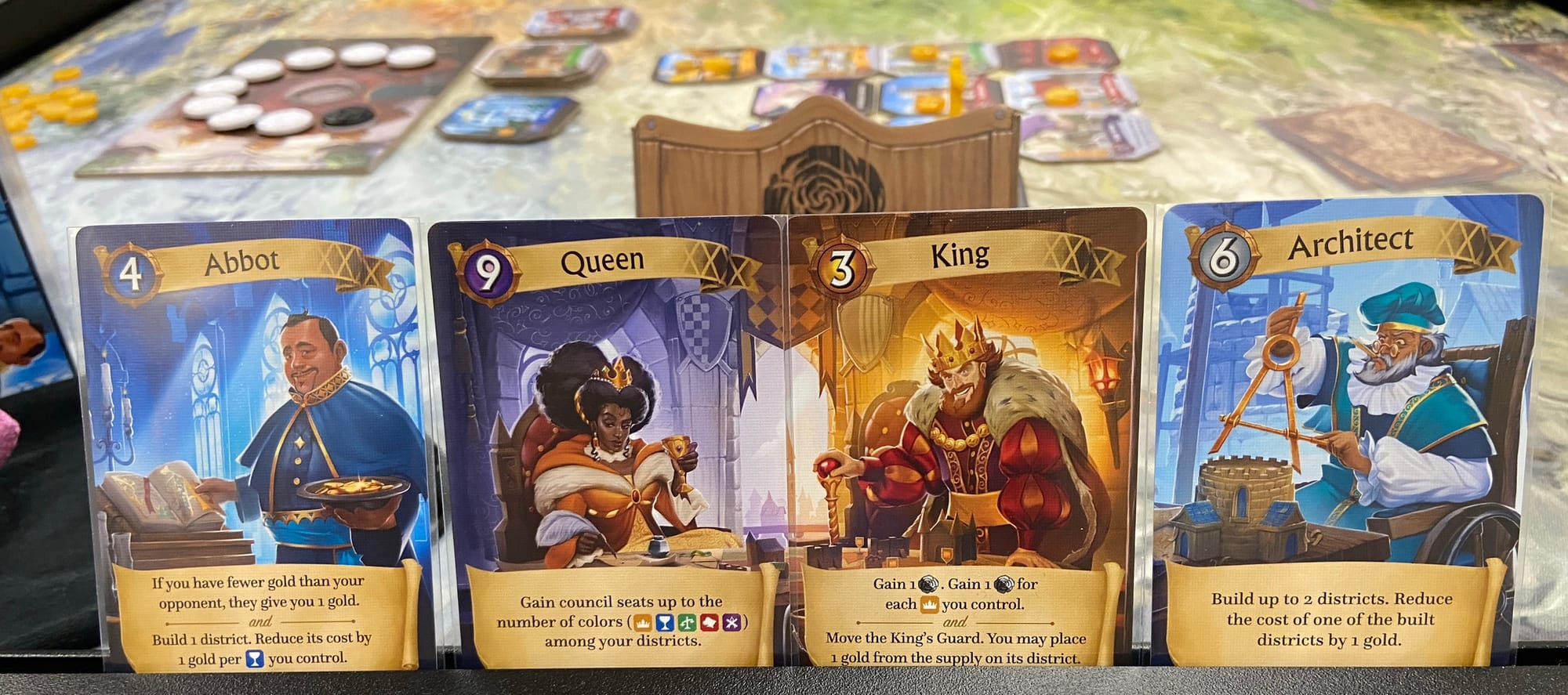
More specifically, you each receive four of nine cards, with the remainder set aside unseen. You keep two cards and give the other two to your opponent, then you discard one card from hand. Someone then calls out the numbers from 1 to 9, and if a player has the number, they play the card. As in Citadels, #1 is the Assassin, which lets you name a character and remove it from the round; #2 is the Thief, and if you name a card in the opponent's hand, they give you all of their money.
Other cards affect new elements, with the King (#3) giving you a council seat, then an additional council seat for each yellow building you control. What's more, you then move the King's Guard — which prevents players from messing with the building its on and each orthogonally adjacent building — and optionally place 1 gold on that building tile.
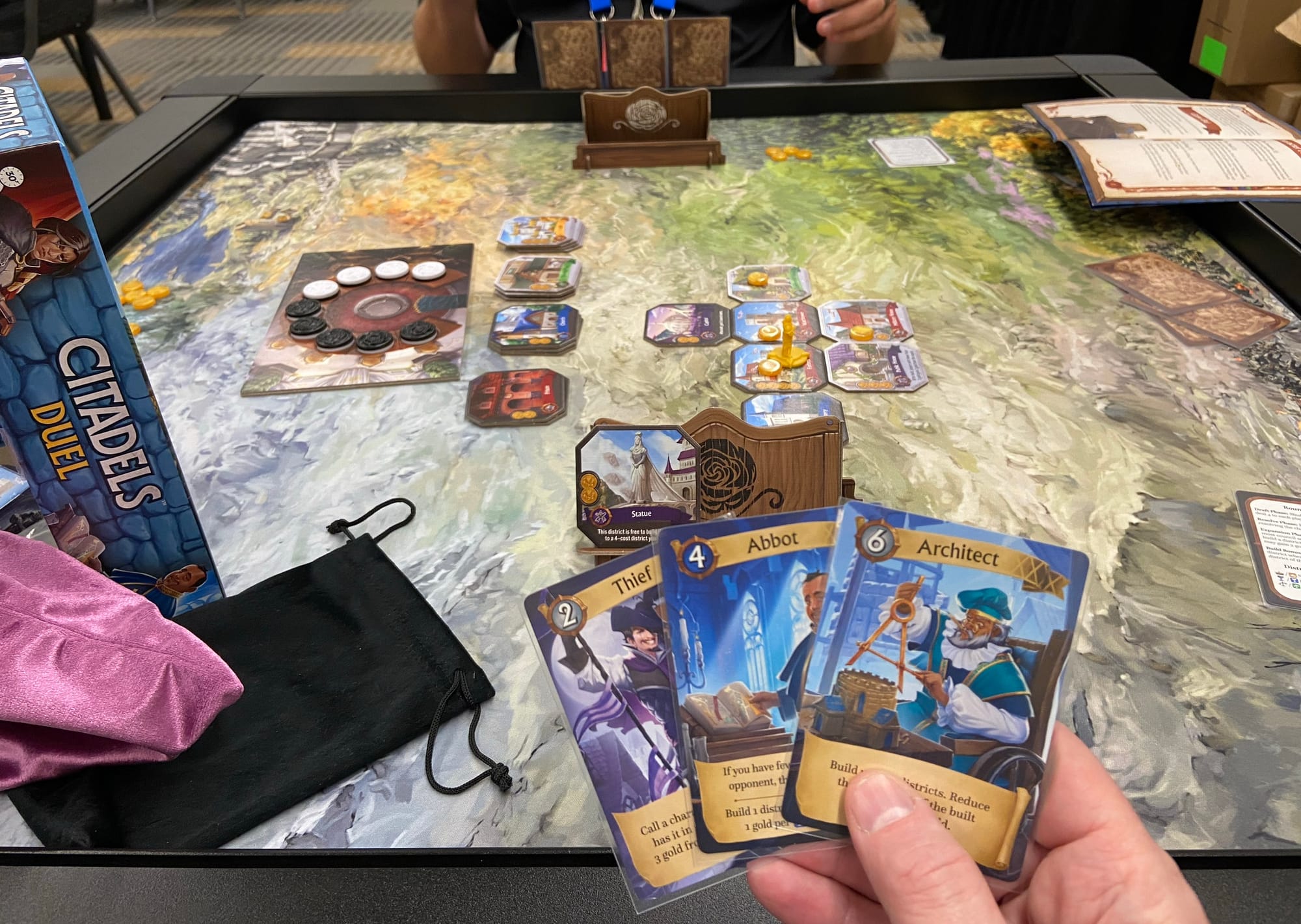
Two buildings start in play, with one each having a black or white border to match the player colors. The Architect (#6) lets you build two building tiles on a turn, as in Citadels, with the building choices being your two random (and secret) purple buildings or the top building of a stack. The Warlord (#8) lets you pay to flip a building tile to your background color.
Once all the characters have been played, whoever has the most council seats gets 3 gold and can build a tile, while the other players chooses between getting 2 gold or building a tile.
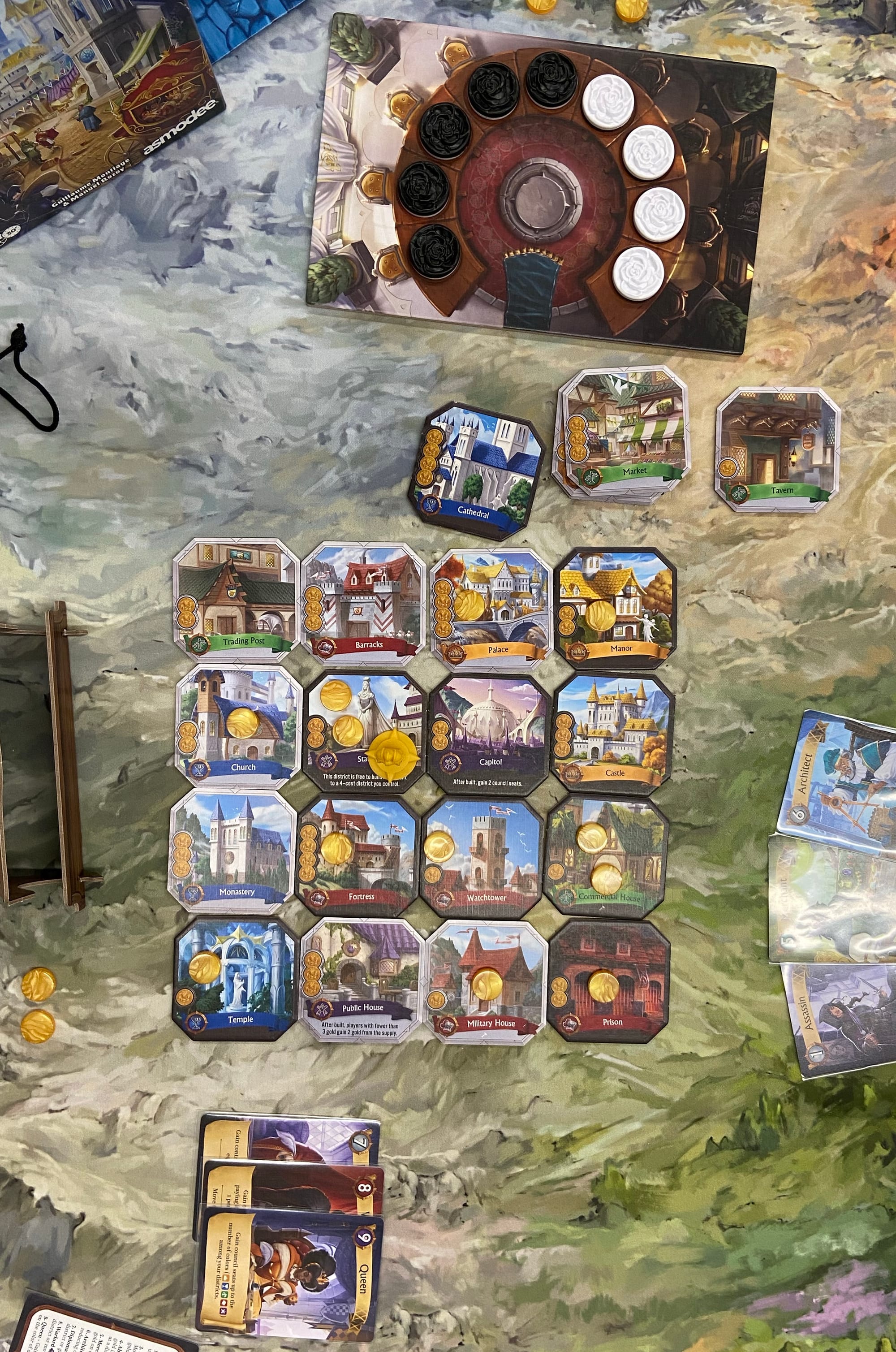
As soon as the city is built into a 4x4 grid, the game ends, with players scoring points for the value of their controlled buildings, plus 1 point per two council seats they hold. In addition to tiles gaining coins from character powers, each time you build a tile orthogonally adjacent to other tiles of its color, the new tile receives 1 coin for each such tile, making the scoring more dynamic from one game to the next.
Still another game receiving a new edition is Michael Kiesling's Azul, which has already had several spinoff titles that will now be joined by Azul Kids, a design for 2-4 players aged 5 and up with a release date of August 2026.
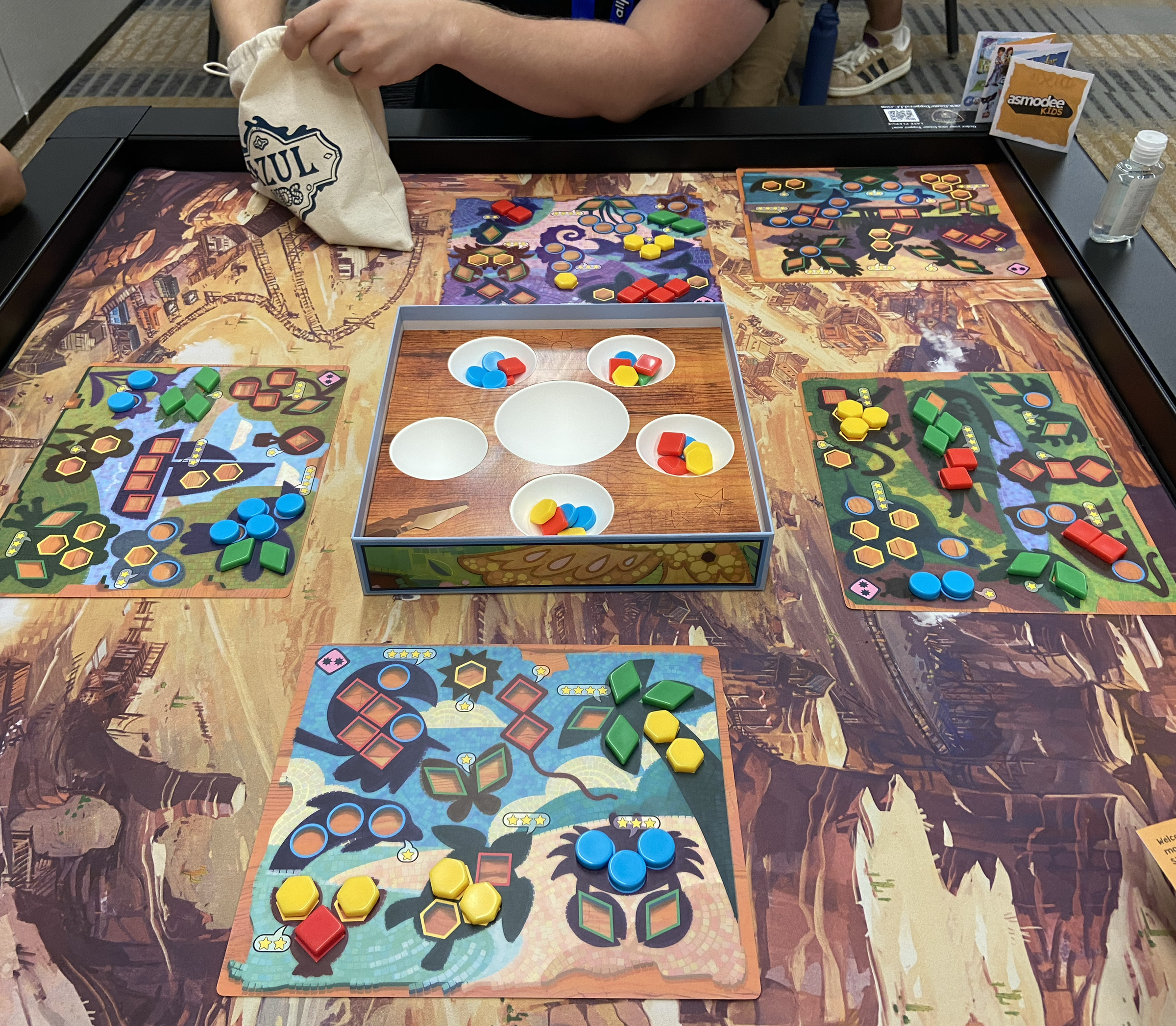
At the start of a round, the outer bowls each hold five random tokens. On a turn, you choose a bowl, take all tokens of one color from that bowl (moving any remaining tokens to the central bowl), then place all of those tokens on one image on your board. If you can't place all of the tokens you take, pass the extras to your left-hand neighbor for them to place on their board, with them passing along the tokens if they don't have room.
Gameplay takes place in clockwise order, and as soon as the bowls are all empty, you refill them, then continue play with whoever was next. You play rounds equal to the number of players, then add up your points for images that you've completed with tiles.
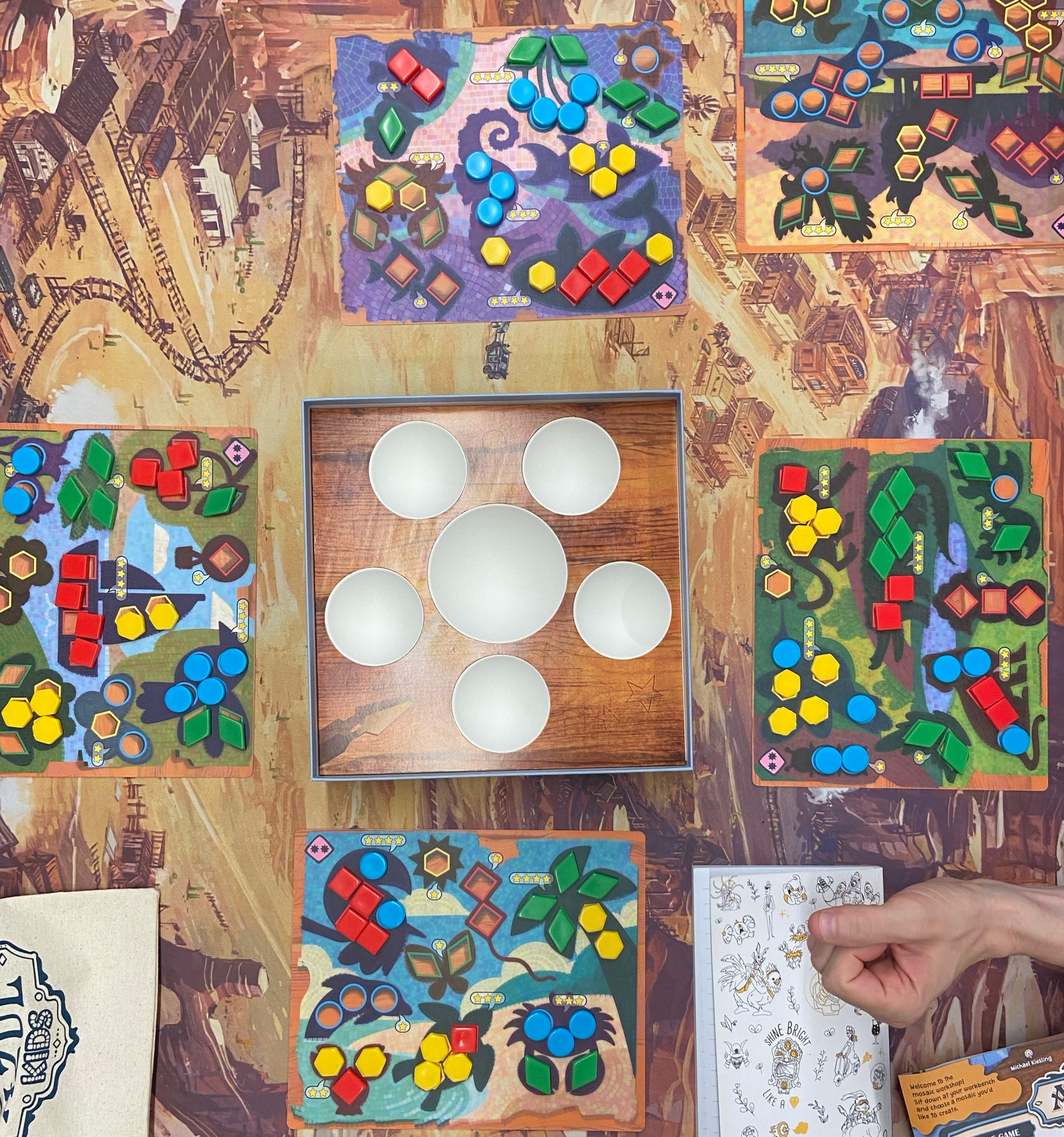
I'll note that we were playing on the "expert" boards because we were all adults who have played Azul previously. (Note the two stars in the corner.) The game also includes basic boards with a single image featuring lots of holes. When playing with these boards, whoever completes their image first wins.
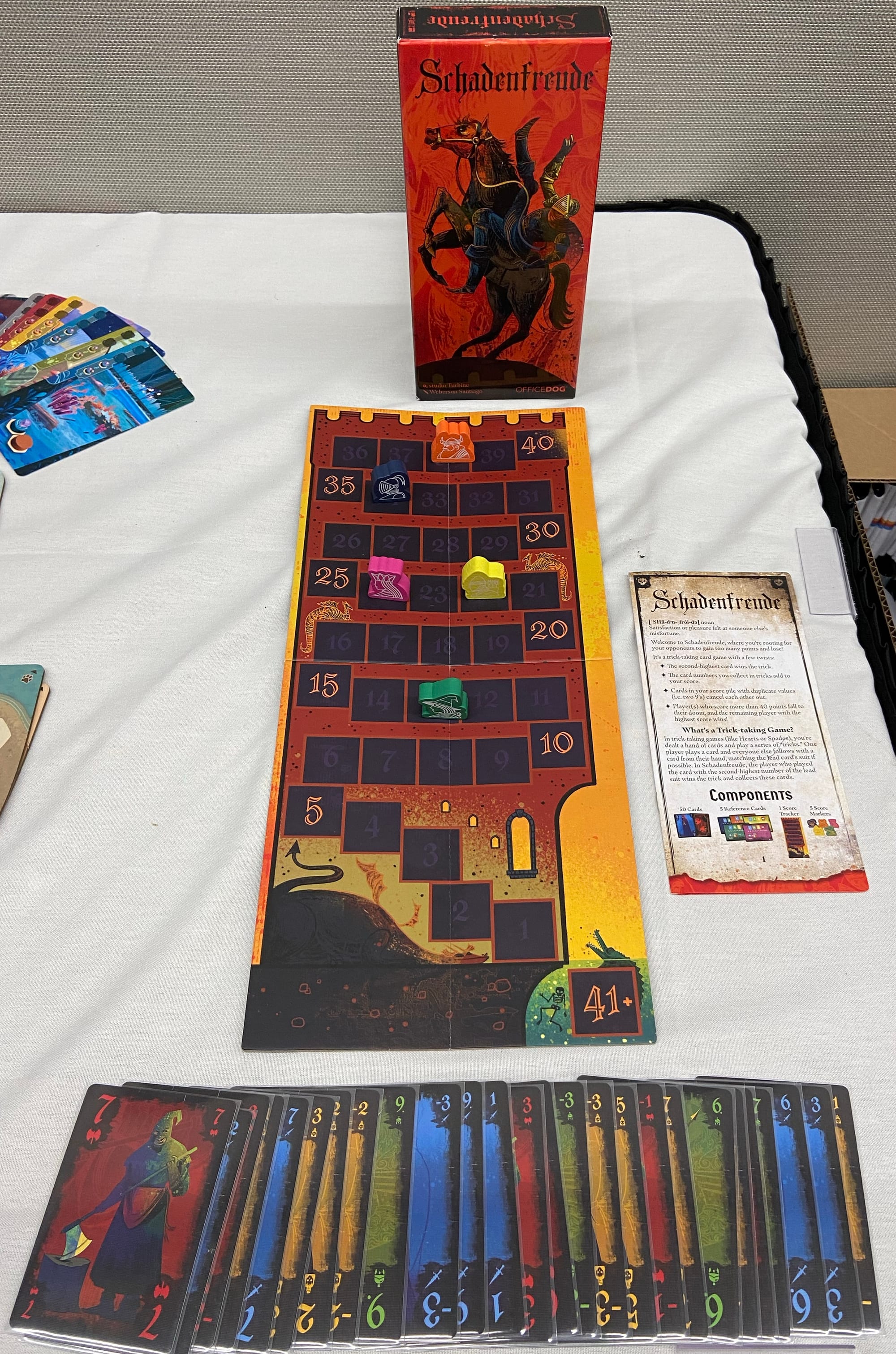
On Origins eve, asmodee studio Office Dog announced a new version of designer ctr's trick-taking game Schadenfreude, which debuted in 2020 from Japanese doujin publisher Studio Turbine.
In this game, the concept of "being second" is repeatedly important. You must follow suit in tricks, if possible, and the second highest card in the lead suit wins the trick, with the player collecting their card and all cards played off suit. Place collected cards face up in front of you, discarding a value if you collect a second one. Once all cards have been played, sum the cards in front of you and add them to your score.
When someone goes over 40 points, the game ends, with whoever is closest to 40 without going over winning the game.
Jason Brown, asmodee's tabletop marketing director, told me this Office Dog edition — which is due out on November 6, 2026 — has updated graphics and art with no rule changes.
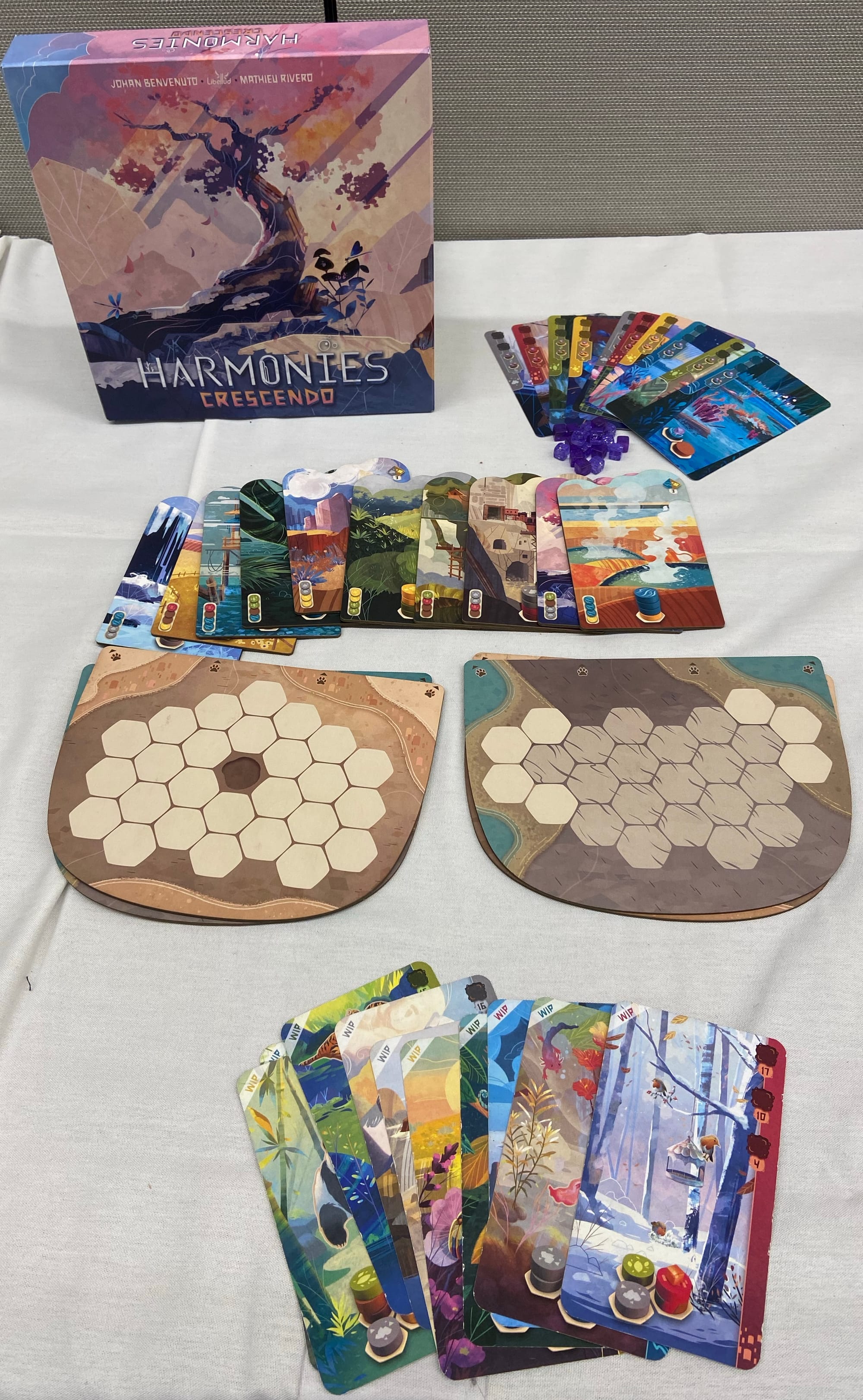
Harmonies: Crescendo from Johan Benvenuto, Mathieu Rivero, and Libellud was a late addition to the line-up, so I took a pic, but didn't get details beyond this expansion consisting of three modules that can be used individually or in combination, with the modules being small, medium, and large. Hmm, that's super vague. I'll see whether I can learn more before I leave Origins.
The image above also features a work-in-progress version of Harmonies: Pulse, which will debut at Gen Con 2026, with Crescendo to follow at SPIEL Essen 26.
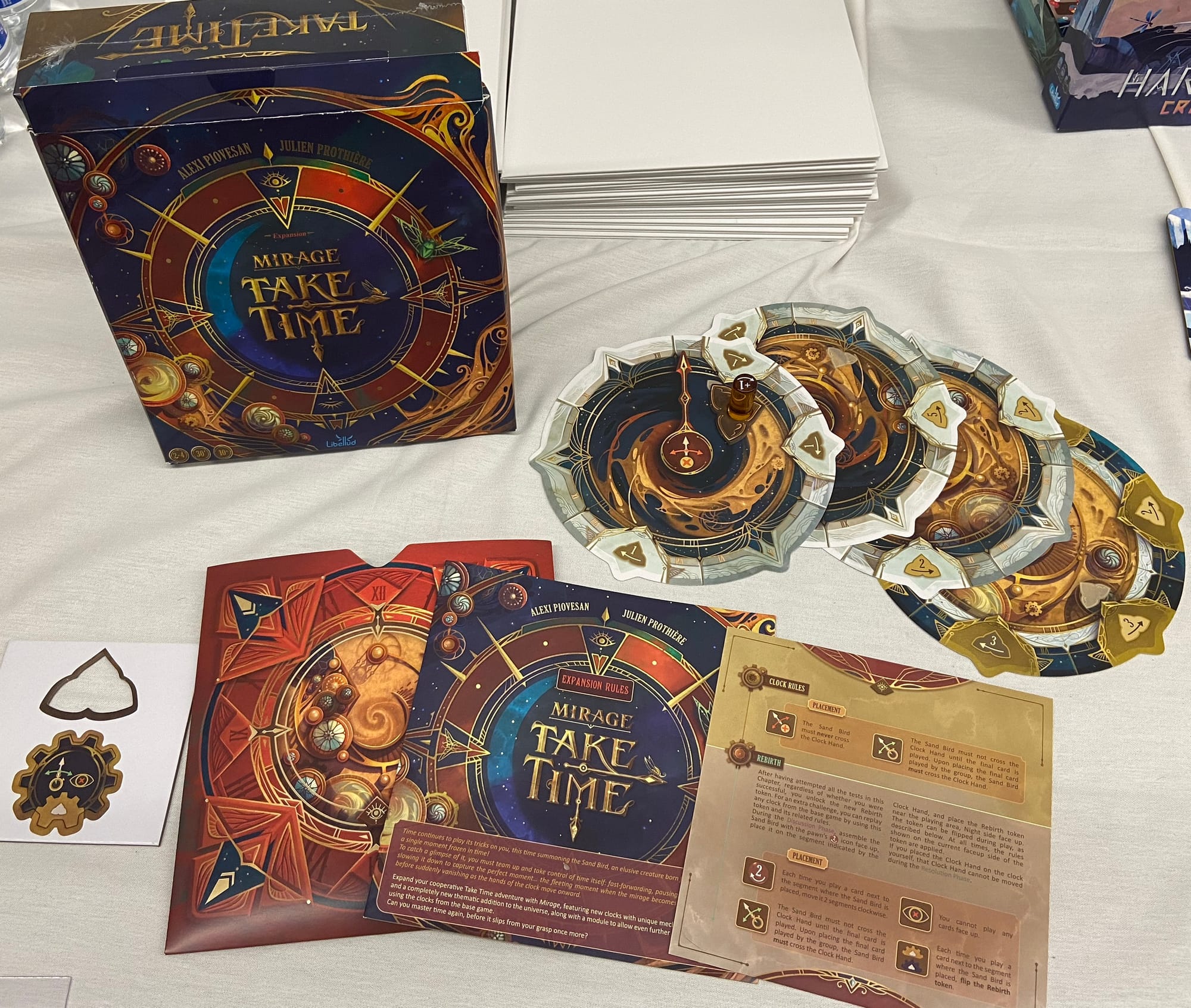
Libellud also sent along a mock-up of the October 2, 2026 title Take Time: Mirage from designers Alexi Piovesan and Julien Prothière, with this being an expansion that consists of four new levels, two components, and a separate component that will let you introduce the new gameplay element in all levels of the existing Take Time base game. (Once you remove the expansion sleeve, the components will fit in the base game.)
That gameplay element is the Sand Bird, which consists of a triangular tile and a wooden column. Whenever you play a card next to the Sand Bird token or next to an icon that shows an arrow and a number, you must move the Sand Bird in the direction of the arrow as many spaces as shown on the column or in the icon — or both, if they happen to be on the same space.
However, if the level shows a red arrow crossing the clock's arm, then the Sand Bird cannot move across the clock's arm; if it does, you lose. Some levels show a green arrow crossing the clock's arm, and despite what you might suspect, this does not mean the Sand Bird can cross the arm freely. No, instead the Sand Bird cannot cross the arm until the final card is played, at which point it must cross the arm. Really looking forward to more Take Time as I find this game magical.
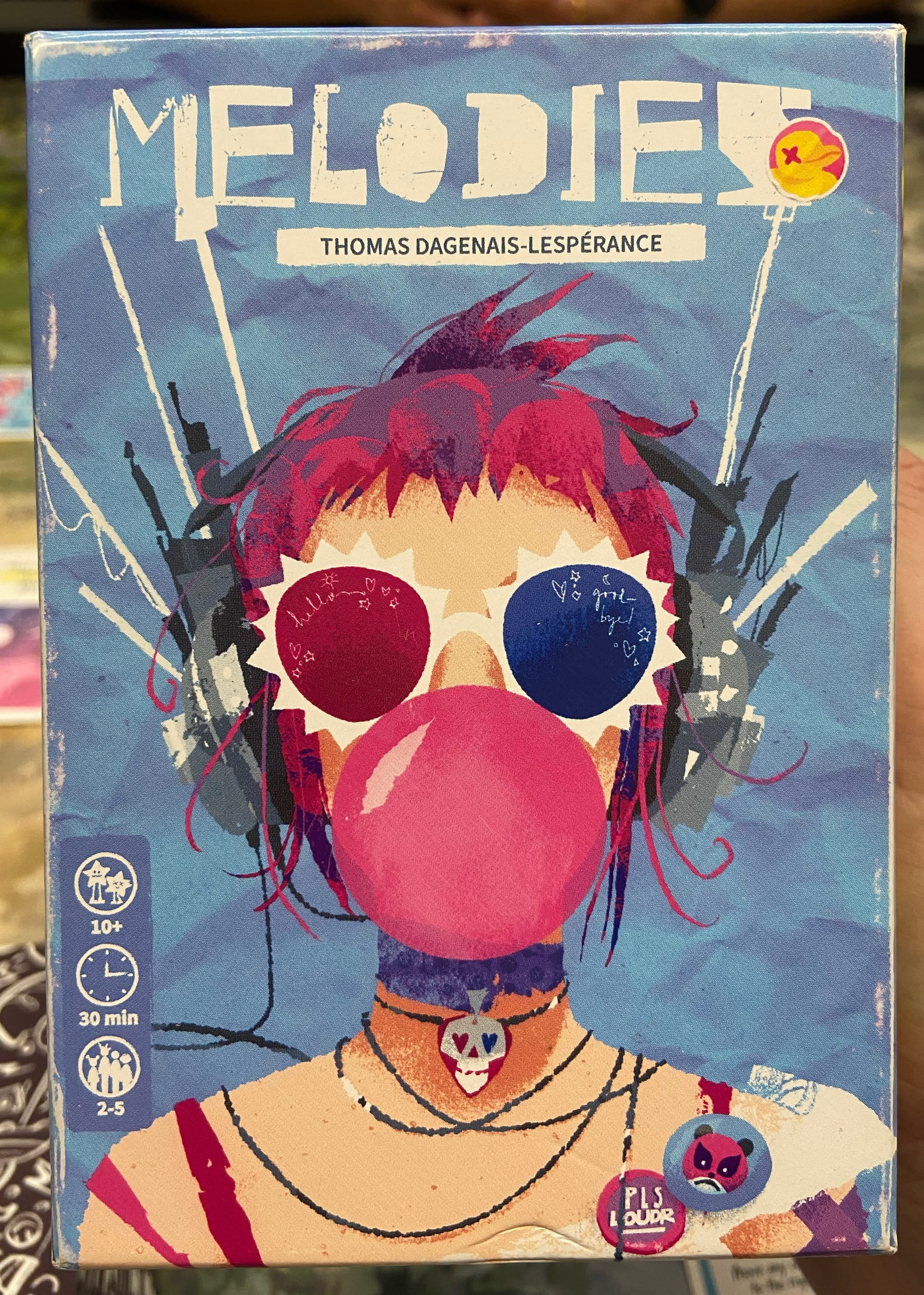
To close, we'll look at a new design from Thomas Dagenais-Lespérance, who's best known for Decrypto, with Melodies featuring the same vibe as Take Time in that it's a co-operative game with limited communication between the 2-5 players as you try to replicate a melody through clever card play.
The game lasts three "songs", with players getting seven, nine, then eleven cards over those songs, with which they will collectively play four, five, and six "notes" over 4-6 rounds.
Gameplay is tricky to explain. Whoever wants to can play first during a round, with you being able to play one or more cards that are adjacent in your hand as long as those cards are (1) all the same value or (2) an ascending or descending sequence. No matter what others play, you can play whatever you wish — but you will definitely want to pay attention to what they play!
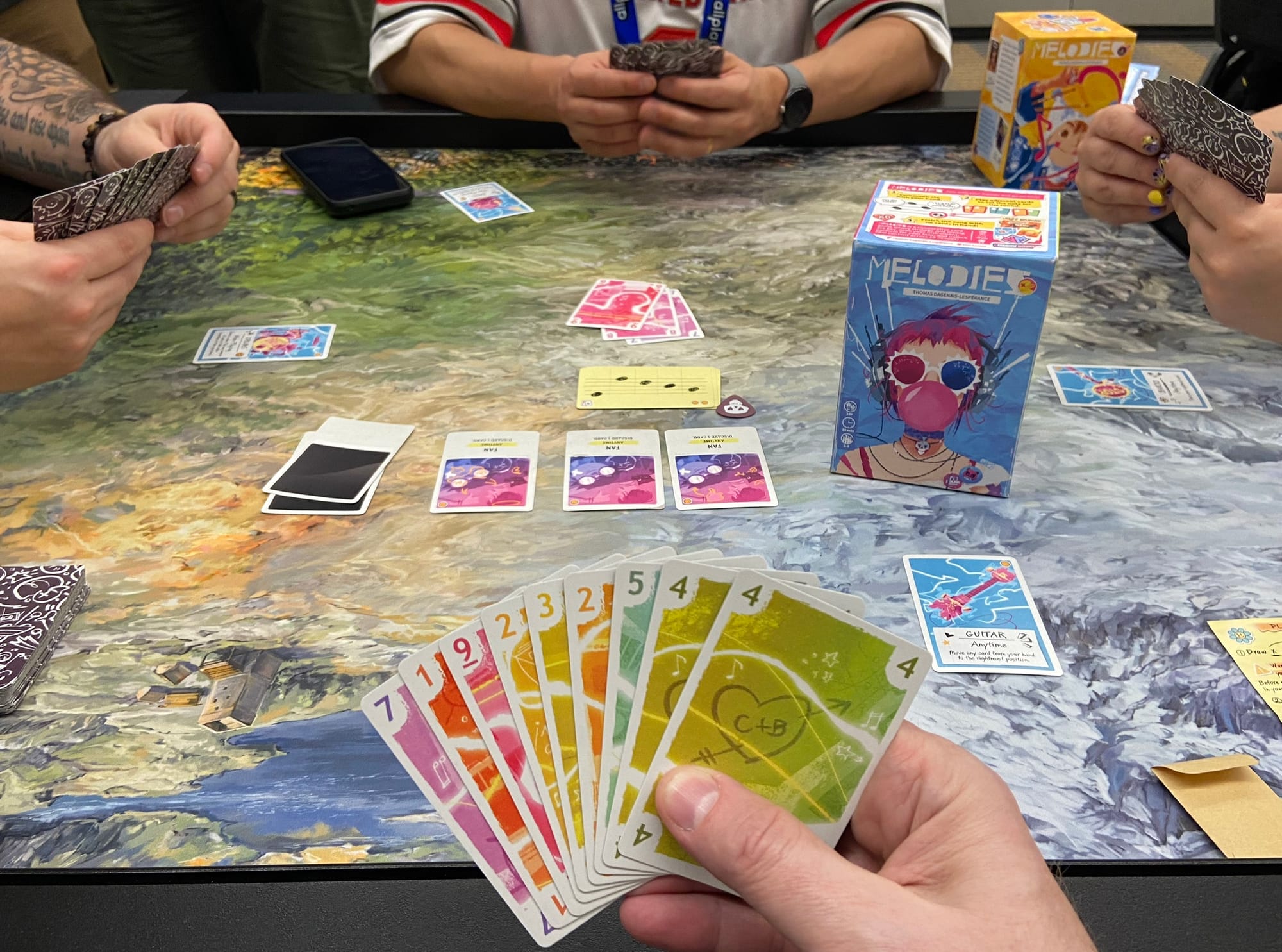
Whichever value appears most on all cards played during a round becomes that round's note. (If multiple values appear most, then the highest "most" value becomes the note.) The song is represented by a card that shows notes in a certain combination.
In the image above, you can see the second song upside down, and it shows that we want four descending notes, then a final fifth note higher than all others. Thus, we ideally want 9 as the fifth note and 1 as the fourth note to give us as much room as possible in between for the other three, but you have to work with what's dealt to you in whatever order you get it — not to mention whatever everyone else has in hand — with the final requirement being that you must play all of your cards!
Well, you do have three outs from the randomness of your hand. First, before anyone starts playing, you can take one card and move it anywhere in your hand. Second, each player has an instrument card that gives you a special power, with my guitar allowing me once per song to move a card to the right of my hand. Third, you start with a number of fan cards on the table, and you can discard a fan to discard a card from your hand.
For this song, we're each playing five "notes", so which card should I move to have the ideal five notes?
Many choices are available, and I realize while writing this that I didn't make a good one in our game. I think I should have moved the rightmost 2 to the right of the 1, thereby giving me playable combinations of 7, 9, 12, 54, and (once the 54 has been played) 234. Sound good?
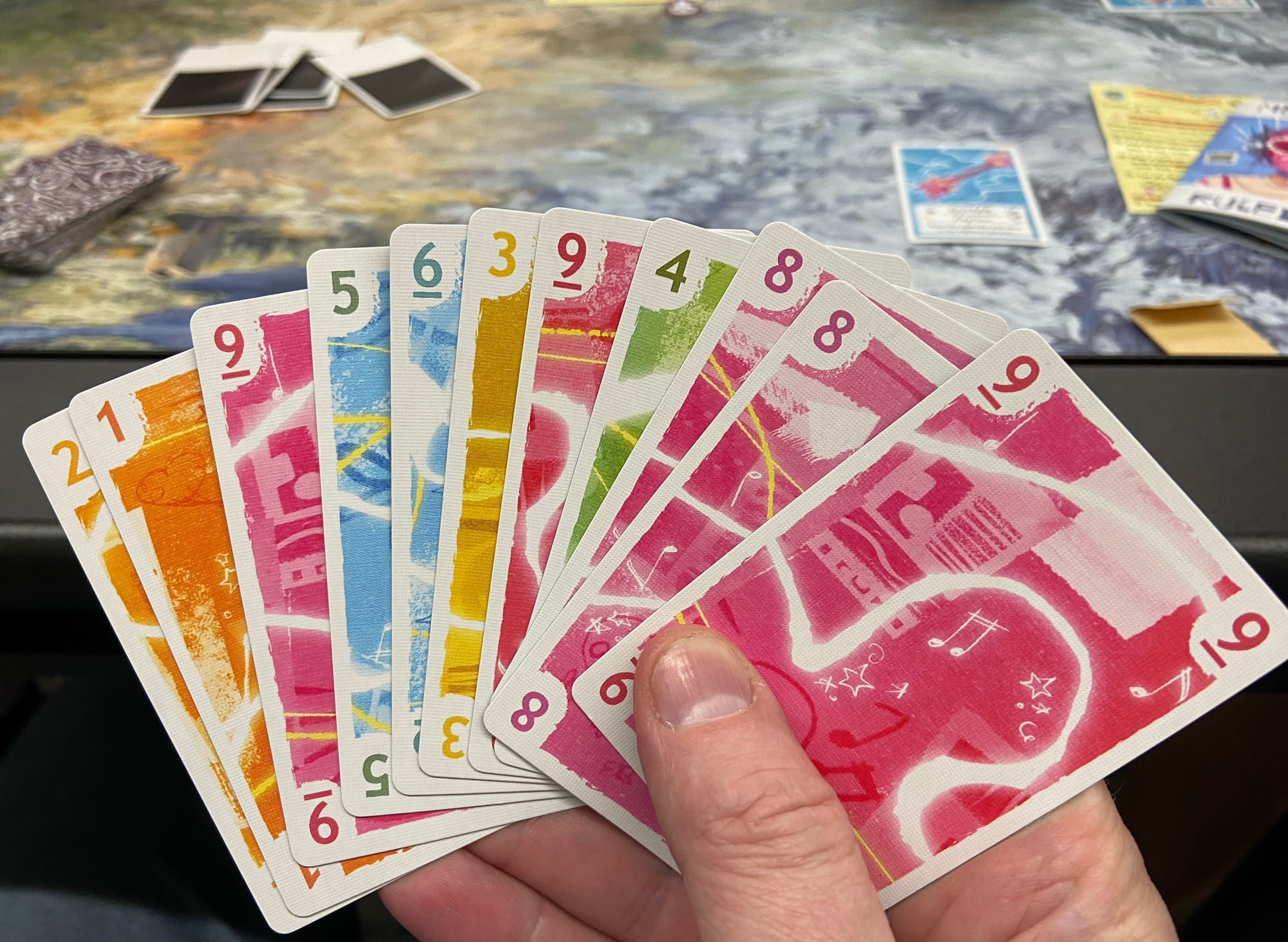
We burned through all our fans by the end of the second song, but luckily for me my final hand was ideal when I picked it up. All I had to do was move the middle 9 to the right to create six combos: 21, 9, 56, 34, 88, and 99. (I would need to ditch the single 9 at some point, but I never saw a round in which we had only one of each number played.)
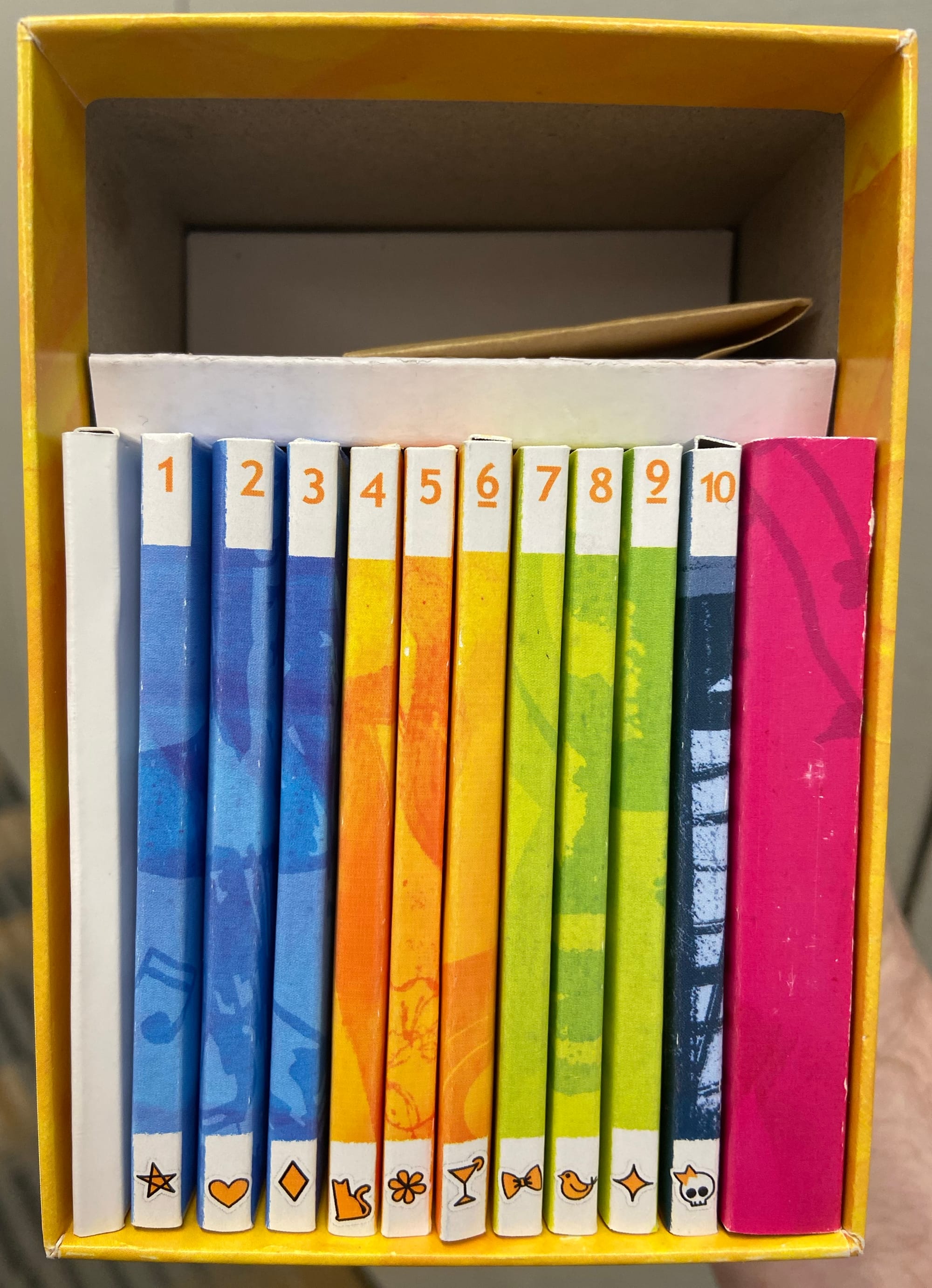
After the initial set of three songs, you can open one of the ten "albums" included in the box to find a new set of three songs, along with new instruments and other types of components. Maybe you'll need to have two notes of the same value at the beginning and end of a song; maybe you'll draw a new card during the song and have to fit that to whatever you're currently holding. If you've played Take Time, then you can imagine the types of complications you might face.
Melodies is due out on October 23, 2026, and I'm excited to play more as this was a fun challenge, even with the easiest mix of songs.

Smashing glass is not the type of "fresh start" I would expect a yoga student to make, but perhaps this is some new type of yoga that's caught fire in Columbus, Ohio...


