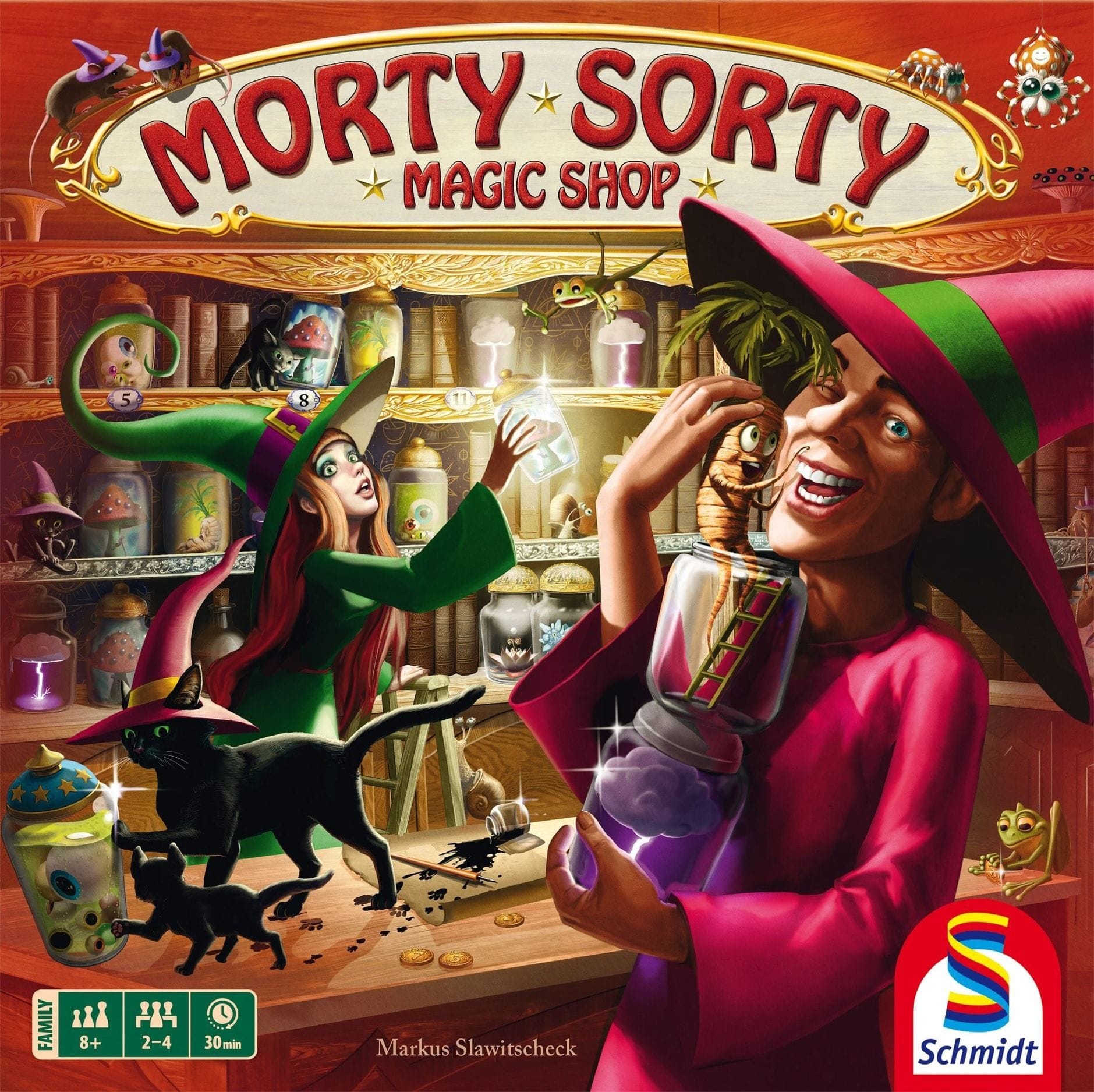
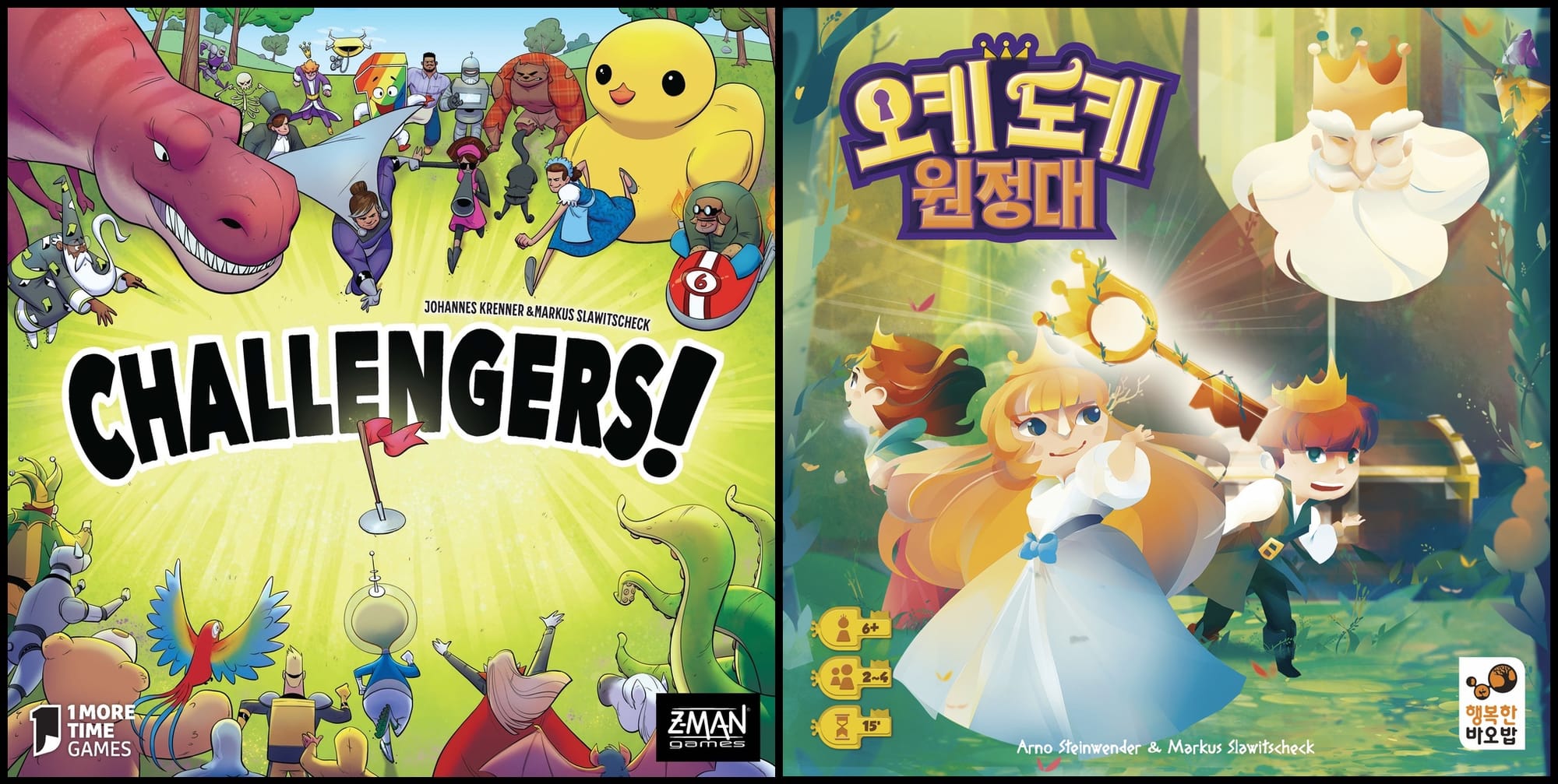
Markus Slawitscheck, age 34, is proving to be a name to follow in the board game world. He's had twelve games published since 2018, with his first breakout title being 2022's Challengers!, co-designed with Johannes Krenner and developed and published by 1 More Time Games.
Challengers! has up to eight players building a personal deck of combatants one or two cards at a time, then competing in "capture the flag" face-offs in a tournament format. (For more details, check out this game overview and this designer diary.) In 2023, Challengers! won the Kennerspiel des Jahres, this being one of the best-known game awards in Germany, an award given annually by the non-profit Spiel des Jahres organization. (Here's a background explainer on these awards.)
Another 2022 release from Slawitscheck was 오키도키 원정대, which was co-designed with Arno Steinwender and the title of which translates to something like "Okidoki Expedition". In this press-your-luck game for players aged 6 and up, you roll dice to collect keys that might release gems from a sealed treasure chest.
Originating publisher Happy Baobab licensed the design to companies in other countries, including Switzerland's Game Factory, which released the title in early 2024 as Die Magischen Schlüssel ("The Magic Keys"). Later that same year, this game won the Kinderspiel des Jahres, another award from the Spiel des Jahres jury.
On May 19, 2026, the Spiel des Jahres jury nominated Slawitscheck's Morty Sorty Magic Shop, a family game released by Schmidt Spiele in early 2026, for the main Spiel des Jahres award — an award that typically leads to sales in the hundreds of thousands of copies as many German families view the award as a buying guide for gifts and holidays.
While visiting Spielwarenmesse — an annual toy and game fair in Nürnberg, Germany — in January 2026, I was given a review copy of Morty Sorty Magic Shop by Schmidt Spiele, and given the game's SdJ nomination, I finally opened it up and played...twice. (Yes, sometimes I need a prod like that to get a game to the table.) Here's how it works:
In Morty Sorty Magic Shop, you're employed by a store that sells magical ingredients, and you need to keep those ingredients organized on the shelves. Each round, you'll add one new bottle to your shelves, which may let you grab a bonus bottle from the reserve, which may let you grab another bonus, and so on, with you trying to optimize overlapping scoring conditions as best as possible.
To start each round, draw 4-5 bottles from the bag (depending on player count), then drop them on the table. If any bottles have blue tops, set them aside in the bonus row, then draw and drop more bottles until you have the proper amount.
Dropping the bottles matters because each bottle contains one of four ingredients, with the mandrake being paired with eyeballs and the mushroom being paired with the storm cloud. Thus, the more that eyeballs show up in bottles, the less often that mandrakes will be available.
Each player in turn takes one of the available bottles and places it in an empty space on their rack or passes, receiving a cat from the reserve. On a shelf, bottles must go in ascending order from left to right; the bottle cap color determines on which shelves a bottle can be placed: gold on any shelf, silver on the bottom two shelves, and black only on the bottom. (Note: One player with color-recognition issues in my games had trouble distinguishing the silver and gold colors.)
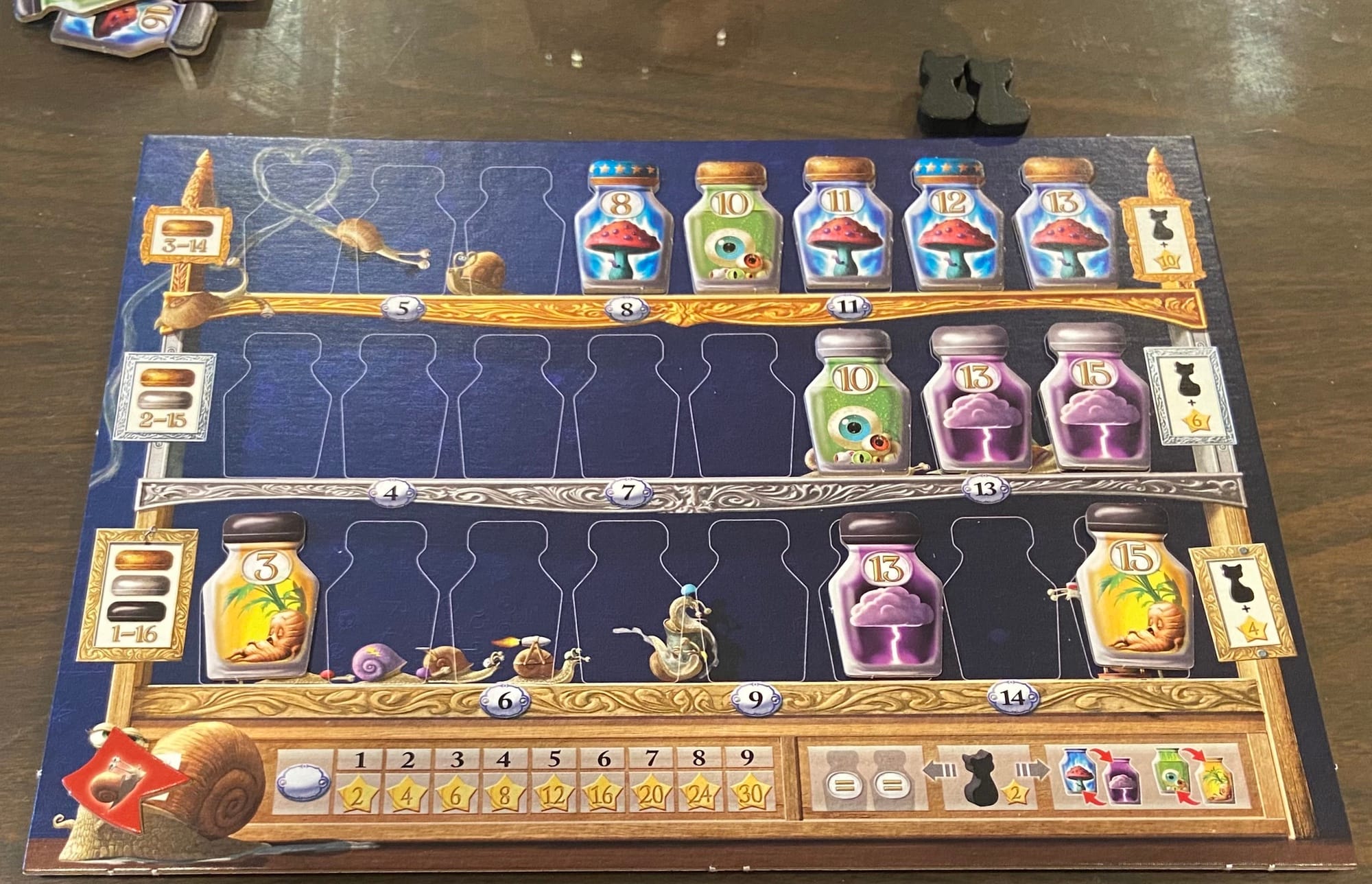
You can't repeat a number on a shelf unless you spend a cat; a cat also lets you flip a bottle to the ingredient on the reverse side. Spend two cats, and you can do both! Don't spend a cat, and it's worth 2 points at game's end.
Why might you want to flip a bottle? One reason is that if you complete a column with three different ingredients, then you take one of the blue bottles previously set aside. On the board above, you can see that I've done this twice. If instead of the blue-capped 8, a blue-capped 14 showing a mandrake or eyeballs were available, I could have placed that 14 under the 13-cloud in the second row to receive another bonus. In the second game we played, I mostly filled two rows, then managed to get four bonus bottles on the same turn by completing column after column.
As for why you're placing bottles in particular spaces, it's all about the points, baby! When you fill a shelf with eight bottles, for example, you receive both a cat and 10, 6, or 4 points. At game's end, you also count how many bottles match the number on the shelf's silver badge below it, then score bonus points based on this sum; at this point I'm scoring 6 points from three matches.
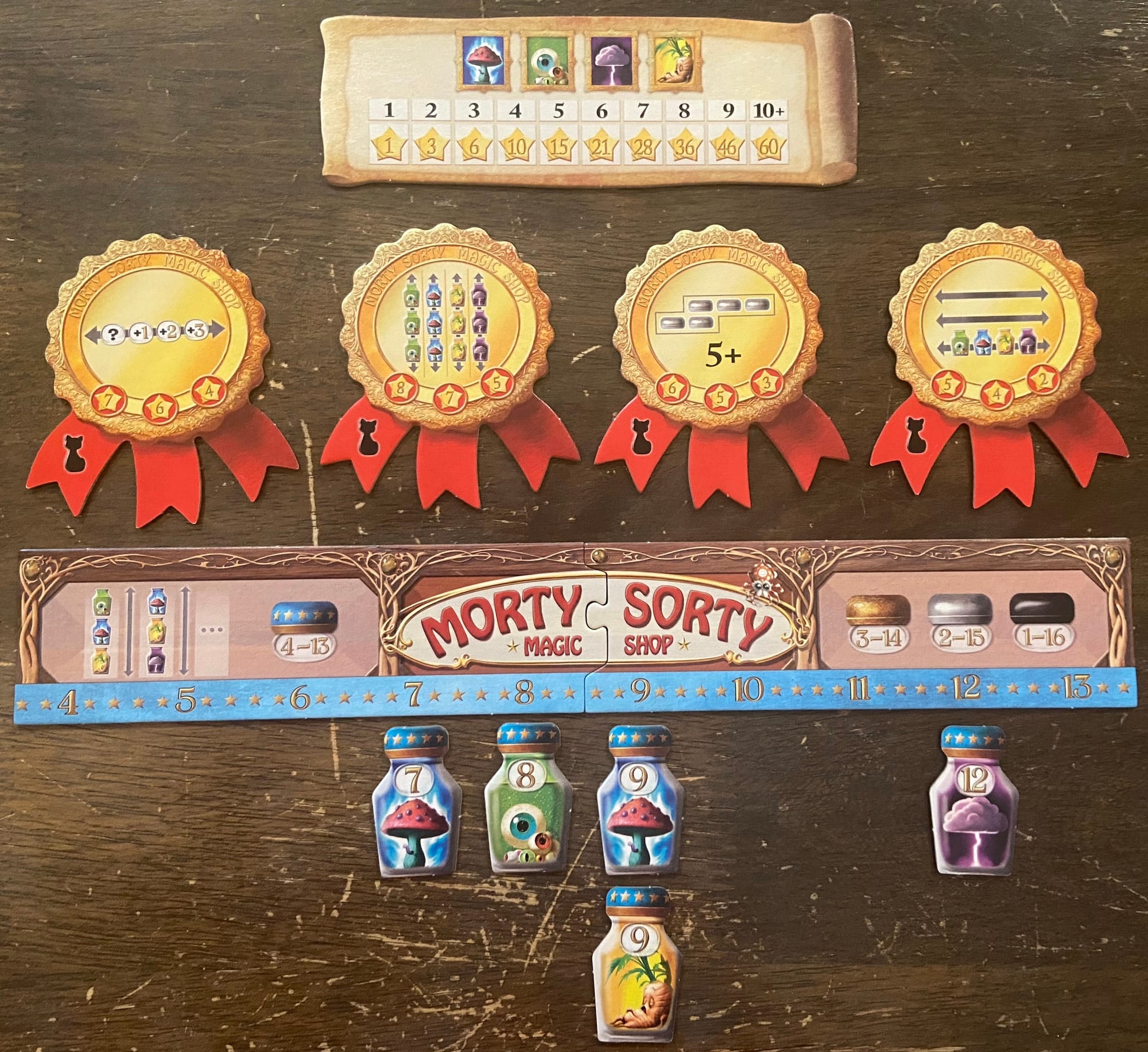
Beyond that, at the start of play, you put out two random badges (out of four double-sided possibilities), and as players complete the challenge on a badge, they mark it with a player icon, taking a bonus cat immediately if they complete it first, and scoring the listed points above their marker at game's end. On my player board, you can see 10-11-12-13 in my top row, which satisfies the badge at left
You also score for each ingredient based on how many you've collected, with it being more beneficial to specialize in a couple of ingredients: ten of something is worth 60 points, for example, whereas two fives are worth only 15 each. That said, you do need three ingredients to nab the bonus bottles, so these four scoring systems pull you in opposite directions sometimes.
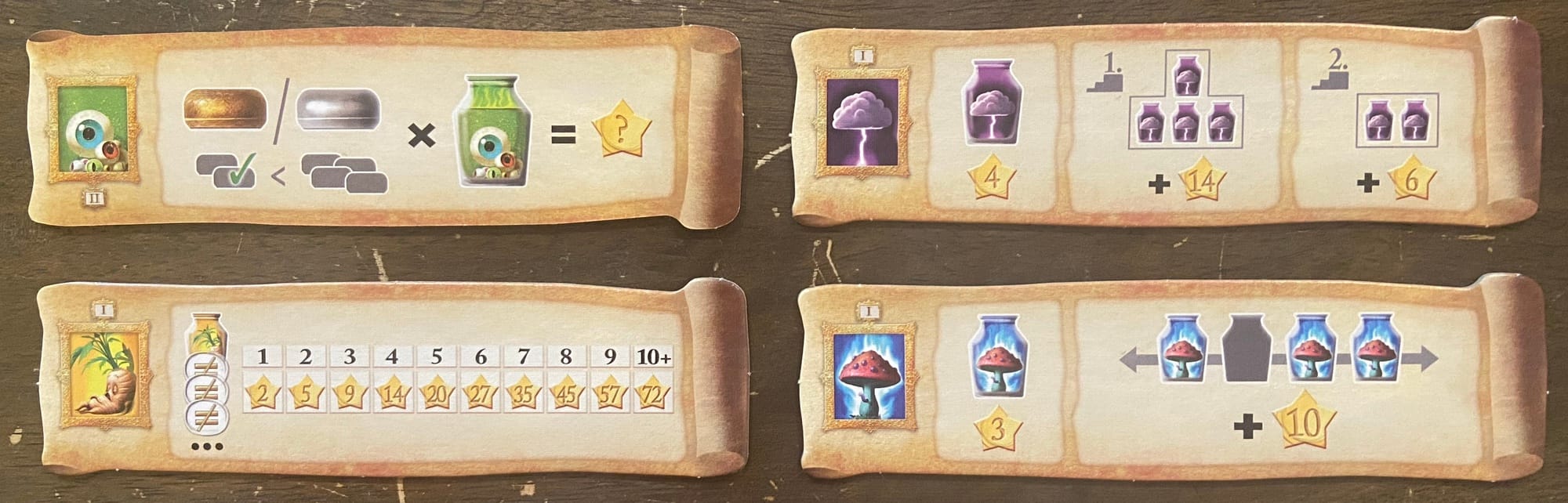
Instead of using the "all ingredients score the same way" board, you can use the "all ingredients score differently" boards, which are double-sided because (I would guess) Schmidt Spiele learned a valuable lesson from The Quacks of Quedlinburg: Give players as much variability as possible because they'll value the possibility of one thousand different set-ups without coming anywhere near that many plays. (The player boards are also double-sided, with a different shelf bonus scoring system on the reverse.)
In the upper left, for example, you score eyeballs by multiplying eyeball bottles by the lower number of the gold or silver caps on your shelves. As in the basic set-up, you still want to maximize that ingredient, if possible, but your points per eyeball is now (somewhat) under your control. With mandrakes, you want as many different values as possible; with clouds, you want the largest connected orthogonal group to 14 or 6 bonus points to your base value of 4 points per cloud.
During a round, after each person has taken a bottle or passed, you discard what's left, then pass the bag to the next player so that they can draw the next batch. When you can't fill the market, the game ends and you tally points.
As for how it feels to play Morty Sorty Magic Shop, I'll say the same thing that I did about Martin Ang's JinxO, another 2026 Spiel des Jahres nominee: None of it feels new. You're drafting game elements bit by bit and challenged to arrange them to maximize a variety of scoring conditions. No one who has played a decent number of modern board games is going to experience anything novel...but that doesn't mean the game is bad.
The design delivers the intended experience in that you will often feel challenged when deciding what to pick on a turn. That's it; that's the appeal of the game. Take the sure thing now or gamble that a desired number or cap color or ingredient will show up in the future. Some rounds will have lots of gold caps, so everyone can get something for their top row, and others will have one, with everyone else facing black caps and possibly settling for a cat since they've already filled that space.
In my initial board shown above, I started by taking high numbers in all rows, locking myself into hoping that I'd always have some low number available to me in future rounds since it seems like placing a bottle will always be more valuable than taking a cat. (Maybe I'm wrong based on only two plays, but any bottle seems like it will net you more than 2 points...and yet you might be desperate for a cat to use the same number in a row, complete a column for a bonus, earn a badge, etc.)
Was that smart? Was that good play? No idea. I focused on completing one of the badges, then I did it, then I moved on to something else, trying to maximize my mushrooms along the way.
The design feels like it will have variability, but only in the modest way that The Quacks of Quedlinburg as variability, not in the way that something like Innovation has variability. You're scoring for different patterns and the bottles come out in different orders, but the flow of the games will be similar: drip, drip, drip, with intermittent splashes of activity when you line up ingredients the right way.
In short, Morty Sorty Magic Shop feels like an ideal Spiel des Jahres candidate. Players will spend a half hour doing something pleasant and feeling a bit mentally challenged, while spending time with people they like. The games won't be memorable on their own — just the time spent with others.