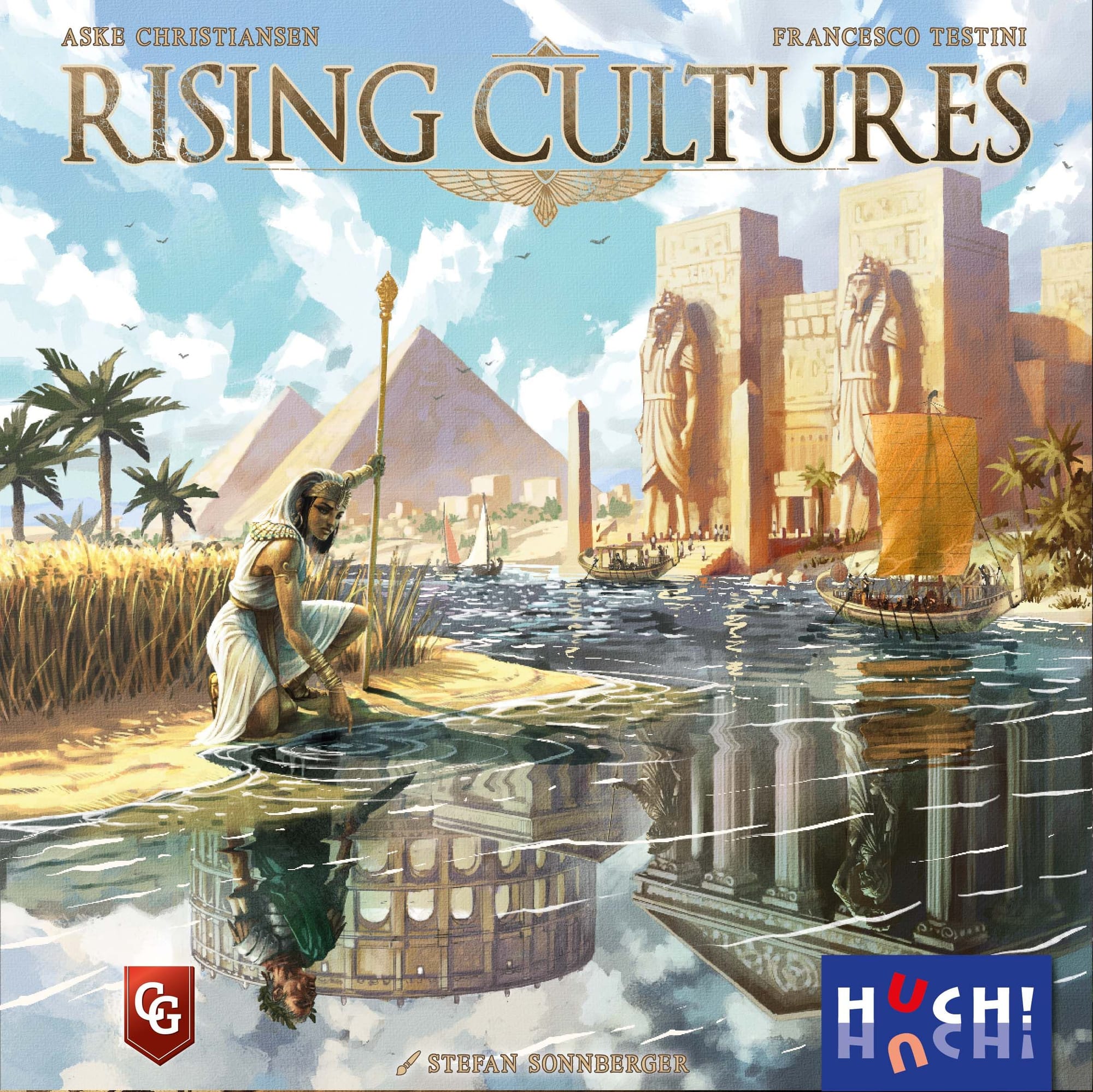
In addition to previewing upcoming games at Origins Game Fair 2026 — such as these three from Allplay and these seven from asmodee — I got to take the role of "Joe Gamer" and try out a released game about which I was curious: Aske Christiansen and Francesco Testini's Rising Cultures, which German publisher HUCH! debuted in Q4 2025 and which Capstone Games has now released in North America.
I knew the game featured four asymmetric civilizations with multi-use cards — both attractive features for me — but what was it like to play?
The game lasts seven rounds, with seven provinces up for grabs between the two players, each with a bonus for whoever has the most of the proper icons in their military.
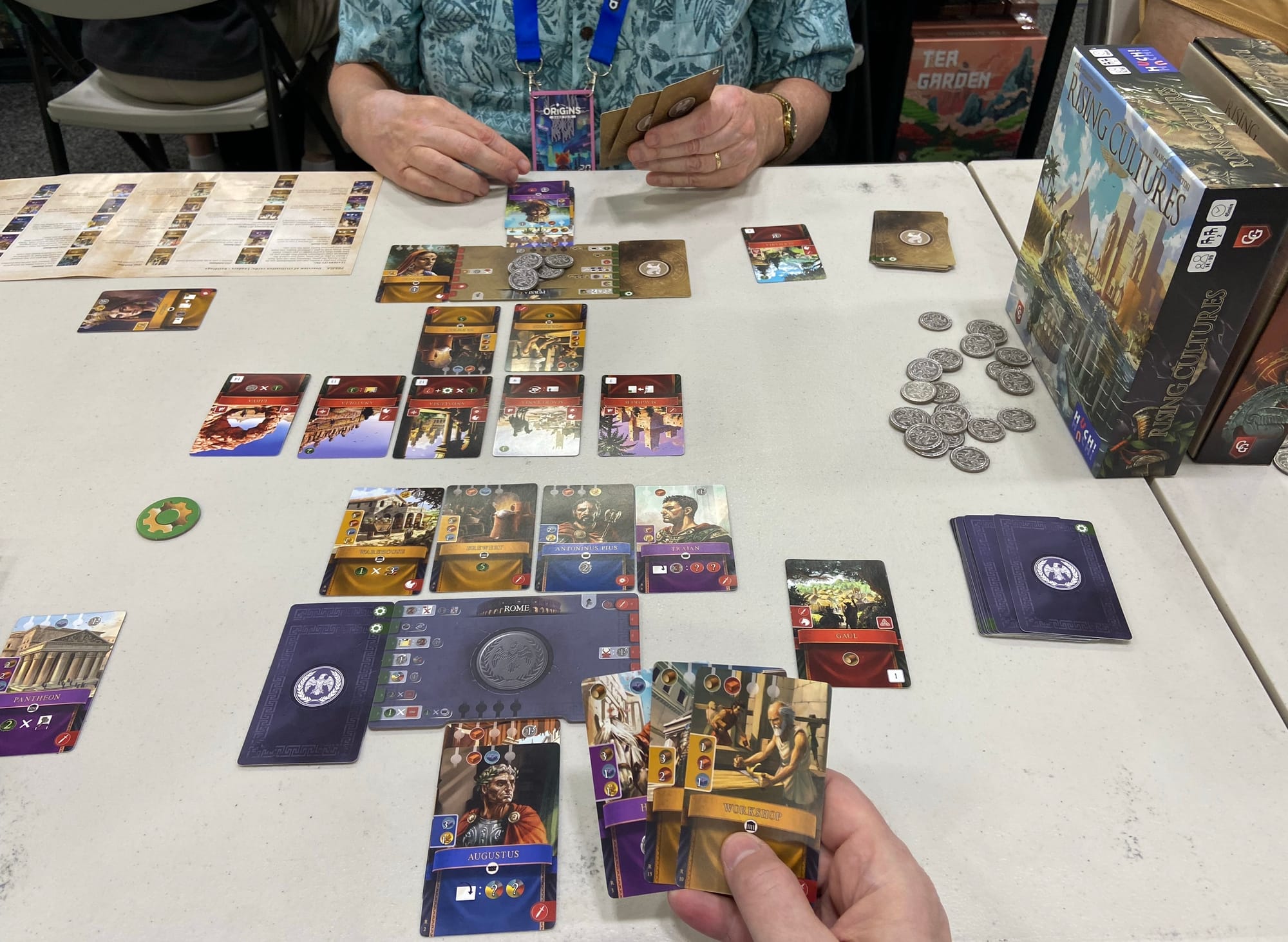
In a round, you draw four cards, then take turns playing three of them in one of four ways:
- Place it below your civ board so that you can use the resources depicted to play other cards (and gain immediate income if depicted, as with the first resource I played)
- Place it upside down to the right of your civ board to gain the military symbol depicted in the bottom right corner — and any symbol on your board linked to that card
- Discard it to gain 2 coins
- Place it above your civ board as a building or leader as long as you can pay the cost depicted halfway down the left edge; resources aren't spent, so you'll have them in the future, and you can pay 2 coins for each missing resource
When you play a building or leader, you can choose to convert your most recently played resource card into "progress" by flipping it face down and placing it to the left of your civ board. This unlocks special abilities for your civ, with Rome gaining the ability to pay 2 coins to not discard a military card when winning a province, lowering the cost to upgrade its civ board, gaining 1 income each round, gaining a resource of its choice, and scoring points based on province icons.
Upgrading your civ board costs 7 coins, with a discount for each progress/military pair you have — and the upgraded board earns you points at game's end, while having better in-game abilities.
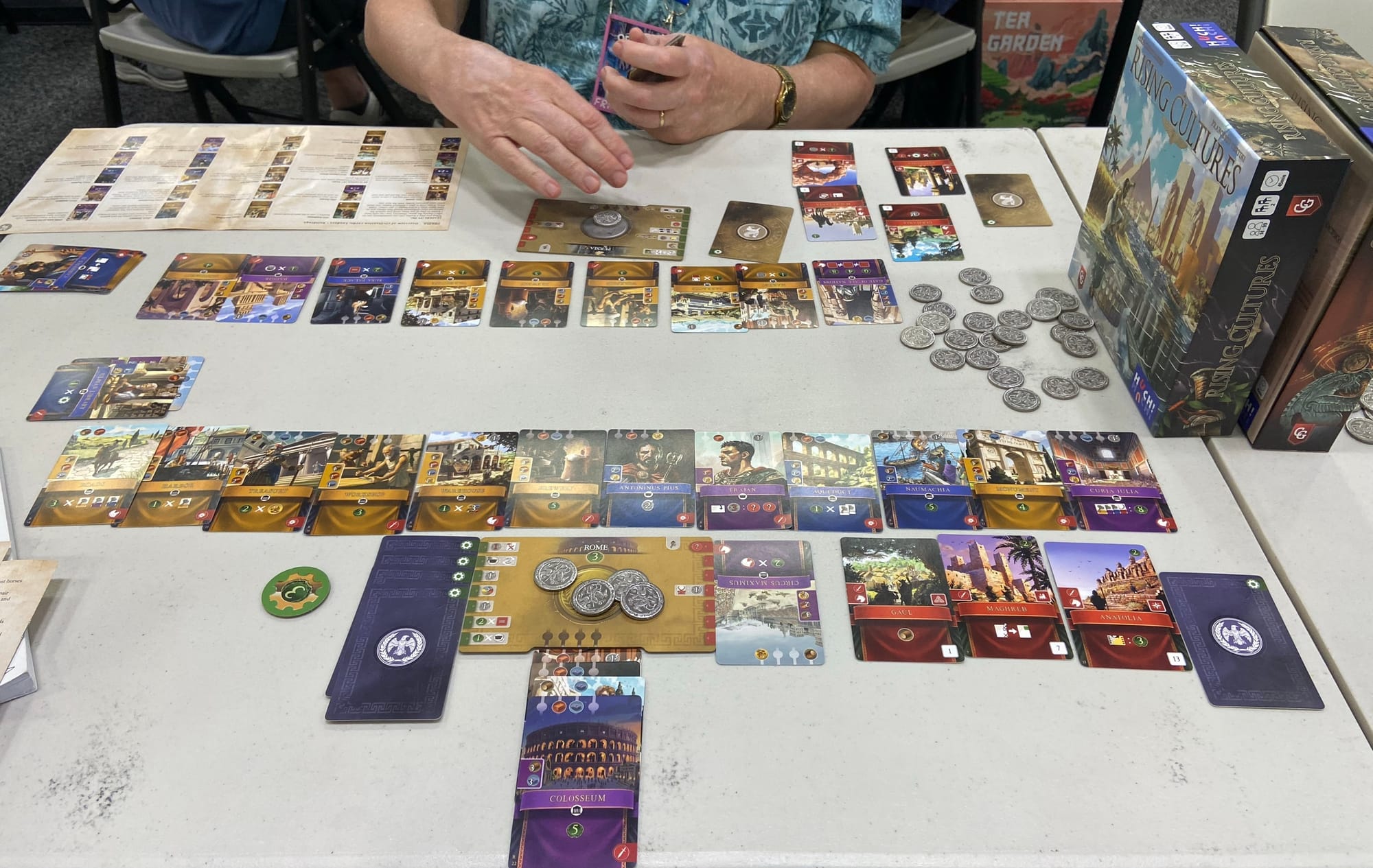
The fourth card in your hand each round goes back to the top of your deck, so you can play the first three cards to set up that card for play next round...although you might also kick it down the road for later. By game's end, you'll have gone through your entire deck, then summed points for provinces won, stuff built, a city upgraded, etc.
My thanks to Jim, who dove into this demo game with an attitude similar to mine: Let's not worry about playing well; let's just do things to see how this works. Clearly once you know the game, you'll optimize your three plays in the round to do as much as possible. Jim, for example, ended up with six or seven resource cards as he turned only one into progress, but your civ board in Rising Cultures is an engine that you want to boost through progress, even if that means dismantling one engine mid-race to build another.
I enjoyed the challenge of Rising Cultures and imagine the experience would improve with...experience, but two issues popped up in this design that I've encountered repeatedly in other games.
First, the only interaction between Jim and me was a competition for provinces, and sometimes the competition was in name only. If I need shields to win a province, and I've played no shields and have none in my hand, well, that's that. I'll focus on other aspects of play instead, with all of those aspects challenging me to maximize what I'm doing three cards at a time. The sole other interactive element that I see is possession of the progress marker, which determines who starts the round and who scores 3 points at game's end.
Second, all of the iconography is frustratingly small. I don't like needing to bend over the table to make out which resources I have, which icons I need to compete for a province, what my civ board bonuses are, and so on. Yes, with more experience I'd likely remember such things, but I dislike needing to make excuses when I introduce a game to others. "Don't worry, you'll get used to it!" You might counter that I need bifocals, and you might be correct, but in the meantime I'll opt for games that I can see more easily.
Enjoying the Origins coverage?
If Eric’s convention reports help you discover new games, please consider supporting Board Game Beat. Paid memberships start at $2/month and help keep this kind of independent coverage going.
A couple of days ago, I mentioned that Arcane Wonders would demo Christwart Conrad's card game Crescendo at the 2026 Origins Game Fair. When I showed up at the booth, that game wasn't yet on the tables as most of the booth space was devoted to Sol Kong's Dogfight: 1917, including this sweet prop created (and manned) by company president Robert Geistlinger.
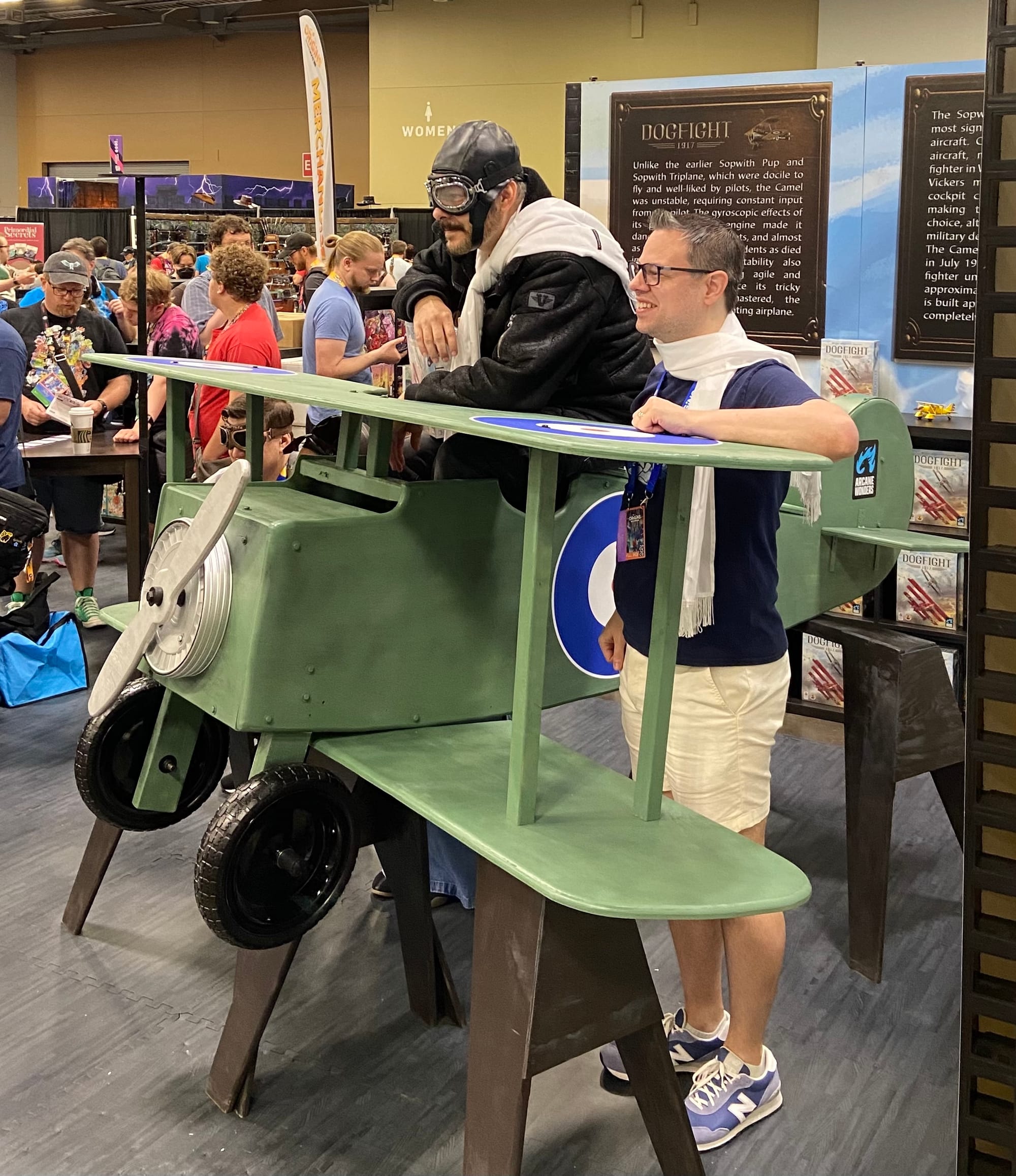
But I was able to talk my way into a Crescendo demo, mostly because I would not be at the fair on Saturday when the demo was scheduled, so let's give it a look.
The deck contains cards numbered 1-100, and at the start of play you receive nine cards that you place in a row in the order they are dealt. Each card shows one of three number ranges on the back, along with one of three symbols. Your goal is to get your row of cards in numerical order.
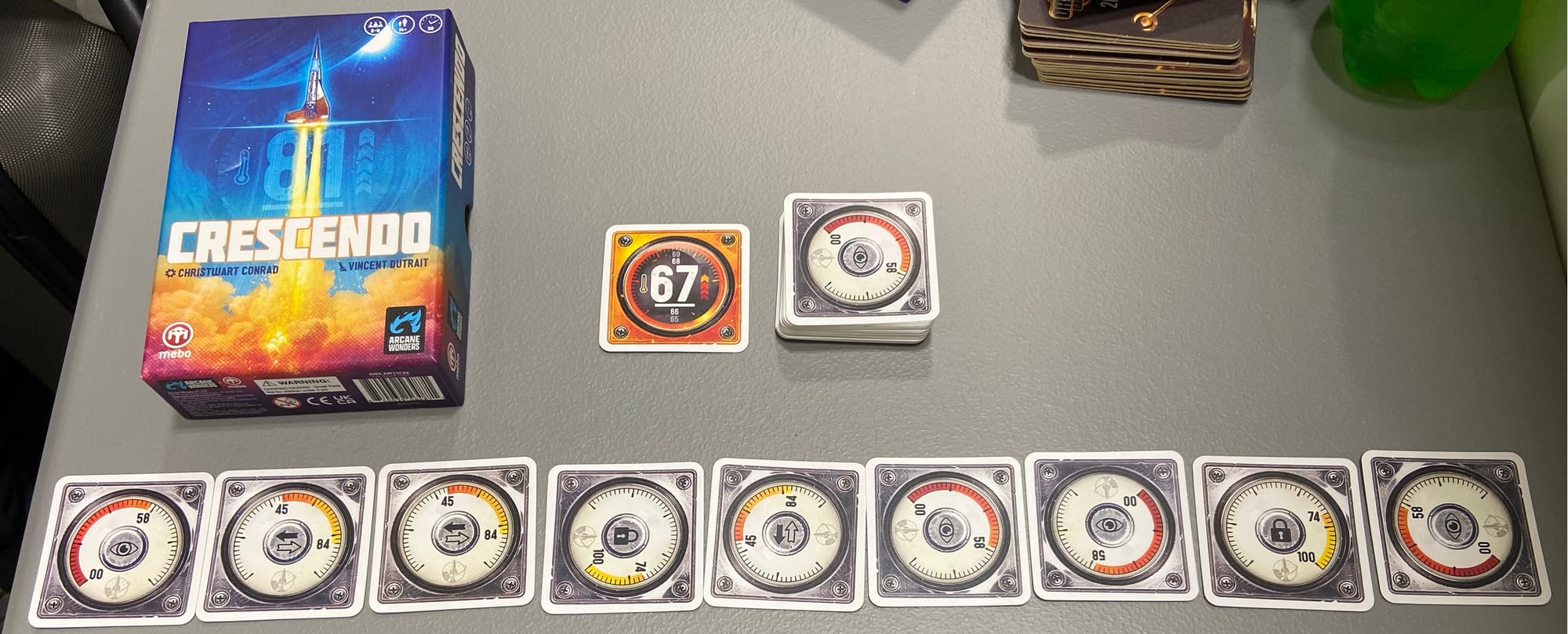
On a turn, you do one of three actions. First, you can take the top card of the deck or discard pile, look at it, then either discard it or swap it for one card in your row, discarding the replaced card. These cards stay face down, so you must (brace yourself) remember which cards are where.
The number ranges give you an idea of whether a card might be roughly in the proper location, but they overlap, so a 74-100 card might be lower than a 45-84 card. Whenever a player discards, if you think you have a card with a number at most two digits away — in the example above, 65, 66, 68, or 69 — then you can call "Number!" and flip that card in your row face up. If you're correct, you remove that card from your row, scoring 1 point for it at the end of the round; if not, you draw a card and stick it in your row without looking at it. More work for you!
Second, you can use the power of the deck's top card: peek at a card, swap one of your cards with an opponent's card, or turn one of your cards face up to lock it in place and make it off limits for swaps.
Third, you can call for the end of the round...which doesn't really feel like an action, but so be it. Each other player takes one last turn, then you reveal your row. If all your cards ascend in numerical value, 6 points for you; if not, -3 points, plus -1 for each card that's out of place. Other players score 3 or -1 points, with bonus points for correct "Number!" calls. Play three rounds, then place the winner on a rocket.
Crescendo is due out in September 2026, with copies likely to be available at Gen Con 2026.
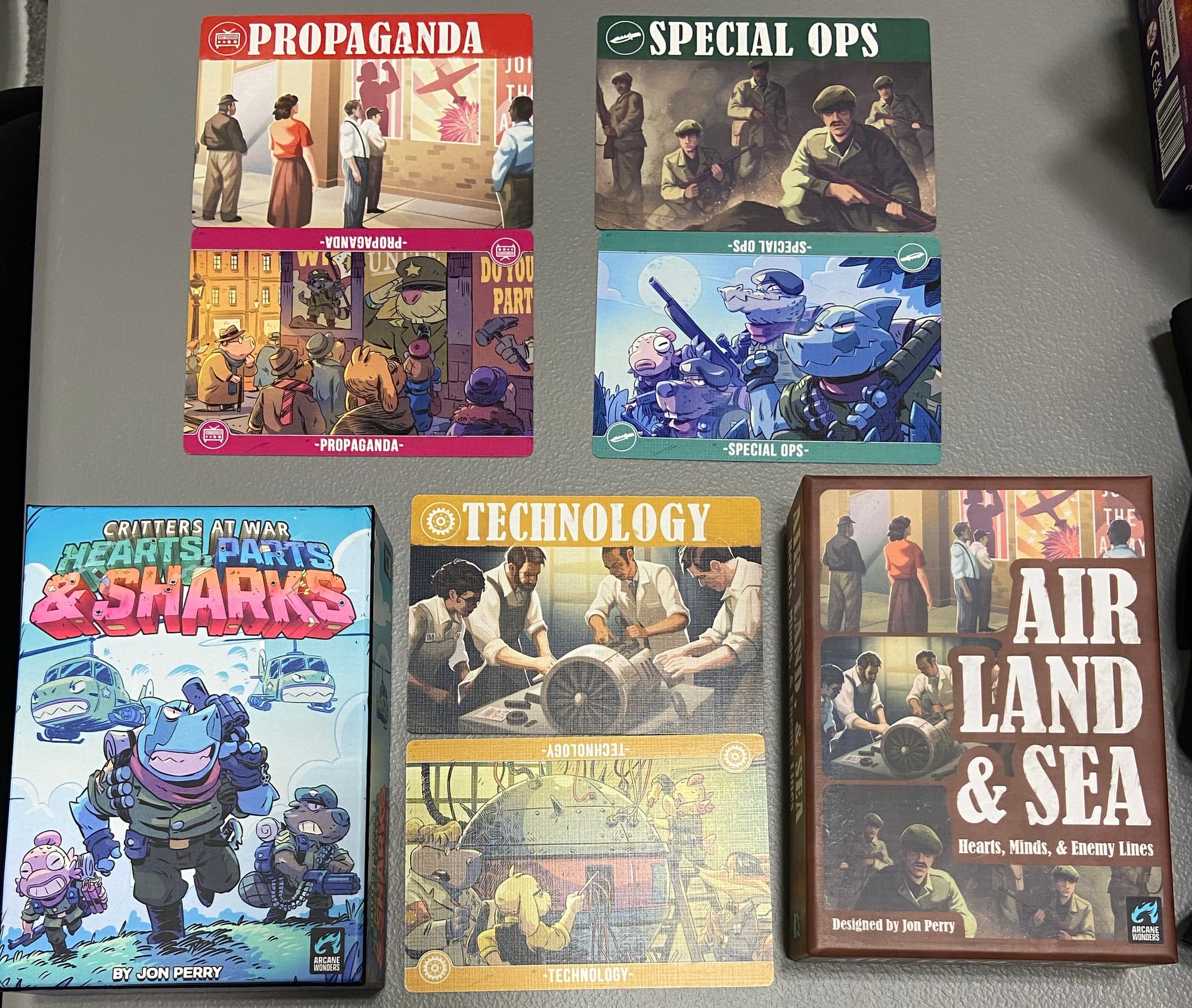
While at Arcane Wonders, I got a peek at two future game releases that could also be considered the same release: Air, Land & Sea: Hearts, Minds & Enemy Lines and Critters at War: Hearts, Parts & Sharks.
Each title is a new standalone game from Jon Perry in his (respectively) Air, Land & Sea game line and Critters at War game line. For now I can show only the covers of the games and the three theaters of activity: Propaganda, Special Ops, and Technology.
Arcane Wonders expects to have these titles available at SPIEL Essen 26, with a retail release likely in Q1 2027.
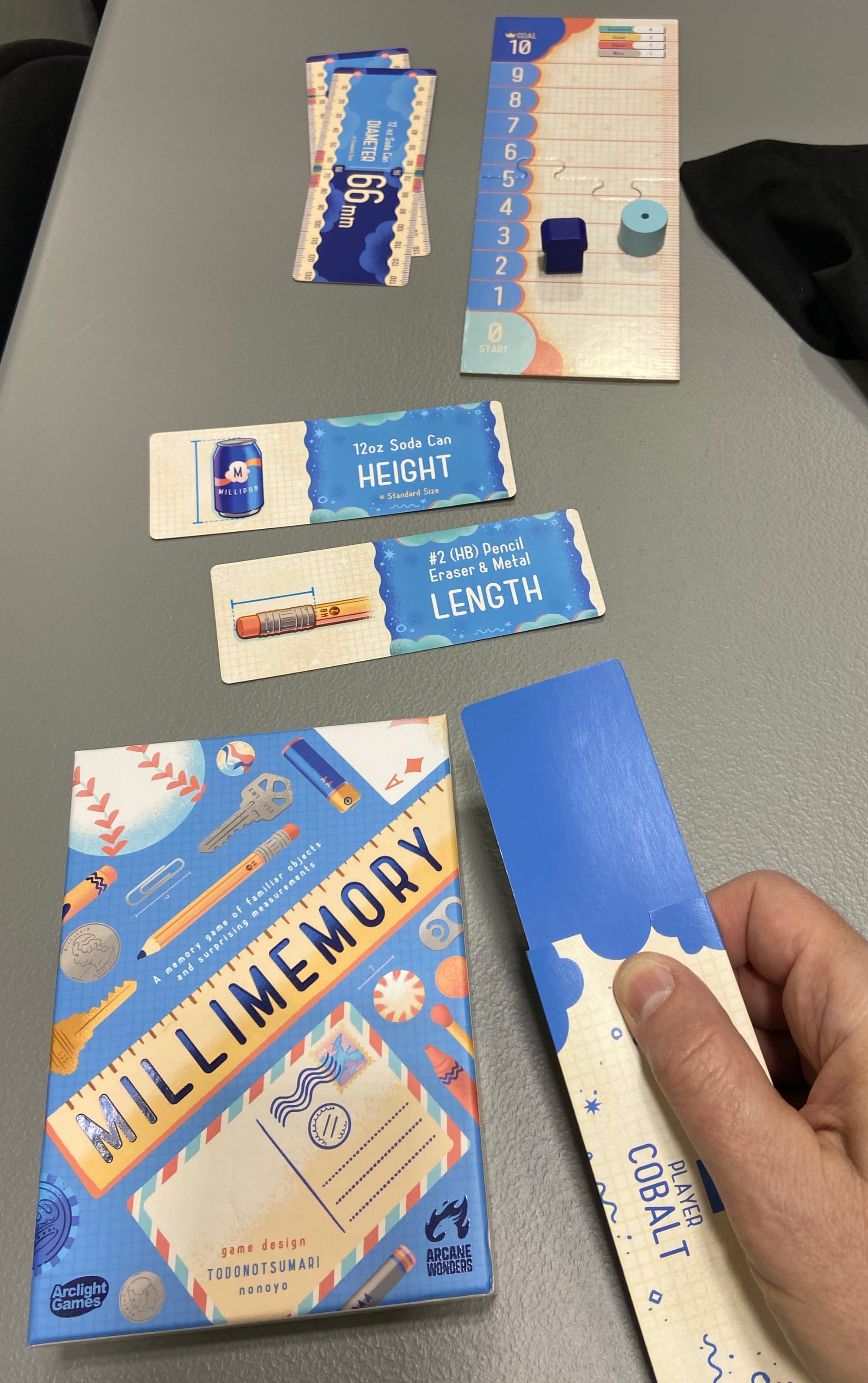
And a fourth (third) title that Arcane Wonders showed me is an English-language edition of Todonotsumari Nonoyo's Millimemory, which Arclight Games first published in 2022. This title has the same planned release dates as the two (one) above.
Your goal in the game is to repeatedly and accurately give the measurement of a common item. You'll be presented with a card that names and depicts an object, such as the diameter of a standard 12 ounce soda can, then you adjust your "ruler" to match what you think that distance should be.
Once everyone is ready, flip the card over to reveal the answer. Everyone judges their answer by placing their ruler next to the card, and if your answer — that is, the edge of your ruler — lands in the card's red, yellow, or green zone (which is the exact answer), you earn points. If your answer is outside the red zone, you lose 1 point. Whoever scores 10 points first wins.
Arcane Wonders' operations manager Dustin Wessel told me that while this edition is licensed from the original design, it's also mostly new given that the Arclight edition references objects that would be familiar to people living in Japan. Are sodas the same in Japan as they are in the United States? Pencils? Business cards? Not necessarily. Even so, the current challenges might still baffle U.S. residents depending on their age. Does anyone under age 30 know the length of a music cassette?
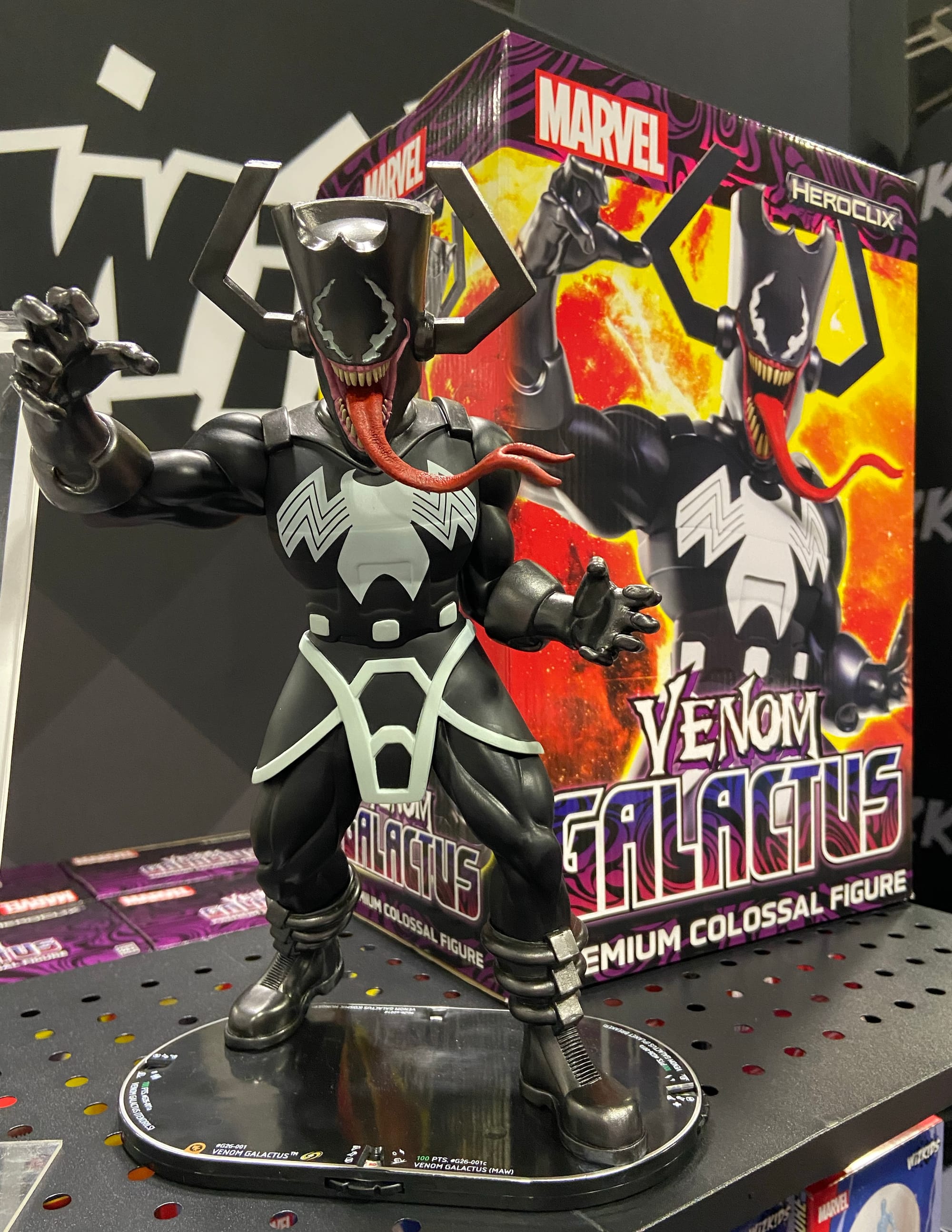
The supersized HeroClix figure depicted above retails for US$100, and I don't begrudge WizKids for marketing such things, but I'm baffled as to what it must be like to read Marvel comics these days. I look at trade paperbacks and current comics every so often, and it feels like the "Everything Is a Remix" ethos is feeding on itself within the House that Jack built. The same characters appear in new guises, then another guise, then a new familial connection is revealed, then two characters magically merge like the one above. Nothing ever goes away or resolves itself.
I mean, this feeling isn't new. Once X-Factor brought Jean Grey back to life in 1986, anything was fair game. (Apparently I've reached "shaking fist at clouds" stage on my timeline.)
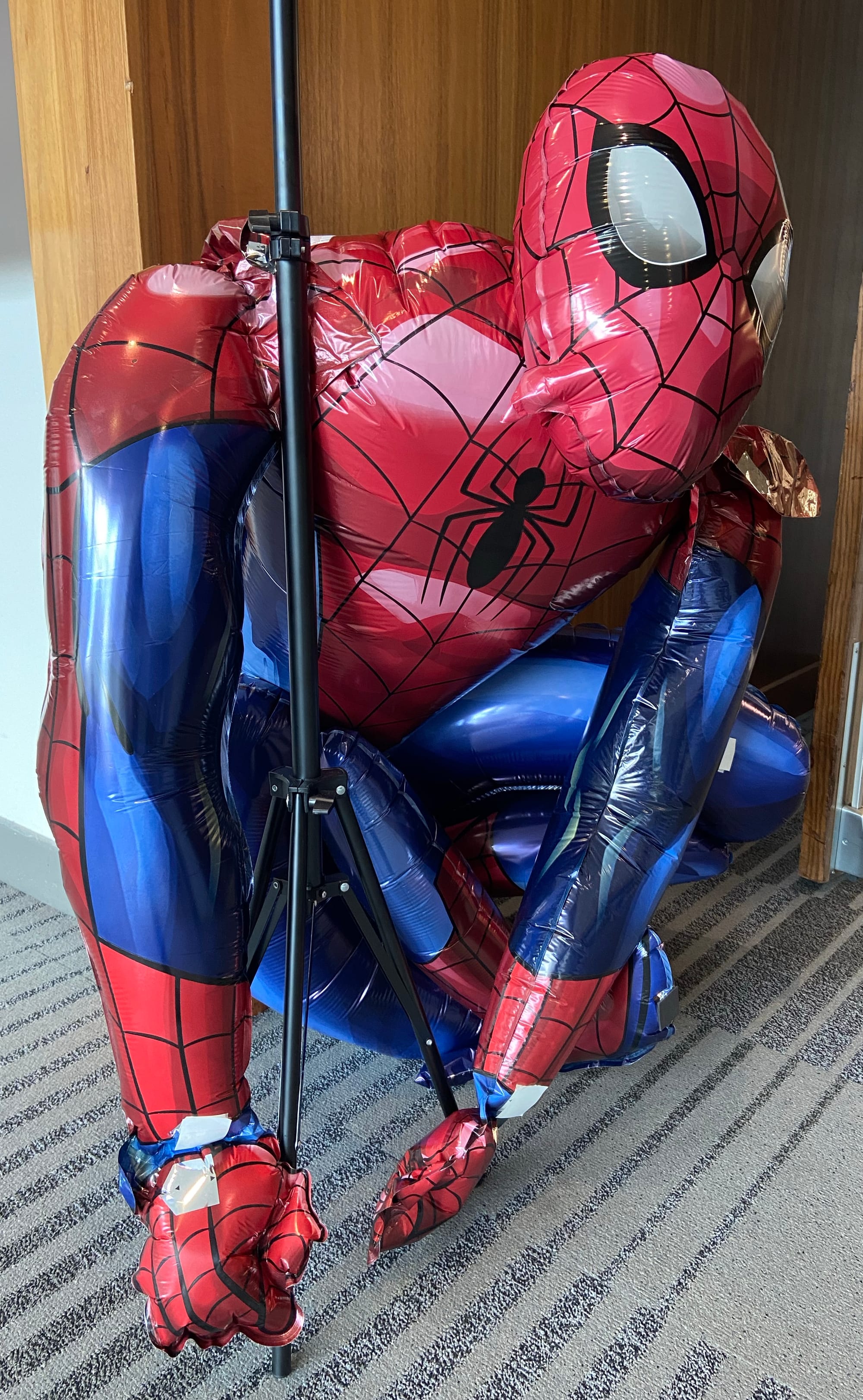
Also on site in the Greater Columbus Convention Center — a sad-looking Spider-man balloon that inspires pity more than marvel.