

On July 23, 2026, the Tabletop Game Designers Association issued a press release pleading for recognition of game designers in the publication of their work:
TTGDA CALLS ON AWARDS, CONTENT CREATORS, AND PUBLISHERS TO ATTRIBUTE GAME AUTHORSHIP FULLY AND ACCURATELY
Several recent announcements in the tabletop games industry have failed to identify creators of the games being discussed or described those games as being "by" their publishers, without naming the individual designers. The TTGDA finds this practice unacceptable and calls on awards organizations, content creators, publishers, and sales platforms to accurately identify designers when discussing games. "You would never recommend The Widow as the latest book by Doubleday. It's by John Grisham." said TTGDA Treasurer Elizabeth Hargrave. "The same
should go for tabletop games."
Common Ways Designers Are Not Properly Credited
● Designers not receiving clear and specific credit in published products.
● Publishers failing to name designers in solicitations and marketing text.
● Sales platforms not including designers in their listings for products.
● Awards not promoting creators as prominently as publishers in ceremonies and PR.
● Influencers and games journalists covering a work's publisher but not also its creators.
● Publishers identifying themselves as "creators" in marketing text or as "authors" or "designers" on sales platform listings.
● Derivative products not identifying individual designers and source works.
Specific examples of these issues exist across our market. TTGDA has been actively working with both GAMA on the Origins Awards and Mensa on their Select winners to correct problems with their promotions, which have failed to include designers across multiple years. TTGDA has also had success working with Barnes & Noble to add designer names to their listings. Amazon, on the other hand, has resisted calls to properly make designers part of their listings, even though they have the ability to identify musicians and book authors in ways that make them
searchable and connect them to their creations.
TTGDA would also like to emphasize that while we see many instances where designers are not properly or accurately credited, there is also widespread support for designers in the industry. Some recent examples include the designer-focused Spiel de Jahres [sic] awards and the BoardGameGeek convention preview (such as the currently active Gen Con and Spiele [sic] lists).
An Aside on Barnes & Noble
TTGDA launched in May 2024, and on October 4, 2024, its second press release (PDF) highlighted efforts by the organization to work with the Barnes & Noble retail bookstore chain to have game designers credited on its website. From that press release: "Starting today, visitors to the Barnes & Noble website will see the names of game designers prominently displayed alongside game titles. TTGDA is using the resources at the BoardGameGeek website to assist Barnes & Noble in the ongoing process of adding designers to their large catalog of games, enabling this information to be available for both new releases and existing games."
Looking at the B&N website, you'll see that the company took the "names alongside titles" pledge literally. Here's a sample book listing:

And a sample game listing:
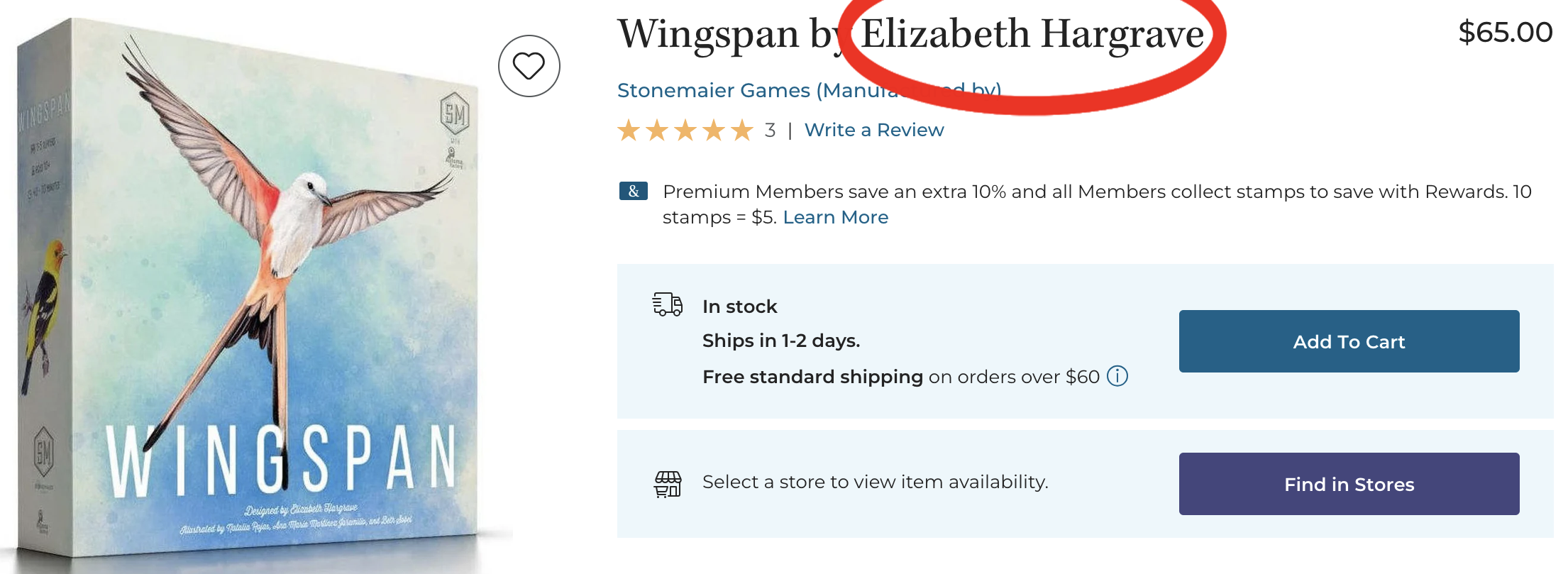
Those two are not the same. Click on "Michel Faber", and you'll see other works written by him or including his writing. No such link exists for "Elizabeth Hargrave", but one does exist for "Stonemaier Games".
And not all game listings on the Barnes & Noble website include a designer name:

And a Similar Aside about the Origins Awards
After the winners of the 2024 Origins Awards were announced in mid-2025, I recall seeing a note by TTGDA president Geoff Engelstein that objected to those awards mentioning only the publishers of those winning games, not their creators.
The winners of the 2025 Origins Awards do have their designers listed on the Origins website, albeit after the publishers, but if you look at the list of finalists for the 2025 Origins Awards that published on March 18, 2026, that list credits only the publishers, not the designers.
Looking at the listings for winners from 2010 to 2024, none of them include designer credits...which seems especially odd given that The Academy of Adventure Gaming Arts & Design, which runs the Origins Awards, also maintains a Hall of Fame for notable people and products. Want to know which creations by Hall of Famer Eric M. Lang have won Origins Awards, if any? Good luck as no links exist between the Hall of Fame and Origins Award winners.
And Now One for Mensa Select
The Mensa Mind Games website lists game creators for the awards given out in 2025 and 2026, but not for earlier years at least as far back as 2010.
An additional oddity is that Mensa credits each game to a "manufacturer", not a publisher — and in many cases the "manufacturer" listed isn't even the publisher, but a distributor of the game in question, or a licensee of that game, not its originator.

Let's return to the interrupted press release:
Games Are Created by Designers
While games can follow many paths before reaching the public, the most common one is for a designer to have an idea that they work on for months or years before pitching it to a publisher or deciding to self-publish. The polishing and product design work a publisher does — while important — does not override the designer's authorship of the game. Even for works that are created by an employee of a publisher, the designer is not the publisher itself but the individual doing the actual creative labor. They deserve to be credited by name.
"Accurate and prominent name credit should be a given in all aspects of game publishing and promotion," notes TTGDA Board Member James Lowder, an author and RPG designer with more than 35 years' experience. "Those credits have clear commercial and personal value for every creator. The industry must do a better job acknowledging the people who imagine the works and worlds that underpin everything we do."
Designers' Names Are Readily Available
In 1988, a group of board game designers organized by Reinhold Wittig banded together and signed a proclamation stating, "None of us gives a game to a company if our name is not written on the box cover!" Even for people outside a publisher's circles, game designers' names are now readily available not only on the covers of some games themselves, but in online resources like BoardGameGeek.com.
"The games industry has largely agreed that designers' names belong on their games for over 30 years. Now we are calling on the industry to carry that over into how we talk about games," said TTGDA President Geoff Engelstein.
Best Practices
TTGDA recommends these best practices for talking about tabletop games:
● If you mention the publisher, also mention the designers. This doesn't mean every person working on a multi-designer project needs to be listed every time, but at least mention the leads. When notable elements, such as innovative mechanisms, are promoted for multi-author works, credit the creators. If art is used in the PR, credit the artist.
● Words matter: A game is "by" its designer or designers, and "published by" or "presented by" the publisher. The "creator" of a game is the designer, not the publisher.
● If you don't want to take the time in a video or awards ceremony to read a list of names, consider a text overlay. This gives the opportunity to also highlight key facts in your presentation such as play time and player count.
● Consent matters: Publishers, awards, and events should coordinate with designers on the use and presentation of their names. If a designer doesn't wish to be connected to something, they should be able to remove their name. As a best practice, this encourages designers to participate more actively in promotions where their name appears by consent.
● Integrate clear designer credits and consent for name use into all game publishing contracts.
The Tabletop Game Designers Association is committed to working with any publisher, influencer, news platform, awards organization, and sales platform to encourage these best practices and continue to stress that fair treatment of creators is both the right thing to do and good for long-term business.
I try my best to credit a game's author(s) whenever I write about it, but I typically don't include the creators with every mention of a game, as when I didn't name check Larry Harris, Jr. following the appearance of Axis & Allies 1941. In the past month, I've started adding artist credits to images of game covers and components. Not sure why I didn't do this previously and why I started when I did — it just felt right suddenly.
I am a stickler for mentioning the originating publisher of a game when it wins an award, as in my cover of the 2026 Spiel des Jahres winners, and if I write about publisher X releasing a game that debuted from publisher Y, I will typically work in a reference to publisher Y. After all, publisher Y brought the designer's work to its final form, so why should publisher X get all the credit? In addition, if someone likes game Z, they would benefit from knowing that they might want to check out other releases from publisher Y.
P.S. Ironically(?), this press release from TTGDA had no credited author.


