I posted a teaser for Matthias Cramer and Werner Schmitt's Secret Museum the other day, and now publisher Schmidt Spiele has revealed the entirety of its late 2026 line-up, so let's dig into it.
Secret Museum
Secret Museum is in the vein of Markus Slawitscheck's Morty Sorty Magic Shop, Schmidt Spiele's early 2026 release that was nominated for the 2026 Spiel des Jahres. (You can learn more about Morty Sorty in my overview.) In short, Secret Museum is a light strategy game in which you collect items, arrange them beneficially, and attempt to satisfy goal cards.
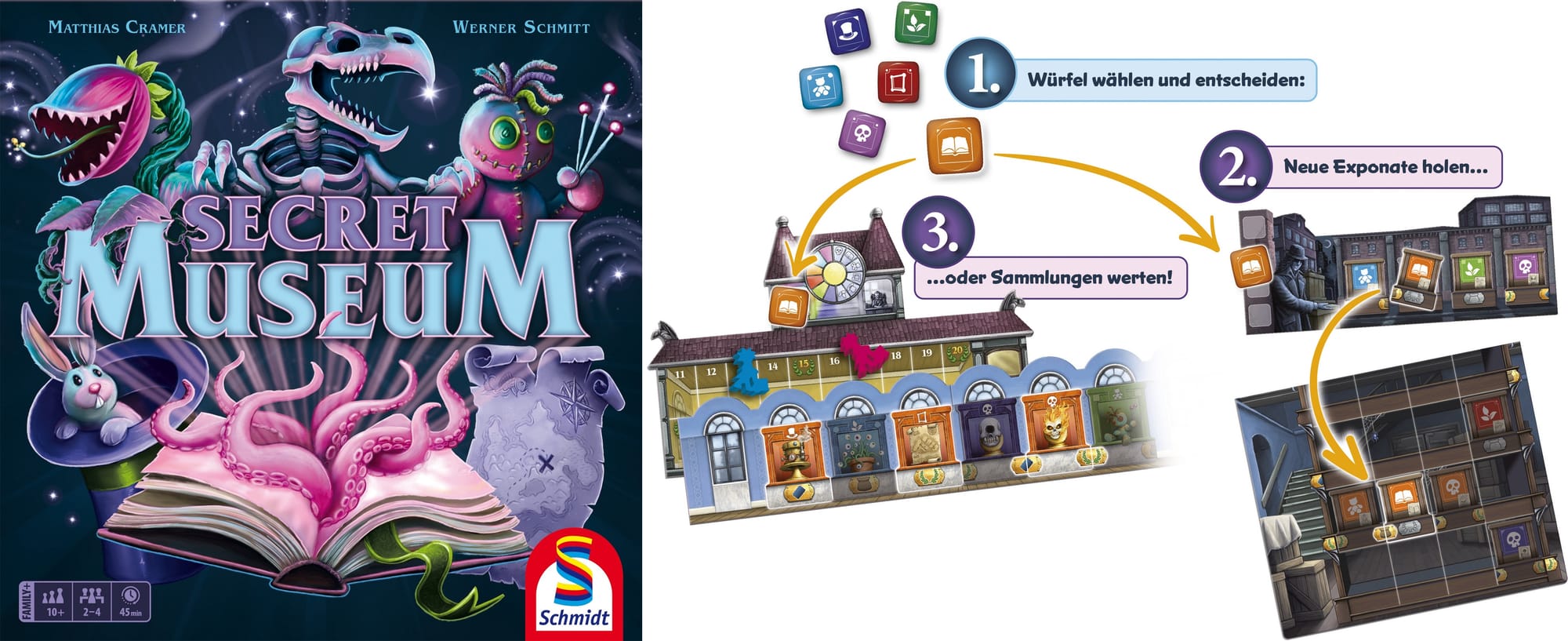
The gist of the game is that you're picking up exhibits on the black market, storing them in your reserve area for a while, then — voilà — adding a selection of them to your public collection once their black market stink has faded. Exhibits come in six colors and types on double-sided tiles, with one side featuring the exhibit in storage and the other side in a display case; you start with one item on display in your collection and two exhibits in boxes in storage.
On a turn, draft one of the dice, then either (1) get new exhibits, or (2) score collections. To get new exhibits, refer to the four exhibits on the "black market" board, then take all that match either the color or type and place these items in storage. Most exhibits have one or two half-symbols on them, and when you complete a symbol by placing two halves together, you get that bonus: 1 point, a job card (that can provide endgame scoring), or a random exhibit from the bag.
If you've now placed three exhibits of the same color or type in a row, return one of them to the box, then flip another to its "display" side and add it to your collection. (You can move exhibits in your collection to match half-symbols.)
To score collections, choose a die, then place it on either the color or type space of the museum, after which all players activate all exhibits in their collection of that color or type, once again receiving points, job cards, or random tiles, which might trigger another item moving to your collection.
As soon as someone has eight or more tiles in their collection, you finish the round. For each space on a job card that you can fill with an exhibit in your collection, you score 1 point.
Die Insel der unsichtbaren Tiere
Speaking of Slawitscheck, he has a new title with co-designer Arno Steinwender, with whom he won the 2024 Kinderspiel des Jahres for Die Magischen Schlüssel.
Die Insel der unsichtbaren Tier ("The Island of Invisible Animals") comes from Schmidt's Drei Magier Spiele imprint, and players are challenged to rescue all animals from the island before its volcano erupts.
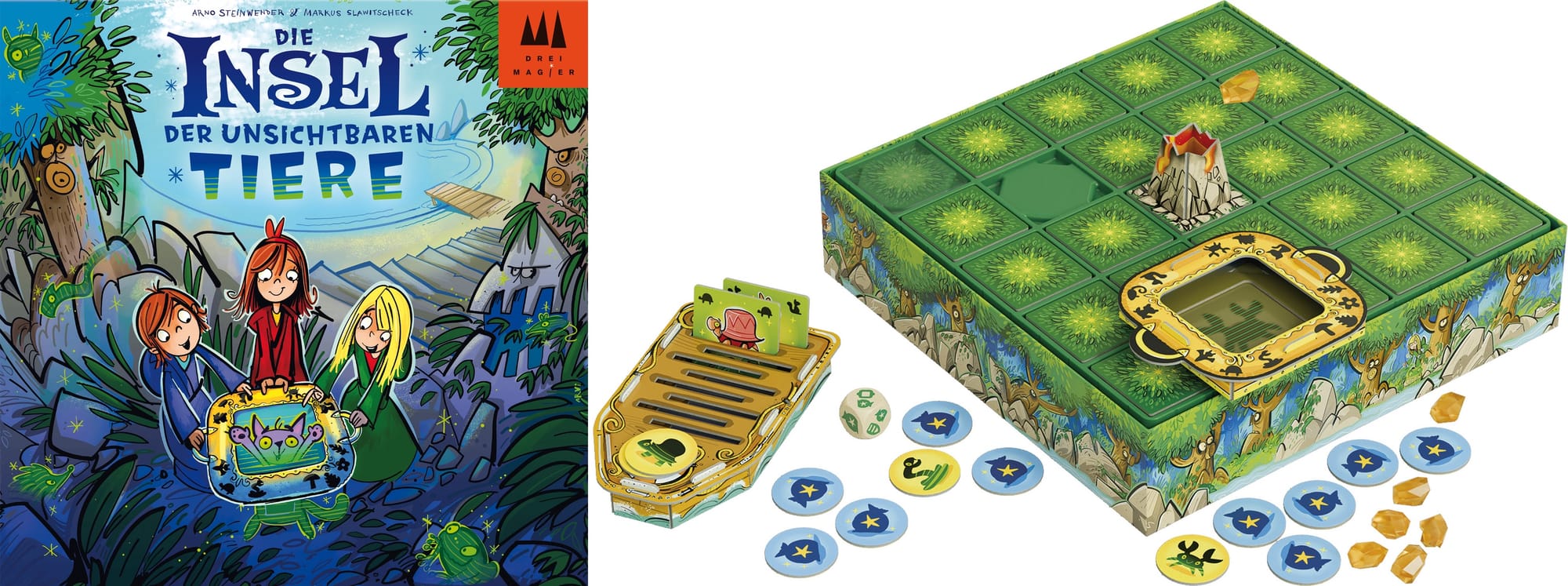
On a turn, place the "magic viewfinder" over one or more squares on the island to see what's underneath: an animal, parts of animals (should you straddle more than one tile), plants, nothing? Next, flip over one of the tiles. If the tile shows food, leave it face up; if it shows the rescue boat, flip the boat face down, then flip any tile on the island face up. Is that animal's food tile visible? If so, you've lured the animal from the island onto your boat. If not, then you've...angered the gods(?) and add a lavastone to the volcano.
If all the lavastones are in the volcano before all nine animals have been rescued, then you all perish, with your charred remains sure to become resources in some future game.
To increase the game's difficulty, you can add tiles to the game that add a lavastone, keep you from talking, or rotate the game board so that you will likely have trouble remembering which animals are where.
Kniffle 8 and HiLo PLUS
Two game lines in the Schmidt Spiele catalog have new entries, with Reiner Knizia's Kniffel 8 featuring a gameplay twist on ye olde Kniffel, a.k.a. Yahtzee.
The starting point of the twist: Instead of a 6, the eight six-sided dice feature an 8. On a turn, you roll the dice up to three times, keeping and re-rolling whatever you wish — except that all 8s must be kept. After you stop rolling, you score one of the fields on your scoresheet: What's the sum of the 1s you rolled? The 2s? The 8s? If you scored 2+ dice in each of those number fields, you earn a bonus.
You can create four- and five-of-a-kind to score as in Kniffel, but your score is the sum of your dice other than 8s, so not being able to re-roll 8s can be a curse as much as a benefit. Other scoring options are familiar, but modified based on you rolling eight dice instead of six: two sets of three, a five-die straight (both with and without a pair of 8s), and a six-of-a-kind. If you can't score on a turn, mark out one field, scoring no points for it. (The scoresheet includes a "reserve" field you can mark out so that you can still try to score all other fields, with that reserve being worth 10 points itself if you don't use it.)
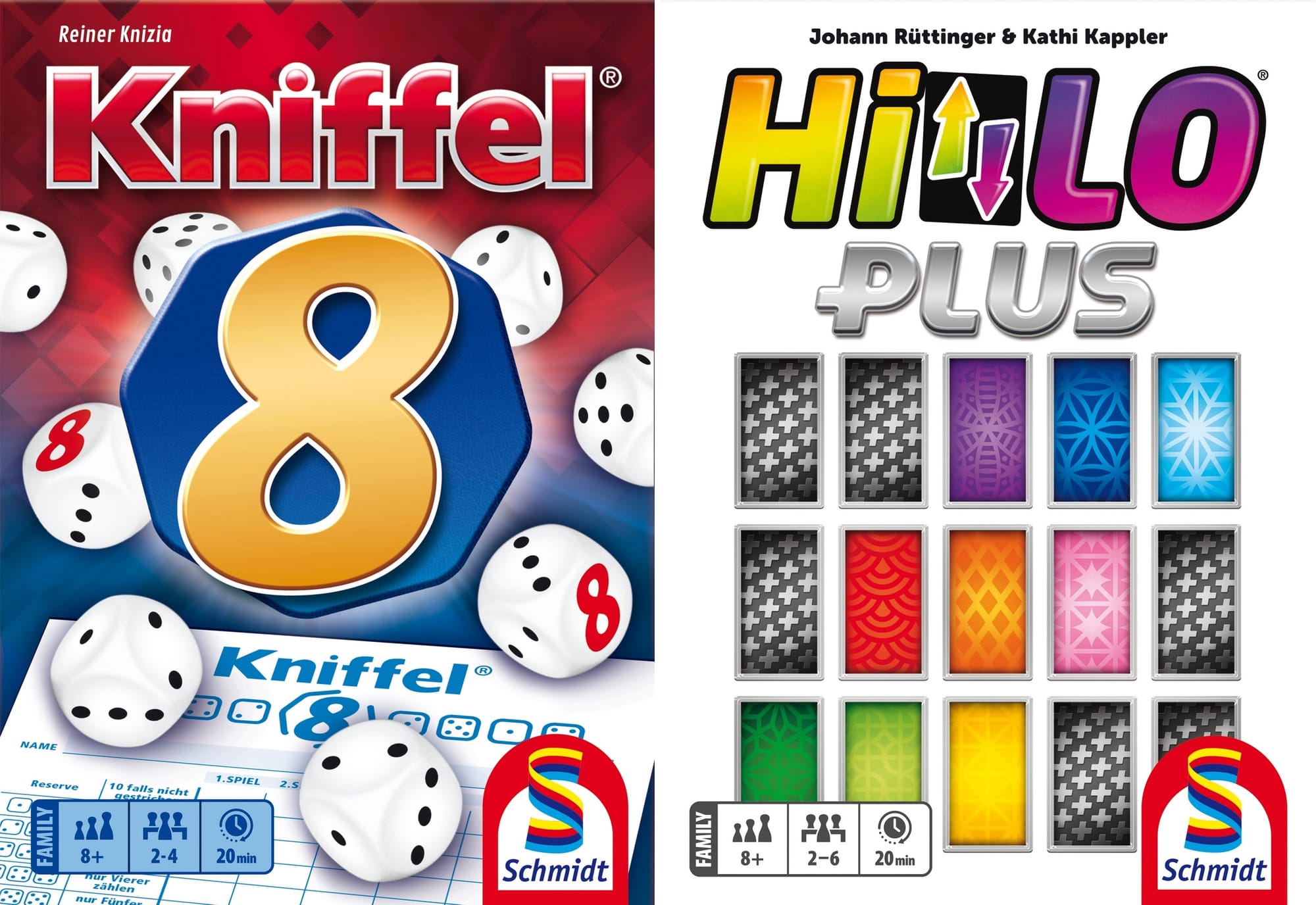
HiLo PLUS is a card game in the golf family from Johann Rüttinger and Kathi Kappler, who had released the golf game ALLEGRA Grande through their own Drei Hasen in der Abendsonne company in 2024.
Your goal in HiLo PLUS is the same as in all golf games: Score as few points as possible. You start with fifteen random face-down number cards in a 3x5 array, then turn any two face up. You also have a hand of five action cards. On a turn, you do one of three things:
- Take the top card of the discard pile and swap it with a card in your array.
- Draw the top card of the deck and either swap it with a card in your array or discard it, after which you flip a face-down card face up.
- Use an action card to swap any two cards in your array or peek at a face-down card in your array. (A played action card blocks the discard pile for the next player.)
If at any time you have three or more cards of the same color in a row, discard these cards, then slide all cards in your array to the left to close gaps.
Whenever all cards in an array are face up, each other player takes one final turn, then you score points equal to the sum of your cards. Play multiple rounds, or have the lowest score when someone passes a point threshold.
Perfect Tour
The only other family game on Schmidt's schedule is Günter Burkhardt's Perfect Tour, which continues the pattern of German publishers using English for their game titles, as with Secret Museum and Morty Sorty Magic Shop.
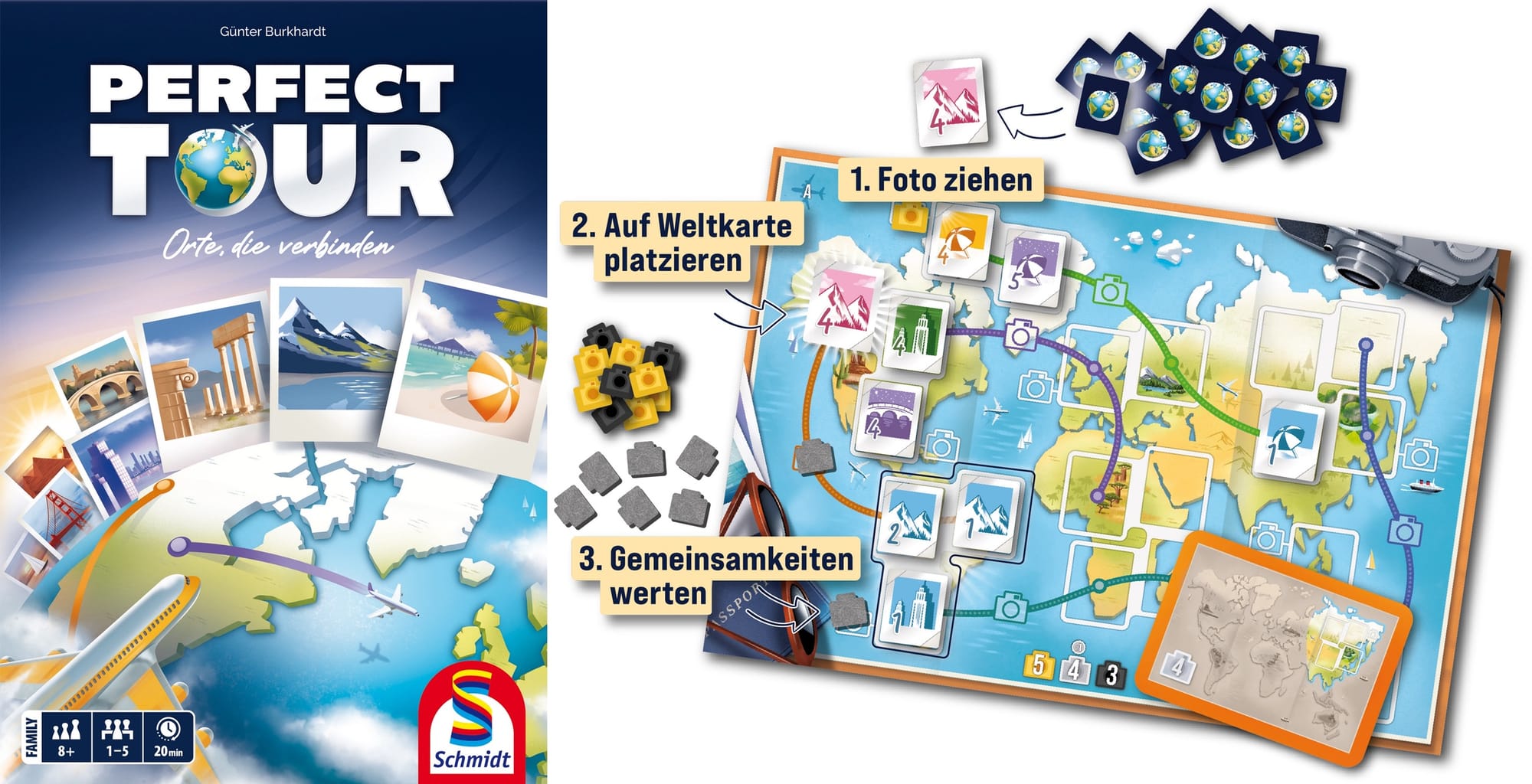
Each player has their own game board, which shows 21 spaces that are grouped by location and colored airline routes. Take a random photo tile, and place it above your game board.
Everyone plays simultaneously. On a turn, take a photo and place it above your game board, then take one of the photos above your board and place it on an empty space.
If you have now filled all the empty spaces in a location or on a route, check to see whether all of these photos feature the same color, value, or image; if so, you score! If you're the first person to score this location or route, take a silver camera token, which is worth 4 points. If someone else has scored this before you, take a black camera, which is worth 3 points — unless the sum of your photos is higher than whoever holds the silver camera for this location/route, in which case you take a 5-point gold camera.
You can reject one photo on a turn, but at a cost of sorts. Place the newly drawn photo face down to your left, then draw another. At the end of that turn, your left-hand neighbor adds this photo to their pool, giving them more options from now on, along with a 1 point bonus at game's end.
Each player holds an endgame bonus card, and two such cards are public. If you have the lowest sum of photos in the region depicted on your private card or the public ones, you score 4 points.
The double-sided game boards feature a map with more connections on the reverse side.
Topp das Törtchen!
Designer Wolfgang Warsch won the 2025 Kinderspiel des Jahres with Topp die Torte!, which was published by Schmidt, so the two have now partnered on a spinoff title that features similar gameplay.
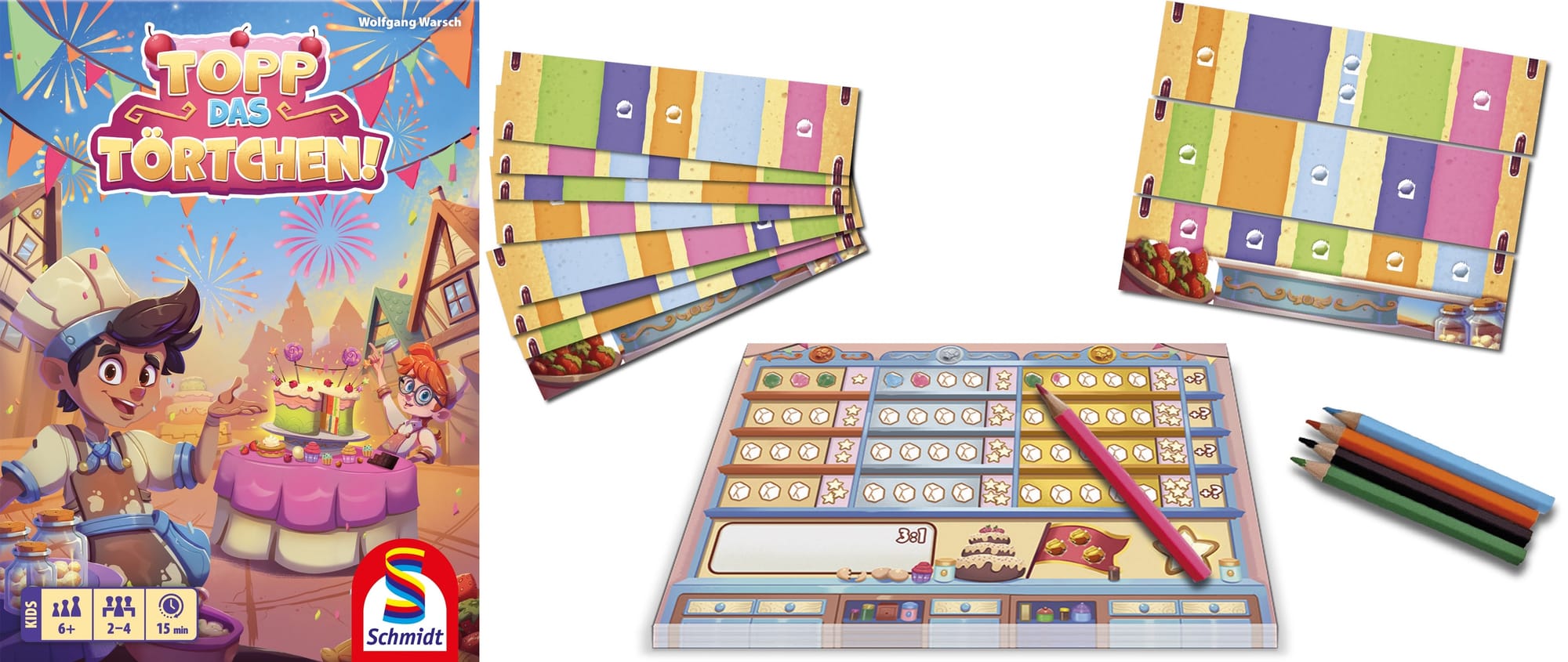
In Topp das Törtchen! ("Top the Little Cake"), each player will build a seven-layer cake one layer at a time on top of the starting layer shown at the bottom of the cake-in-progress in the upper right of the image above.
Each turn, you consider two layers, flipping them as you wish to decide which one you want and which you'll place face down on your left. (Next turn, you draw a layer from your personal stack and the one your neighbor rejected.) When you place a layer, you want to create or add to existing columns of a color...which makes the example cake above odd given that no color in the first layer matches the starting layer. Why show bad gameplay in an example?!
Anyway, the second layer of that example cake extends the pink and light blue colors. Count how many sugar cubes are shown in those layers — one pink and two light blue — then color one sugar cube on your player sheet pink and two light blue. Note that you cannot repeat a color in a scoring field, so once again the example image leads us astray since the upper left "bronze" space features two green sugar cubes. (Someone at Schmidt HQ will probably get a dressing down once these problems are pointed out.)
You must complete fields from the top down, so if you have a pink cube in all fields in progress, then additional pink cubes go in the exchange box on your player sheet, which can be cashed in at a 3:1 ratio for another color. Boo, don't do this. Vary the cake colors for multicolored sweetness.
When you complete a field, circle the stars next to it — and when you complete a gold field with all five colors, you name two colors, then flip a cake layer from the reserve. Score bonus stars equal to the number of sugar cubes in one of the named color fields. After the seventh round, use three golden joker cubes to ideally fill nearly completed fields, then sum your stars.
P.S. German side note: Interesting to think about torte (cake) being feminine and törtchen (little cake) being neuter, as if the little cake hasn't hit puberty yet, so its gender is currently unknown or not yet explicit, despite all "adult" cakes being feminine.
(I'm sure someone knowledgeable of the history of German could tell me why my joke is lame, similar to how my wife's study of Old Church Slavonic gave her some understanding of how Russian ended up as it did.)
Want more game write-ups like this one?
Get Board Game Beat’s free posts by email — original reporting, designer interviews, and industry news, with no tracking, no ads, and no spam.