In August 2024, I previewed Richard Garfield's King of Tokyo: Duel, a two-player-only take on his 2011 game King of Tokyo, and just as King of Tokyo saw a standalone sequel — King of Tokyo: Godzilla — released in 2026, a sequel to Duel is hitting the market in Q4 2026: the less-than-elegantly-named King of Tokyo: Duel – Tokyo Bay.
Guess you can't keep a popular (and well-selling) monster down.
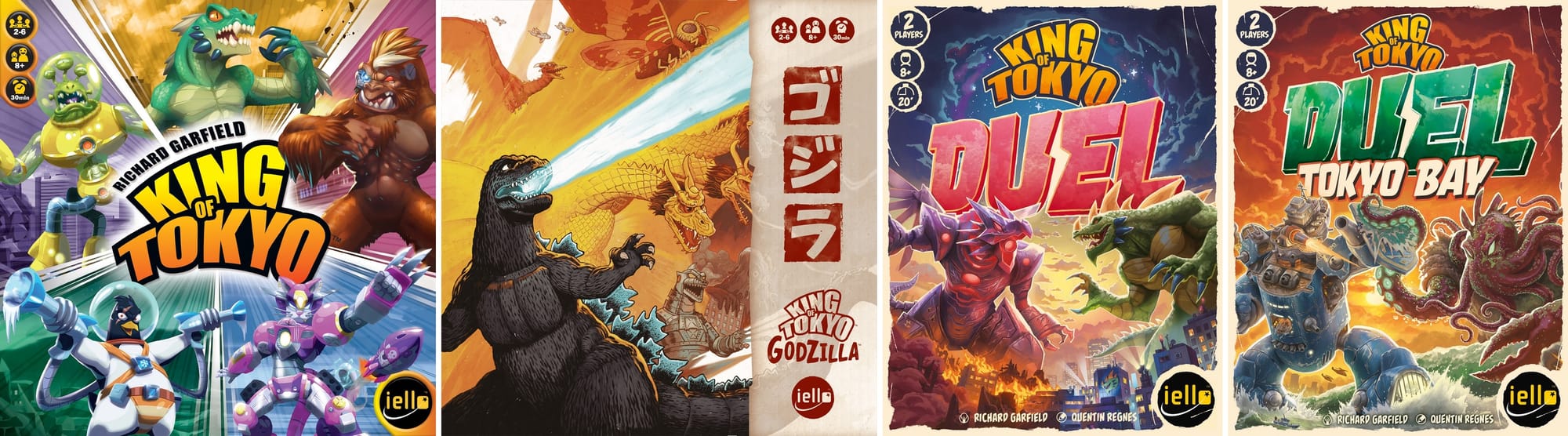
Tokyo Bay mimics the format of Duel, with two giant monsters bashing on one another repeatedly while playing tug-of-war over fame and destruction tokens, while Duel mimics the gameplay of King of Tokyo: Each turn, the active player rolls six dice up to three times, locking or re-rolling dice as they wish, then they carry out the results:
- Claws damage the opponent.
- Hearts heal you.
- Energy bolts grant you energy cubes.
- Stars advance the blue fame token.
- Wrecked buildings advance the red destruction token.
- Exclamation marks do something unique to your monster.
One of the key features of King of Tokyo is the dynamic tension of its dual victory conditions. If a monster is damaged enough to bring it to 0 health, it's out of the game, and if you're the last monster standing, you win. Alternatively, if you collect 20 points, you win.
Those two victory conditions run perpendicular to one another, so you tend to focus on one, not both. If your dice rolls and the power cards you purchase with energy cubes give you points, you're probably not damaging opponents, and vice versa. Your "path to victory" each game depends on a double dose of chance and choice (via dice and power cards), as well as the actions of your opponents.
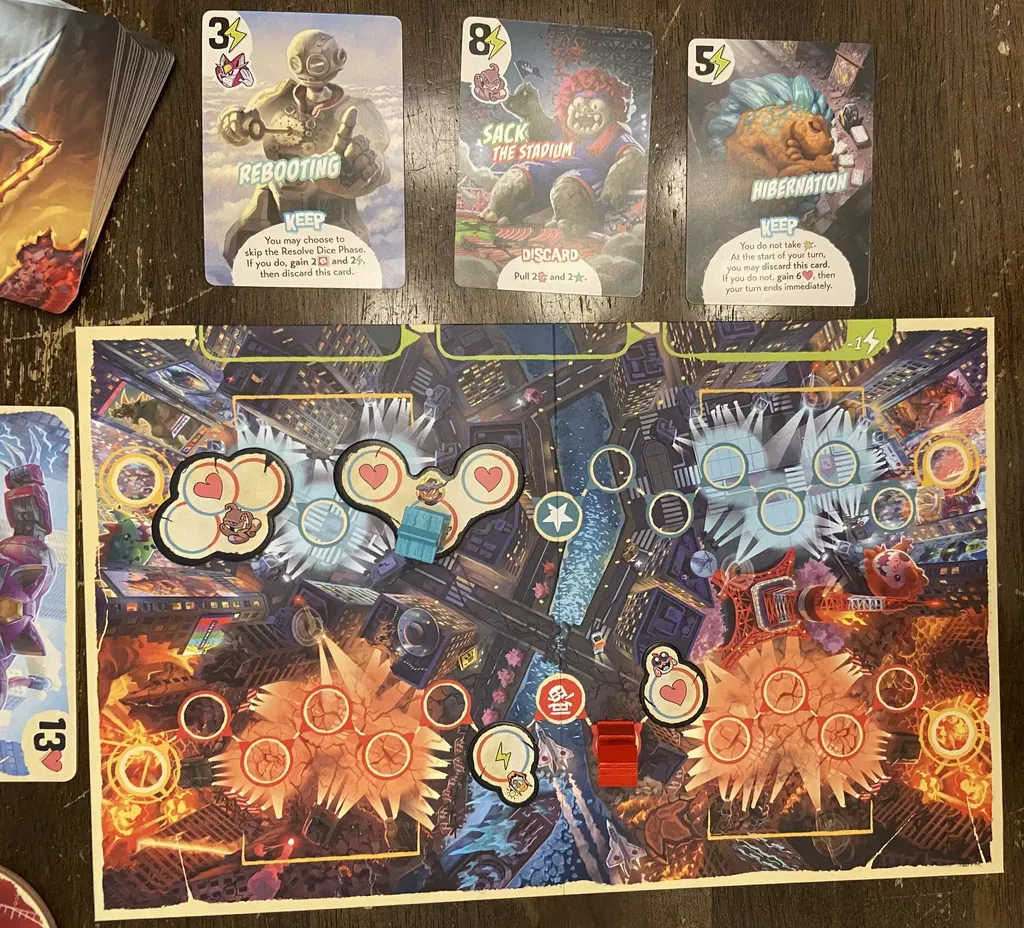
The King of Tokyo: Duel titles feature a similar dichotomy: You can win by damaging your opponent to death, or you can "pull" the fame or destruction tokens (or both!) close enough to you on their movement tracks that Tokyo residents acknowledge your superiority and your opponent slinks away in shame.
That said, Garfield tied these two goals together more in Duel than in King of Tokyo as many power cards allow you to place "buzz tokens" on the tracks, sometimes shortening them, sometimes lengthening them, and almost always adding symbols to them. When you advance a token on a track and land on a symbol, you get that bonus, which might be additional damage to the opponent or hearts to heal yourself. Thus, one action can advance you toward both victory conditions.
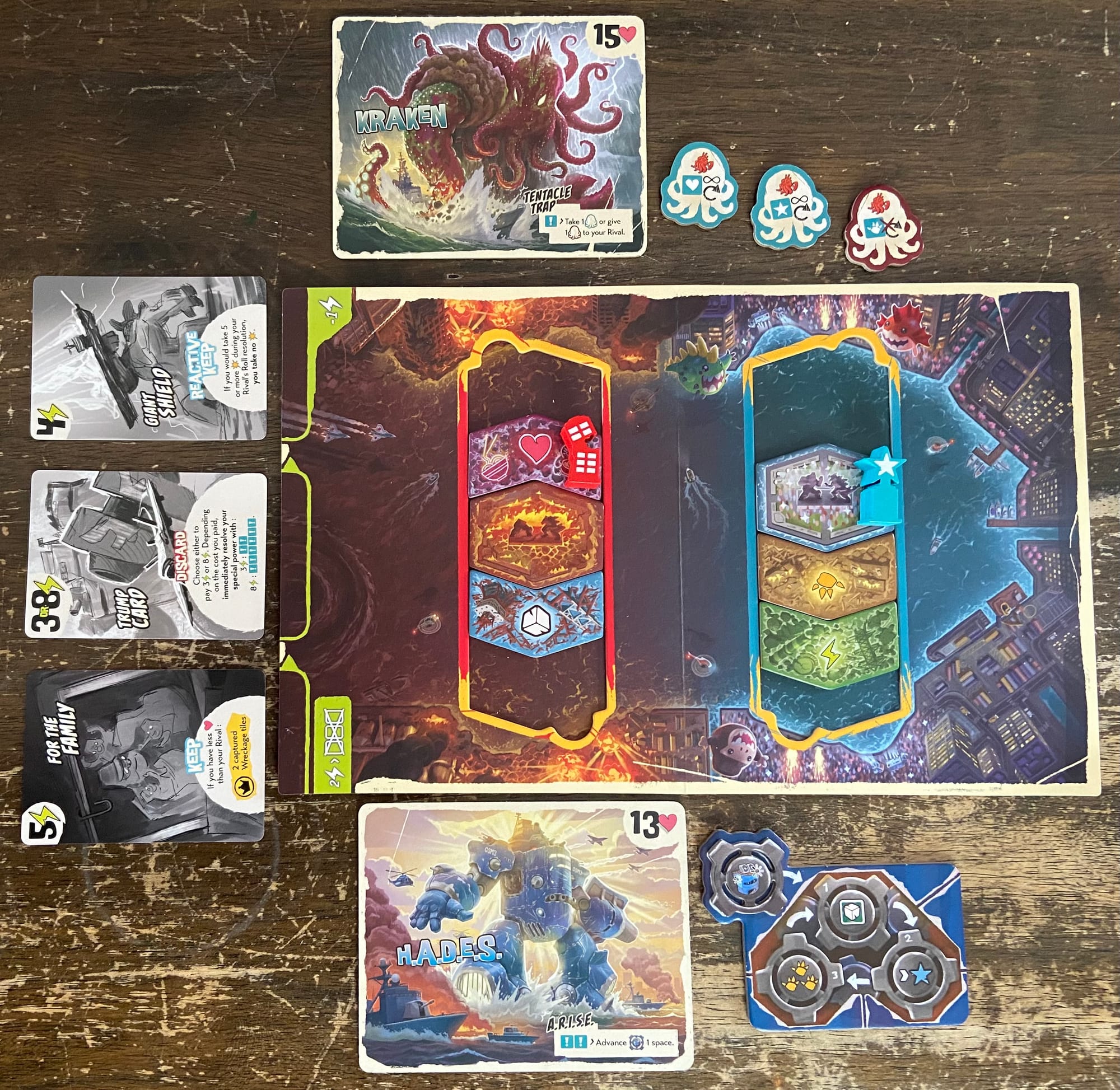
Tokyo Bay ups this entwining of actions even further. Instead of having fixed fame and destruction tracks that you modify with buzz tokens, the tracks start with a floating platform in Tokyo Bay, then each time you would pull a token toward you, if that token would land in the water, you draw a wreckage tile, add it to the track, then move the token onto that tile and get that effect.
Once a track has four tiles on it, that track is locked; if both tracks are locked and both tokens are at your end of the tracks — that is, in the yellow zone — you win, similar to Duel.
But having only one token at the end of a track is still good for you. If you would advance that token again, you instead draw a wreckage tile, get its effect, then place the tile in front of you. If you capture three wreckage tiles, you win the game.
On top of that third victory condition, Garfield has seeded additional victory conditions on power cards, one of which is visible above, with it giving you the win if you have less health than your opponent and two captured wreckage tiles. If you already hold one tile and purchase that card, your opponent needs to respond quickly with damage or token pulling, especially since a few power cards let you capture wreckage tiles regardless of where the fame and destruction tokens stand.
Other power card-based victory conditions include:
- Have 7 KEEP cards.
- Have 20 health, with this card allowing you to gain more health than your starting value.
- Have 18 energy cubes.
- Capture one wreckage tile — but with a massive bonus/drawback: You must roll seven dice on your turn instead of six, and if you ever have a four-of-a-kind in your final dice result, you take 10 damage immediately.
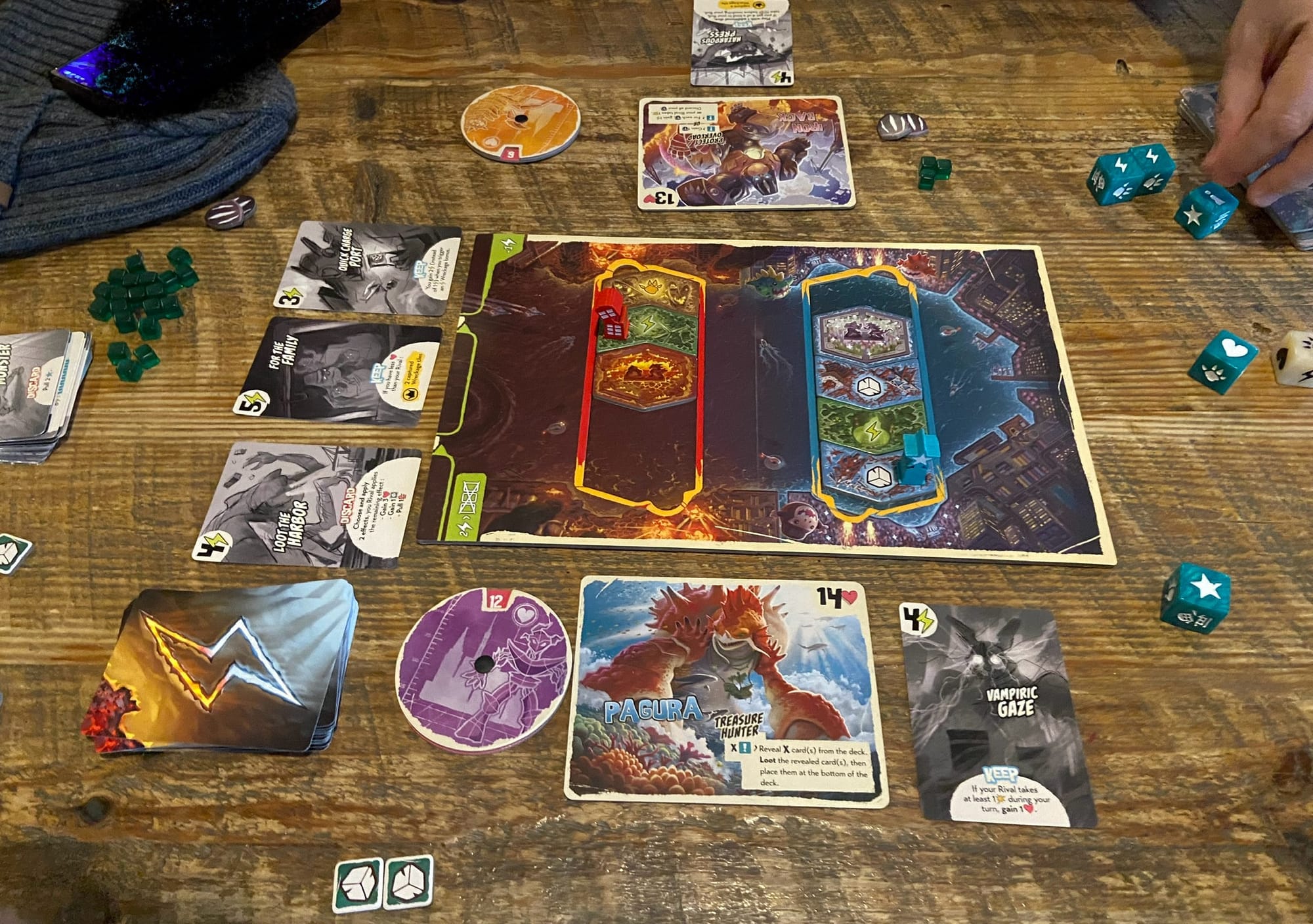
In the game above, my opponent had that final power card and was carefully trying to balance his die results. With that 10-damage blast hanging over your head, the extra die forces you to do a little of this and a little of that instead of going all-in on one result, which is a mixed blessing.
Why? Normally it takes three stars or three wrecked building icons on your dice to move the fame or destruction token, with each additional star or wrecked building moving that token an additional space, which is a "discount" after the initial "cost" — but now you can't take advantage of that discount unless you have a massive health cushion. (Eventually, my opponent blew himself up, with my Vampiric Gaze keeping my health at a decent level since he couldn't go all-in on claws either.)
Tokyo Bay includes six new monsters, each of which can be played in Duel against any of the original six monsters. (Tokyo Bay also includes four wreckage tiles for use by The King, whose original track-modifying tokens wouldn't work with this new game board.) Pagura, in the image above, lets you draw as many power cards as the number of exclamation marks you roll on a turn, then you get immediate effects from those cards based on the symbols on them. Maybe you'll whiff, and maybe you'll advance both the fame and destruction tokens two or three times.
Kraken, in the second image above, gives you three tokens to distribute to either you or your opponent, with a token affecting that player's next turn. Either you get to re-roll all stars/hearts/claws, or your opponent cannot re-roll stars/hearts/claws. (My non-final rulebook states, "On your next turn, you may always reroll this results. [sic]" Maybe you're supposed to wait until after your third roll to re-roll that symbol, but we decided that you may re-roll the die immediately without it counting as a re-roll.) You need to make a judgment call each time you'd use one of these tokens because the board situation and your potential path(s) to victory are fluid.
H.A.D.E.S., on the other hand, is as straightforward as can be: Get two ! on the dice, and the token advances one space on your special game board, giving you the listed bonus: an extra die token, a pull on the fame track, three damage to the opponent, an extra die token, a pull on the fame track, etc. It's a mixed bag of effects that just keeps rotating.
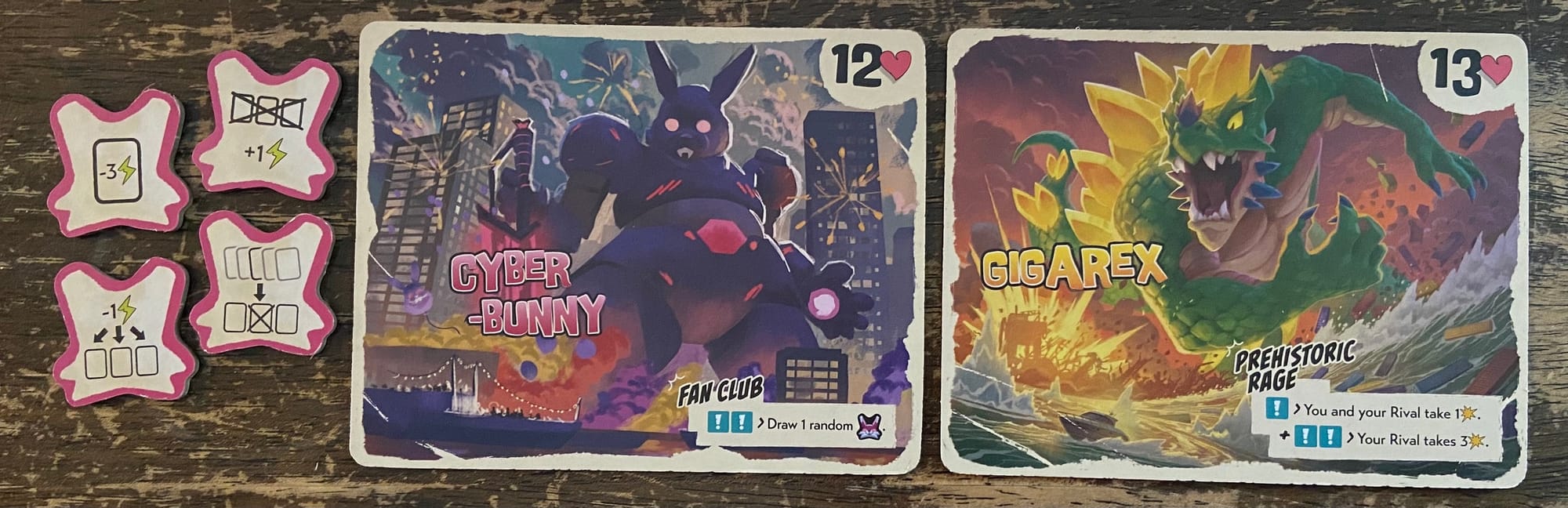
I've played three games with Cyberbunny and have yet to make it work. (Admittedly one game was only three turns as my opponent rolled six stars to place four wreckage tokens on that track, then two turns later rolled five stars to claim three wreckage tokens and victory. BOOM!) With Cyberbunny, you're manipulating the cost of power cards as well as which cards are on the market, but I never felt like I had a good handle on what I was trying to do, so the effects felt random. I blame the monster's operator for that failure. More experience needed...
In total, I've played Tokyo Bay five times on a non-final review copy from publisher IELLO, and I don't yet know whether I have a preference for original Duel or Tokyo Bay. At arm's length, the details of this game board or that one blur, so the games are effectively offering the same experience: Keep your monster's ability in mind as you evaluate the board over which dice to keep and which to re-roll.
As in the original Duel, you're going to be surprised in Tokyo Bay by the power cards that pop up, whether they offer new victory conditions or "just" an overpowered effect. In one game, for example, my opponent spent 8 energy for "Empty the Bay", which allows you to gain the bonus effects on all wreckage tiles not yet placed on the board. We had placed only one or two tiles, so he got 12-13 bonuses: SMASH, four damage; KAPOW, two extra dice tokens, ZZZAP, three energy. Needless to say, when that card showed up in a later game, one of us spent two energy to clear the board and turn up new cards so that the other player couldn't get it.
(The card isn't broken. We just didn't realize how powerful it was until we carried out its effect the first time. You need play experience to get a handle on such extremes, then account for them in your choices in future playings.)
One new feature in Tokyo Bay I've yet to use is the "lost dice" mode. Each player starts with six tokens in front of them, each showing one of the die faces. Whenever you have a pair of dice you can't use, e.g., one star and one exclamation mark when you're Cyberbunny, you can choose one token now and add it to your die results next turn. Each token is single use, and they can whiff just like the dice depending on what you roll; after all, one star on a token is the same as one star on a die. This system offers a helping hand to someone who's bombing out on their rolls, but if you are bothered by extremes of luck in a Yahtzee-style game, you should be playing something else.
Want more game previews like this one?
Get Board Game Beat’s free posts by email — original reporting, designer interviews, and industry news, with no tracking and no spam.