

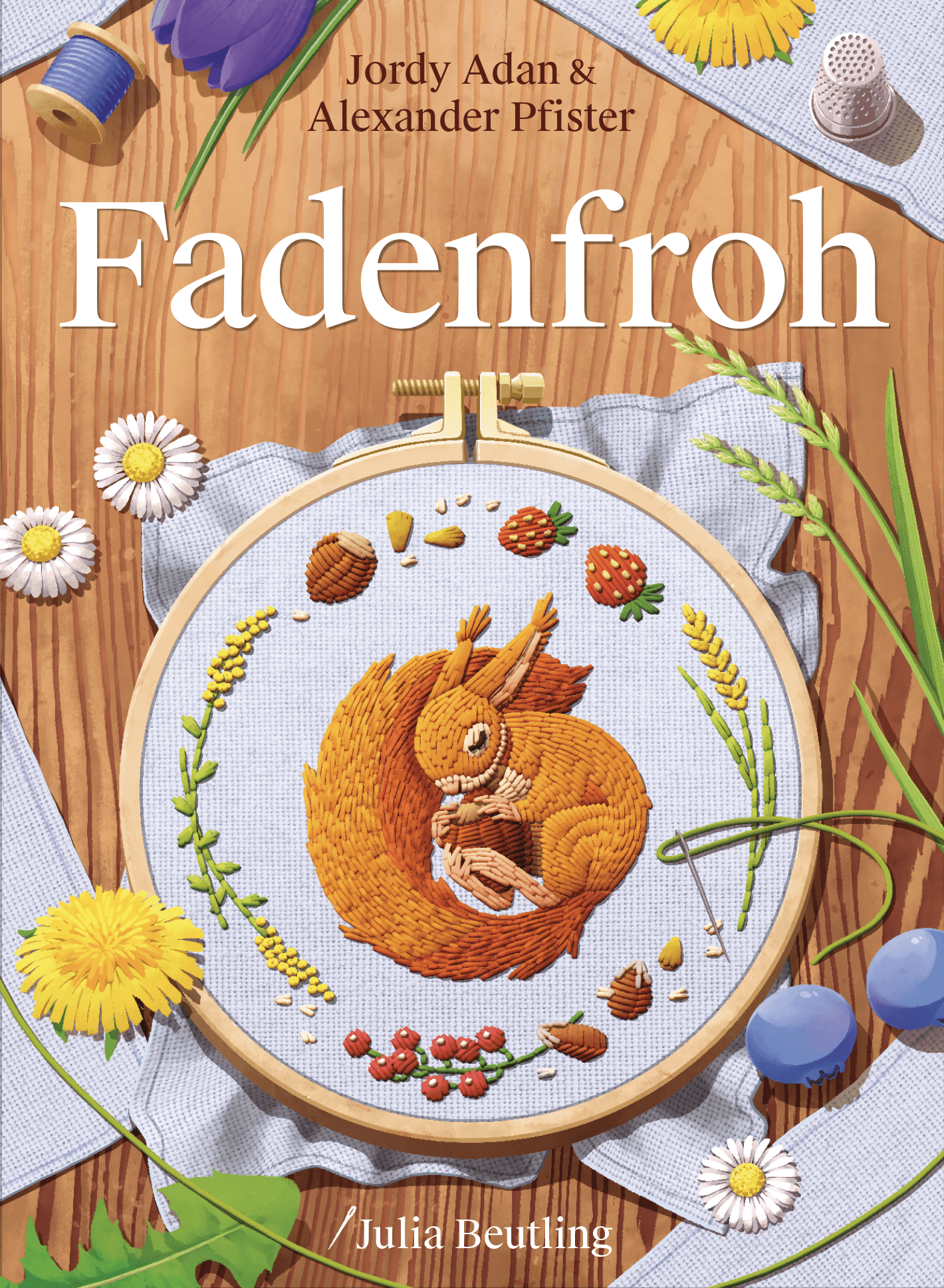
While researching games that will be featured at SPIEL Essen 26, I was amused by the similarity between the two covers above. Side by side, they're less similar than they were at first glance, but the brown background/golden ring connection stood out at first glance. As for the games themselves...
Fadenfroh
The word "Fadenfroh" means something along the lines of "thread-filled" or "joyous threading", and in this game from Jordy Adan, Alexander Pfister, and 1 More Time Games, 1-4 players will be "stitching" cards together to create valuable tapestries. Cards are divided into halves, with each half featuring one of three colors and 0-2 symbols, with symbols being either fruit, animals, or flowers. Each player starts with three rows of cards, each seeded with a card entirely yellow, white, or purple.
At the start of each round, you lay out as many "offers" as the number of players, with an offer consisting of 1-3 cards; threads, needles, and a thimble — collectively known as "material" — are also placed on the table. Starting with whoever had the thimble at the end of the previous round, players take turns drafting either one item from the material or one offer, but once you take an offer, you sit out the remainder of the draft.
If you have three or more thread tokens, hand in three, then draw three cards and keep one. Repeat as needed, then take all of your cards and "stitch" them by adding each card to a row of your choice, covering at least one-half of a card already present — unless you spend a needle, which allows you to connect a card to the left or right end of a row without covering anything.
At the end of rounds 2-5, you score points based on how well you meet two scoring cards, and the scoring card pairs rotate through the rounds: A&B, B&C, C&D, and D&A with your choice of B or C. Thus, you're all competing to score the same cards, yet you could focus entirely on B and D and ignore everything else. (Four scoring cards exist in four categories — berries, animals, flowers, and card color — and you use one card at random from each category.)
I played Fadenfroh once digitally in a mock-up version, and the draft format for this take-and-make game is more attractive for my tastes. You're not just taking one thing from a pool and stepping out, but playing chicken and trying to take more than your fair share, while also getting cards that will work well with what's in front of you without giving away too much to whoever outlasts everyone else.
Blattwerk
Like Fadenfroh, Blattwerk ("Foliage") is a 1-4 player game, and in this design from Christian Heuser, Tim Hüwe, and ABACUSSPIELE you will be exploring the leaves of the forest in excruciating detail one by one. Gamers are obsessive that way.
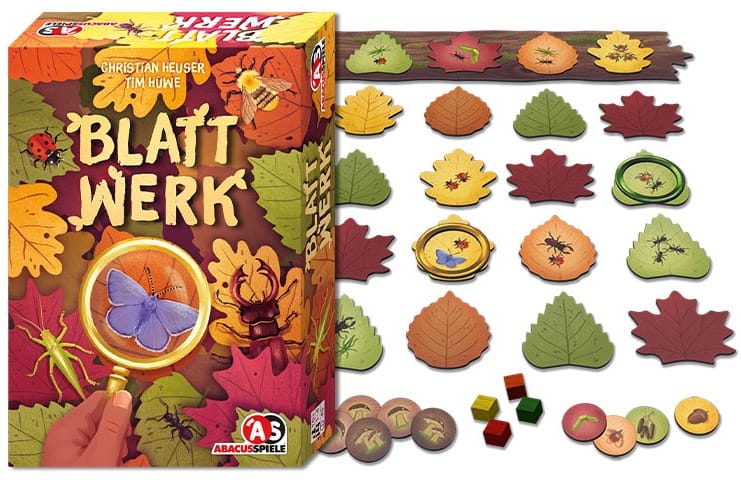
Each player takes a set of leaves in a single color, along with the matching fruit token, then you place two at random face up — that is, showing the insects and fruit — on the tree trunk to form the "undergrowth". All other leaves are then shuffled together face down and laid out in a grid. On a turn, you:
- Turn one of your face-down leaves face up, then either score 1-3 mushrooms based on the more prevalent insect or place one of your seven "magnifier rings" on it.
- Swap one of your face-down leaves with a leaf in the undergrowth, then turn your leaf face up.
- Swap another player's face-down leaf that's orthogonally adjacent to one of your face-up leaves with a leaf in the undergrowth, then turn the swapped leaf face up.
Thus, each turn one more leaf will be turned face up, and when all leaves have been revealed, you score what you've magnified, in addition to scoring 1 point for each mushroom. To score a magnifier leaf, look at the insects on it; each insect of the same type on orthogonally adjacent leaves is worth 1 point, so the green magnified leaf in the image above is scoring 3 points for the ants on the leaf below it. If your fruit is adjacent to a magnifier leaf, it's worth 2 points, and if you're also magnifying fruit, then adjacent fruit doubles to 4 points.
Magnifier leaves don't score adjacent magnifiers, so the game is all about discovering and creating scoring opportunities, while trying to thwart others.
Bärenstich
ABACUSSPIELE will have a few other new games at SPIEL Essen 26, including Wolfgang Kramer's Bärenstich ("Bear Sting"), a climbing card game for 3-8 players that is his latest take on Das GROSSE und das kleine A, his 1996 card game later released in a revised form as Who's the Ass?
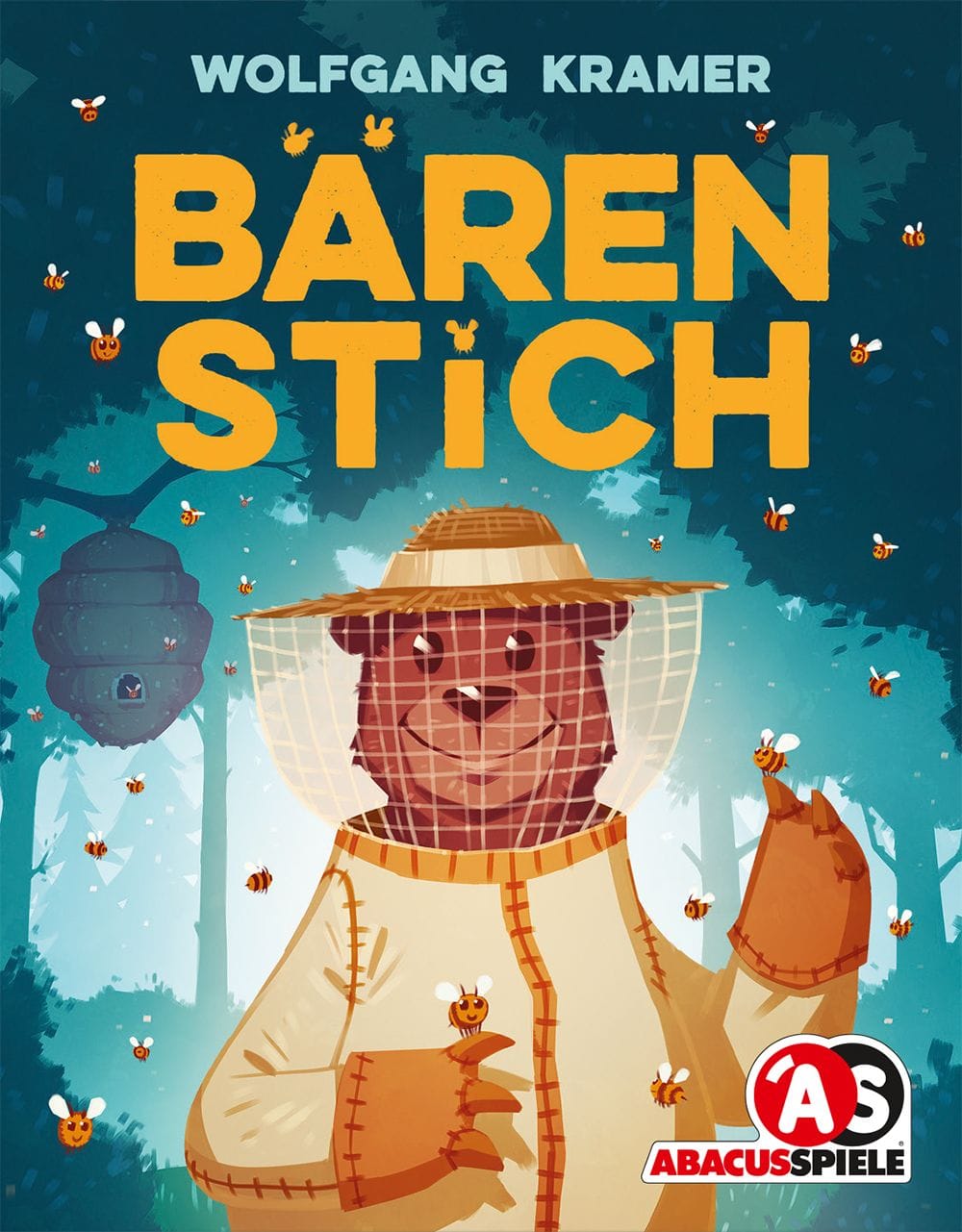
The deck consists of cards numbered 2-14, along with five jokers and one beehive, and each player starts with a hand of thirteen cards, with someone getting the beehive and leading the first trick.
When you lead, play one or more cards of the same value (with jokers on their own equaling 15), then each player in turn has the chance to play the same number of cards of a higher value. All played cards are discarded, then whoever played last leads the next trick.
When you hold the beehive, you can lead that card, after which each other player simultaneously reveals one card from their hand. Whoever reveals the highest card places the beehive in front of them, then adds one of the played cards to their hands and leads the next trick. (After this trick, they add the beehive to their hand, i.e., they can't play it immediately.)
When a player runs out of cards, the round ends, and everyone scores points equal to the sum of the cards remaining in their hand, with the beehive worth 20 points. After four rounds, whoever has the lowest score wins.
Other Games
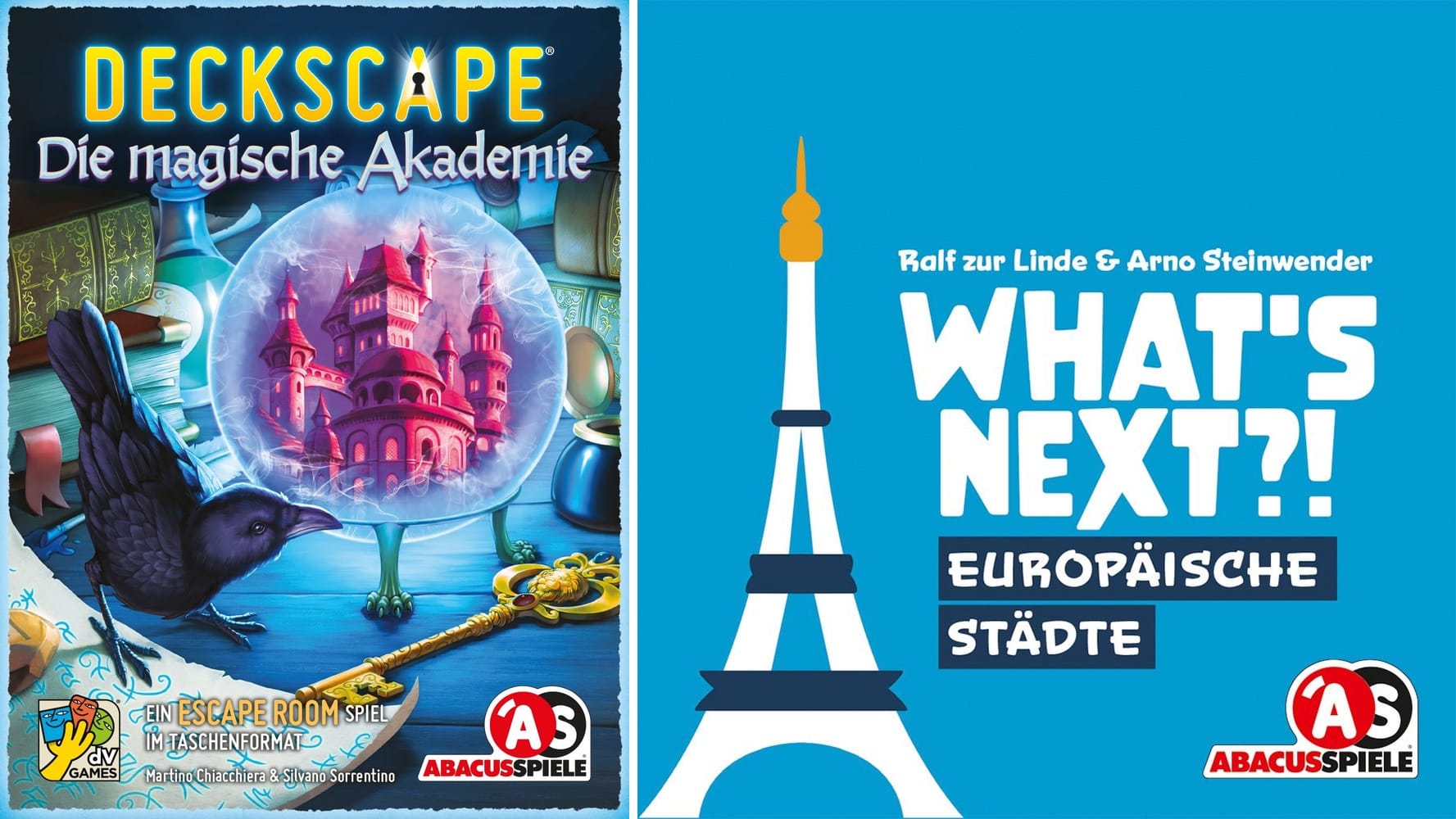
At SPIEL Essen 26, ABACUSSPIELE will also have Deckscape: Die magische Akademie ("The Academy of Magic"), the German edition of the latest Deckscape title from Martino Chiacchiera, Silvano Sorrentino, and DV Games, and What's Next?! Europäische Städte, a party/trivia game from Arno Steinwender and Ralf zur Linde in which you try to identify which of five European cities is closest to a sixth city. The closest chosen city is removed from play and replaced by the sixth city, after which a new city is revealed, taking you mentally across the European continent.
Want more SPIEL Essen 26 previews like this one?
Get Board Game Beat’s free posts by email — original reporting, designer interviews, and industry news, with no tracking, no ads, and no spam.


