

Berlin Brettspiel Con takes place July 10-12, 2026, and many publishers use this annual event to preview games they plan to release at SPIEL Essen. One company doing so in 2026 is Korea Boardgames, which will feature titles it first showed at Spielwarenmesse 2026 and at Game Market Spring 2026, as well as two upcoming releases detailed below.
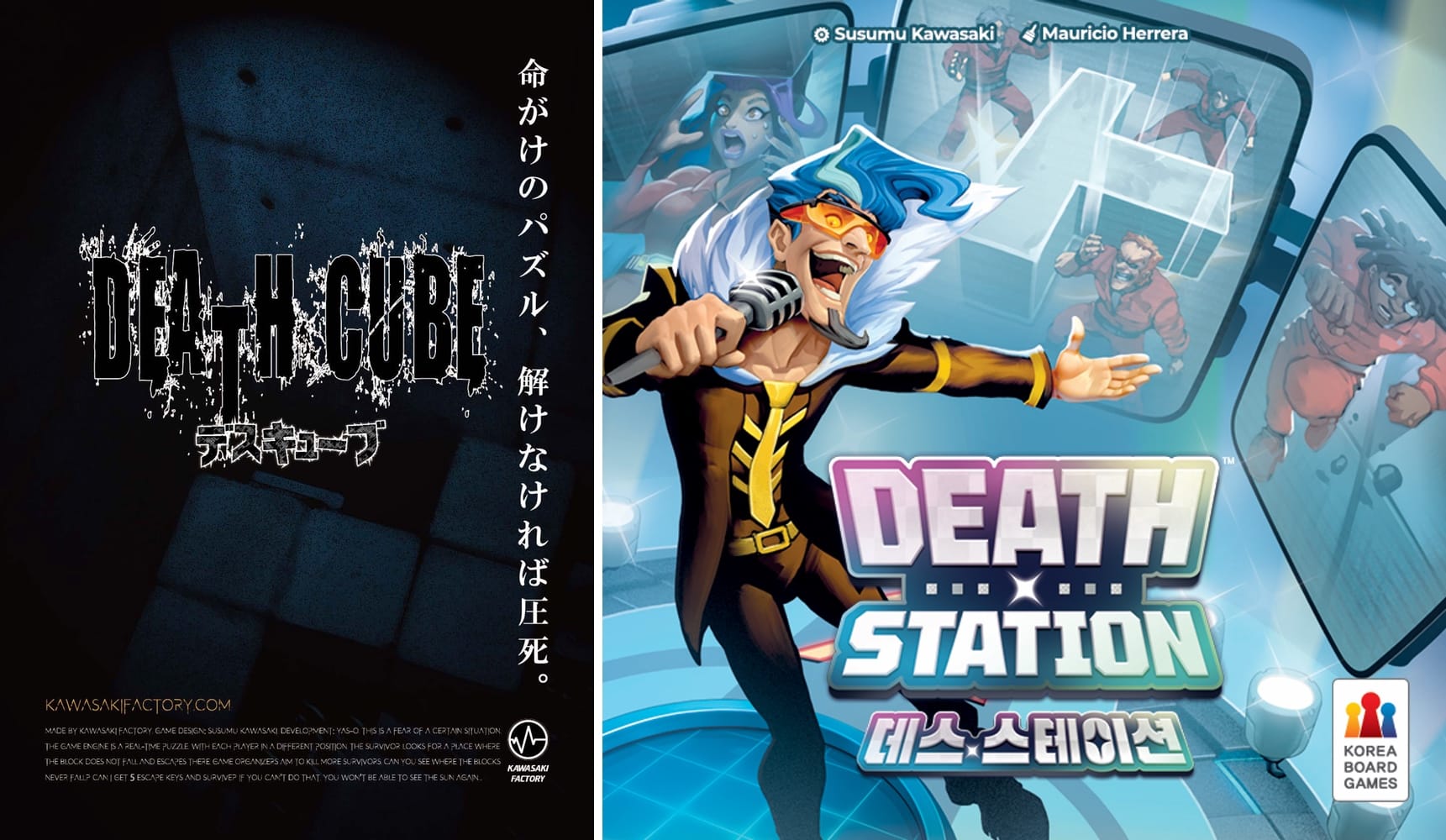
In 2021, I wrote about Susumu Kawasaki's game Death Cube, which he released through his own Kawasaki Factory, and now Korea Boardgames has licensed and tweaked the design for release in 2026 as Death Station. Fun!
In this 2-5 player game, one person is the TV presenter who hopes to catch other players in traps, while those participants want to escape five times. Each round, the TV presenter sets up the 4x5 "death pad" with five numbered spaces that are off limits to all players and with the participants seeing where those spaces are located. Next, the TV presenter discovers which two pentominoes they must fit within the remaining 15 spaces of the death pad, and they have 24 seconds to do so.
While they're trying to puzzle that out, the participants have the same 24 seconds to each take one or two numbered tiles where they think they will be safe from the pentominoes. (Alternatively, someone can grab the lone "safe" token.) When time is up, the TV presenter reveals the pentomino-laden death pad. If a participant chose one or two numbers that are still visible, they receive one or three escape cards, each with a value from 1-5. If they chose "safe", they get nothing. If they chose poorly, they lose one of their lives. If they lose three times, they're out of the game, and any escape cards they hold go to the TV presenter.
If all participants are eliminated, the TV presenter wins, but if a participant holds 5+ escape cards, all other participants play one more round, then whichever side holds the most value in escape cards wins. (Special rules apply in a two- and three-player games to even the odds.)
This version includes character abilities that participants can use, as well as event cards that trigger when any participant claims their third escape card.
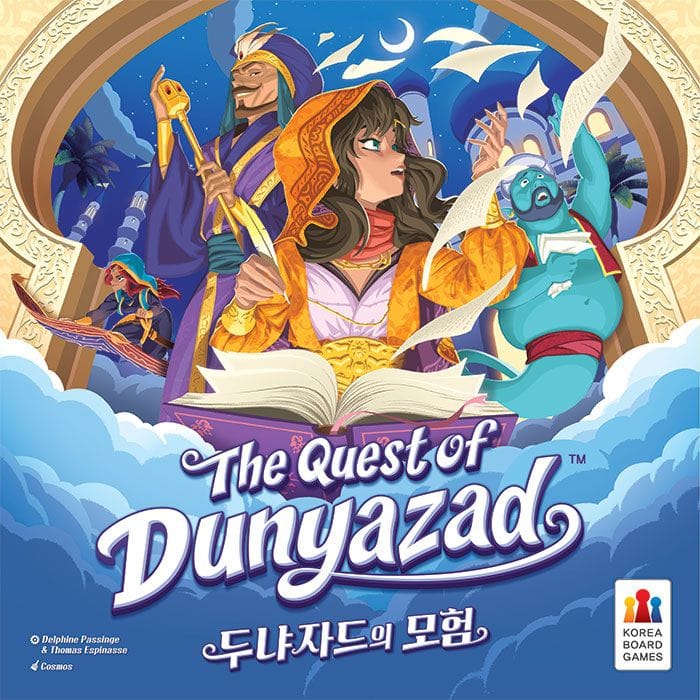
Did you know that Dunyazad was the younger sister of Shahrazad from One Thousand and One Nights? I did not, but Shahrazad has a better press agent, I suppose, getting her included on Magic cards and whatnot.
The co-operative game The Quest for Dunyazad from Thomas Espinasse and Delphine Passinge puts 3-6 players in the role of assisting Shahrazad to ensure she has enough story material to keep King Shahryar from having her beheaded in the morning.
In game terms, each day you reveal five story cards and place them in a row. Five stacks of tiles stand on the table, with the story cards replicated on these tiles, along with guards, djinn, and snakes that put you in a state of hypnosis. You have 90 seconds to complete the story by finding the right tiles to match the revealed cards.
If you hold the Dunyazad token, look at the top tile of a stack, say what type of story or djinn it is (if it is one), then place it on a story card or the top or bottom of the same tile stack and pass the Dunyazad token to your neighbor. You can cover story cards only left to right, so if you skip a story card, you can cover it only with a djinn tile. Guards make you pass the Dunyazad token as many times as the number of guards, and hypnosis cards freeze you until someone grabs the Dunyazad token to become the active player.
Complete the story in time, and the king is satisfied by your competency. Remove the story cards and tiles used, then reveal new story cards. If you fail, the king gets upset. Complete four stories before the king blows his top a third time, and you get to keep your head connected to your body.

In addition to its line-up of family and strategy games, Korea Boardgames releases educational games as well, with three new titles designed by Korean school teachers appearing in the first half of 2026.
응결게임 ("Condensation Game") is a 2-4 player game from Wonjun Choi that explores humidity and saturation, with players trying to avoid creating condensation. Players start with tokens near the lower-right corner of a game board that features an X-axis of temperature and a Y-axis of water content.
Each turn, play as many cards from your hand as the number of water tokens you hold, with cards allowing you to make opponents colder or add to their water content, that is, moving them left or up on the game board. You can also recover your own position, making you warmer or drier. Event cards affect all players, and "hidden" cards allow you to deflect attacks or turn them back on their player.
If your token lands on a water droplet at the condensation line, you gain another water token, then return to a starting position. Get a fourth water token, and you lose, with the driest player winning.
I know some folks like collecting odd starting player rules, so here's a new one for you: "The player who most recently opened a fridge is the starting player."

15도씨 ("15º Celsius") is also from Wonjun Choi, with this being a co-operative game for 2-4 players in which you want to have the Earth exactly at 15ºC (59ºF) at game's end — not too warm, not too cold.
To set up, place heat cubes on a game board covering spaces 8-30, with seven other heat cubes on the cards "Water Vapor", "Carbon Dioxide", and "Methane", which start on Earth. In effect, these substances are on the planet, locking in heat and starting us off at an average temperature of 7ºC.
On a turn, play one or two cards from hand, with cards removing heat from Earth or adding heat to it, often thanks to event cards that must be played as soon as they're drawn, with variable effects depending on the current temperature.
When all cards have been played, you win only if the temperature is exactly 15ºC, with an immediate loss during play should the temperature ever hit 30ºC (86ºF).
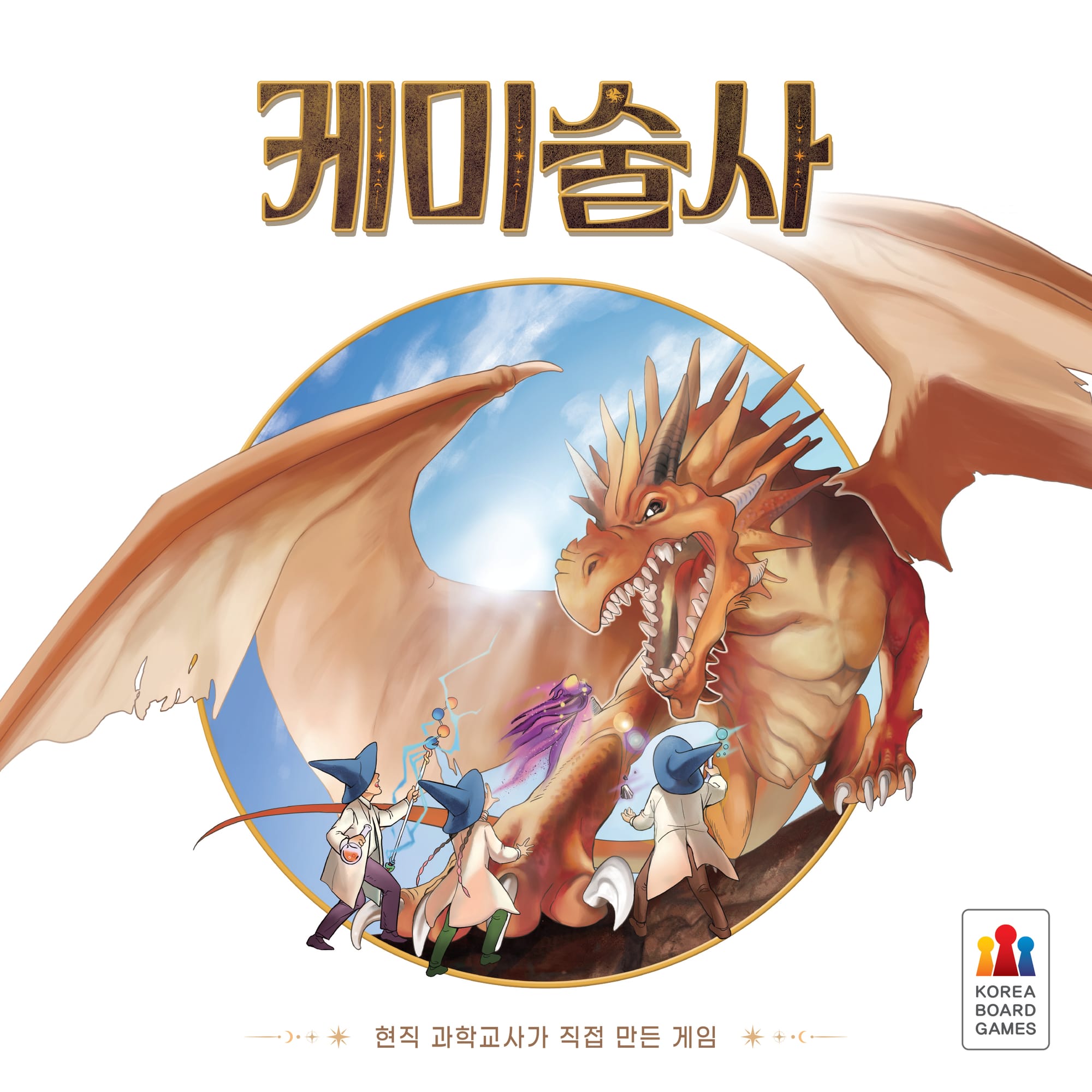
케미술사 ("Chemomancer") is a co-operative co-design by Kyuseon Han and Wonjun Choi in which players use chemistry to defeat dragons. Very educational! I mock, but the core idea of the game is using chemical reactions to cast spells, so players will gain an understanding of how hydrogen, carbon, nitrogen, and oxygen interact.
Each turn, the active player draws cubes from a bag one by one, stopping whenever they desire, then throwing away the final cube they drew to represent them removing impurities during their work. If they draw a dragon cube, however, they discard all of the cubes drawn that turn, then the next player goes.
If the dragon doesn't show up in cube form, the active player can then apply chemical elements to the two spell cards in play. If you fill all the reagents on a spell, you must answer a question about that spell — that is, the chemical equation taking place — and if you answer correctly, you gain the effect of that spell, which might be damage on the dragon, reclaimed cubes from the current spell, cubes being added to the draw bag from the discard pile to the bag, and so on. Bring the dragon from 20 health to 0 before the bag runs out of cubes, and you win.
Like this kind of board game coverage?
Get Board Game Beat’s free posts by email — original reporting, designer interviews, and industry news, with no tracking, no ads, and no spam.


