

German publisher AMIGO will have a larger-than-normal number of game releases in October 2026, most of them in the familiar small and small-ish boxes the company has used for years. Let's run through the list:
Strange Creatures
Designer Matthias Cramer describes the 3-5 player Strange Creatures as "a deck-building trick-taker" in which you either take the trick or receive a coin with which you can improve your deck by buying cards from a market filled with creatures that allow for fantastic combos.
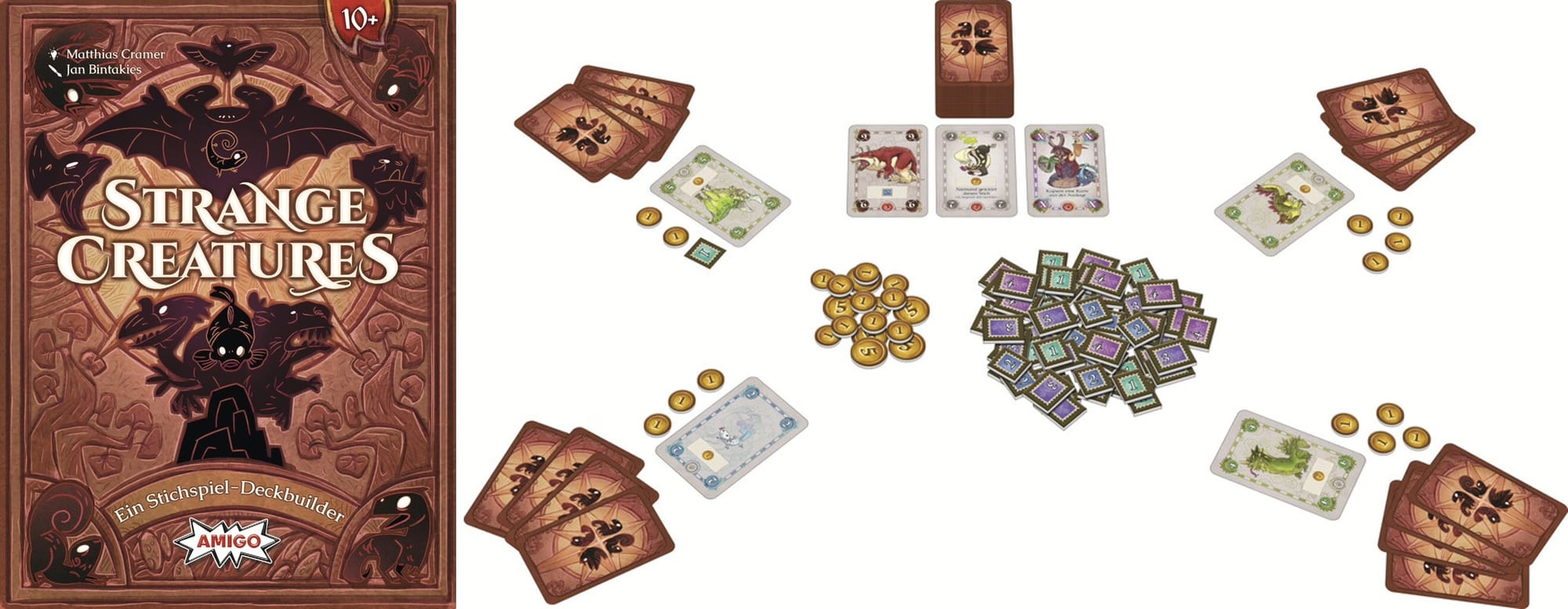
Here is AMIGO's short description of this 30-minute game:
Welcome to Lumora, a mysterious island found on no map. Driven by curiosity and courage, players embark on an expedition. Along the way, they encounter strange creatures — some beautiful, others a bit eerie. Players will uncover the creatures' secrets, compare their unique traits, and immortalize rare finds on coveted postage stamps.
Panika
In a May 2026 Facebook post, designer Haim Shafir says, "Since Taki, I have created over a hundred games, some of which are international bestsellers, but I have never said about any of them what I dare to say about Panika: 'Panika is our best game since Taki.' Because apart from the amazing responses we've received from those who have already played it, the global market is also speaking out, and by the end of the year it will be on shelves in many countries."
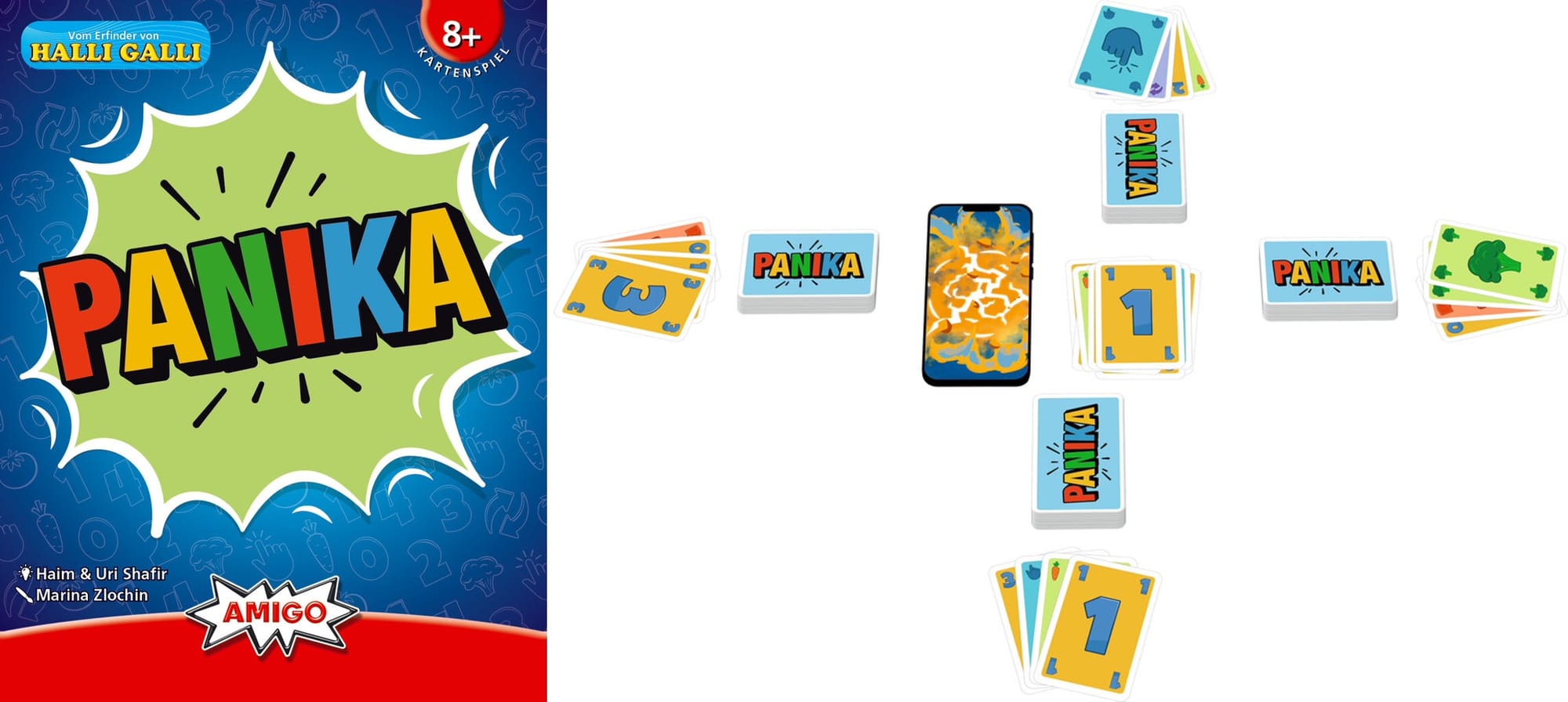
Germany is one of those countries thanks to AMIGO, which has been publishing Shafir's design since at least 1993, and this co-design by Haim and Uri Shafir for 2-5 players features all the hallmarks you would expect: quick play, simple rules, and strong graphics.
Your goal is to ditch all of your cards first without being blown up too many times. To start, the deck is split amongst players, with each player holding four cards in hand; a phone bearing the Panika app needs to be on the table.
On a turn, play a card, tapping the screen 0-4 times if you play a number card; 5 times if you play a single vegetable; and 0 times(!) if you play a pair of matching veggies. When the phone is tapped 21-30 times — a number determined randomly by the app — BOOM! Everyone else at the table gives that player one card from their deck. The count then resets.
Special cards reverse play, allow you to force someone else to play two cards, or make everyone else tap the phone once, after which you play again.
unglaublich einfach
A 2-6 player design by Klaus Altenburger is called unglaublich einfach, which means "incredibly simple", and the gameplay must reflect this as the description from AMIGO is rather vague in details:
Small, green, and suddenly everywhere: peas. The goal is to collect high-value cards to secure the most points. Players need only keep an eye on their own display, however, as space is limited. An incredibly simple card game that is hard to put down.
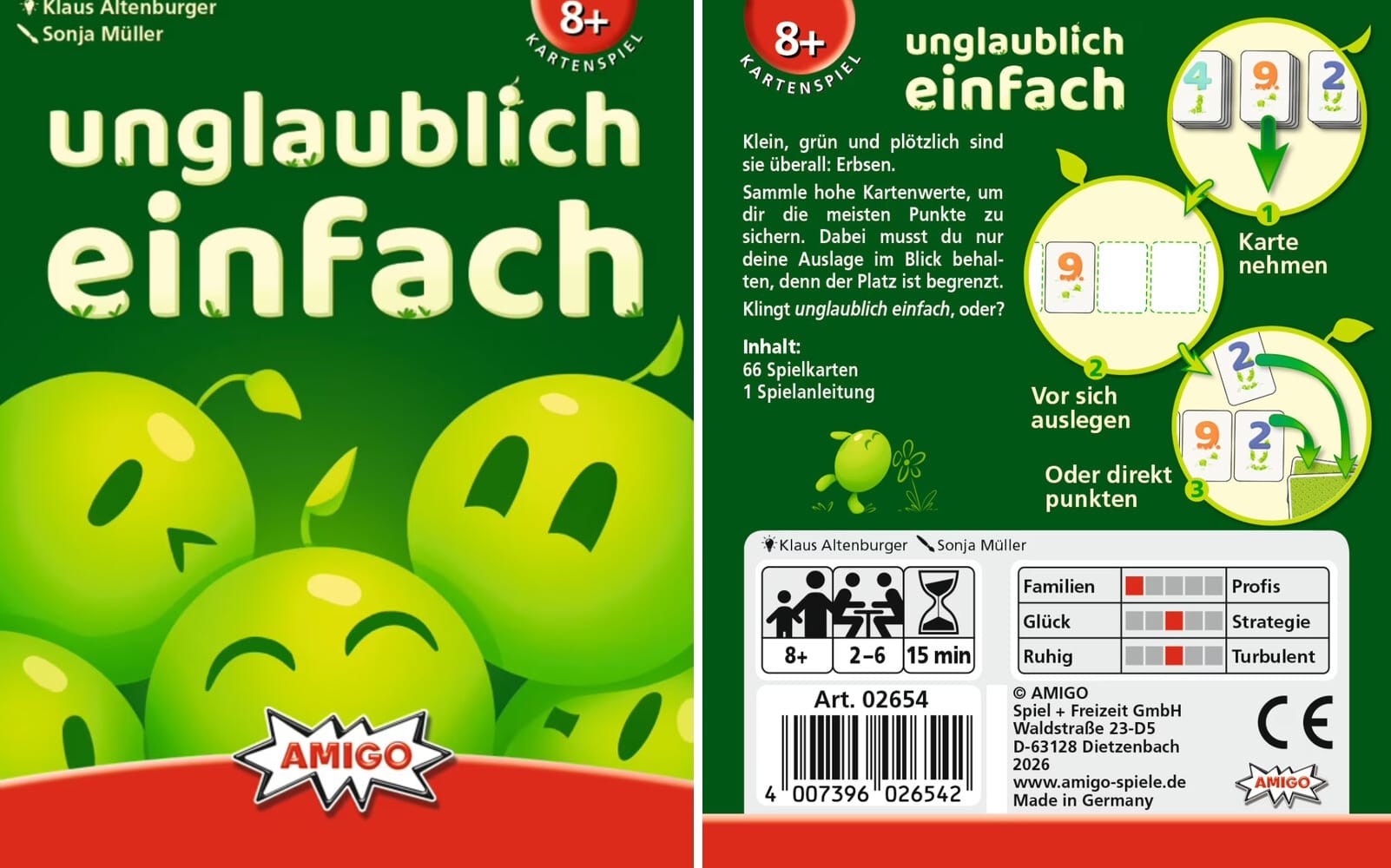
The 1-2-3 gameplay description on the back of the box says, "Take a card", "Lay it in front of you", and "Or score directly". Cryptic!
Fantastique
This 2-5 player card game by UK designers Brett J. Gilbert and Trevor Benjamin debuted in June 2026 at select retailers and will be available through all retailers in October 2026.
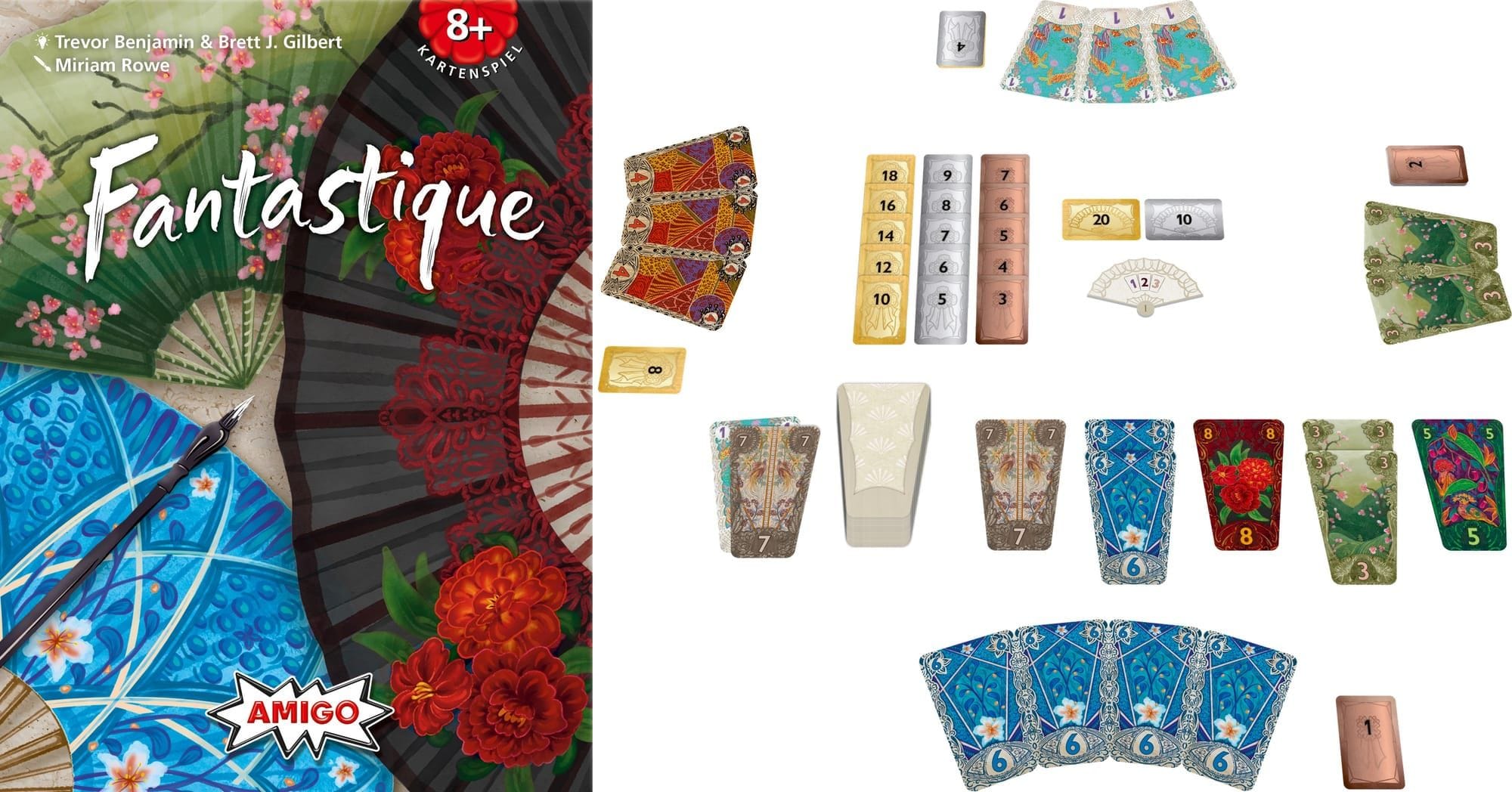
I previewed the card-drafting game Fantastique in April 2026, then posted Miriam Rowe’s Fantastique artist diary in June 2026 as I loved her work on this game, not to mention the stories and travel that went into the creation of each design. Very inspiring!
Molly Mampfzahn
The Frederica Scott Vollrath design Molly Mampfzahn resembles a coin pusher arcade game, you know, the kind where you drop a coin in front of a vertical sweeping bar that then pushes your coin into a crowded field, ideally dropping many other coins into your hand so that you can turn a profit but rarely doing so.
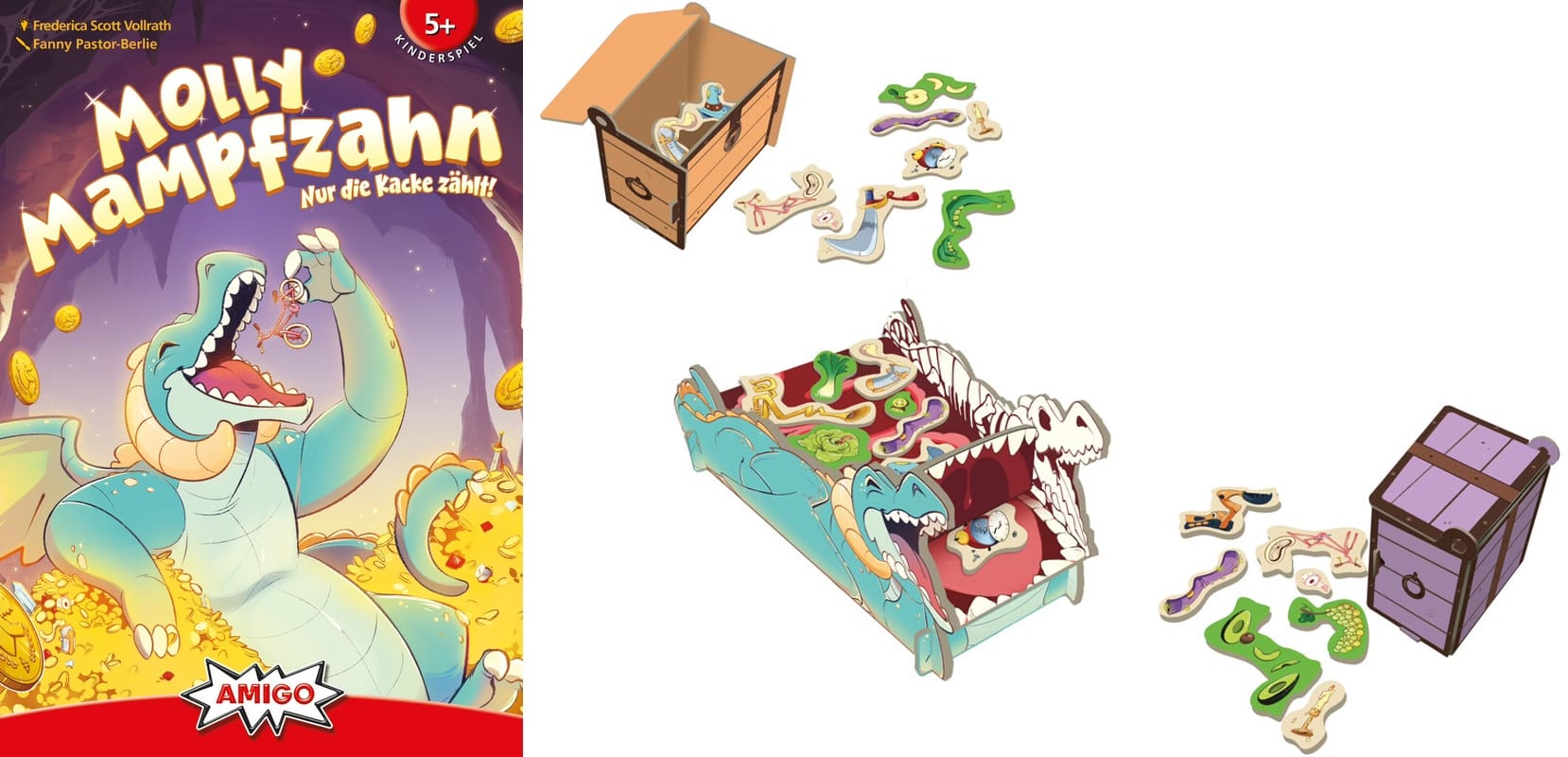
Molly Mampfzahn works the same way as a coin pusher, except that the horizontal surface represents the dragon's digestive tract, and 2-4 players are pushing items into the dragon's mouth in the hope that treasure will fall out of its backside. Magic swords, hats, clocks, bicycles — everything that tumbles out of that dragon's ass is worth gold coins to you. Well, everything other than fruits and veggies, which get charred in the process and turn into lumps of hot coal that will melt your cloacal coins.
Baddass Bunnies, Restart, and BLUFFIT
AMIGO is releasing German-language editions of these three games originally released by other publishers. "We were able to secure Badass Bunnies, BLUFFIT and Restart", editor Bernd Keller told me. "All three of those were already released in other parts of the world, so we felt it would be good to release them ASAP. That is why they ended up in the roster for Essen."
Sjoerd Yska's Badass Bunnies debuted in 2025 from Dutch publisher 999 Games, and it's a press-your-luck, deck-building game for 2-4 players that I've played a dozen times on a review copy and greatly enjoyed, as explained in this November 2025 review. Gameplay is akin to The Quacks of Quedlinburg in that you're trying to gain as many resources as you can each turn without busting so that you can buy new stuff and be the first player to reveal ten rabbits from your deck in a single turn.
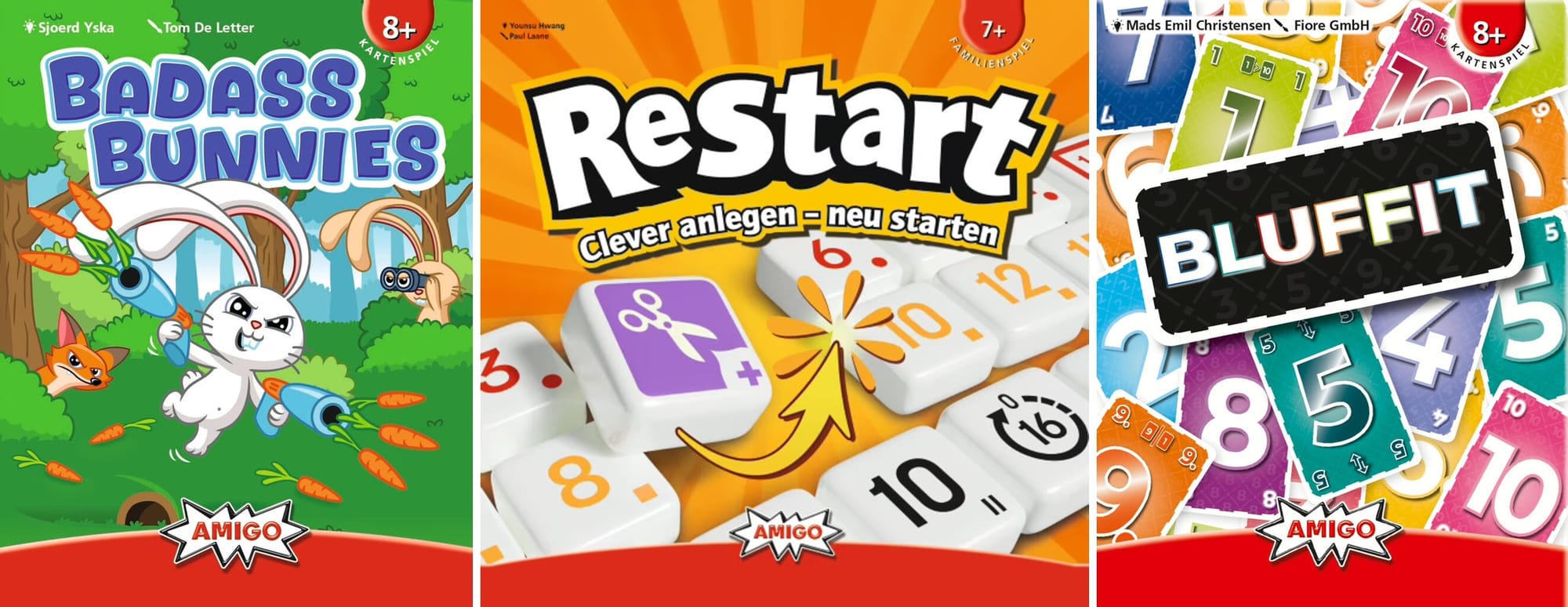
Restart is from designer Younsu Hwang, and the design first appeared in print in 2014 as Sixteen from Korean publisher Magic Bean Games. The game contains tiles from 1-16 in five colors, along with a few special tiles, and all the 1s start in play. On a turn, play one tile or a consecutive run of tiles of the same color on that color's row as long as your lowest played tile is higher than the highest tile in that row. In short, the numbers go up. You're trying to ditch as many tiles as possible as leftover tiles count against you when the game ends due to no one being able to play.
At SPIEL Essen 25, Danish publisher Gameplay Publishing gave away one thousand copies of Mads Emil Christensen's card game BLUFFIT, presumably trying to copy the marketing that The Op Games used for Flip 7 at Gen Con 2024: Put it in people's hands, and let them spread the word. Seeing as AMIGO is releasing the game in German in 2026 — while IELLO is releasing it in French and Gémklub in Hungarian — the strategy seems to have worked.
Gameplay in BLUFFIT is somewhat akin to Alex Randolph's Hol's der Geier in that players start with cards numbered 1-10, and each round they'll secretly bid with one of those cards to try to claim a numbered scoring card. Here's how:
All players simultaneously play a card from their hand face down. Then, in turn order, players either claim one of the available scoring cards or challenge another player who has already claimed one. In a challenge, both players secretly compare strength cards, with the higher card winning the scoring card. (In a tie, the challenging player wins.)
Once all players have acted, remove any unclaimed scoring cards from the table. Claimed scoring cards are placed in each player's score pile. The played strength cards are then shuffled and revealed to form the new set of scoring cards for the next round. After ten rounds, players complete one final round using the cards last played by selecting a card from their score pile. Those played cards are removed from the game, claimed cards are added to score piles, and the player with the highest sum wins.


