

In something of a tradition, I post about new titles from German publisher Clemens Gerhards, a.k.a. Gerhards Spiel und Design, just a couple of days prior to the opening of the annual SPIEL game fair in Essen, Germany. SPIEL Essen 26 opens on 22 October 2026, so it's time I did my thing.
Rivolto
The headliner for 2026 is probably Rivolto, a new two-player design by Alessandro Rizzi that plays in 10-15 minutes.
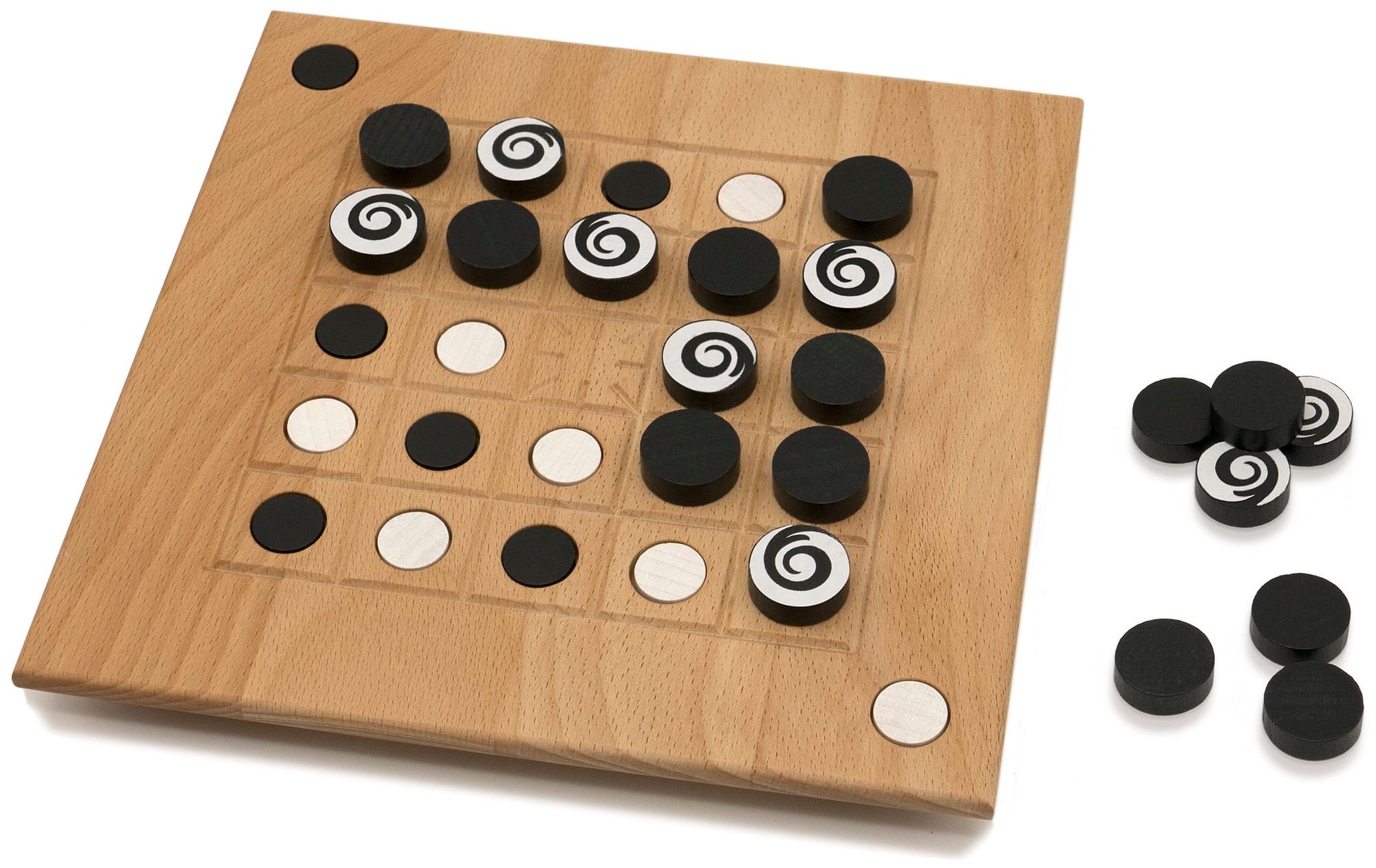
To set up, fill the 24 holes on the 5x5 game board with black and white discs at random. Players then take turns placing a larger disc on the board that's black on one side and white — well, swirly white and black — on the other. The player can place either side face up, and:
- If the color placed matches the color covered, then all other large discs in the same horizontal and vertical columns are flipped over.
- If the color placed is not the color covered, then all other large discs in the diagonals passing through the just placed disc are flipped over.
Thus, the colors of the placed discs changed repeatedly throughout the game. Whoever has more of their color showing after all 24 discs have been placed wins, with a tie being possible.
Quint-X (travel edition)
Hartmut Kommerell's Quint-X first appeared in 2013 under the name Katalon from Mathematikwettbewerb Känguru e.V. before gaining a Clemens Gerhards edition in 2014. This new edition is smaller and therefore cheaper.
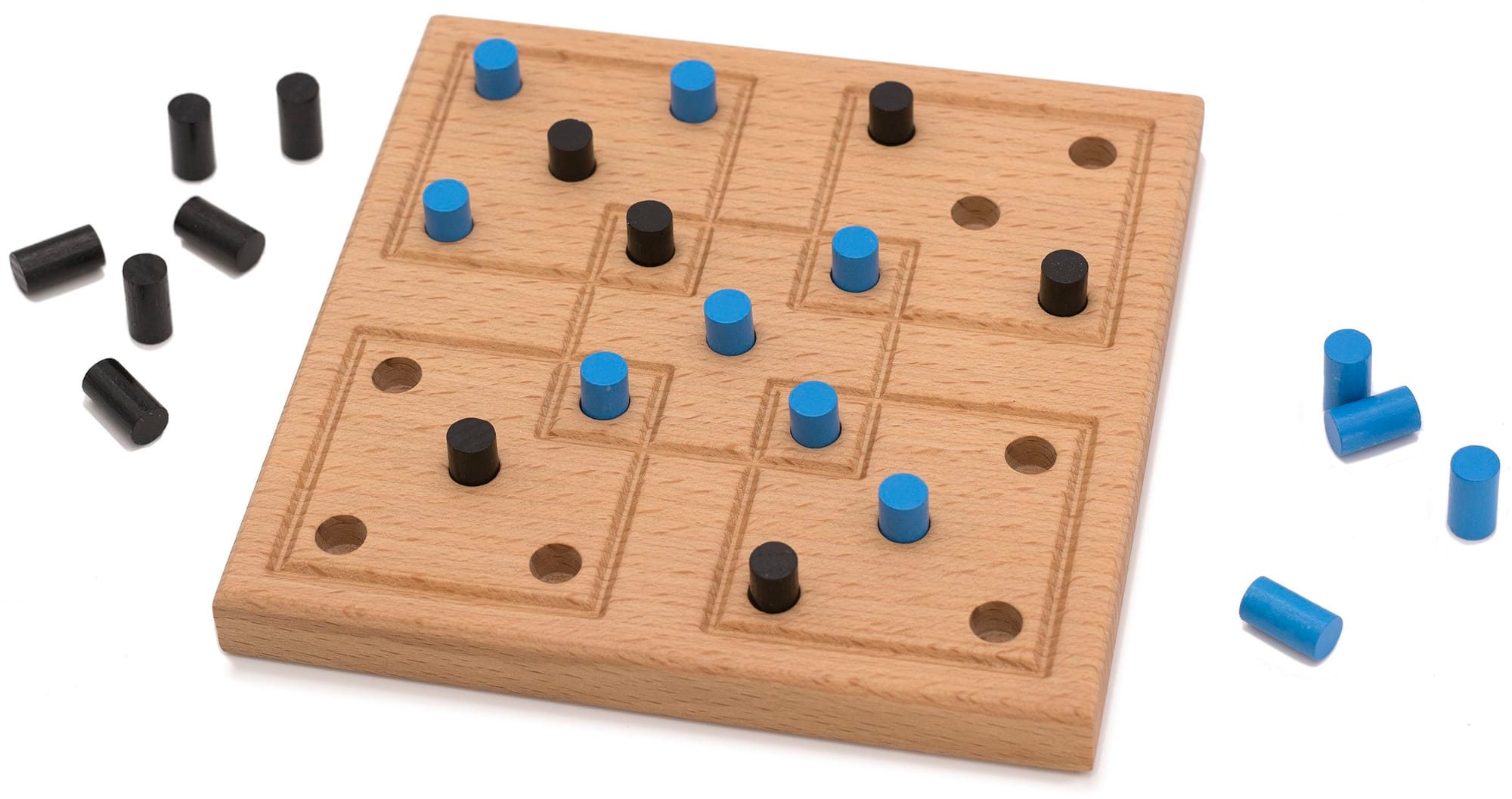
Quint-X falls into a style of abstract strategy game I'll call "directed play", with one player's move determining where the other player can make their move.
The game board features five overlapping squares, with five holes in each square, although some squares share a hole due to their overlap. Players alternate turns placing pegs in holes, and if a player places their peg, say, in the upper left hole of a square, then the next player must place a peg in the square in the upper left location on the game board, with that placement directing where the first player must place their peg. (If the first player places a peg in overlapping squares, they indicate which square is intended, then things carry on from there.)
If you would be directed to place in a square that's full, you remove one of the opponent's pegs and replace it with one of yours. If you fill all five spaces of a square with your pegs or have no pegs to place on your turn, you win. If all pegs have been placed with no winner, whoever has a majority of their pegs in at least three squares wins.
Cha-Cha-Cha
In addition to games, Clemens Gerhards publishes puzzles that use similarly snazzy wooden components, and its newest such puzzle comes from Oliver Schaudt, who has had two previous publications by Clemens Gerhards: Semiramis in 2011 and Sia Doble in 2012.
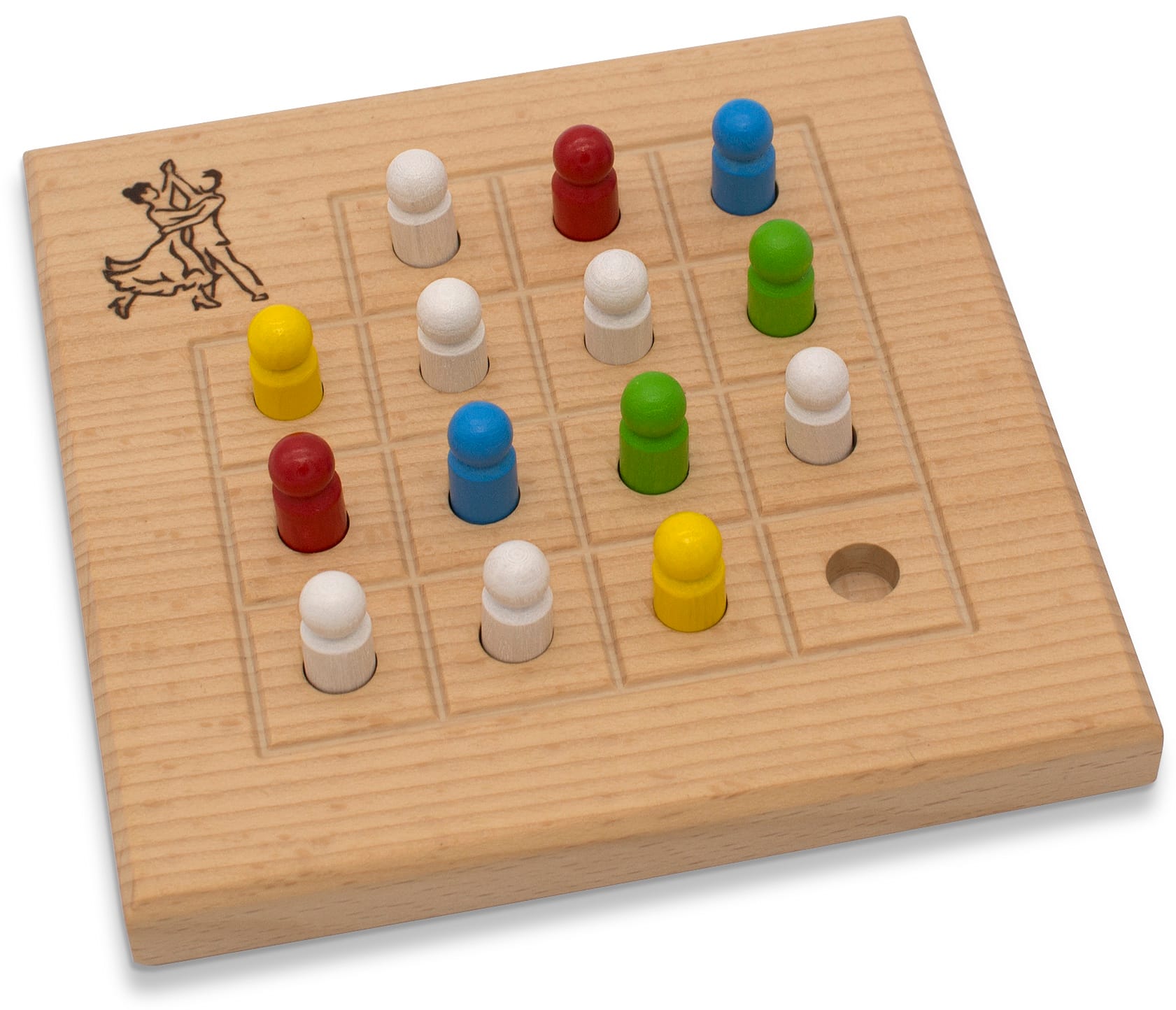
Cha-Cha-Cha is a logic puzzle that challenges you to pair (colored) dancers on the fifteen-square dance floor. Start with as many color peg pairs as you wish, then take white pegs until you have fourteen; shuffle those pegs, then place them in holes at random.
Each turn, pick up a peg and move it in a "knight's move" — two squares orthogonally in one direction, then one square in a perpendicular direction — to land in the empty hole. (Alternatively, you could think of starting with the hole, seeing how many pegs are a knight's move away from it, then moving one of those.) If all of the colored pegs are paired adjacent to one another, you've solved the puzzle.
White pegs are considered to be free dancers and don't have to be paired. Cha-Cha-Cha includes six pairs of colored pegs and twelve white pegs, so you can increase the difficulty pair by pair until you're trying to pair seven couples at once, counting two white pegs as the seventh pair. What's more, you can take on the "formation dance" challenge that requires couples to be paired all horizontally or all vertically. All set-ups can be solved.
Raupenrallye Puzzle
Lilly Schauf's Raupenrallye Puzzle is a new take on Sascha and Elke Schauf's 2010 game Raupenrallye ("Caterpillar Rally").
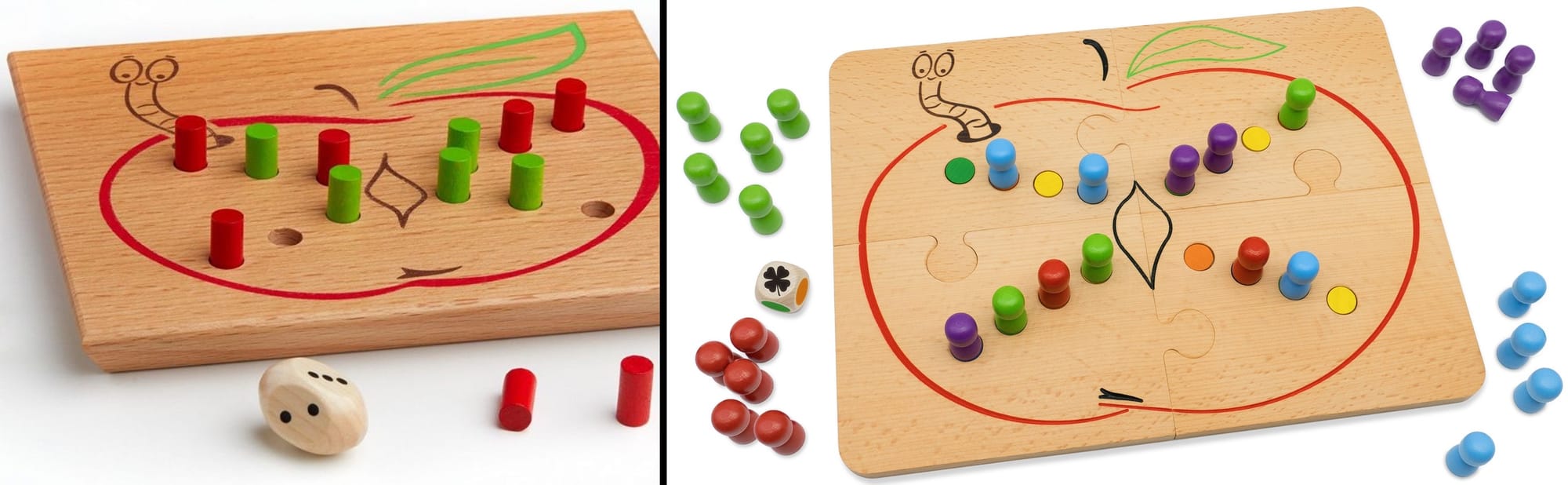
In the original Raupenrallye, two players compete to get their caterpillars to the apple core first, rolling the die to determine how far they move from the skin toward the core, with special rules when you roll 4s.
Raupenrallye Puzzle expands the player count to 2-4, with players still trying to reach the core first with their seven caterpillars. To set up, fill the sixteen holes on the game board at random with colored discs. The die you roll each turn determines where one of your caterpillars moves:
- One of the four colors? Move a caterpillar from off the board to a space matching this color or move a caterpillar in a line toward the core to land on this color. If all of those color spaces are occupied, as with blue in the image above, move a caterpillar from off the board or in a line to the core.
- The clover? This functions as a joker, so name a color, then do what's described above.
- The caterpillar? Remove one caterpillar from the board and return it to the player's supply.
If you place three or four caterpillars of your color in a line — with purple being set up to do in the image above if they roll yellow or clover — those caterpillars supercharge their munching powers and feast, jumping straight to the core.
Want more game announcement coverage like this?
Get Board Game Beat’s free posts by email — original reporting, designer interviews, and industry news, with no tracking and no spam.


