

In early August 2026, I wrote about how I culled 150 games at a library swap. In short, you didn't swap games directly with another person; no, you placed all the games you brought on a table, then you walked away, possibly taking with you games that someone else had brought. The swap was more on a community level than an individual one, and I enjoyed the experience of just letting the games go rather than negotiating for this or that.
In that article, I wrote the following:
My approach to getting rid of games aligns with my approach to sleeving cards in games: If I'm not sure whether I want to keep a game or get rid of it — that is, if I would place it on a "maybe" pile — I consider the cost of replacing that game. If the game is a mainstream U.S. or European release and I could likely find a copy for $20 or less, then I should get rid of it. Most likely, I'll never think about that game again, but for the rare game that does haunt me and make me wish that I could replay it, copies will be available at some point.
Little did I know what was coming one month down the road.
My wife Linda and I have one child, who started his senior year at high school in August, and for years we had talked about downsizing once he was out of high school and off to college. We had a checklist for what we were looking for:
- Within walking distance of a downtown, regardless of the size of that downtown
- An older house, say, built prior to 1950, although we didn't have a fixed date
- A smaller house that would be easier to keep clean and cheaper to own
By chance, in late August 2026 we ran across the perfect house and decided to make an offer. Why wait?! That house wouldn't still be on the market come June 2027 and who knows how quickly we might find another suitable location at that time. The owner accepted our offer — then I was confronted with an immediate result of that decision: I needed to get rid of hundreds of games ASAP.
I had planned to downsize over our son's senior year, although I hadn't thought in any detail about what that downsizing would look like, and now I needed to accelerate that process as quickly as I could. Here's what I did:
Prepare for Another Library Swap
I don't mean that literally as the library had no plans for such a thing, but mentally. I had culled 150 games using a simple metric, so let me attack more game shelves and see what else I can find.
Thankfully, I've visited Origins, Gen Con, and SPIEL plenty of times, so I have some idea of which games publishers have deeply discounted in the past and therefore which games should be plentiful on the used market. Any game that fits that category should go, unless I have a particular attachment to it compared to everything else. More on that later.
Bring Games to Give Away at Every Opportunity
A twice-monthly game group was scheduled to meet at the end of the week, so I loaded the car with 100-ish games divided into two categories:
• Recent unopened games that I could give to the group organizer. He hosts a weekend event twice a year during which he gives away dozens of games donated by publishers. Many of the games I brought had been sent to me by publishers as review copies (typically without me asking for them), so by the transitive property if I passed those games to the organizer, in effect the publishers were the ones donating those games, right?
• Opened games, which I placed on a table next to handmade signs that said "FREE GAMES". Many people said, wait, really? Yes, really! Hopefully they found something they liked, while doing me the favor of emptying my shelves.
Expand My Criteria
I had initially put a blanket restriction on giving away games from Japanese, Korean, Taiwanese, etc. creators because of the difficulty I might have in finding those games again. Many of those titles appear at a single Game Market event in Tokyo, then are never seen again. Others show up at a single SPIEL and might be impossible to find unless I traveled to the country in question.
Yet I realized that giving away only "mainstream U.S. or European releases that I could find cheaply" wouldn't get me to my goal. What's more, I hadn't actually played many of those Japanese, Korean, etc. games, despite owning some of them for up to a decade. I could have a "cool collection of hard-to-find games", sure, but if I never played them, what was the point?
Maybe I could part with at least a few of them?
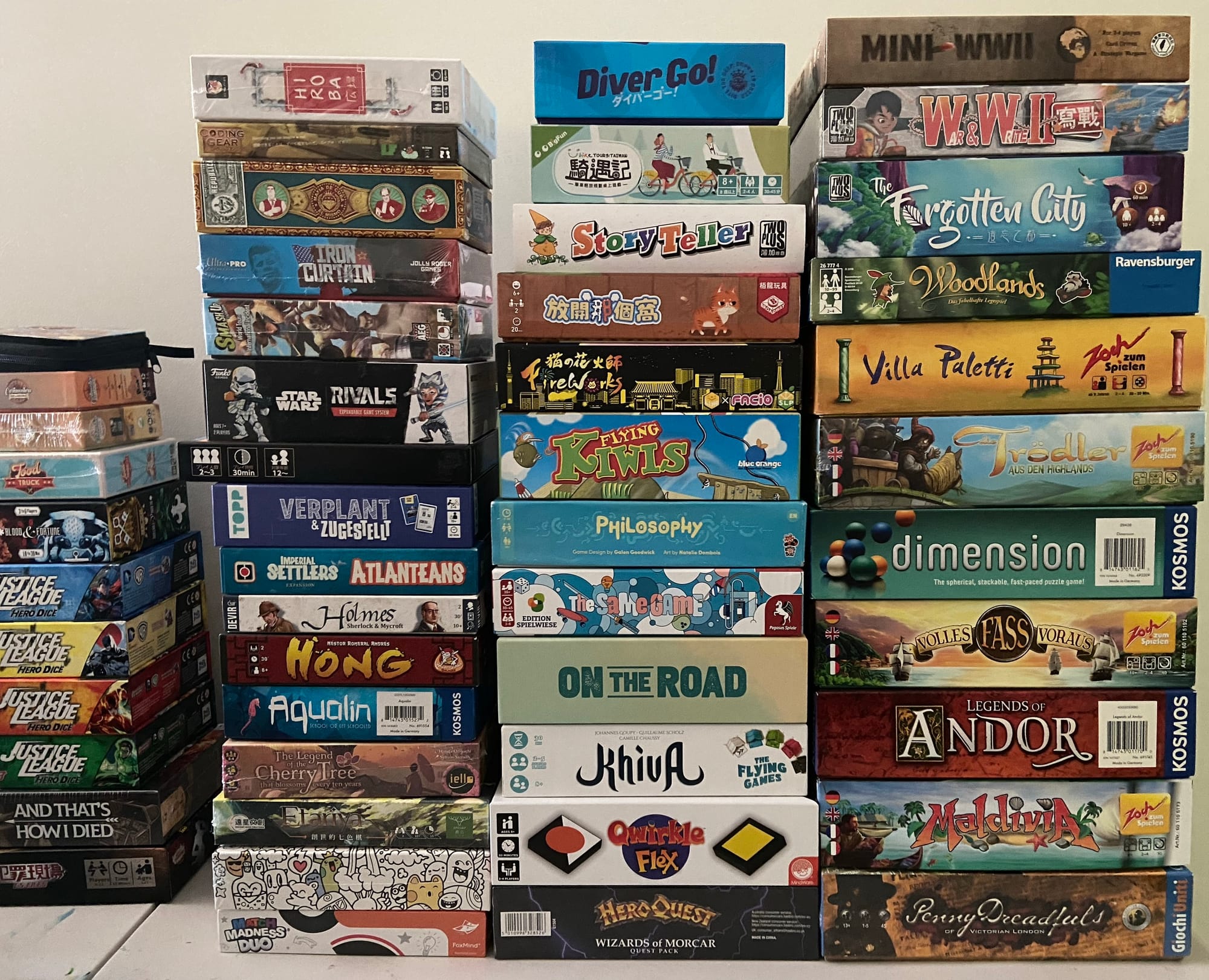
Strangely, as soon as I started moving those games off the shelf, I lost all inhibition and started pulling most of them down. It felt like one of those movie scenes in which a character wildly sweeps things onto the floor, except that I was neatly stacking everything into piles of similarly-sized games.
Invite Others to Take Games
I hosted a semi-regular game group at the old house (which was then the current house), and I told everyone on the group mailing list that they were welcome to drop in over the weekend and take any of the games that I had pulled. Again, they were mostly review copies — some of which I had reviewed, some of which I had played, and some of which I had never opened — so I thought it best to give them away.
I sent out three pics of 150-ish games, then at the last minute I pulled another 100-200 games and placed them on a separate table. I let folks call dibs on two titles they really wanted, but otherwise it was first come, first serve.
Six people came on Saturday morning, some of whom I hadn't seen in a while, and it was great to catch up with people while seeing what they were taking. If someone seemed unsure about a title, I was like, what's the worst that happens? Take it home, then pass it on to someone else if you don't like it!
After they left, I pulled even more games for a couple coming on Saturday evening and for another couple on Sunday. Sure, the first people who came on Saturday missed out on those new offerings, but them's the breaks. I had a deadline, so I needed to keep finding more to ditch.
Be Open to Opportunities
One of my Saturday visitors, designer Matt Wolfe, mentioned that his monthly game group was going to meet the following Saturday. Matt's a member of Game Designers of North Carolina, and he said he'd distribute donated games among designers in the group, many of whom would be at his event.
I know one thing that can make you a better creator is exposure to and experience with the work of others, so I showed up at his house with a Mazda CX-5-sized load of games — somewhere between three and four hundred. We piled as much as we could on a folding table, then kept piling games on the floor around it, then invited the fifteen-or-so attendees to have at it.
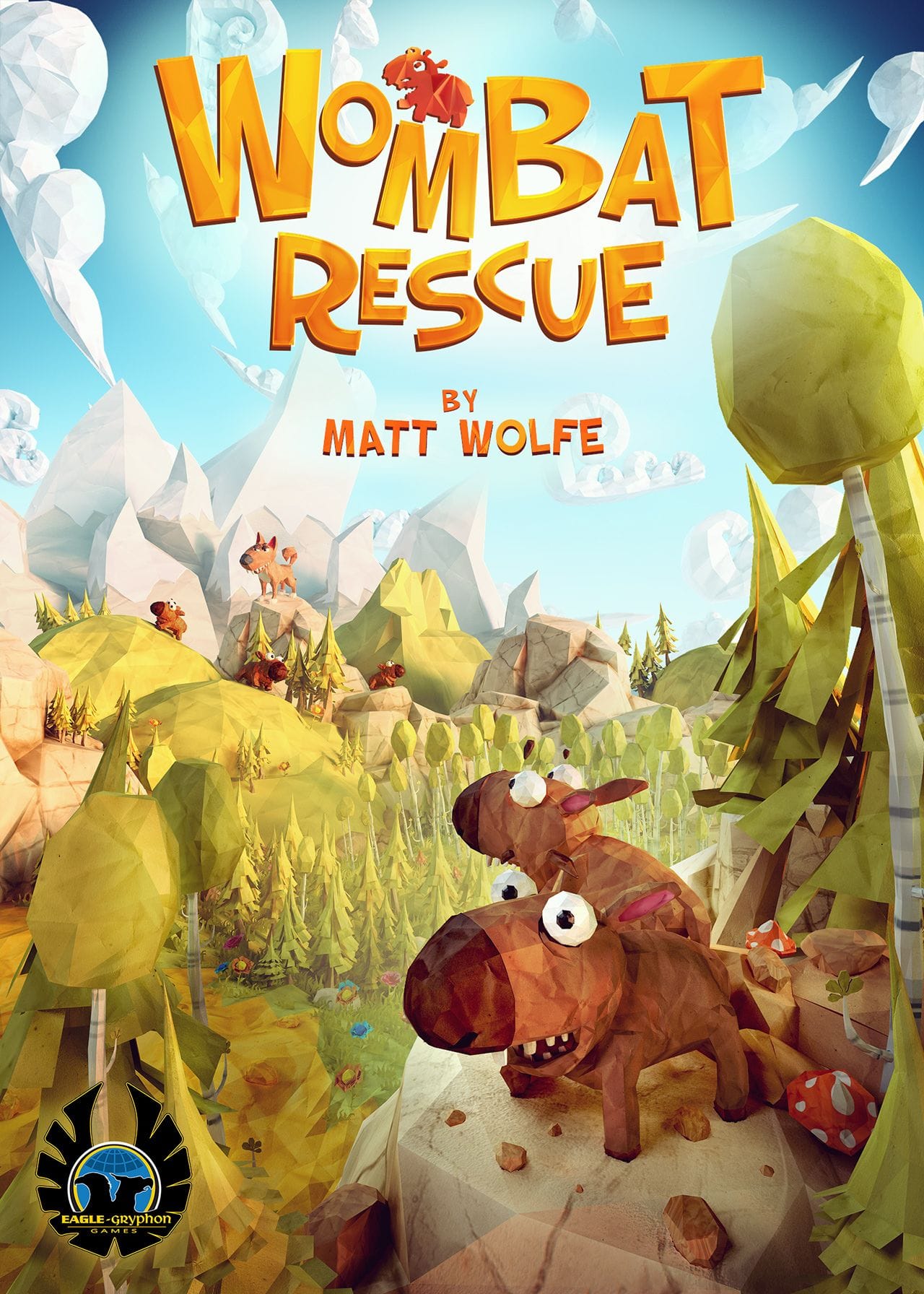
(Matt's Wombat Rescue was one game that found a new home. I had backed the crowdfunding project in 2015, played the game a couple of times and liked it...then never got back to it, which meant I didn't like it enough to keep it. Sorry, Matt!)
Ahead of that event, one of the attendees had asked whether anyone could bring Australis, a game by Leo Colovini and Alessandro Zucchini that I had reviewed in 2024. I like the game, so I brought it with me and got it to the table again after not playing it since writing that review — a practice far too common during my BGG days.
The person who had asked about Australis turned out to be an aspiring designer in GDofNC whose mentor had suggested she play the game, presumably because she was working on a design with similar elements. Even though I enjoy Australis, I saw a chance to do good two ways and offered it to her. She will ideally benefit from playing Australis multiple times, and I had one fewer game to pack. (Plus, KOSMOS titles aren't usually in short supply, so I can get it again some year if desired.)

Similarly, someone in another group asked me to bring Gardlings by Kristian Amundsen Østby and Maria Østby to the next session as she had greatly enjoyed the game when I taught it to her at a convention. We played again, and she still loved it, so I offered the copy to her. (Gardlings is a take-and-make design in which each player draws and assembles their tiles into a personal grid each round, then uses the gems they collect to buy a new tile. Whoever first makes a grid that contains twenty gems wins. It's a fine design, but I'm not a fan of most take-and-make games.)
Sell Games...But Not Individually
Not everything that I was getting rid of was a review copy, and not everything that I had offered to friends was taken, so I sent pics of yet more stacks to a local couple that deals games at flea markets, during conventions, and out of their garage and asked them to make an offer. They did, then they showed up the next day to cart everything away. Boom — one sale, lots of games gone.
In the early 2010s, I had made the mistake of listing individual games for auction on BGG when preparing for a move. (Apparently that's what motivates me to get rid of stuff!) I had priced everything with a starting price of US$1 and figured that people would bid on multiple games since shipping multiple games in one box would cost only slightly more than shipping a single game.
Indeed, many people did win auctions for multiple games, but I had thirteen auctions close with a winning bid of US$1. The winning bidders were paying the full price of shipping, so I wasn't losing money, but given how much time and effort it took to package those games and haul them to the post office, I was, in fact, losing money. It would have been easier and more efficient to give the games to a thrift shop.
I've sold games a few times at a local store that runs a flea market-style event. A seller prices their games however they wish, and buyers buy scrip from the store equal to the cost of the games they want to buy, then give the scrip to the seller. When the seller is ready to leave, they bring the scrip to the store, which pays them 90% of the total value. Everybody wins!
Whenever I've sold games at these events, I group games by price, but I also list a price for EVERYTHING on the table — a heavily discounted price that I drop every five minutes, partly because the lot is getting smaller via individual sales, but also as an incentive for a potential buyer. Near the end of the event, people who want to buy a couple of games see that they could pay double that amount to buy all that they see — and all but once I've found a buyer to take everything off my hands. The buyer gets a great deal, and I can pack up and leave without bringing anything home.
I realize that I'm in an unusual situation. I've written about tabletop games on a full-time basis for nearly twenty years, with my editorship at BoardgameNews.com starting in late November 2026, so I'm in contact with hundreds of publishers and have received a large number of review copies over the years. I understand the calculus publishers operate under: The cost of sending out a game — or (even better) handing one over at a convention — is relatively small compared to the publicity a write-up or video could bring, so why not do it?
While I appreciate the opportunities these games provide, they're also something of a burden. (I know — poor me.) I feel bad when I don't have time to get to a game, but that happens more and more frequently these days, so I rarely ask for review copies as I don't want to take on more than I can actually play.
That said, I'm still at the mercy of other players being willing to play what I'm bringing to the table, so no matter how much I prepare, sometimes I can't get a game played in a reasonable amount of time. A group will play something once and say, nah, not for us, but since I want more than one play in order to get a feel for the experience, I'll have to find others...who are then playing for the first time...and who might not want a second game. This happens far more frequently than I would like, but unless I start paying others to play with me, that's what I'm stuck with.
At least now I'm stuck with far fewer games than I had previously. The weight of those games — and the guilt I felt for not covering them — has now been dissipated throughout North Carolina, shared with dozens of others who will ideally...finally...bring those games to life on their tables.
Want more articles like this one?
Get Board Game Beat’s free posts by email — original reporting, designer interviews, and industry news, with no tracking, no ads, and no spam.


