For this post, I thought I'd serve up an indulgent dish of randomness in the form of games that use dice as their main component:
Dicey Waters
In 2012, AMIGO released the Haim Shafir design Piraten Kapern ("Pirates Boarding"), and more than a decade later an English-language edition is being released on the U.S. market by Hachette Boardgames USA under the title Dicey Waters.
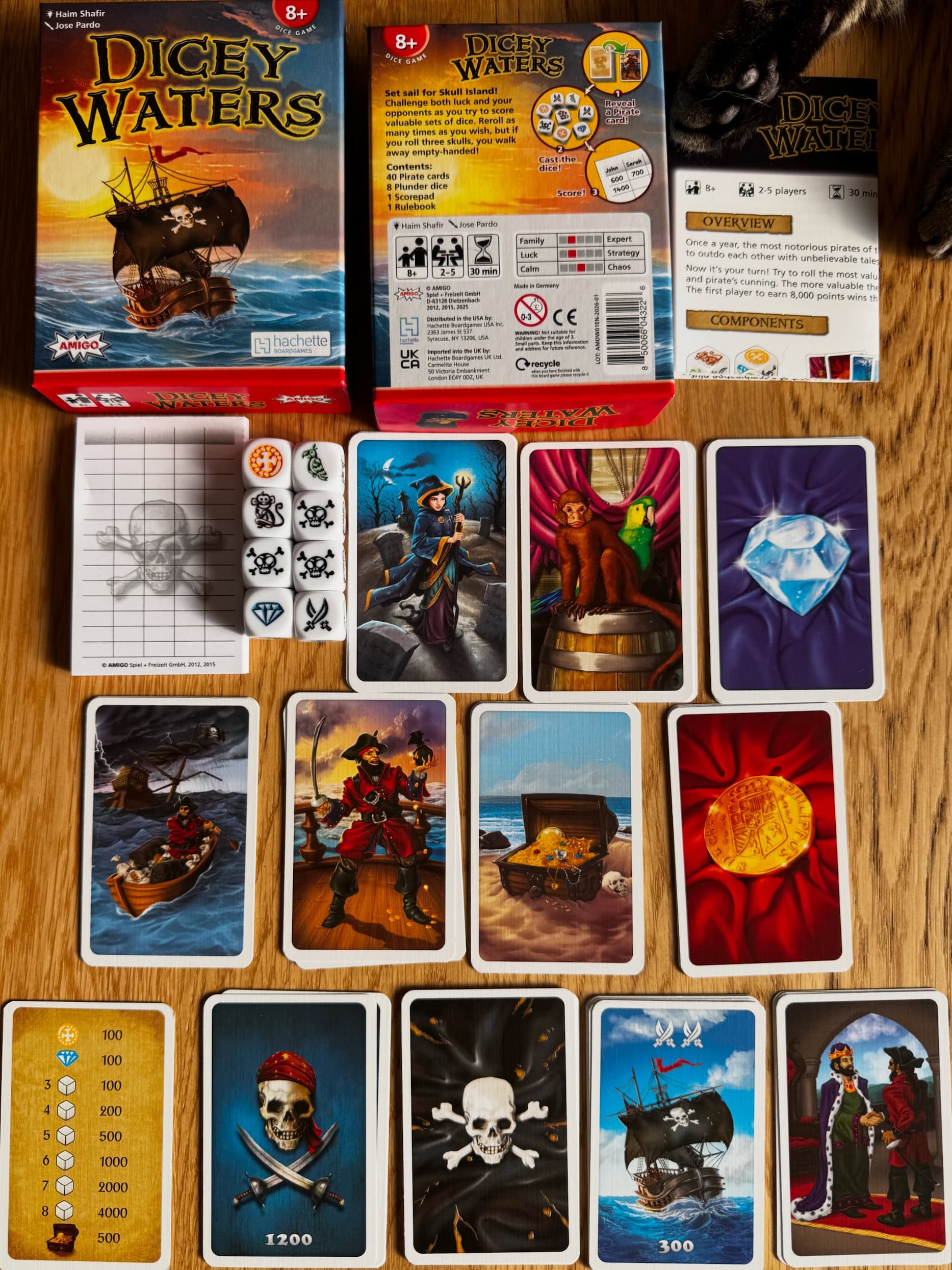
Each turn, you draw a fortune card, then roll the eight dice. You can re-roll dice as often as you like, except for skulls — and if you have three skulls face up, you bust and earn nothing for the round. If you stop before that, you score based on the gold, diamonds, and sets showing on the dice, with the fortune card impacting those results and (most likely) affecting how long you continue to re-roll: the captain doubles your score, the sorceress lets you re-roll one skull, a sea battle requires you to roll the indicated number of swords to score for the turn and earn the listed bonus.
If you have at least four skulls on your first roll, instead of losing your turn, you head to the "Island of Skulls" for that turn, re-rolling until you don't get a skull, with each other player then losing 100 points per skull.
As soon as a player hits 6,000 points, each other player has a final turn, but if someone overtakes the player who triggered the endgame, that player gets a final shot to end up on top.
Robo Rally Dice
In February 2026, Renegade Game Studios released a spin-off title of Richard Garfield's Robo Rally — which is now more than thirty years old! — with Kane Klenko's Robo Rally Dice featuring the same basic gameplay and goal as in the original game: Race your robot through a factory floor filled with dangerous obstacles in order to reach all the checkpoints in order, ideally reaching the final checkpoint first to win.
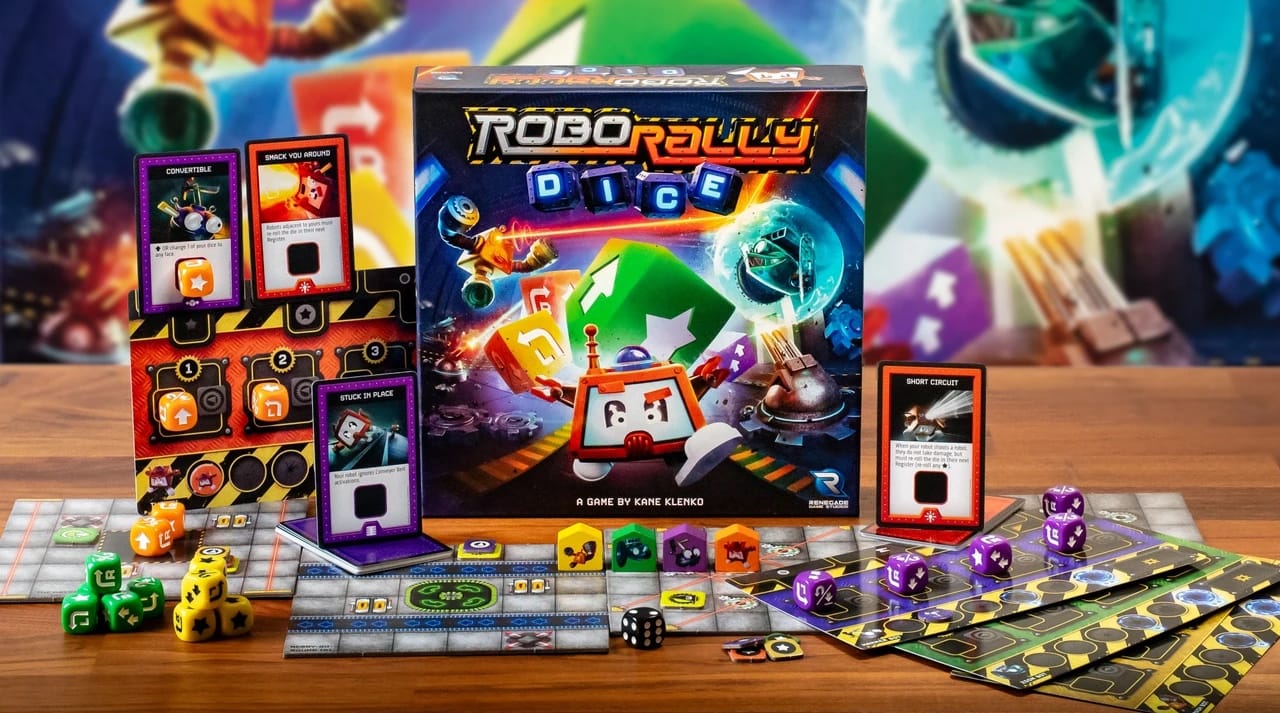
How Robo Rally Dice differs from that earlier game is that your movement is now determined by rolling dice instead of by receiving a handful of movement cards and placing them in the order you want.
At the start of a round, everyone rolls and re-rolls their dice simultaneously, locking them on their personal game board in whatever order seems best. You have four movement registers and four triggers that activate upgrade cards, but only five dice, so you must make choices. Once a player has locked their dice, they count down until everyone must stop, then players all resolve their first movement die in order, after which board elements take place, with conveyor belts moving robots on them, lasers causing damage if your robot stands in front of them, gears rotating your robot, batteries giving you upgrade cards, and so on.
Robo Rally Dice includes four factory game boards, which can be used in the Robo Rally base game, just as the game boards in that game will work in this newer one.
Jump Masters!
At Gen Con 2026, Jeff Jacobson and Manny Trembley of Neon Knight Games, which is owned by Chip Theory Games, showed off their newest release: the 2-4 player game Jump Masters!, which uses dice to represent the energy value of your heroes as you work to smack down the opposing team(s).
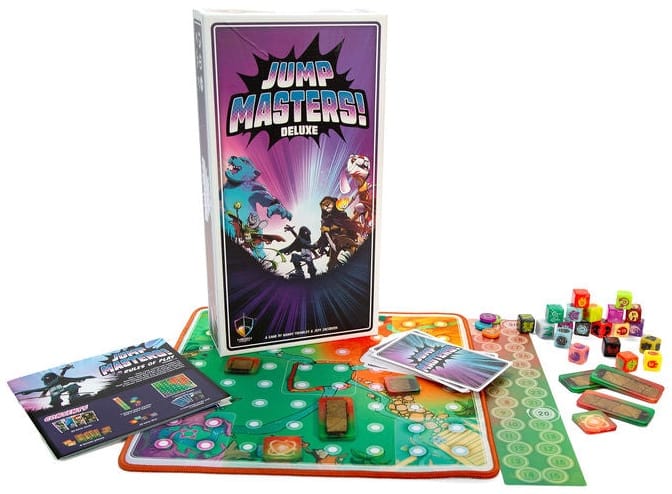
In more detail, each player drafts a team of four heroes with their associated dice, then sets them up in the deployment zone in a corner of the game board. On a turn, you choose one of your heroes to move (1-2 spaces) or jump, with this being what you want to do most. The game isn't called "Move Masters!", after all!
Each hero has an energy value that you track with its six-sided die. When you jump one of your teammates, that hero's energy increases by one (although never over its maximum), and when you jump an opposing hero, both of your heroes lose energy equal to whoever has the lowest value — that is, at least one of the heroes goes to 0 and is removed from the board, with the opposing player gaining points equal to that defeated hero's maximum energy. That hero will then be re-deployed, and turns continue until someone has at least 20 points and wins.
All heroes can perform multiple jumps on a turn, as in Checkers with a kinged piece or in Chinese Checkers, and each hero has a special ability, such as jumping over 1-2 spaces instead of only one, moving up to three spaces, dealing damage to a nearby hero after moving, and so on.
One final bit: If on your turn, your heroes in the central four spaces — "the hill" — have the highest sum of energy, you earn 1 point in addition to whatever else you might earn that turn. That "king of the hill" aspect of play gives you an incentive to mix it up, but you're not playing randomly since the dice aren't rolled — only used to track current energy.
Dicecream
To end your game night, you might wish for a dessert, and designers Manfred Keller and Fabian Zimmermann have tried to satisfy this desire in Dicecream, a 2-4 player title from Skelling Games that hit the market in August 2026.
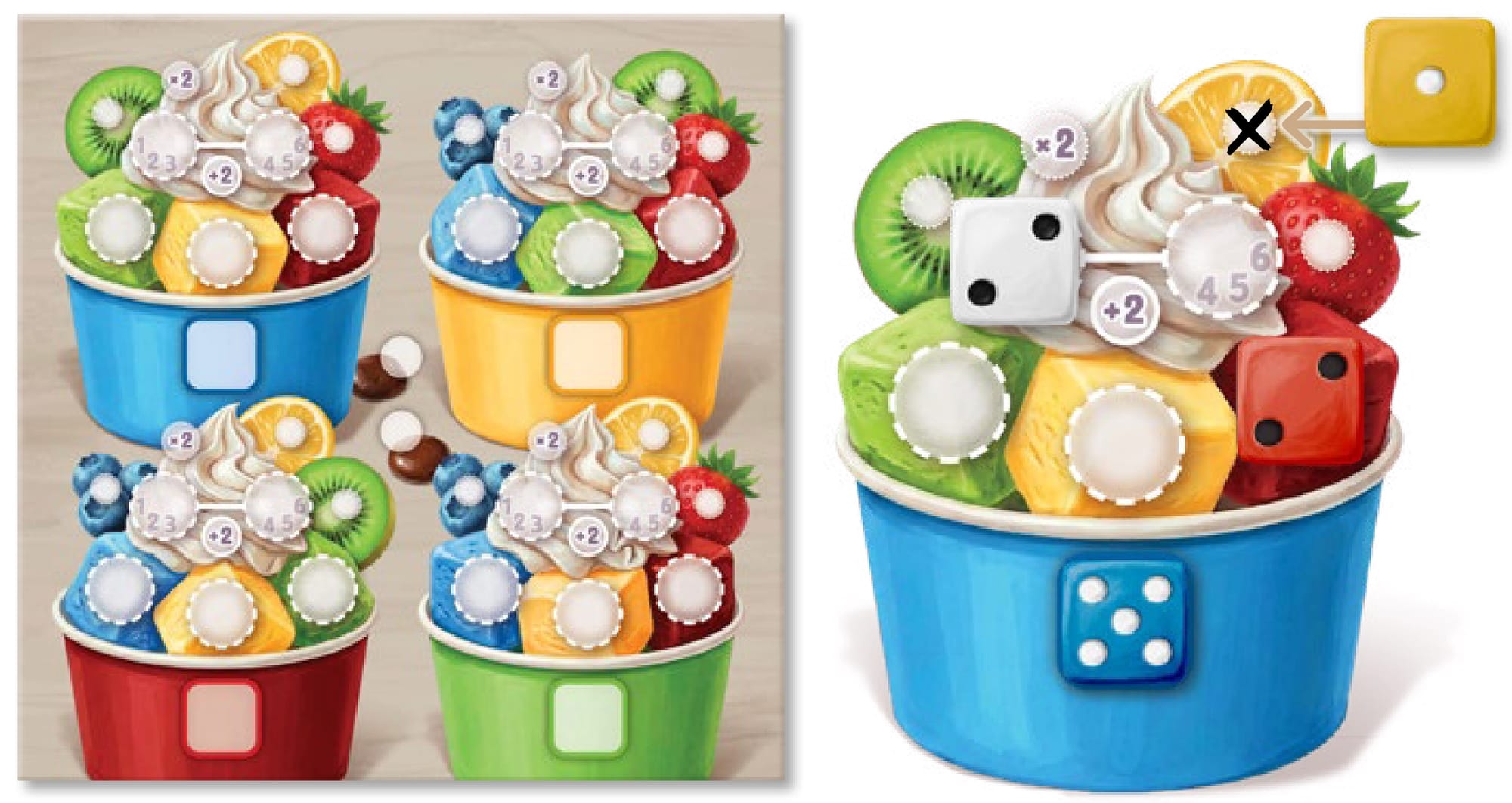
During set-up, each player has their own player sheet (as shown on the left above) that shows four ice cream sundaes; the sundae cups are in four colors, and each cup holds ice "cube" scoops and toppings in the other three colors, along with space for two dollops of whipped cream.
On a turn, you roll the five dice (in the colors of the four sundae cups, along with white), then you use these dice to "fill" your cups. You use a colored die to "unlock" a cup, then use other colors to add a scoop (scoring points for the die used) or tick a filling in this scoop, with white allowing you add a value in one of the dollops. You can unlock at most two cups on a turn, and the sum of the dice used in a cup can't exceed the die used to unlock the cup.
On your turn, each other player can use one of the dice that you used for ice cream, whipped cream, or filling in a sundae of their own without needing to unlock the cup.
After each player has had a turn, you reveal two bonus cards that allow you to mark spaces and choose one of them. After 3-5 rounds, you score your sundaes by tallying their points, with both whipped cream dollops earning a bonus 2 points and all three ticked fillings doubling that value.
Want more game write-ups like this one?
Get Board Game Beat’s free posts by email — original reporting, designer interviews, and industry news, with no tracking, no ads, and no spam.