Origins Game Fair 2026 has been over for nearly a week at this point, but I have a bit more to share about this fair, so let's get to it:
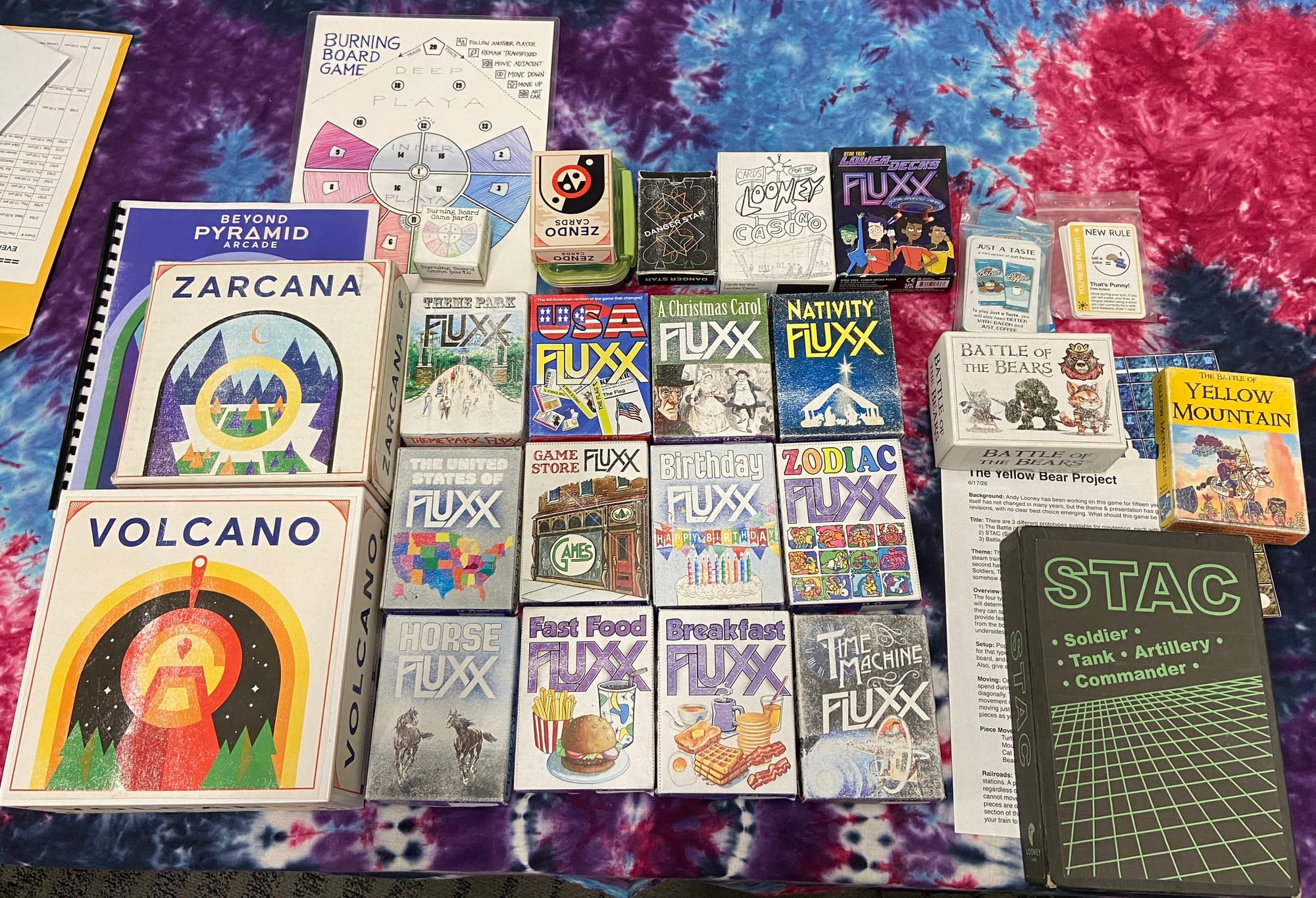
▪️ U.S. publisher Looney Labs celebrates its thirtieth anniversary in 2026, and for the occasion it had a special room in the Greater Columbus Convention Center with an itinerary of events and display of oddities, such as more than twenty prototypes that you could play and give feedback on, including a dozen Fluxxes from Andy Looney, a new edition of Kristin Looney's Volcano (which is now due out in 2027 featuring the Pyramid Arcade branding), Beyond Pyramid Arcade (a 76-page companion to Pyramid Arcade with rules for 22 games), a boxed edition of John Cooper's Zarcana with a game-specific Tarot deck, and a new set of Zendo Cards for Kory Heath's Zendo.
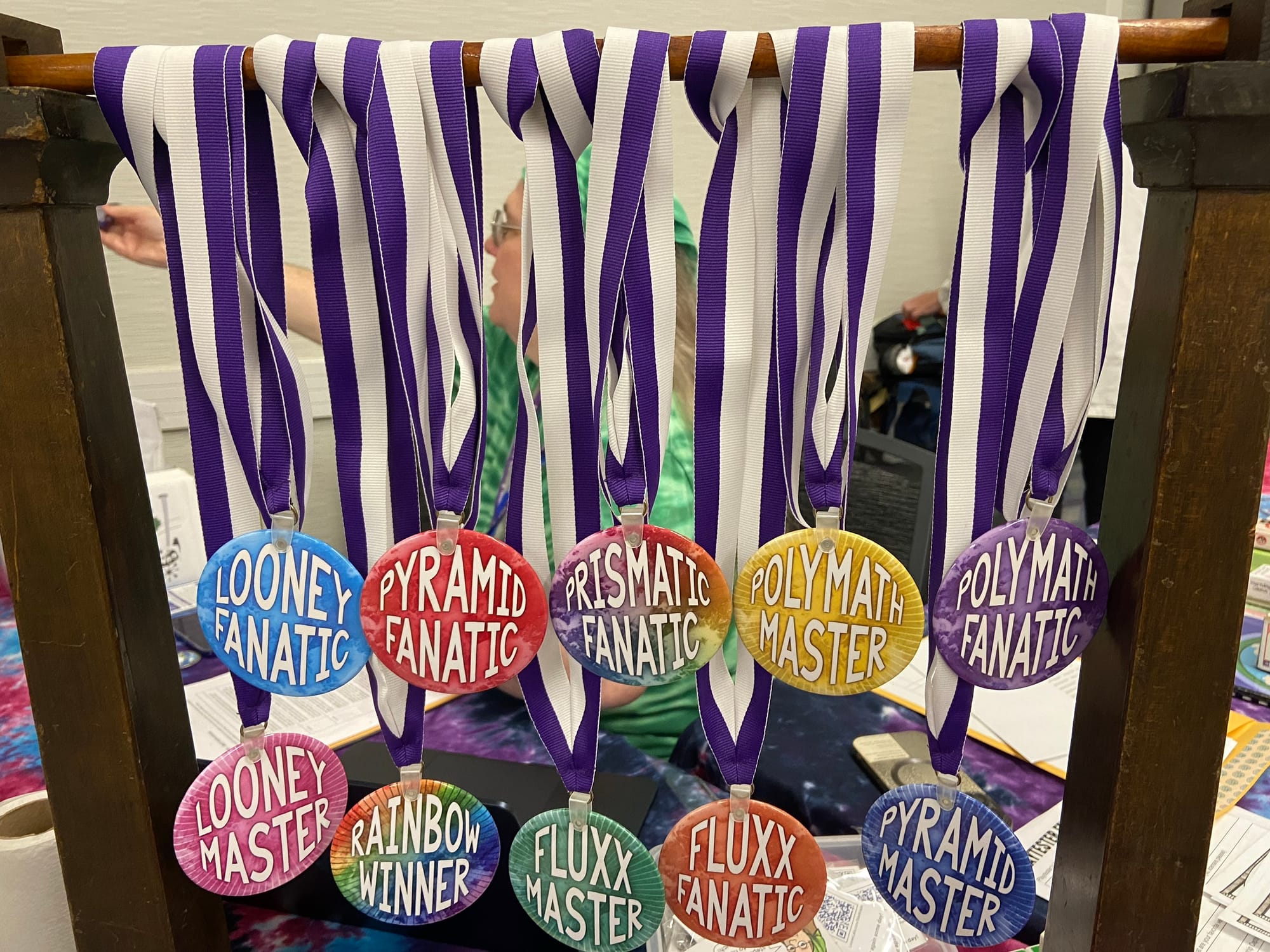
Looney Labs also scanned player badges in case you wanted to record the games you played in the room to have a shot at taking home one of ten awards.
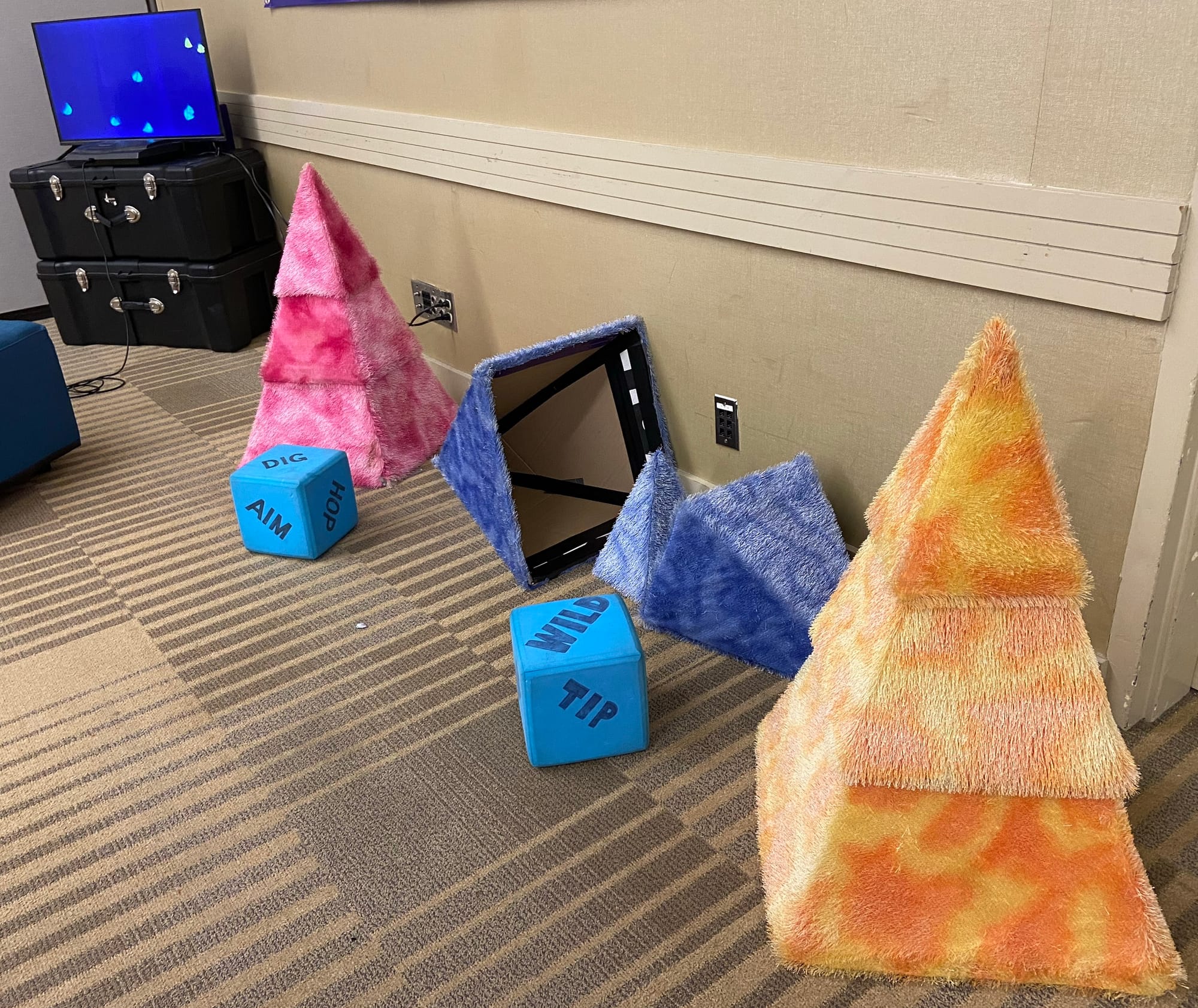
In addition to the giant pyramid set shown at the top of this page, a fuzzy set of pyramids was on hand for playing, along with a pyramid-based arcade game created more than a decade ago by Andy Looney...
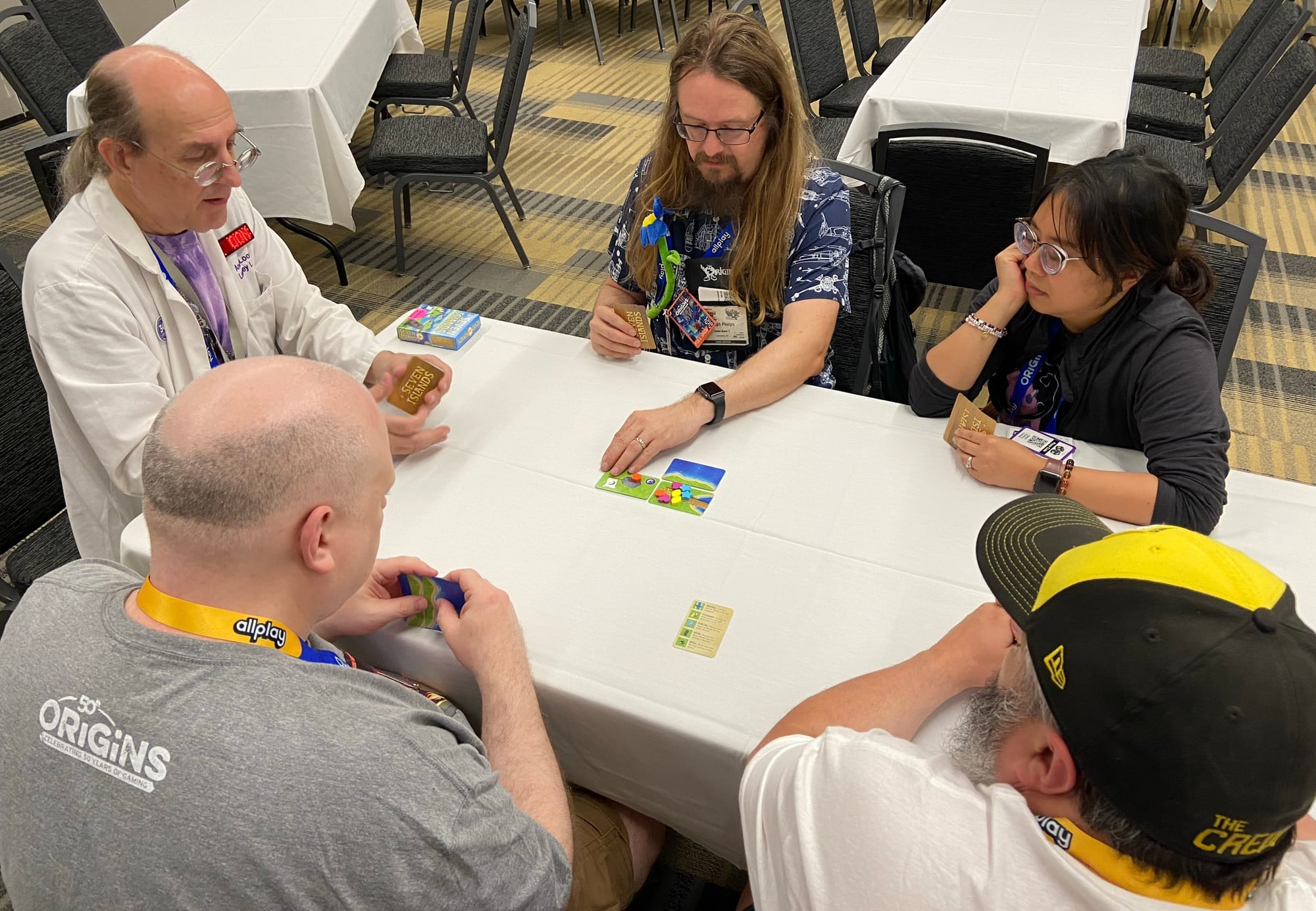
...who was on hand to teach his newest release, Seven Islands, which I previewed in a GAMA Expo 2026 post.
Enjoying the Origins coverage?
If Eric’s convention reports help you discover new games, please consider supporting Board Game Beat. Paid memberships start at $2/month and help keep this kind of independent coverage going.
In April 2026, I wrote up five titles coming in mid-2026 from Gamehead, including Scott Brady's party game Size Wise, and during Origins the publisher pulled out a giant-sized version of the game, which caught the attention of all who saw it. Here's a recap of how to play:
Each player gets a string that features a ring at one end and a bead that you can move up and down the string. Each turn, you're presented with a random object — bag of chips, suitcase, washcloth, dog's tail, etc. — then asked to demonstrate the size of this object by placing your bead somewhere along your string.
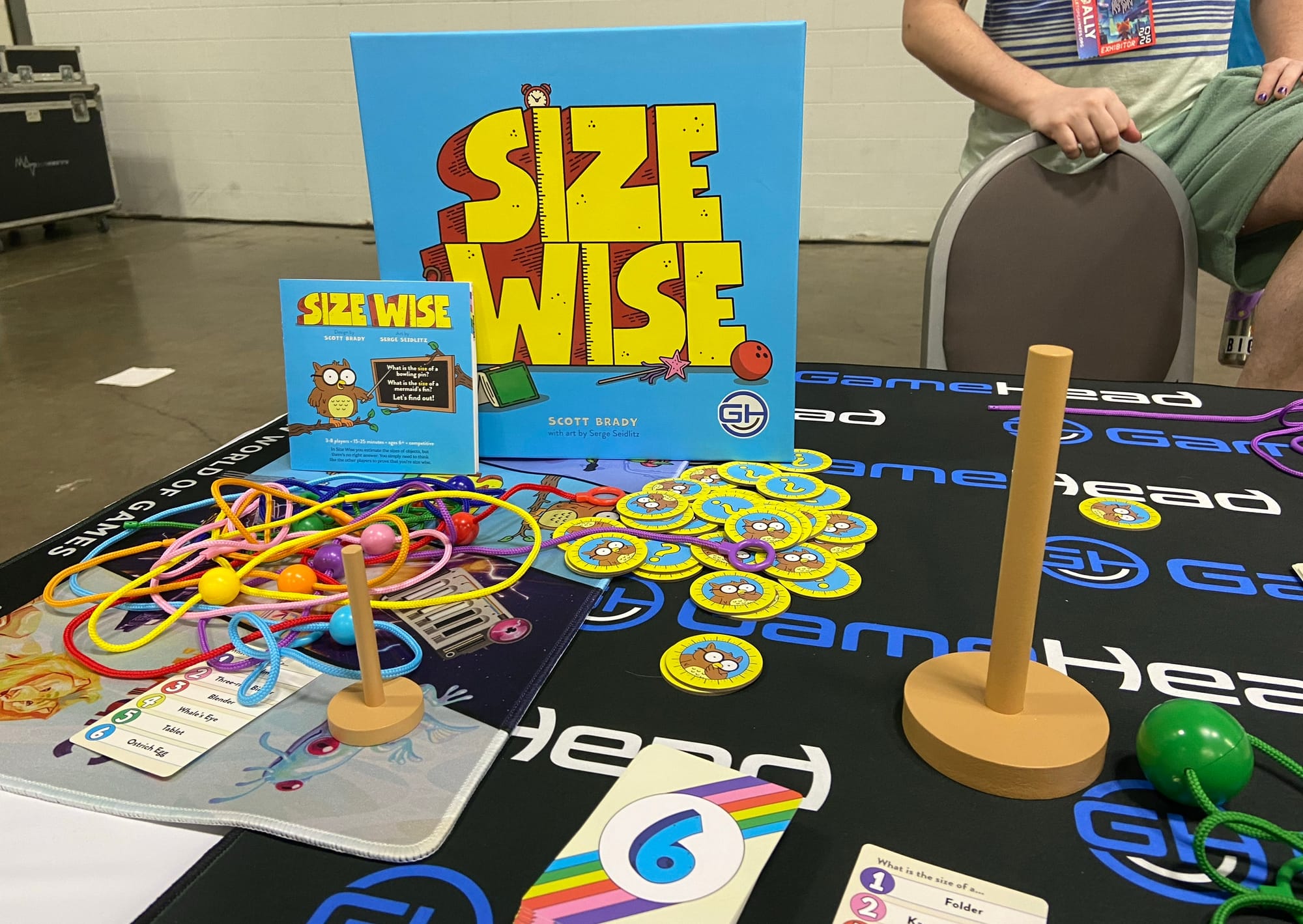
All of the strings are then placed on a wooden dowel so that the strings hang down, and whoever has indicated either the shortest length or the longest length loses a wisdom token. When a player has lost all of their wisdom, the game ends and whoever has the most wisdom wins.
Any publisher who creates a giant-sized version of a game to demo at conventions should be ready to tell people what it would cost to buy their own giant-sized version because people will ask if it's for sale — and you'd be foolish to tell them no. After all, if someone is willing to pay 3x-5x the cost of the regular retail price, they're likely to show off that giant game to as many people as possible to get their money's worth and show off their cool thing that few others will have.
In early June 2026, I wrote about DVC Games' new edition of Rosetta that it planned to debut at Origins, but aside from that game the company showed off its next release, which will be available at Gen Con 2026.
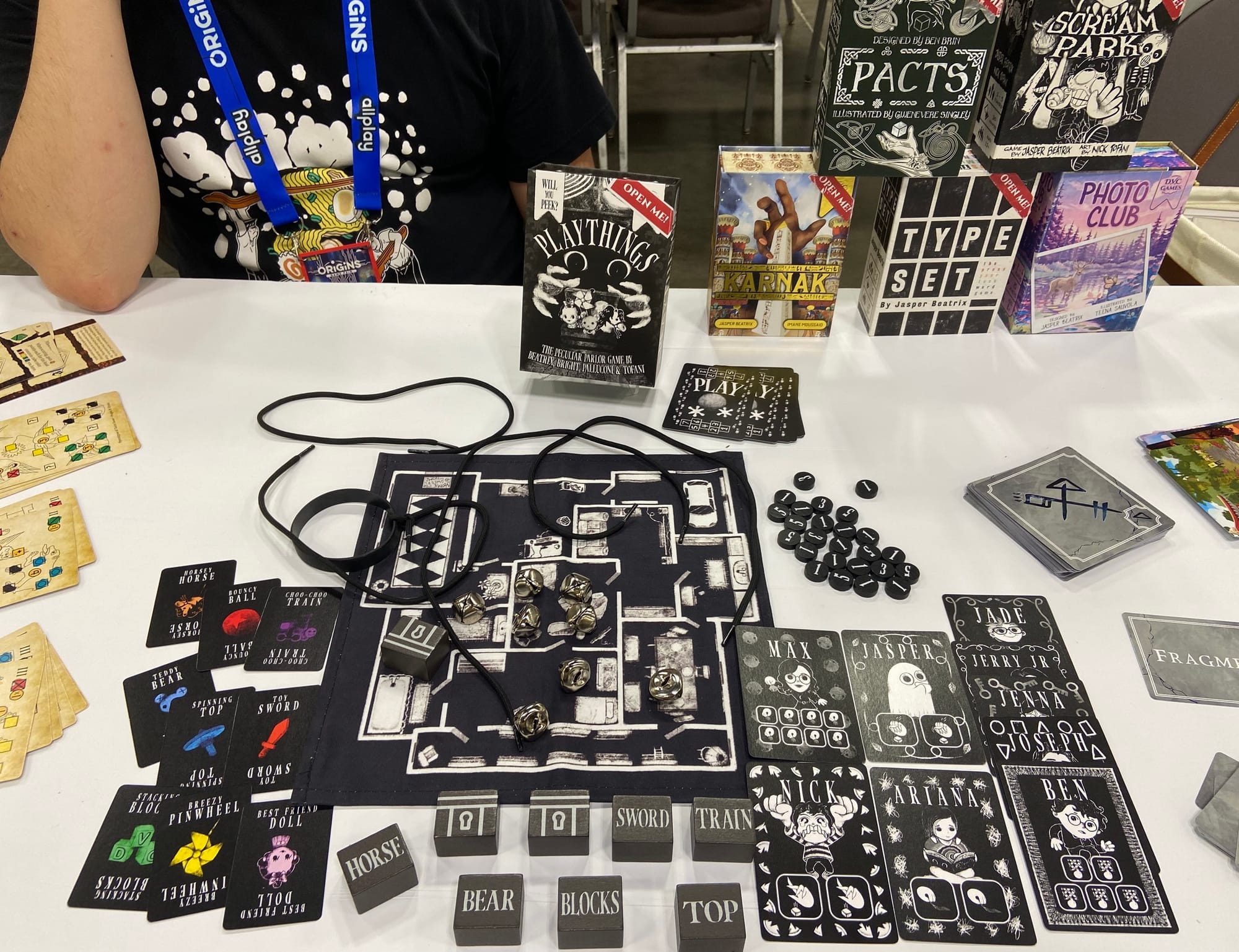
Each round in Playthings — a design by Jerry Bright Jr., Joey Palluconi, Ben Sobine, and Jono and Jess Naito-Tetro — one player is the Night Terror and will hide toys, represented by named wooden blocks, face down in the rooms of the house while everyone else keeps their eyes closed, saying the name of each toy while placing it.
Each other player is a guest who wants to find a specific (secret) toy as quickly as possible, and while that might seem like luck of the draw, the guests have a few ways to get information. First, before the Night Terror places the blocks, the guests reveal three friend cards, then use those friends' tools to set up traps. Maybe you'll tie a string to the Night Terror's wrist so that you can feel it moving, or hold a corner of the mat to feel the pressure of where something is placed, or place bells in rooms so the Night Terror must make noise when placing a block in those rooms — and each room must have at least one block.
Second, you can peek at the Night Terror while they're working! That will give you info at the risk of being caught, which allows the Night Terror to steal points from you.
As a guest, you need to use memory, logic, and traps to figure out where your toy might be, giving this deduction game a playful feel.
Photo Club, shown in the pyramid of DVC Games above, will be a 2027 release, with 2-4 players trying to take pictures to satisfy goals. To do this, you'll move 3D elements in the environment that you're "walking" in, trying to set up ideal scenes from your (literal) point of view at the table, which might mess up views that others were trying to arrange.
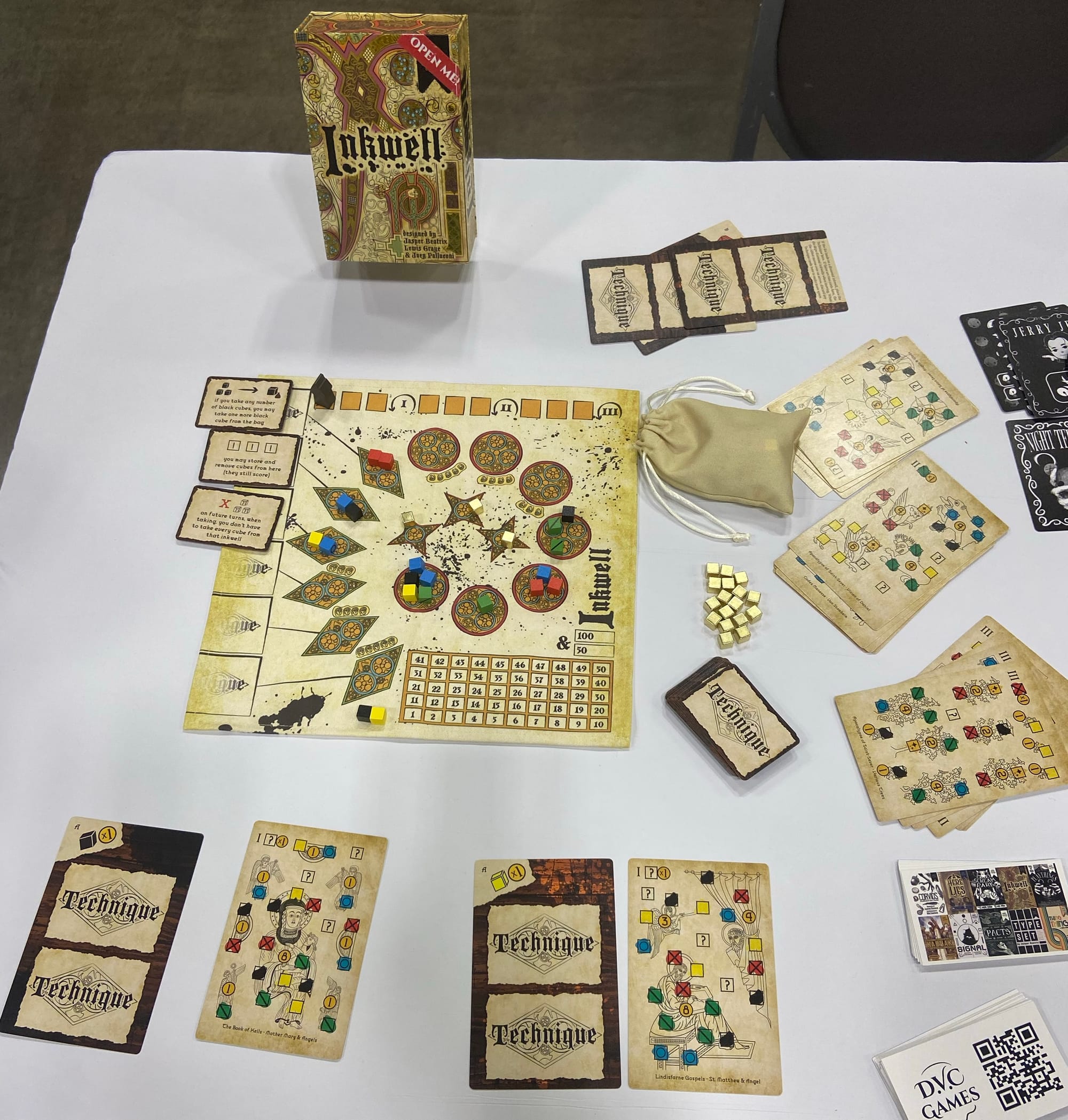
And in March 2026, DVC Games released Inkwell from Lewis Graye, Julie Koerwer, Jono Naito-Tetro, and Joey Palluconi, with this game putting you in the position of monks who are trying to complete illustrated manuscripts.
Gameplay is akin to Azul, with you drafting colored cubes to place them on the appropriate places on your pages-in-progress, but gameplay differs in a variety of ways:
- You must use all the cubes you take, with none being thrown away.
- The star spaces on the drafting board feature a single golden cube that can stand in for any color.
- The diamond spaces have fewer cubes than the round spaces, but they each come with a technique card that gives you some special power.
- You score for completed illustrations on a page, and you can place a cube on a multiplier to score bonus points for cubes matching that multiplier.
- When all spaces of one shape (star, circle, diamond) are emptied, you refill all empty spaces of that shape and others, then add one cube to each non-empty space, thereby pumping up the value of previously unattractive spaces.
- On a turn, you can "turn the page" instead of drafting cubes, scoring for your current page and moving on to page II or III. This lets you get a bonus gold cube, make room for more techniques, and choose a new page before others, using the cubes currently available as a guide for what to take. (A monk advances on the game board each refilling, eventually forcing slow scribes to turn their page.
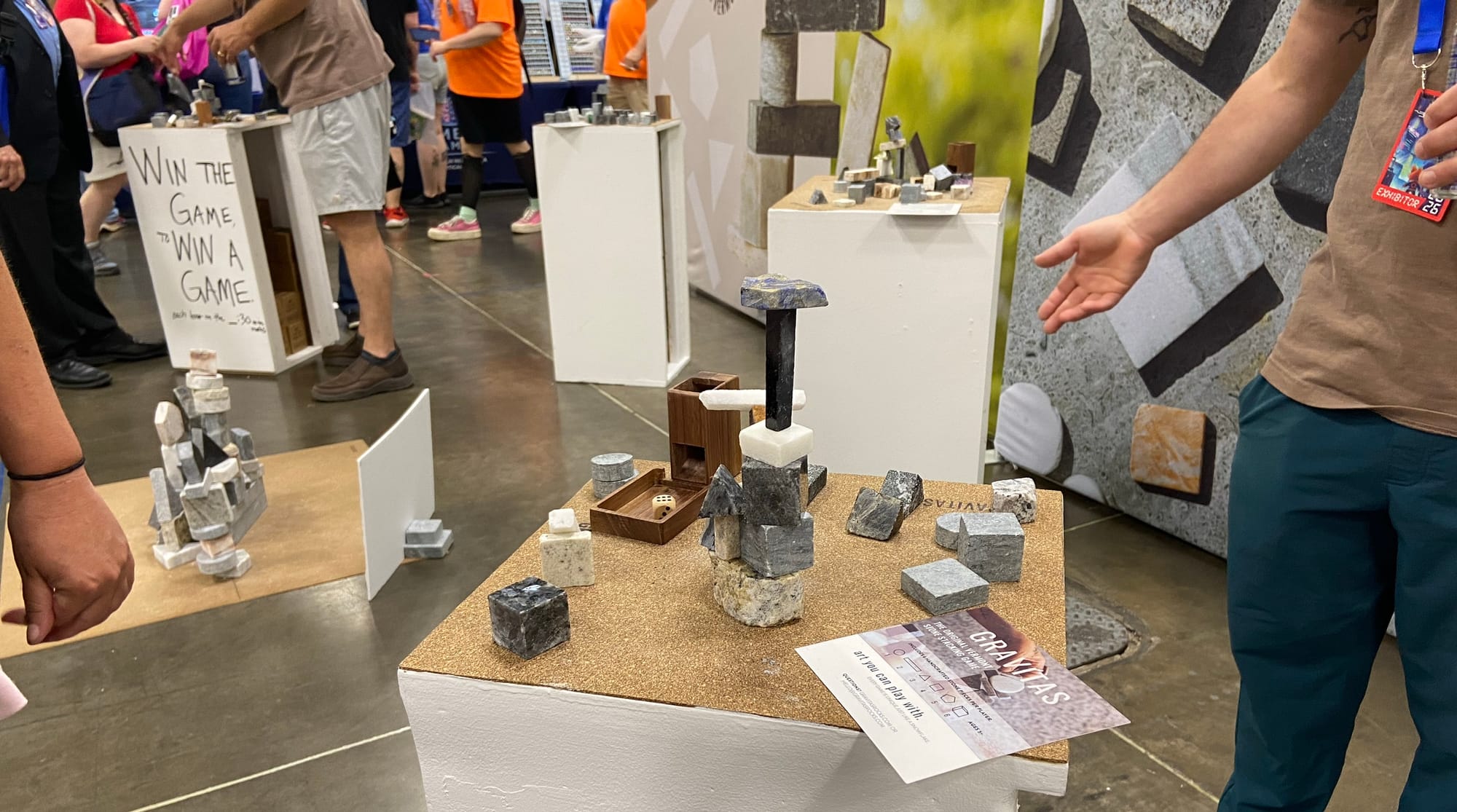
Gravitas is a 2017 stone-stacking game from Chris Gagne, Tom Hathaway, and Beck Lotka (with the company name also being Gravitas) that I saw for the first time at Origins Game Fair 2026. New to me!
Gameplay is straightforward: Roll a die, then place a single stone from your collection with the rolled number of sides on the shared base — or place multiple stones that add up to the number rolled. If you knock stuff over, take it. Place all of your pieces first to win.
The hook for this game over similar ones seems to be that the creators live in Vermont and use stones from their environment as the source material for game components, shaping them as needed, with each set having a unique set of components.
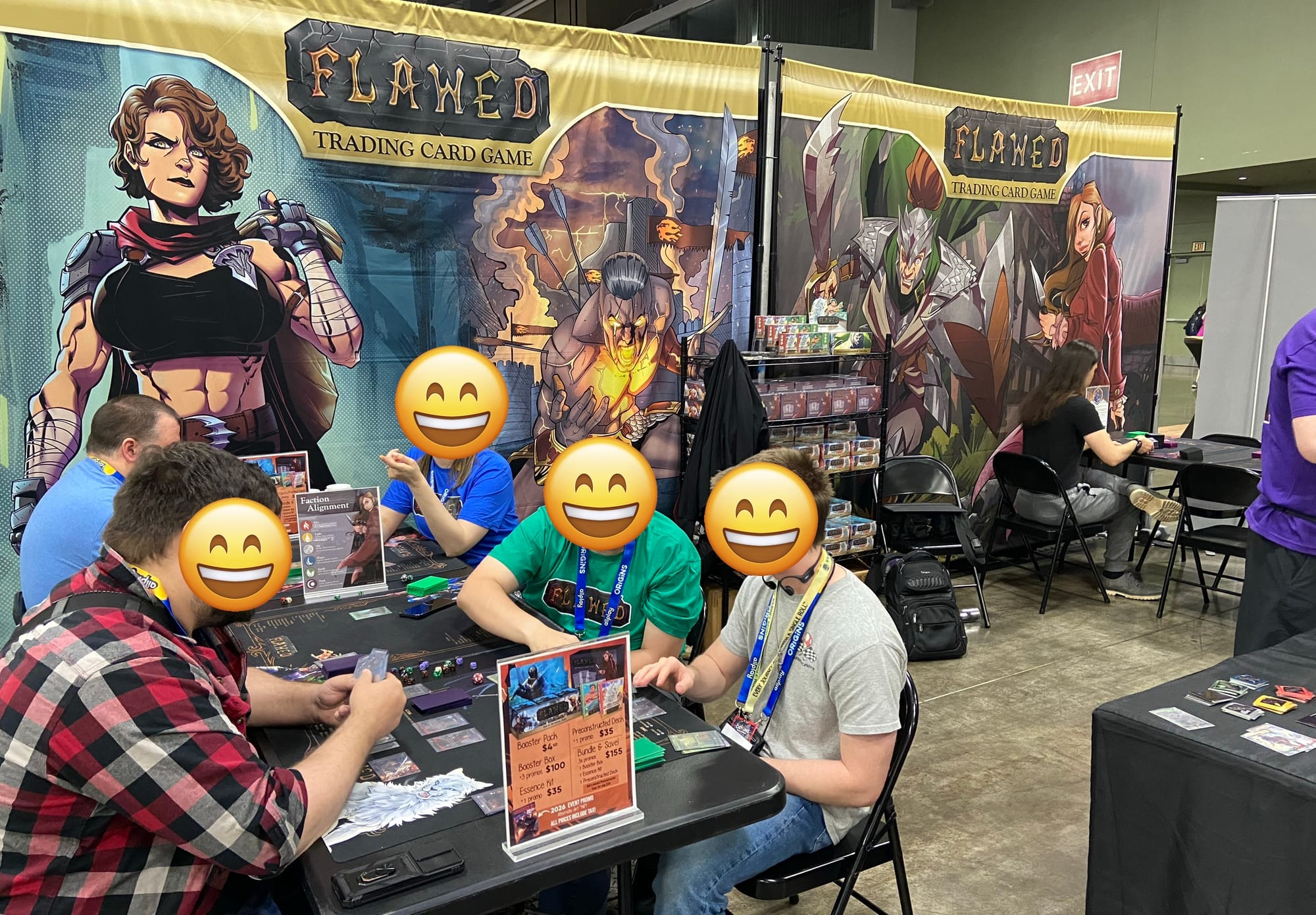
Another older game I "discovered" at Origins 2026 was Ken Tober's Flawed TCG from Best Man Gaming LLC — and by "discovered" I mean "took a picture of it while wondering whether the name would be a turn-off for potential players".
Italian publisher Horrible Guild, for example, launched in 2014 as "Horrible Games" and changed to its current handle in 2019 after perhaps realizing that players wouldn't be in on the self-deprecating joke.
Also, I think Jeff Siadek of Gorilla Games took that concept as far as it could go with the 2015 release of The Worst Game Ever.
I have one more Origins-related post coming the week of June 29 to wrap up that show's experience and give feedback on a few items that could use improving...then we can re-train our focus on Gen Con 2026, which opens in just over four weeks. Are you excited? I'm...split. More on that later.