

Everything old is new again, sometimes because you're re-evaluating the past, but also because the old is updated and introduced once again. With that in mind, here are three new editions of older games:
▪️ In 2020, U.S. publisher Story Machine Games released Jono Naito's co-operative game Rosetta: The Lost Language. Story Machine shut down in 2021, but many of the people involved launched a new company — DVC Games — in 2023, and in Q3 2026 DVC will return Rosetta to print, with the game now credited to Jasper Beatrix, the pseudonym used on many DVC releases.
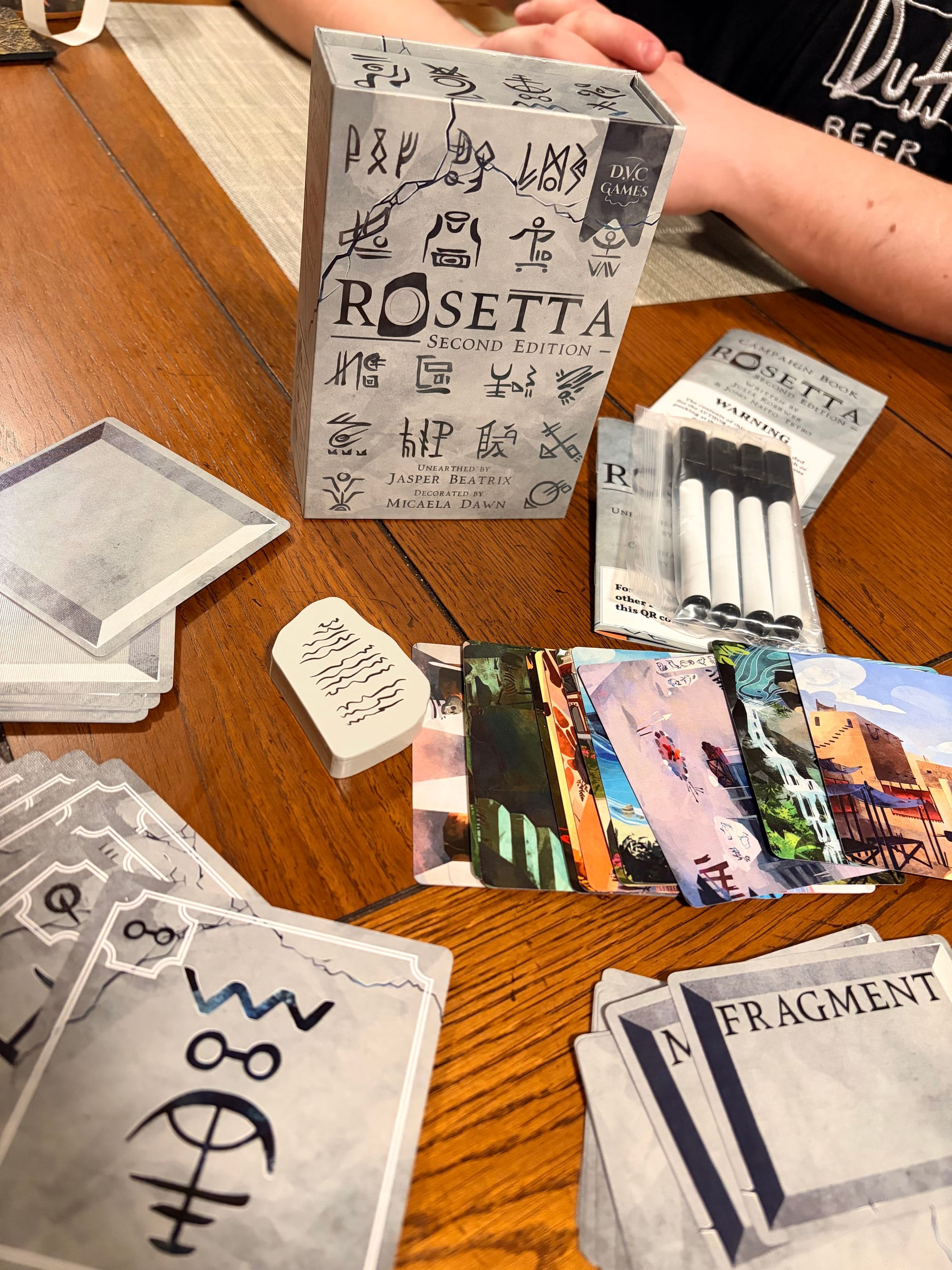
In Rosetta, one player takes the role of author, taking a random inscription (seen in the lower left of the image above) and location (seen in the image's middle), then creating a meaning for this inscription. The other players have ten guesses to discover this meaning, with each guess consisting of a word; the author then either crosses out the guess because it's not at all related to the meaning or creates a new inscription inspired by the guess to try to help others learn the "language" behind your meaning.
After three guesses, the author can use one of two random abilities to give a clue to the guessers, and after six guesses the author can either use the other ability or reveal the meaning of the inscription "fragment" depicted in the corner of the card.
DVC Games plans to have copies of Rosetta at Origins Game Fair in mid-June 2026, with the full release coinciding with Gen Con 2026.
▪️ Nicolas Oury's game Mykerinos appeared in 2006 from French publisher Ystari Games, and in 2026 Spanish publisher Looping Games plans to crowdfund a new edition that contains both the base game and the Nile expansion.
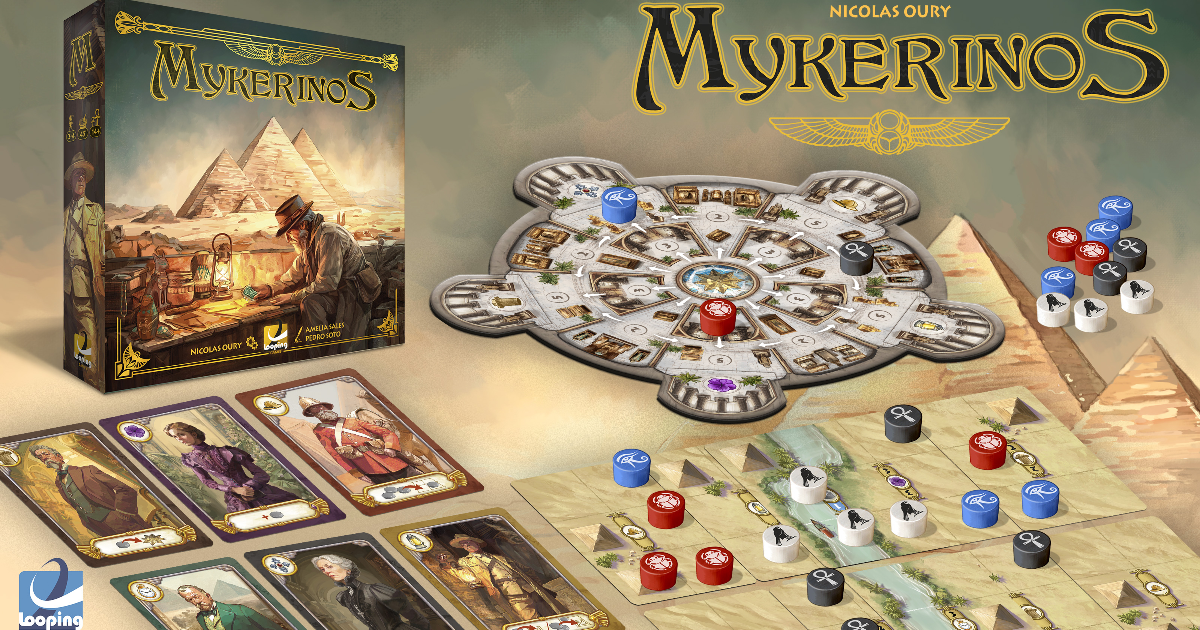
The gist of the game is that you're archaeologists trying to place relics in a museum, but you'll be forgiven if you think of it as placing tokens on cards and a game board.
Each round, a new region is laid out, with each area in the region being comprised of cards divided into spaces. In turn order, players take one action, either placing a token to start a new expedition, placing two tokens that branch from an existing expedition of yours, using the power of a patron (more on them soon), or passing.
Once all players have passed, you see who has the most tokens in an area, with that player either claiming a card from the area — which possibly comes with points and which almost always comes with a patron — or placing a token in the museum. The player with the secondmost tokens does the same, then if cards remain, the remaining players present can have at them.
You want patrons because they grant you special abilities, such as placing three tokens on a turn or placing on the pyramids that are normally off limits, but also because they're worth points at game's end, with the value of a card being determined by where you placed tokens in the museum.
▪️ U.S. publisher 9th Level Games will crowdfund a fourth edition of James Wallis' storytelling game The Extraordinary Adventures of Baron Munchausen, which first appeared in 1998 from Hogshead Publishing and which blurs the lines between role-playing games and tabletop games.
In this game, each player will tell a story to others, a story likely to be unbelievable though you'll swear to its truth. Those listening might challenge you at one point or another by placing a wager token on the table and questioning a detail in the story or posing a historical complication you have overlooked. You can respond by either sliding a token back their way to serve as a rebuttal — bribery for silence, if you will — or incorporating their objection into your story to detail the facts as they happened.
After all players have told a story, each player gives all of their tokens to whoever told the best story, with whoever ends up with the most winning. Thus, collecting tokens during play doesn't help you win, so don't hold them tight since you want them boomeranging your way once time runs out!


