

Online retailer Amazon ran its first Prime Day event on July 11, 2015 to celebrate its twentieth anniversary, with the idea being to offer specially discounted items available only to Prime members, that is, those customers who pay Amazon a monthly or annual fee in order to receive shipping discounts and other retail benefits.
More than a decade later, Prime "Day" now lasts four days, and many media outlets and specialty sites treat this sales promotion as a newsworthy event that merits coverage of all "the best deals", giving Amazon millions of dollars of free advertising while adding affiliate tags to the items they write about in order to earn a few bucks from each purchase.
However, as Judd Legum, Rebecca Crosby, and Noel Sims wrote in Popular Information in July 2025, "Amazon deploys deceptive tactics to exaggerate its markdowns and create a false sense of urgency. Featured items are often available at similar or lower prices at other times." To sum up the situation using their article headline: "Prime Day is a scam". Here's one example the authors cite:
[T]he Ninja Air Fryer Pro XL is on sale for $119.99, which Amazon says is a 33% discount off the list price of $179.99.
But Camel Camel Camel tracking reveals that the airfrier was not listed at $179.99 until May 19, 2025. It has been available for $119.99 or less every month since last November. Last November and December, the same product was sold on Amazon for $89.99.
The same air fryer is also currently available for the same $119.99 price from the manufacturer, Macy's, Best Buy, Kohl's, and Wayfair.
On September 25, 2025, Amazon agreed to a US$2.5 billion settlement with the U.S. Federal Trade Commission "settling allegations that Amazon enrolled millions of consumers in Prime subscriptions without their consent, and knowingly made it difficult for consumers to cancel".
Already reading Board Game Beat?
If you find my posts useful, interesting, or fun, please consider supporting. Paid memberships start at $2/month and help keep the site going.
~Eric
Three days earlier, two U.S. citizens had filed a proposed class action lawsuit (PDF) in a U.S. district court in Washington, citing examples similar to those in the Popular Information article and writing:
Amazon uses these fake Prime Day Percentage Discounts, offered under the extreme time pressure of the brief Prime Day window, to lure consumers to purchase products...
While there is nothing wrong with a legitimate sale, a fake one based on a fake reference price is deceptive and misleading to reasonable consumers. It is also unfair. And it violates Washington's consumer protection laws, which prohibit "unfair methods of competition and unfair or deceptive acts or practices." See Wash. Rev. Code § 19.86.020.
Aside from Prime Day, Amazon exploits and mistreats small- and medium-sized businesses as a matter of policy. To quote from "How Amazon Exploits and Undermines Small Businesses, and Why Breaking It Up Would Revive American Entrepreneurship", a 2021 article by Stacy Mitchell and Ron Knox from the Institute for Local Self-Reliance:
In a 2019 survey, three-quarters of independent retailers ranked Amazon's dominance as a major threat to their survival, and only 11 percent of those selling on its site described their experience as successful. It's not only retailers; small consumer product manufacturers, book publishers, and other creators are also imperiled. All of these small businesses are trapped in Amazon's monopoly gambit: the tech giant controls access to the online market, which leaves them little choice but to sell on its platform. Yet doing so allows Amazon, also their competitor, to exploit and undermine them.
Read the article for many examples of how Amazon takes advantage of its size to bully small businesses, including game publishers, who often use the site because they feel they have no choice but to do so. After all, if you don't create listings for your products on Amazon, a random seller will do so, giving them control over the details on that retail listing.
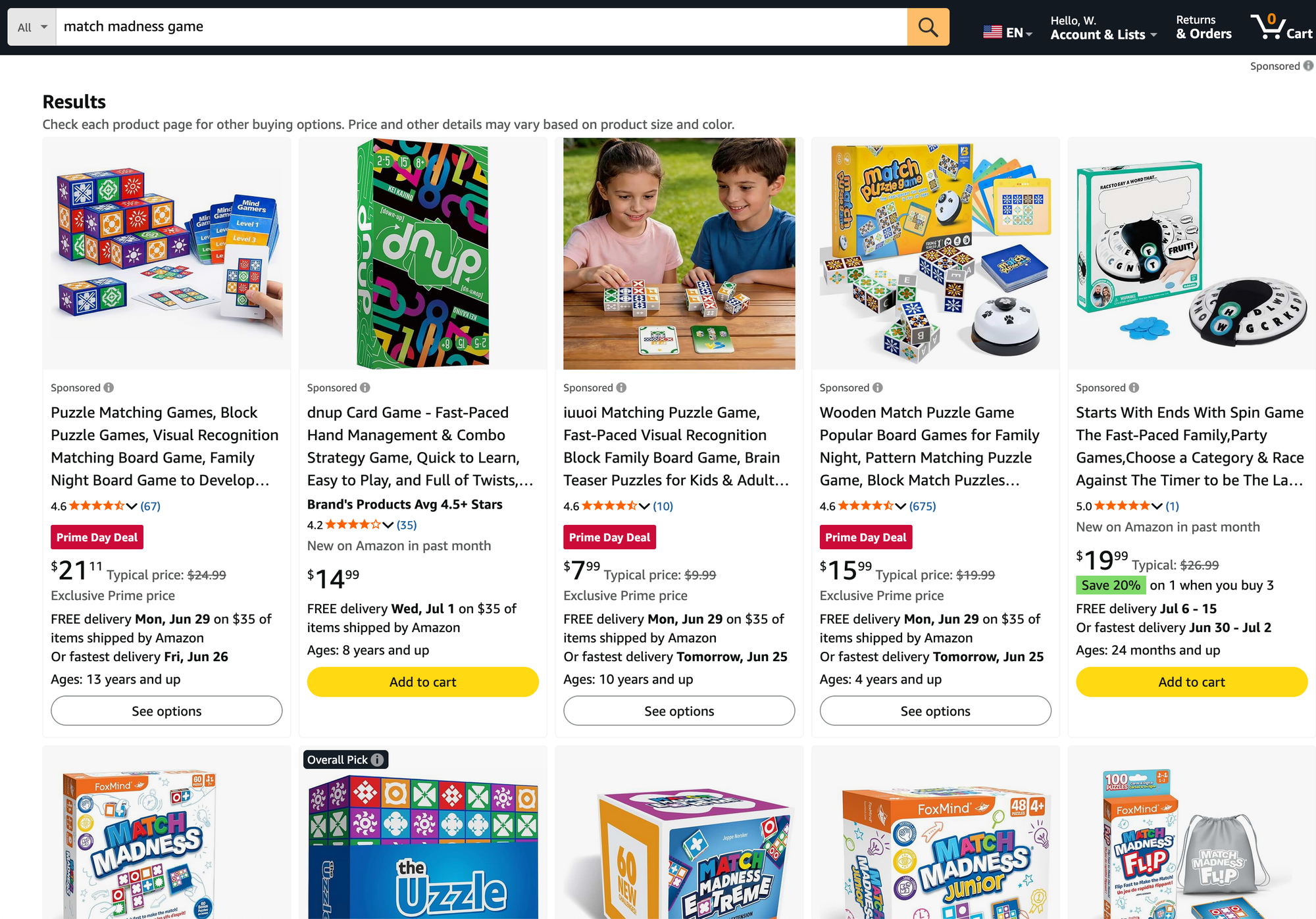
Companies also have to police Amazon for counterfeit products, reporting them in order to keep bad products out of buyer's hands and maintain their own reputation. This doesn't even include knock-off products. Search for Match Madness, for example, and three sponsored knock-offs appear at the top of the page, not to mention The Uzzle, a knock-off that's been around since 2021.
This isn't even to get into the issue of giving more money to Jeff Bezos, who destroyed The Washington Post, among other things.
Ideally, you can purchase games directly from their publishers so that more money ends up in the hands of their creators. Failing that, local game stores are an ideal source since they tend to introduce games to communities that would otherwise not see these designs. My third choice would be non-Amazon online retailers, which are sometimes the only option since not everyone has a local game store in their area.
I know my suggestions will rankle some who argue that a low price on a product is the best benefit to the buyer, but I think the long-term cost of such an approach is detrimental to all, especially when Amazon has a history of creating knock-off products itself and boosting sales of those items over the original ones. Knowing about Amazon's impact on game publishers and thousands of other small businesses has me giving the side-eye at outlets that use Amazon affiliate links. I realize that they're often trying to earn money for sales that (they would argue) would be made anyway, but I prefer to encourage others to shop elsewhere.
P.S. If you live in the United States and choose to shop for books online, I recommend shopping at Bookstore.org. You can choose a local bookstore to fulfill the order and to receive the profits from the sale, or you can have profits placed in a fund that benefits all local bookstore members. Thankfully, Amazon hasn't killed all of the small bookstores yet...


