

UK publisher Play for Keeps debuted in 2022 with an original design — Mandela Fernandez-Grandon's Overstocked — but since then it's focused on new editions of previously released games, with Hisashi Hayashi's The String Railway Collection and Nilgiri's My Favourite Things appearing in 2025.
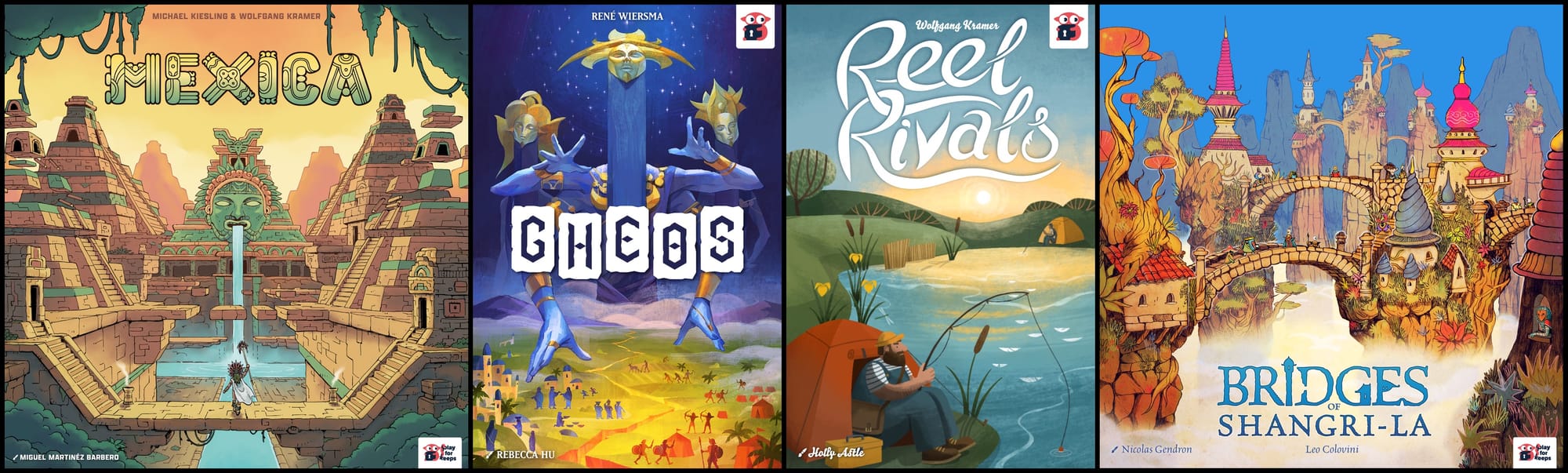
Now in May 2026 at UK Games Expo, Play for Keeps is demoing four new editions of older games that it plans to crowdfund in Q3 2026, with the amount of revisions in these new editions ranging from "just a smidge" to "I can't believe those are the same games".
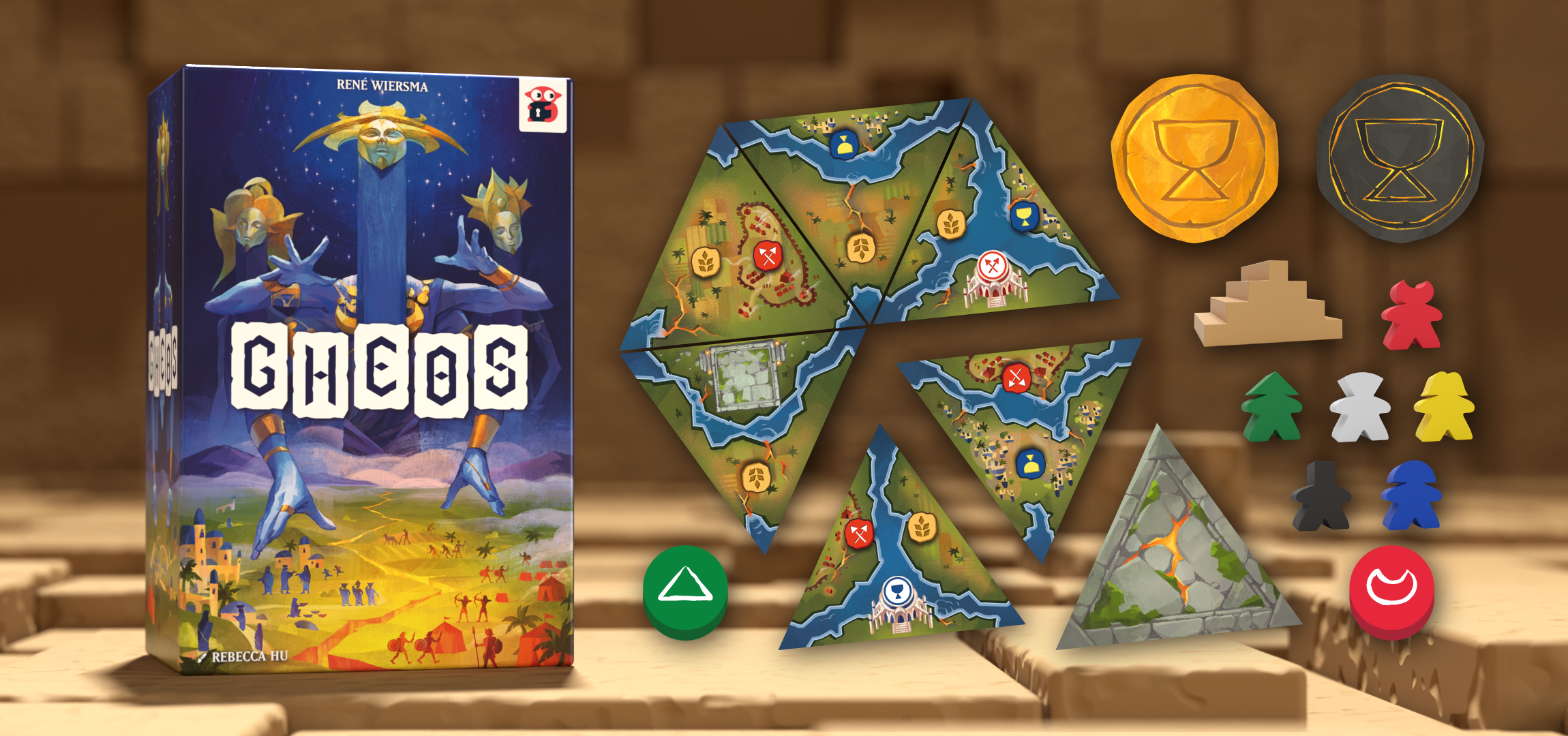
In the "smidge" category, we have René Wiersma's tile-laying game Gheos, which debuted from Z-Man Games in 2006 and which hasn't been published elsewhen until now.
Each turn in the game, you add one of two tiles in hand to the display or replace a tile already in the display. All tiles can be placed next to one another, so you don't have the Carcassonne challenge of finding the only tile that fits; rather, you want to use your tile to create, build up, or destroy civilizations, with a civilization being any landmass that spans more than two tiles.
After placing a tile, you start a civilization on an unoccupied continent or take one of the five followers of an existing civilization. Finally, you optionally play one of your three scoring tokens to score for each civilization you follow based on the characteristics within that continent. (All players score when an epoch tile is drawn from the stack.)
You're pulled in all directions in Gheos, wanting to build civilizations to maximize the value of your followers, yet with the risk that others will score for your work or smash a civilization by replacing a tile to sever the landmass. You don't want to go all-in and risk the latter, but if you wishy-washily do a little bit everywhere, you're unlikely to score in a meaningful way.
For this edition, Play for Keeps is pre-punching all of the tiles, which allows for a box half the size of Z-Man's, while including wooden temples that can be placed on tiles as a reminder that they can't be replaced.
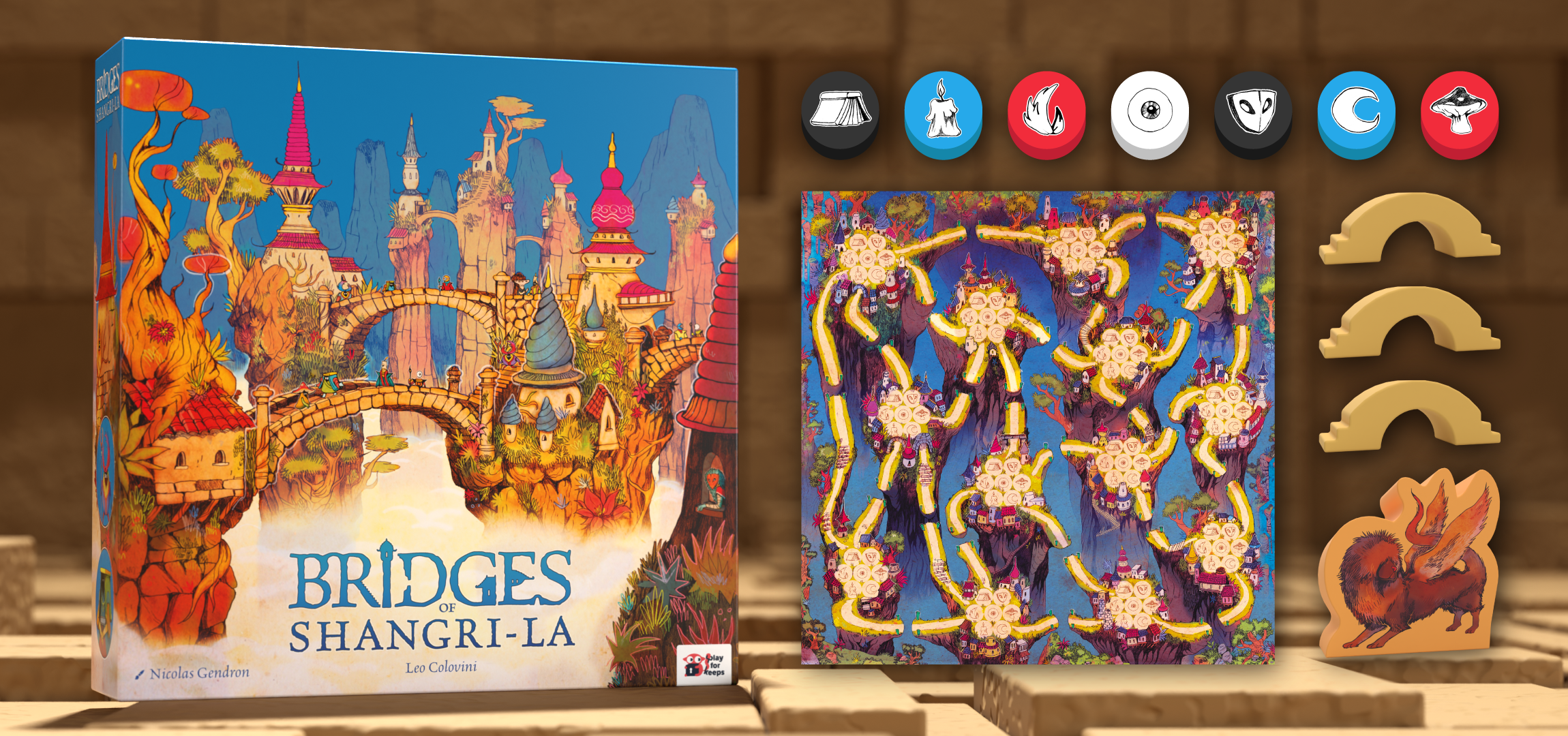
Leo Colovini's Bridges of Shangri-La debuted even earlier than Gheos, with KOSMOS releasing it in 2003. If nothing else, you should keep this game in mind for trivia purposes as it contains the best starting player rule ever: "Whoever has last reached the peak of Mount Everest using nothing but blue and white checkered stilts carved from the wood of a Mammoth tree is declared the Starting Player. In case of a tie, the wisest player of the group begins the game."
As for the game, you have masters of your color in seven disciplines, with one of each master starting on the board in villages. On a turn, you either:
- Place a master on an empty discipline space in a village where you already have a master.
- Place a student atop two of your student-less masters.
- Conduct a "Journey of the Students", which is when the effects of the other actions come into play.
To carry out the Journey, choose a village where you have at least one student as well as a neighboring village connected to the first by a path. If the village being moved to lacks a master in a certain discipline, the moving student becomes a master in that new village. If the discipline is occupied in both villages, however, the token from the stronger village — the one that started with more tokens — will be the master in the village moved to. After a Journey, the bridge between these villages collapses, so they can't interact again.
If you make smart choices, you can introduce masters in new villages while wasting opponents' students that might have taken your masters' jobs in other villages. Once most villages have become isolated, with no paths to the outside world, the game ends and whoever has more masters wins.
I played Bridges a handful of times in the early 2000s, but I haven't revisited it since — which is dumb since I'm a huge fan of most Colovini designs, which tend to have simple rulesets that lead to highly interactive games, with each action you take changing the landscape shared by all players. Time to break out that oldie!
Play for Keeps will introduce a two-player mode in its edition, which runs counter to the player interaction that I enjoy in Colovini designs, but it's not all about me, is it?
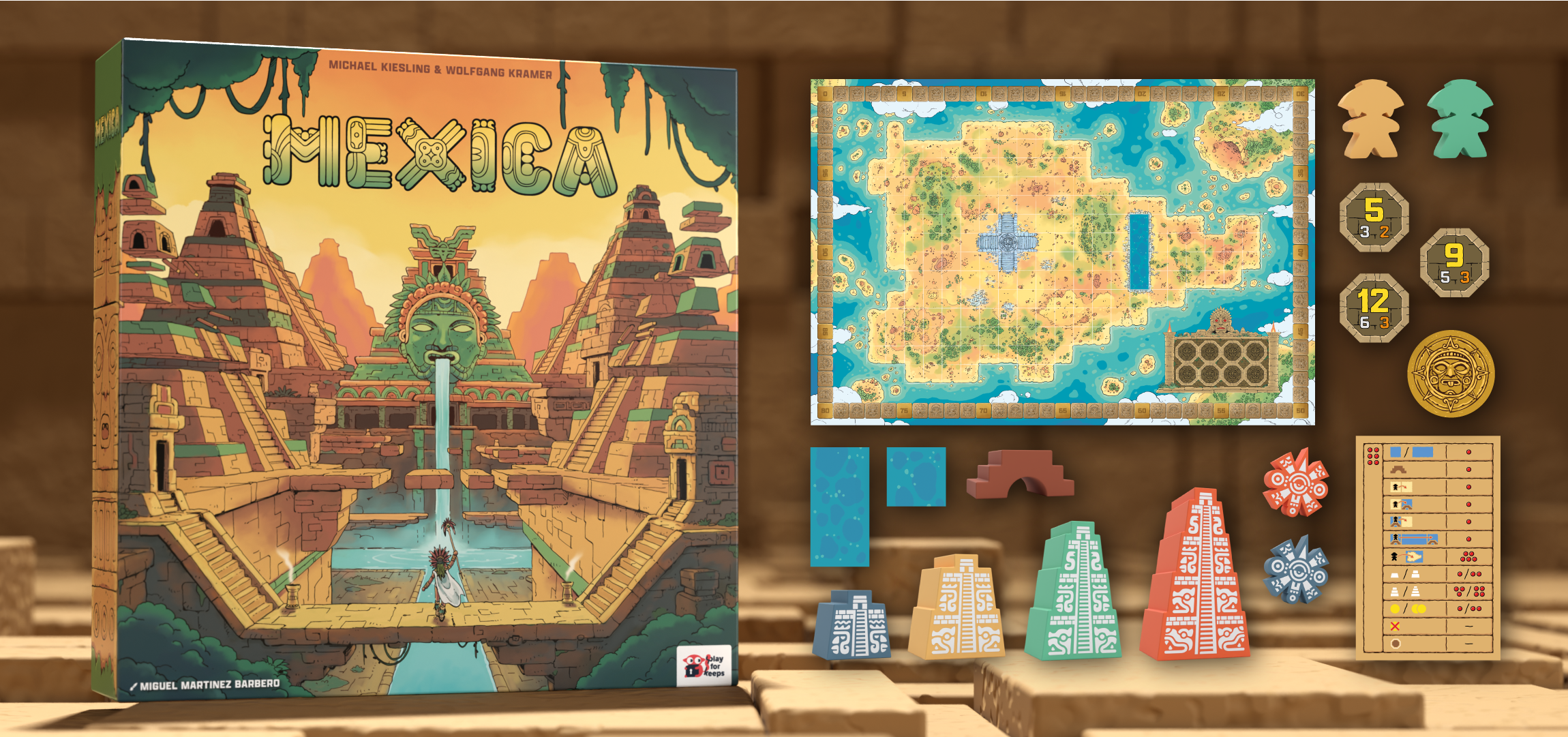
Stepping back in time a bit further we come to Mexica, part of Wolfgang Kramer and Michael Kiesling's "Mask Trilogy" with Tikal and Java. In this 2002 design, each player has six "action points" to use in a turn to move their figure around the island, place canals that carve up the land into districts, build temples, and place or move bridges so that you can move from one district to another.
You want to create districts in sizes that match the yellow numbers on the "calpulli tokens" — the octagonal tiles in the image above — so that you can place that token in the district and score points. What's more, the game includes two scoring periods during which players earn points based on the strength of their temples within founded districts; the larger the district, the more points you can earn.
For this edition, Play for Keeps has created a smaller playing area on the reverse side of the game board for quicker games.
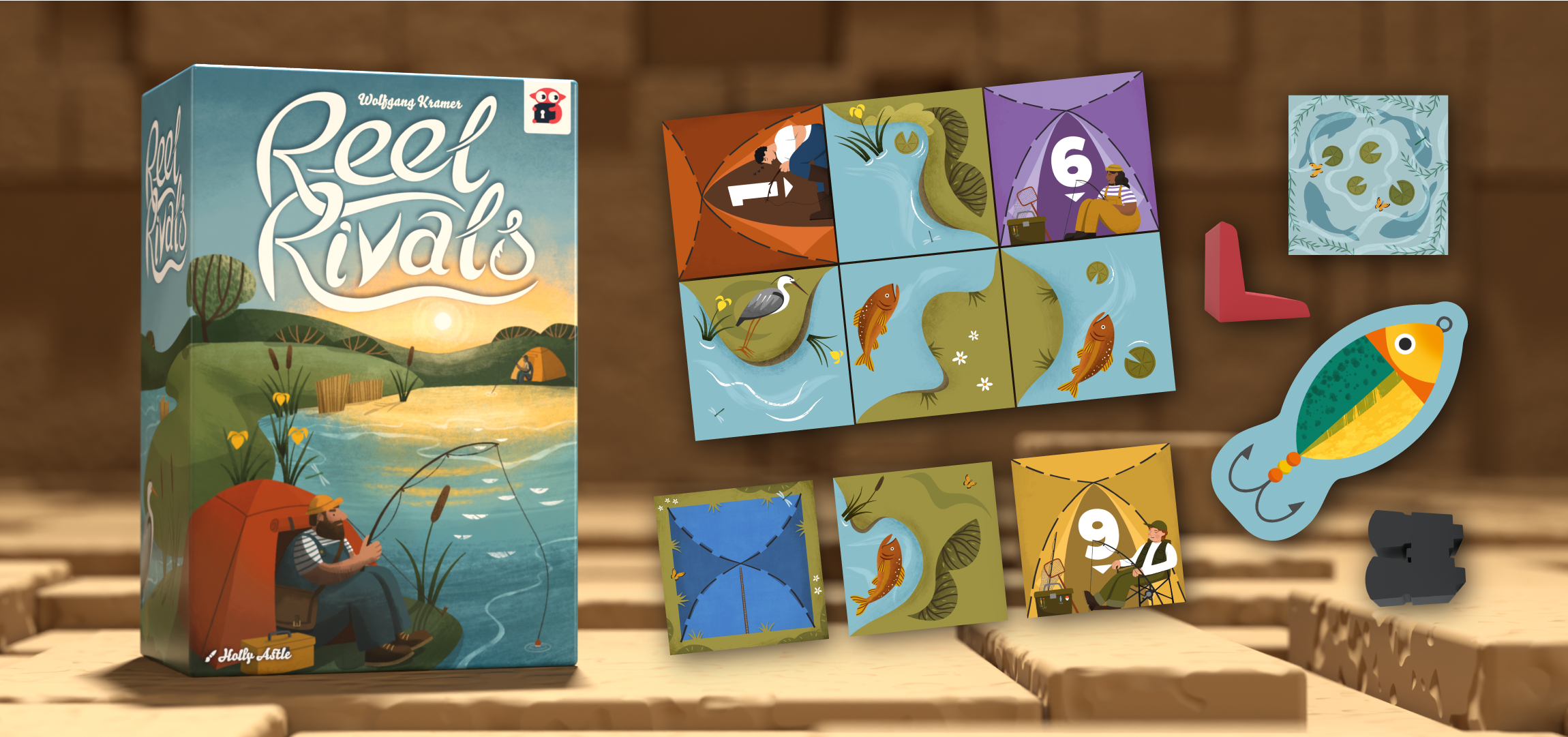
Finally, we come to Reel Rivals, the most radically changed new edition, with this being an overhauled version of Wolfgang Kramer and Richard Ulrich's 1998 game El Caballero. "Reel Rivals changed quite significantly during development, so that was part of the thinking for the name change," Anthony Howgego, Play for Keeps' developer and one of the company founders, told me.
More substantially, the subject matter has changed as well, with players no longer following in Christopher Columbus' footsteps to explore and control the New World. Says Howgego, "We also were a little uneasy about the Spanish colonialist aspect." Instead, players now collectively construct a marshy land filled with puddles and near streams and try to claim the best fishing spots.
Howgego notes that the gameplay has been streamlined: "We've made the game faster. We reduced the number of decisions players are asked to make each turn, but tried to make each of those decisions more consequential."
I don't know the details of the new rules, which is credited only to Kramer, but I'll summarize the earlier design. Each round, players take turns laying down a power card that features a value from 1-13 and a number of caballeros, which I suppose will now be "tent strength" or something along those lines. The higher your value, the fewer caballeros you receive.
Then in order from whoever played the highest value, players add a tile from the display to the shared play area and optionally add 1-2 caballero tiles to the area to show their influence on a particular stretch of land. You can spend caballeros to place ships adjacent to water regions.
Twice during the game, you score each land region, with whoever has the most influence scoring points equal to twice that land's size, plus 1 for each gold icon on it, as well as each water region, with each ship scoring for the size of the region, plus 1 per fish.
You can remove caballero tiles from the play area, and while you don't get a refund on the caballeros you spent on that tile, you might remove such a tile anyway, whether to combine areas, expand an area, or knock out an opponent's tile since each such tile can be adjacent to land along only a single edge.
Howgego tells me that the DNA of El Caballero still runs through Reel Rivals, and "with it the sharp tactical decision making that made us fall in love with it". As with Gheos, the tiles in Reel Rivals come pre-punched, making the box about one-third the size of El Caballero, which was released in an era when everyone's game to shelf ratio was far lower.
Like this kind of coverage?
Get Board Game Beat’s free posts by email — original reporting, designer interviews, and industry news, with no tracking, no ads, and no spam.


