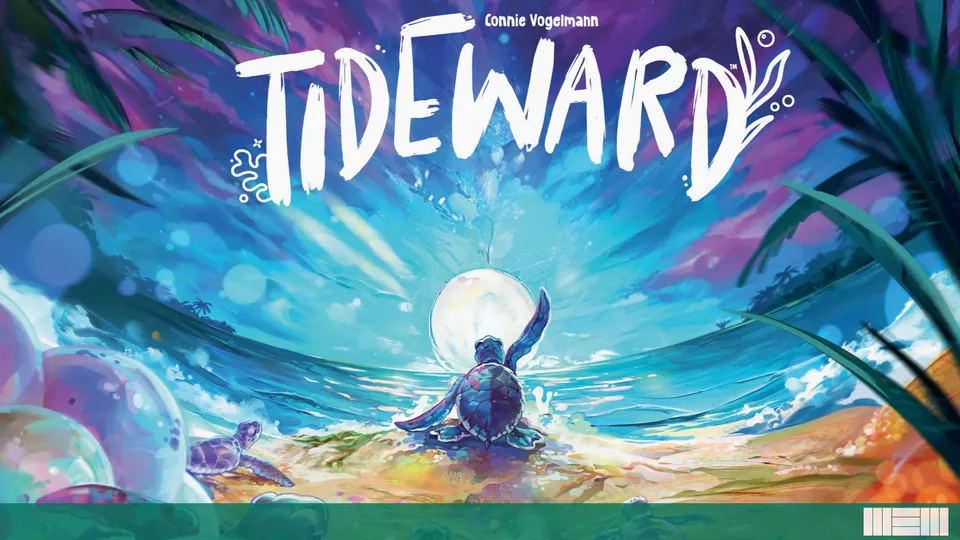
Time to sample a few titles from French creators and publishers. Why? Because they make cool stuff.
Letter Up
French publisher Unfriendly Games came to prominence in 2023 with the dexterity game Nekojima from David Carmona and Karen Nguyen, and now that design duo has released a v. different style of game in Letter Up, which hit the French market on 24 July 2026.
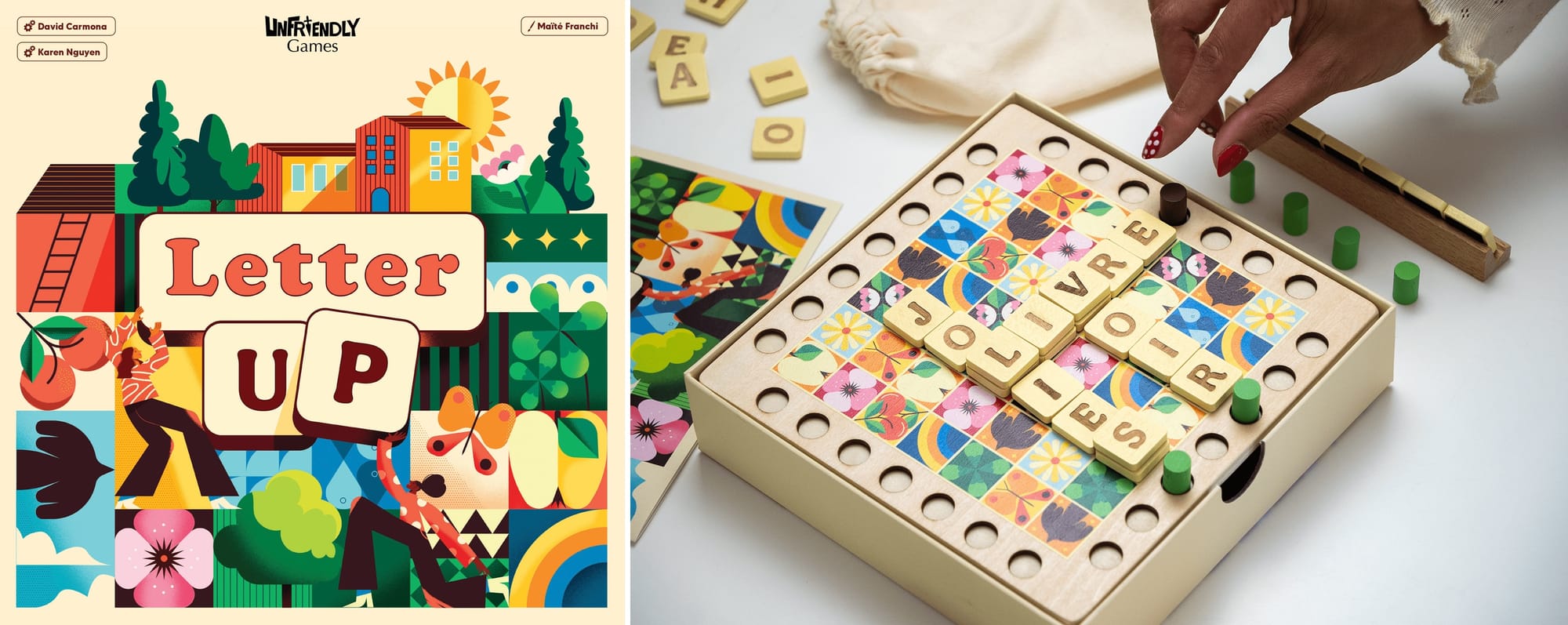
In this game, two players take turns placing letters on the 7x7 board to create words. You've probably seen such games before, yes? Roughly twenty years ago, a friend who competed in Scrabble tournaments told me that at high levels of play, the game becomes an area-control challenge, with you trying to make it difficult for your opponent to grab valuable spaces.
Letter Up is an area-control challenge from the get-go. When a created word touches the edge of the playing area with the first or last letter, you place a token next to that letter. As in Upwords, another classic word-building game, you can place letters on existing letters in order to create new words — and if that modified word touches the edge, you can replace your opponent's token with your own. In the picture above, you can imagine the green player playing VOIR ("to see") to change LIBRE ("free") to LIVRE ("book"), which allows them to replace that black token with their green one. Yoink!
You can stack at most three tiles on a space, but if a word spans the board from edge to edge, the letters in that word are frozen, which means the player who created (or changed) that word will have locked two tokens in place.
Whoever first gets their six tokens on the board wins.
Un Curieux Jardin
Un Curieux Jardin ("A Curious Garden") is the newest title in the "Fil Rouge" series by Julien and Tom Prothière that debuted in 2024 with Shadow of the Tiger and Dans leurs Regards ("In Their Eyes"). "Fil Rouge" literally translates to "red thread", but it also means "common thread", and in these games players need to reconstruct a story from the parts that they see.
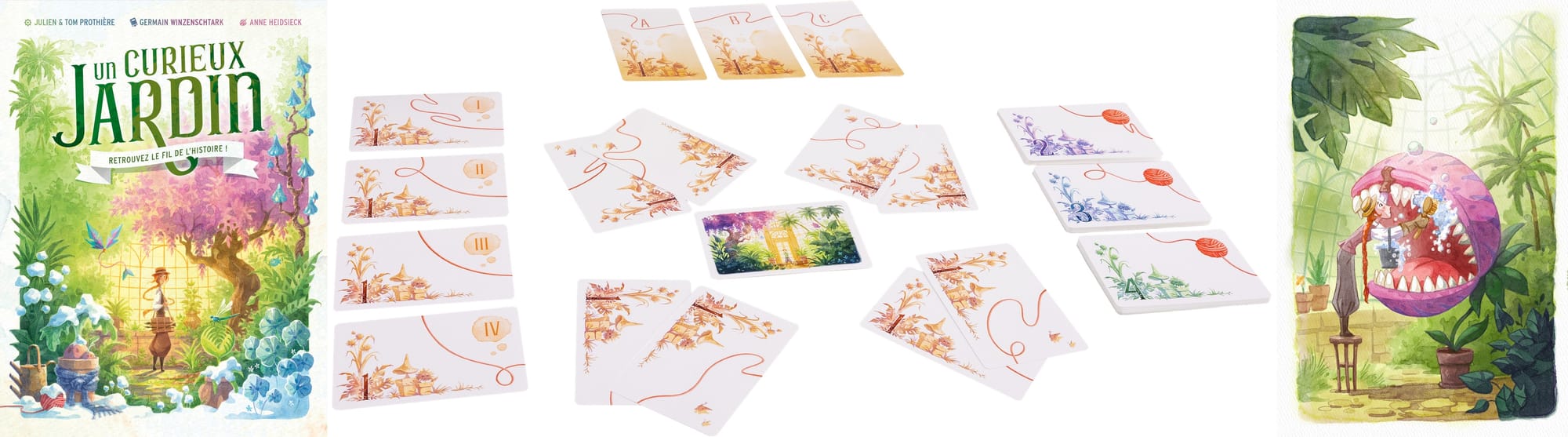
In a scenario by Germain Winzenschtark, Un Curieux Jardin presents 2-4 players with four story chapters that they need to reconstruct. Each chapter features four "discovery" cards numbered I-IV, cards distributed as evenly as possible among players, and a card with a red ball of yarn, which is revealed to all; this card depicts a scene within the story.
Players discuss the cards they hold to try to make sense of the order in which events took place, and whenever someone is ready to do so, they place a card from their hand face up at the beginning or end of all cards currently revealed. Someone then draws the next discovery card, and over the course of the game, you will place all of the cards in a timeline. You can spend tokens to change the order of up to three cards, then you reveal the A-B-C cards one by one to discover whether you've figured out what took place.
The earlier Fil Rouge titles were released by Lumberjacks Studio, but that studio now bears the name KODAMA. L'esprit joueur ("KODAMA. The playful spirit"), although it also bills itself as Kodama Games.
Le Petit Théâtre
KODAMA released another co-operative game earlier in 2026: Le Petit Théâtre ("The Little Theater"), a design by Gricha German and Quentin Guidotti in which 1-4 players attempt to re-create a play about a princess who is in love with a troll.
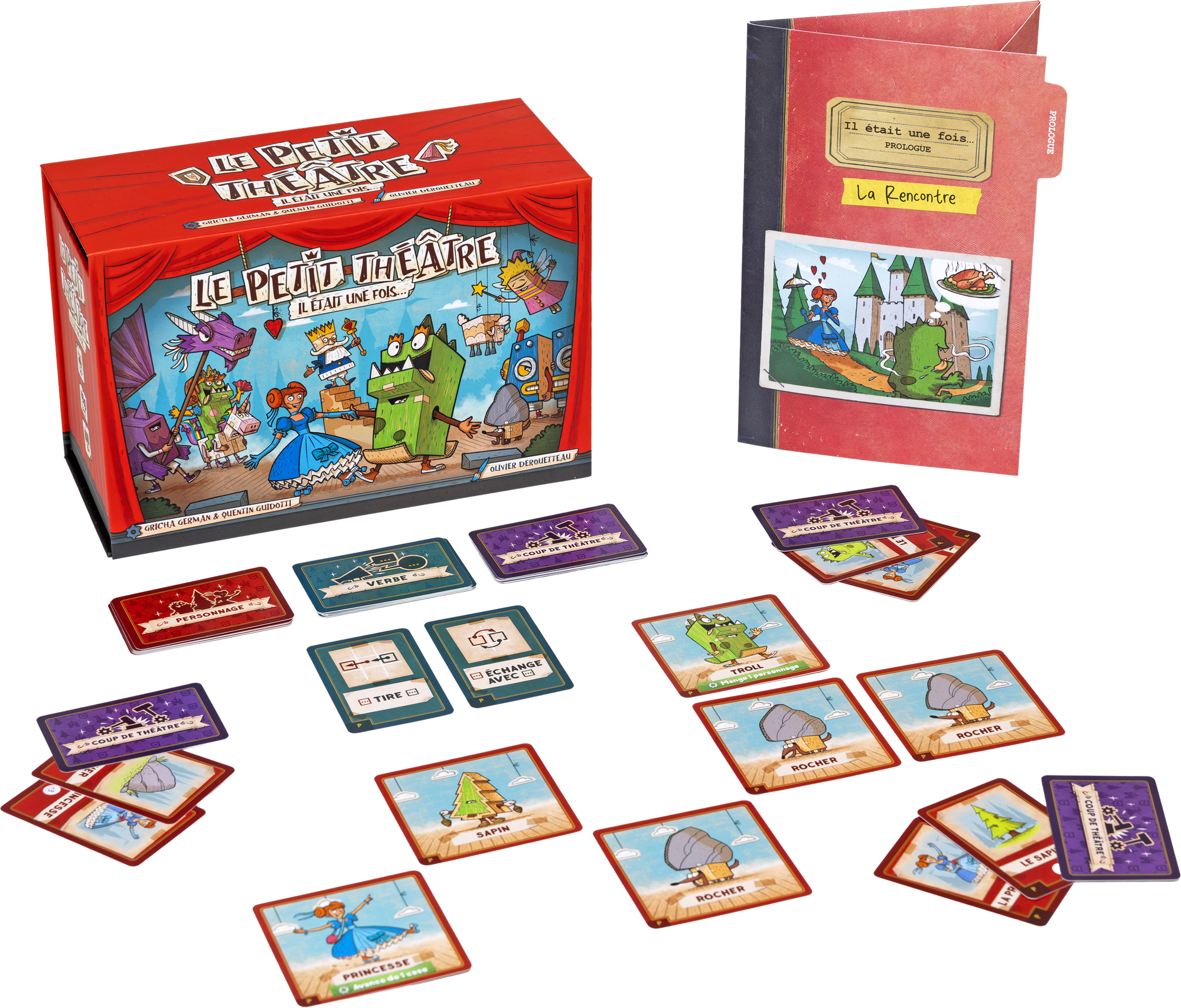
The game consists of a prologue, three acts (each with four scenes), and an epilogue. At the start of each part of the play, lay out cards in a specific arrangement, then deal each player 1-4 character cards and 1-2 "dramatic twist" cards, while placing two verb cards face up. The play set-up gives a bit of direction, along with what you want to make happen in the scene.
Players can talk about what they have in hand, and to take an action, they play one or two character cards around a revealed verb in order to create a sentence, then they carry out the sentence. In the image above, the verbs allow character A to TIRE ("pull") character B or character A to ÉCHANGE AVEC ("exchange places with") character B. Once you carry out the sentence, you discard the verb and draw a new one. You can discard a dramatic twist to draw two characters or carry out its special action.
Ideally you can resolve the scene properly before you all run out of cards, and you'll record the success of your production based on the audience's applause.
LEDA
In June 2026, publisher Sorry We Are French released LEDA, a design by Pierrick Libralesso, Renaud Libralesso, and Yoel Sayada that falls into the chic category of two-player games with asymmetric factions. In LEDA, each player takes charge of an animal clan — cats, pandas, sharks, or scorpions — with each having a unique set of tiles and a personal victory condition.
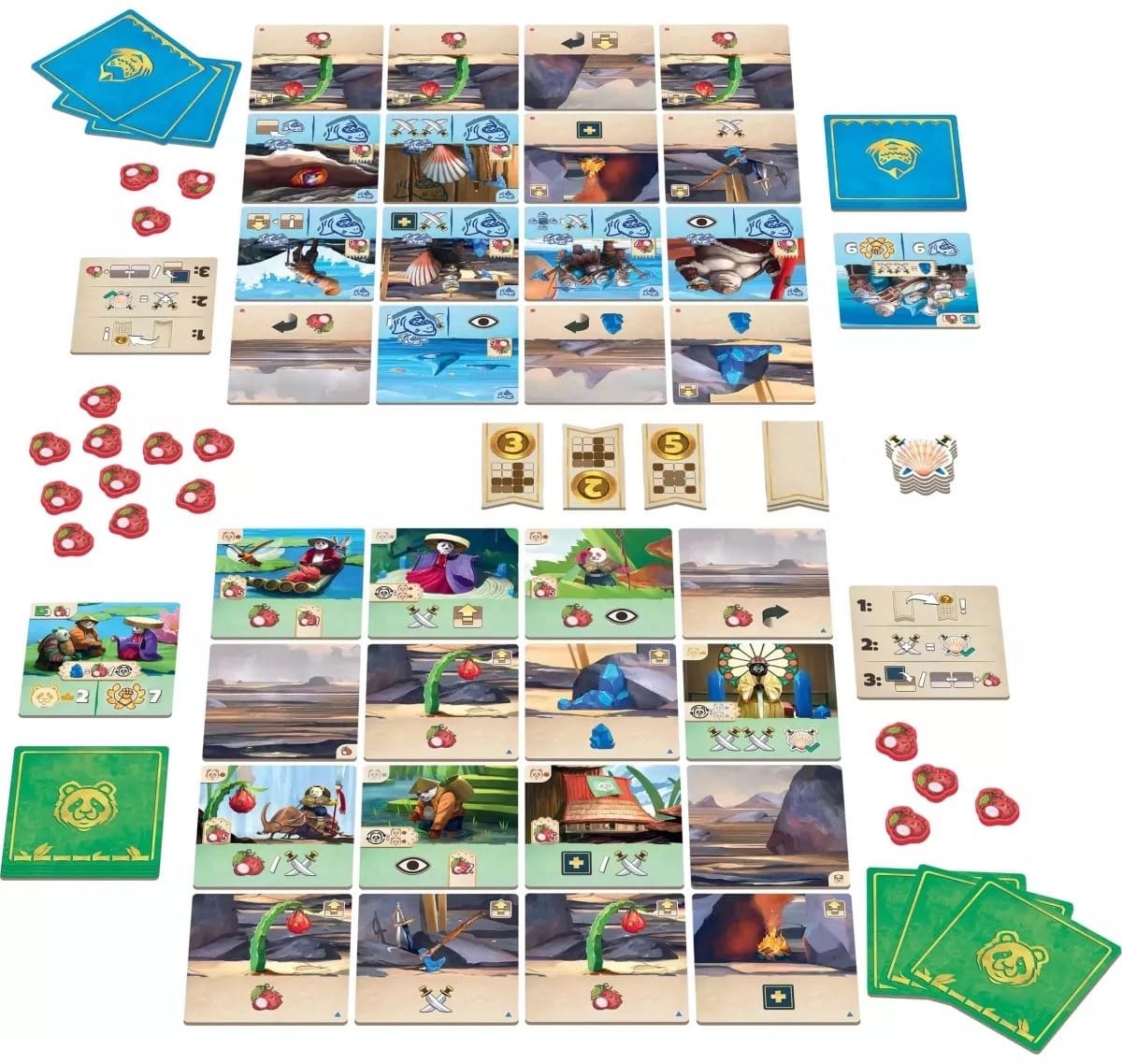
On a turn, the active player reveals an action tile, which indicates a row, column, or grouping of four squares that they can activate in their grid, after which the opponent activates those same tiles in their grid. These tiles might give you food, military strength, additional clan cards, a clan effect, or some other ability. Some of these cards are permanent, while others flip to their desert side after use.
Whoever has more military strength this turn draws a military tile, which rewards them with 1-2 victory symbols and possibly another reward. Starting with the active player, players can now either play a clan card from their hand by paying its cost and covering a tile in their grid or swapping two tiles in their grid and gaining a food.
You win by collecting the indicated number of victory symbols or by completing your clan goal: Sharks want to place their nine tokens on their tiles, scorpions want to place a portal in each corner of the grid, cats must meet board conditions to place rings, and pandas must experience awakening.
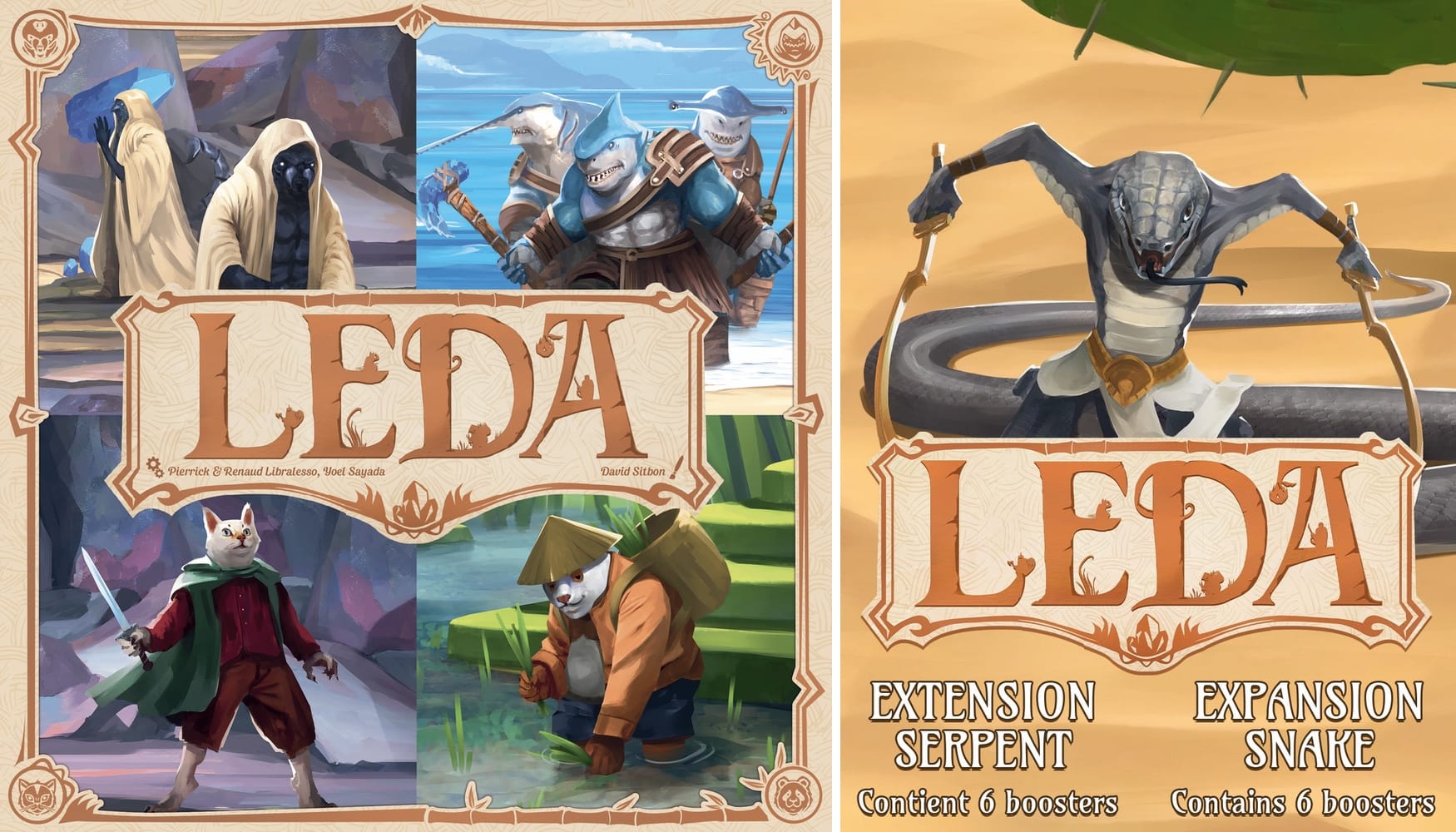
The LEDA rulebook depicts more animal clans that are part of this world, and SWAF has already announced the Snake Expansion, with snakes coming onto the grid as face-down egg cards, then bursting from their shells — i.e., being turned over — when their tile is activated, surprising the opponent with mystery powers.
Want more game write-ups like this one?
Get Board Game Beat’s free posts by email — original reporting, designer interviews, and industry news, with no tracking, no ads, and no spam.