

Designer Stefan Feld has had three games released so far in 2026 — Medico, Manila (a new version of 2013's Amerigo), and Beijing (a new version of 2007's In the Year of the Dragon) — but I've played none of those designs. Instead, I want to talk about his SPIEL Essen 25 release: The Druids of Edora, which was the first time since 2020's The Castles of Tuscany that Ravensburger's alea brand has released a Feld design.
I wrote an overview of The Druids of Edora in May 2026 after playing for the first time, and now I have ten more playings under my belt, which is a nice change of pace from what I used to do at BoardGameGeek. For that site, I'd (ideally) play a game a few times, then I'd record a video or write about it (or both), then I'd never touch the game again because I had to cover something else.
These days, I dig into games as much or as little as I want. With Edora, one person in a weekly game group keeps wanting to play, so I've now brought it four weeks in a row, playing five games over that span...and I'll probably play it again this week, too. The person who keeps asking to play keeps winning, often by margins of at least twenty points, so I keep returning to the game and asking myself, "How can I possibly take down Maria?!" Maybe you can give me some advice...
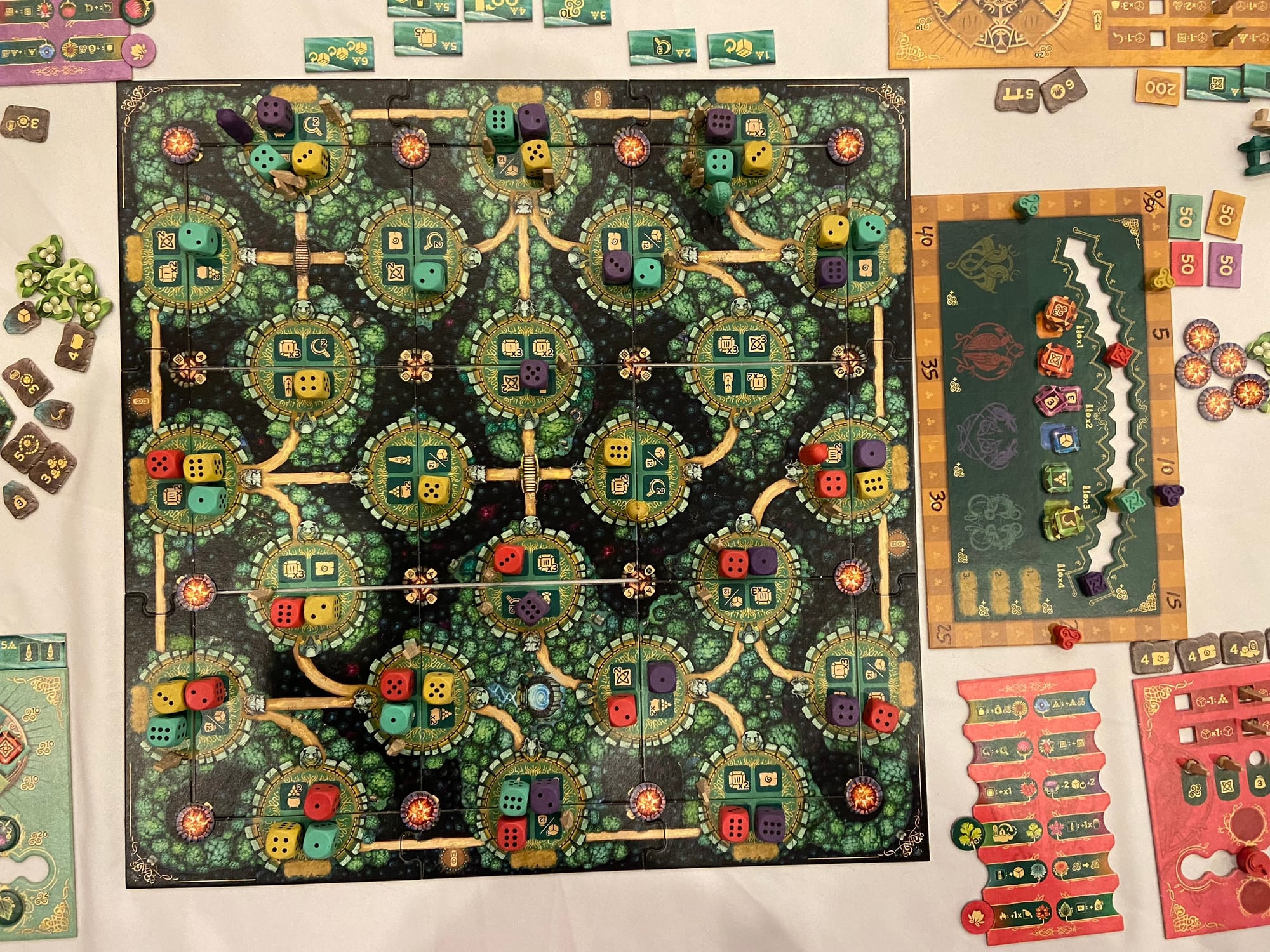
From one perspective, The Druids of Edora has a simple concept: Walk through the forest turn by turn, taking exactly one action at the shrine where you stop and covering that action with a die. Each player has thirteen dice, so the game will likely last only thirteen rounds, with you taking thirteen actions in total.
However, each die you place typically does several things at once, with you trying to maximize the value of each die. You'll carry out whichever action you choose in the shrine where you're located, with the cleverly designed game board placing 2-4 actions on each shrine depending on the player count, but on top of that you want to use the die to:
- Surround bonfires on a first come, first claimed basis, earning you 2-4 teeny bonuses in the process.
- Create a chain of dice that connects two like-colored dolmen on the game board perimeter, earning you points based on the length of the connection and how early you completed it.
- Dominate others at a shrine since the highest-valued die earns its owner a couple of points when an action is taken at its location.
- Claim ownership of runestones and menhirs (a.k.a. standing stones) at game's end, potentially for a huge point payout.
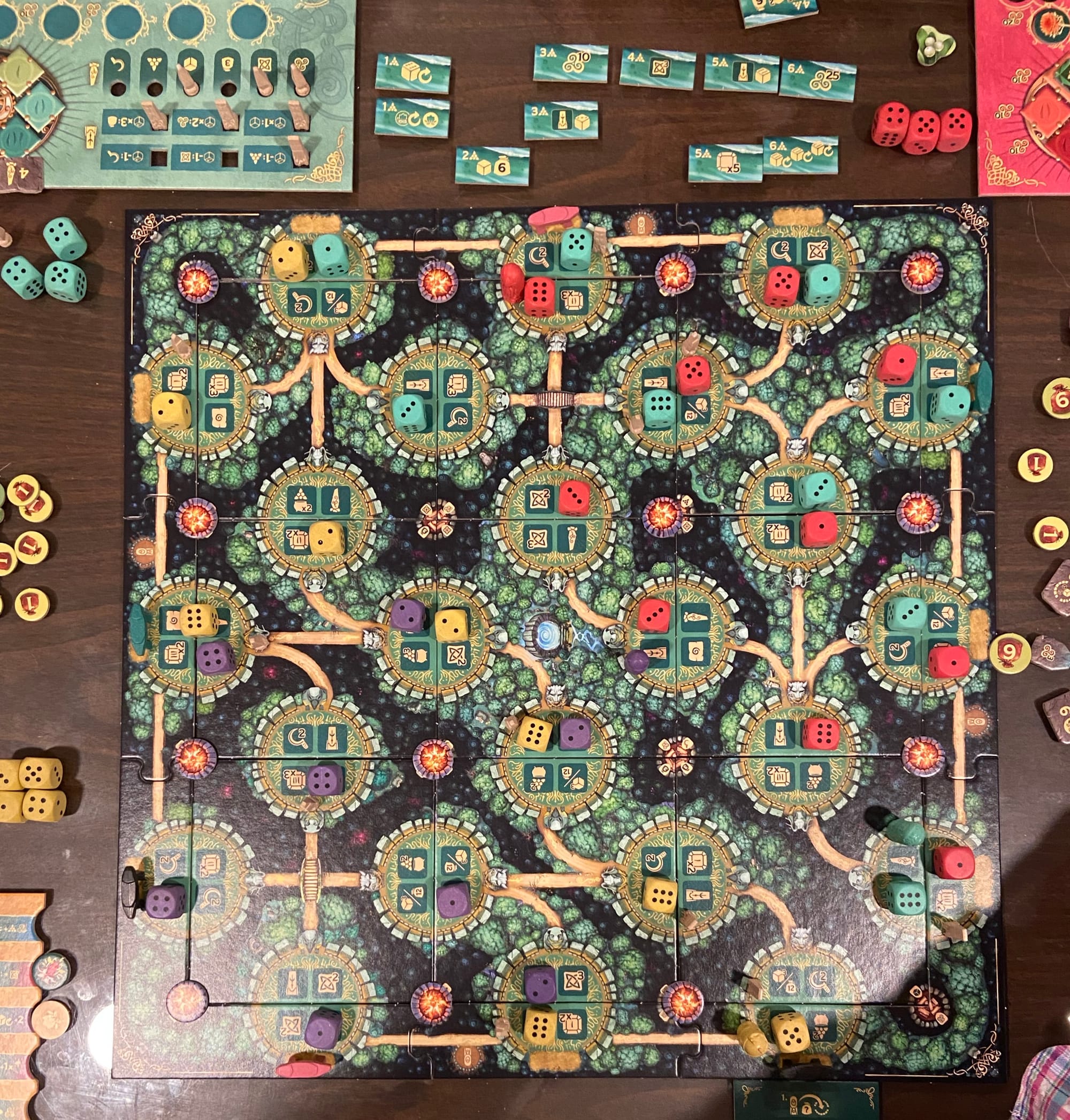
What's more, even the basic action you choose on a turn is often two or more actions folded together...and for some reason this aspect of the design didn't click for me until a couple of games ago. Let's zoom in on part of a game board:
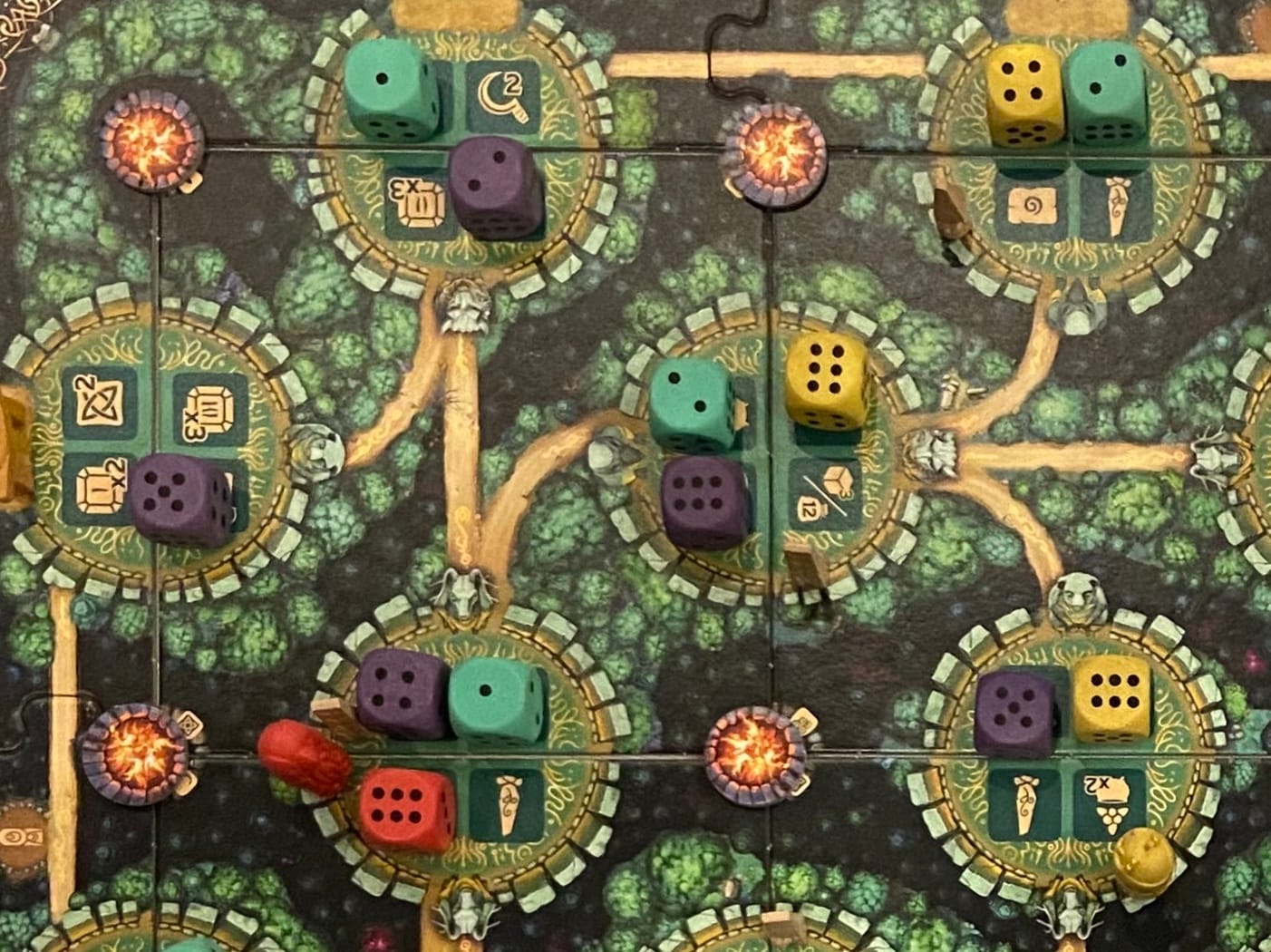
In the upper left corner, one of the actions is to advance the sickle on your game board two spaces, and the more you advance your sickle, the more herbs you put to use, with each herb modifying an action for you for the remainder of the game. Sounds good, right?
And yet the other action on that shrine is to take a gemstone and carry out the action on that gemstone three times — and wouldn't you know it, one of the gemstones you can take features a sickle, so taking the gemstone would advance your sickle further. What's more, if you have the right arrangement of gemstones on your personal player board at game's end, you'll score bonus points, so not only do you get 50% more sickle action, you set yourself up for extra scoring. Why would you ever take the sickle action on its own?!
Admittedly, you can take each gemstone only once, so you can't gem-sickle repeatedly, but you can gain sickle actions in other ways. In the lower left, the only action remaining is to place a menhir from your player board on this shrine, then take the bonus associated with that menhir twice and every other bonus associated with a menhir you've placed once. If you choose the menhir that gives a sickle bonus, you'll move the sickle twice, but you'll also get any other bonuses for menhirs previously placed.
That seems strictly better than choosing the sickle action, but when you take a menhir action, you place the menhir on the shrine where you took the action and whoever has the highest die on this shrine claims that menhir (along with their die) at game's end — and each claimed object is worth 0-4 points depending on how far a player has moved up the tiebreaker/multiplier track. However much the menhir benefits you, you'll give points to the red player at that shrine — both when you take the action at that shrine and at game's end — unless you also have a 6 and beat them on the tiebreaker track, so will the action be worth that cost? Maybe, especially if you plan to place one or more menhirs later (or if red has scored few points).
An action in the lower-right corner lets you take one mistletoe, then cast up to two spells. Here are the spells available:
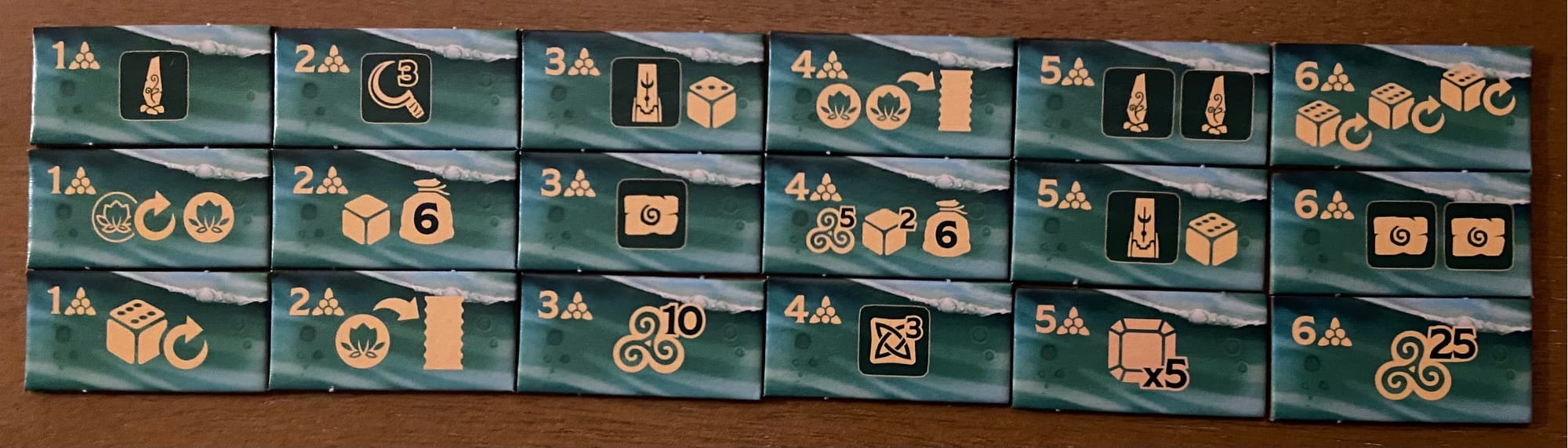
Taking mistletoe is another bonus you can get from gemstones or menhirs or other actions, but only this action space allows you to cast spells, which is where things can get bananas, primarily with the 5- and 6-cost tiles. The topmost 5-cost spell, for example, lets you place two menhirs, one after the other, so you get all the bonuses for the first one, then all the bonuses for the second one (which will include another bonus of the first one), which sets you up for even better future menhir placements, while placing two menhirs on the shrine where you cast the spell. Hope you placed a 6 there in order to score those menhirs at game's end!
Oh, and that was only the first spell you cast, so what's next? One trick people have done in several games is to use the 3-cost runestone spell (third from the left at top) or the 5-cost runestone spell (five from the left in the middle) to gain a bunch of mistletoe so that they can cast another expensive spell for their second one. It might seem silly to spend an action to get mistletoe only to spend it immediately, but by doing this you've placed a runestone or menhir on the board — with runestones being another endgame scoring feature — in addition to claiming a spell, which (1) keeps it out of other player's hands and (2) possibly helps you toward an endgame bonus.
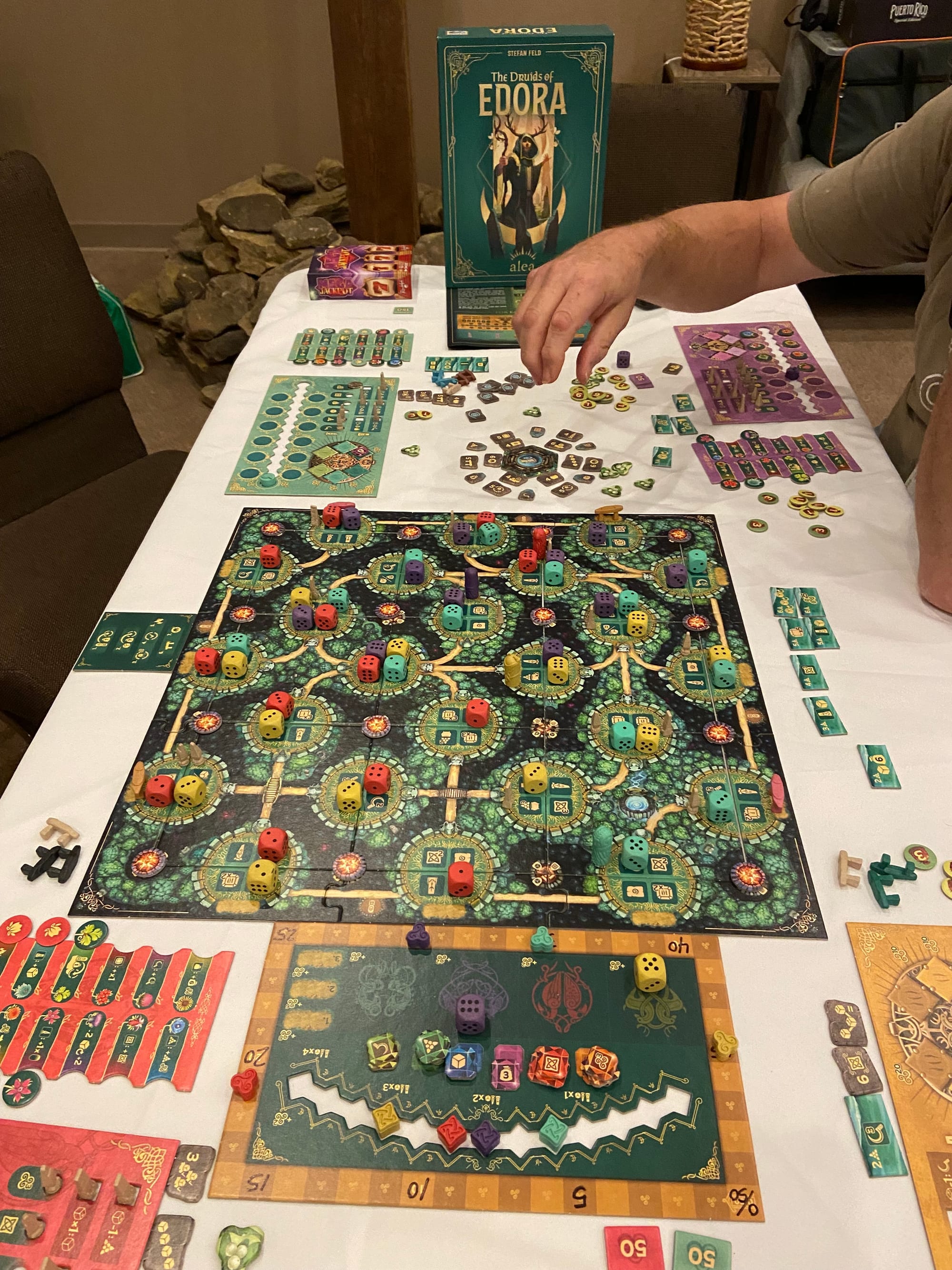
The middle 3-cost and 6-cost spells let you take one or two endgame objective tiles, each of which is worth 10 points if you achieve it, and when you take an endgame tile, you take the bonus lying on each side of the tile. Look at this shot from the end of a different game:
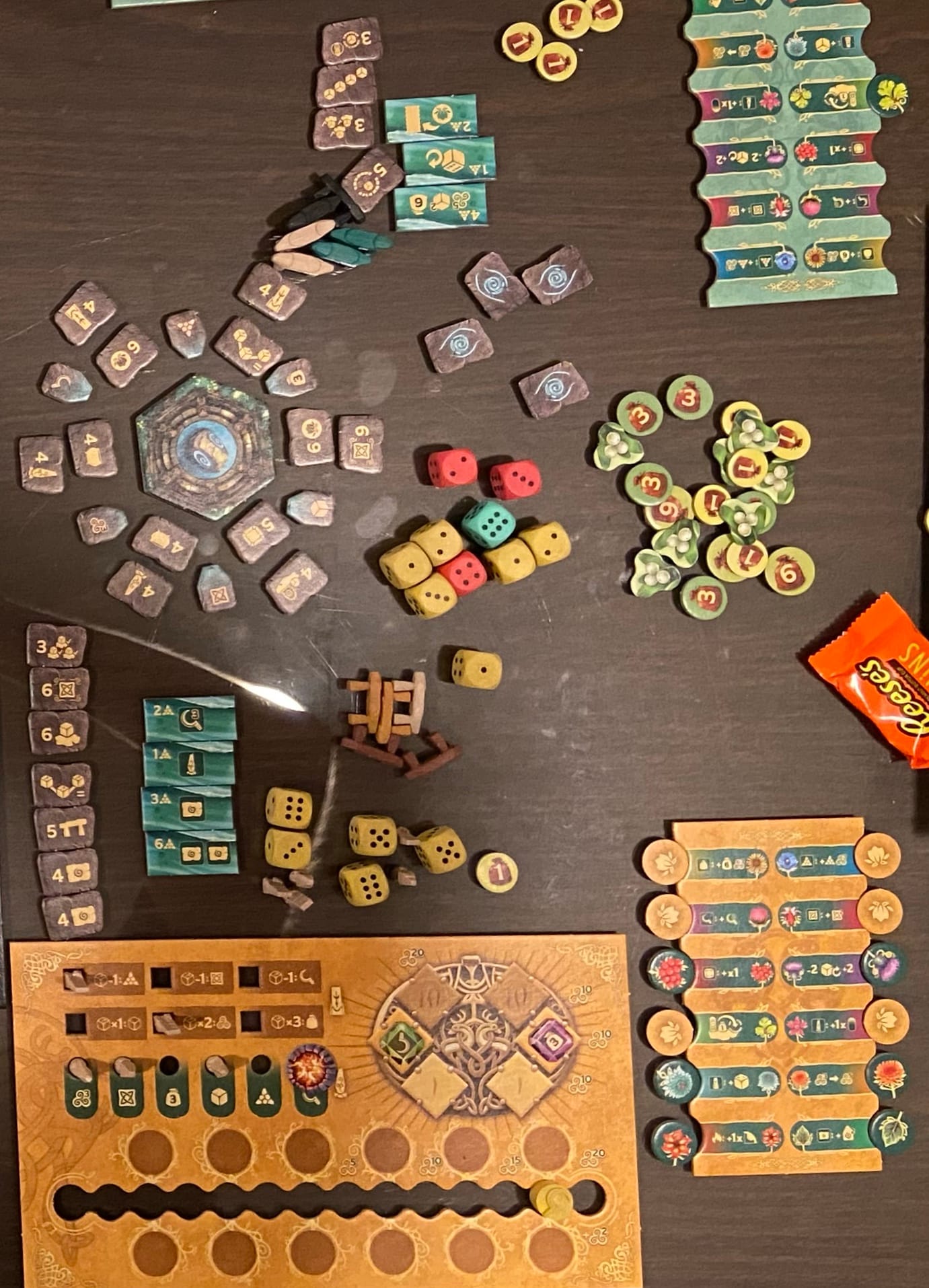
The endgame tiles are in the middle left of the image above, and twelve tiles are available at all times. If, for example, I claimed the endgame tile in the upper left — showing 4 (runestone) — then I'd also collect a mistletoe and a sickle movement since those are the bonus tiles surrounding that endgame tile.
In this particular game, I was the yellow player, and my starting endgame tile was to collect four endgame tiles. Well, I'm one-quarter of the way there! Each tile is available twice, and I picked up the matching tile soon after. What's more, I had moved my sickle enough to place the herb at the bottom right of that image, with that herb's power being that when I take an endgame tile, I get each bonus around that tile twice: two sickles, two dice, two bags of three provisions, etc. (I also used two spells to claim endgame tiles, earning double bonuses for each tile taken. One of the endgame tiles is to have cast four spells. I didn't grab that one, but if I had, I would have scored it.)
Ideally, you can weave together meaningful actions over the course of the game, with each action (or each multiple action) compounding your growth. As in other Stefan Feld designs, you usually benefit from specializing: Place as many menhirs as possible to take advantage of the increasing bonuses with each one you place, or don't bother placing any. Collect all six gemstones to maximize your bonus points, or don't collect any. Dabbling in herbs gets you only a bonus or two, while going all out pumps up multiple actions and earns bonus points at game's end.

Complicating all of this, however, is your continual need for provisions and dice. Each turn, you must move to a new shrine and place a die to take an action, but to do this you will need (1) a die and (2) enough provisions to pay for your movement and the number of pips on your die. Fail to have both, and you'll be stuck taking a loser turn in which you collect a die and six provisions from the reserve, then sit on your thumb and mope.
As a consequence, that spinning-the-wheels sensation of "spending mistletoe to get more mistletoe" repeats constantly. This turn I spent provisions and a die to get a bunch of provisions. Next turn, I'll spend provisions and a die to get more dice. Am I making progress yet?!
One of the eight actions is blah: Take three dice from the reserve or twelve provisions. At times, you need to take this action because you've already exhausted other means of collecting dice or provisions. "I've taken the gemstones, and I've placed the runestones, so fine, I'll just go to the store to 'buy' dice." In some ways, this action feels like the daily routine of life, with you working to afford food so that you can eat and continue to work. Is this all there is? Did Feld intend to recreate the feeling of a 9-to-5 job in The Druids of Edora?
To avoid this monotony, you're scraping for dice and provisions constantly. You really want to connect these two dolmen, but you need another die or else you'll be facing a loser turn, so you head to a shrine on the way to your real goal in order to surround a bonfire and pick up a free die (along with other stuff). That die will enable you to reach an endgame tile action that lets you claim another die as a bonus. And so on. You can do the straight-up boring action and take dice and provisions, but you'd rather do other things and grab dice and provisions along the way.
In a sense, Feld designs have incorporated "hustle culture" for decades, long before the term even existed. You have an ongoing conflict with entropy in his games — against rats in Notre Dame, against the needs of the commoners in Trajan, against a host of disasters in In the Year of the Dragon, against forces that will erode whatever you've built — and you need to press forward, but not in some straightforward "nose to the grindstone" way because then you'll fall behind competitors who have figured out how to get more done in the same amount of time.
This need to multitask and maximize each action is probably why I've hit a wall with The Druids of Edora. I dislike holding up games in order to calculate the results of each possible action and plan my next three turns. I prefer to think through 90% of the problem, then make a choice, often through gut feelings. I'd rather move quickly, make mistakes, and learn a lesson than have others stare at the table while waiting for me to act — but despite eleven games of experience, I've yet to learn the appropriate lessons.
Maria, on the other hand, does calculate the results of each possible action — or at least that's what it feels like to me. Somehow at game's end, she's reached the end of the sickle track, placed a majority of her menhirs and runestones, cast a handful of spells, and achieved several endgame tiles. She playing with four hands, her influence branching out everywhere, while I'm marching on a linear path, unable to defend against her omnipresent advances.
My only "victory" over Maria has come in a recent game in which she was contemplating moving to a mistletoe/spell action in order to use the 4-cost spell (four from the left at top in the spell image above) that lets you activate two herbs from your player board without needing to reach them with your sickle. She was weighing the merits of the herb bonuses she'd have for the remainder of the game against another action she could take, unsure the spell was worth it. I managed to convince her not to take that spell, which is the very spell that I cast on my turn immediately after hers.
She still crushed me (and others) in that game, but my mindgame win gave me some satisfaction. That will have to keep me going for now as I try to re-program myself to stop chasing after dolmen and spend more time contemplating the branching paths that lie before my druid...
Want more game analysis like this?
Get Board Game Beat’s free posts by email — original reporting, designer interviews, and industry news, with no tracking and no spam.


