

I've been a fan of game designs from Arve D. Fühler — TA-KE, AEOLOS, Pagoda, Glory Islands — so I look forward to seeing what he does next. For 2026, he has the trick-taking game All Mine!, which is a new edition of 2014's Scharfe Schoten, and Ährensache, a game for 3-5 players from German publisher Skellig Games.
As with many German titles, "Ährensache" can apparently be read multiple ways, with "Ähren" meaning "ears of grain", a.k.a. "kernels", and "Sache" meaning "matter" or "thing", with the collective "Ährensache" taking on the meaning of "A Matter of Honor". I welcome corrections from native German speakers, as I'm interpreting from outside that language.
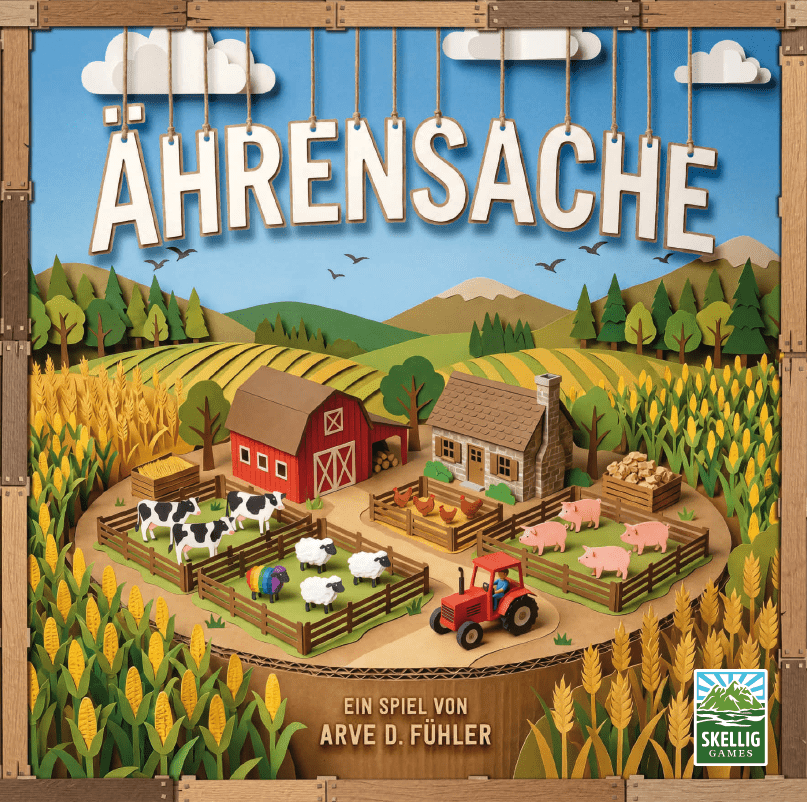
Ährensache is a bidding game in which each player builds their own farm, with the game playing out over eight rounds and with the bidding process coming across as the prime novelty in the game. Bidding cards come in three colors and in values 3-6, with the back of each card having a value of 2. When you place a bid, you can bid only cards of the same value or color, although you can play additional cards face down to add 2 to a bid.
What's more, five bidding cards are placed on the central game board at the start of play, and any cards that match your bid by value or color (depending on the cards you played) add to your bid! If three of those five cards show a 4, then you could bid a 4 and have your actual bid be 16. At the end of each round, two of those five cards fall off and are replaced, so you can plan ahead a bit as to which cards to keep for future bids.
In order of the bids, players claim offers: two pasture tiles; a random bid card and either a pasture tile or a farmer tile; a bid card, a pasture tile, and a grain token, etc. You can also collect apples, a token for the current round that's worth points, and a building tile that modifies the rules of the game for you.
All tiles must connect Carcassonne-style with your starting farm tile, although tiles always have a fixed vertical orientation. When you connect two roads showing grain, you receive a grain token, and you can use such tokens for bidding or points, or you can trade them for apples or farmer tiles.
Farmers come in five colors, and you can collect only one of each such farmer, with each farmer being linked to an endgame scoring card. This game the yellow farmer gives you points for apples and tractors, the latter of which come on pasture tiles, while next time it rewards you for having different animals, with these again being on pasture tiles.
Each player also receives a random "building plan" card at the start of play, and if at game's end you have filled each spot of the plan with a tile, you'll score 15 points. As with many such designs, you can scale up the difficulty, using larger building plans worth 25 points, endgame cards that are more difficult to score, and bonus scoring cards based on the paths and areas you create on your farm.
Want more game previews like this?
Get Board Game Beat’s free posts by email — original reporting, designer interviews, and industry news, with no tracking, no ads, and no spam.


