

Portuguese publisher PYTHAGORAS plans to feature two new titles at SPIEL Essen 26, the giant game convention taking place in Essen, Germany on 22-25 October 2026. Let's take a look at each of them:
Caribe
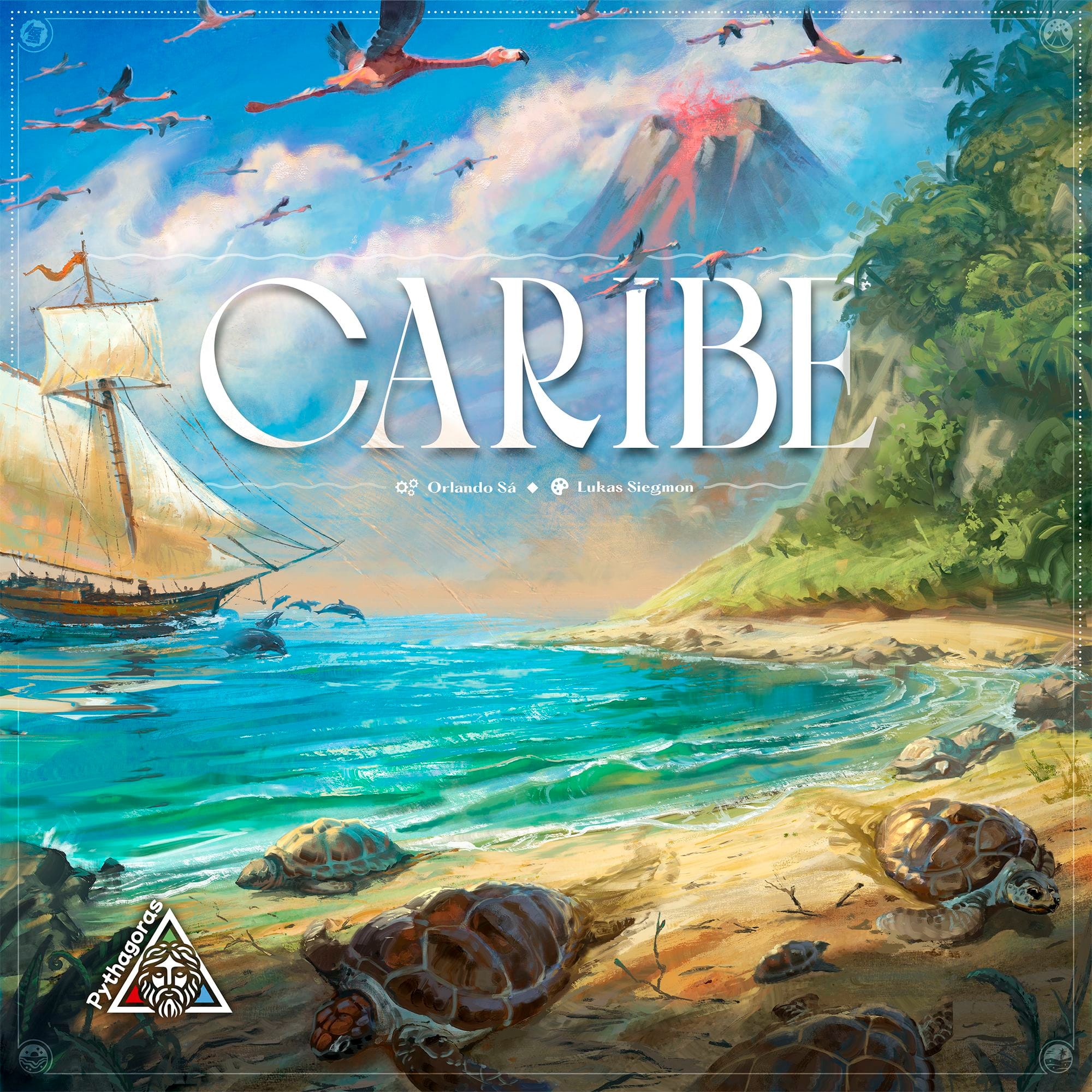
Caribe is a 1-4 player game from designer Orlando Sá, who is best known for the solitaire game Adamastor, as well as the games Porto, set in a Portuguese city best known for port wine, and Pessoa, based on the works of Portuguese poet Fernando Pessoa.
In Caribe, players represent explorers who are visiting the Lesser Antilles, a group of islands in the Caribbean Sea, to explore the landscape and record the animals seen there. The Lesser Antilles are presented by four double-sided 4x4 tiles laid out in an 8x8 square, with the rows and columns being labeled A-H. Dolphin, turtle, and flamingo tokens fill most of the water spaces surrounding the islands, with the land spaces being marked as forest, shoreline, or volcano.
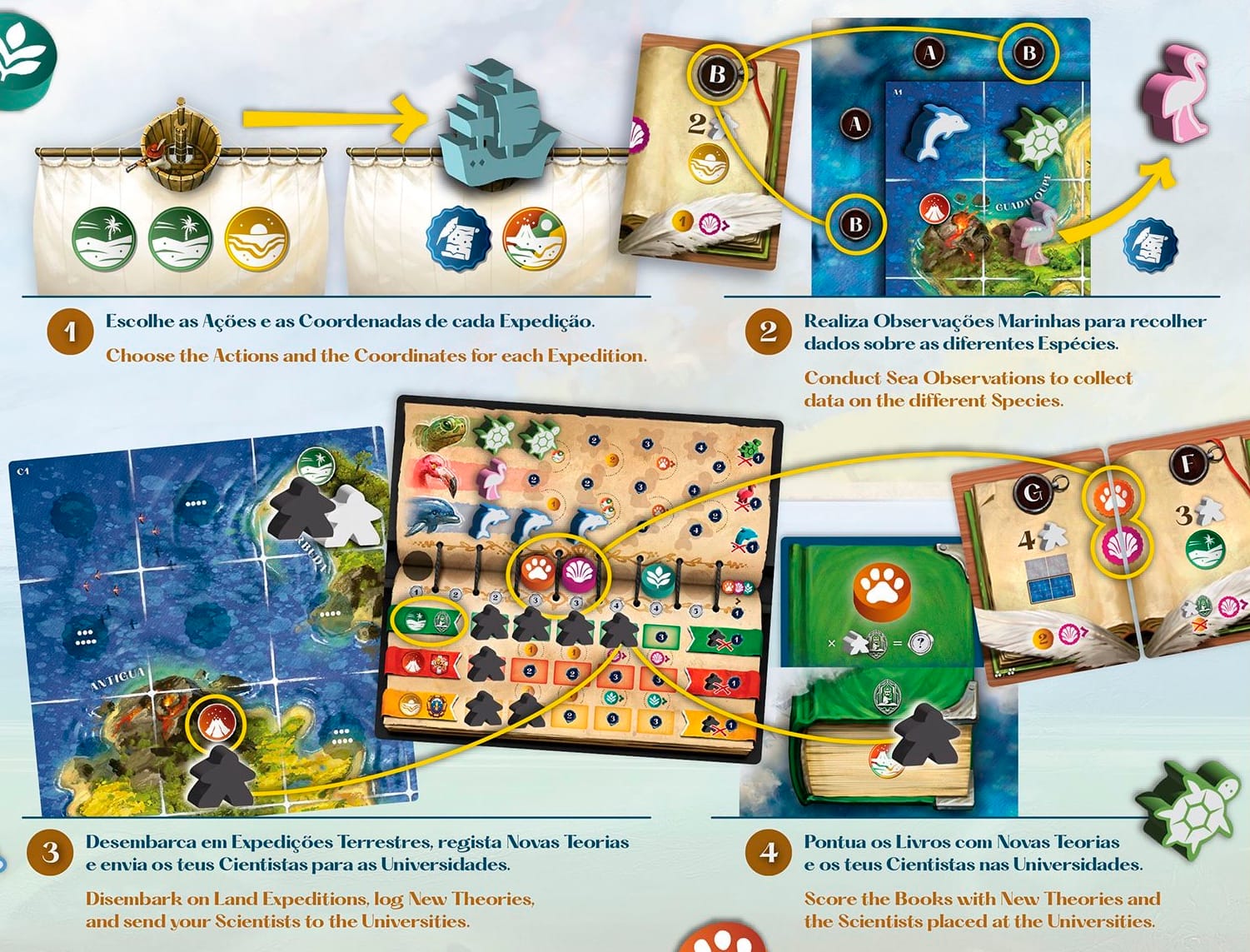
On a turn, you choose one of five action spaces, then discard a theory card from hand that shows a letter A-H. You then take the actions depicted in that space in the row and column matching the letter discarded; for each compass marker you discard, you can add one additional row or column to your exploration space. For sea observation actions, you pick up an animal in the water to represent you drawing and recording it; for land exploration actions, you place a scientist on a space with the matching icon.
You can pay money to take bonus actions adjacent to the space you chose, after which you take a new theory card from the display: the card in the action space you chose, or (for the cost of a coin) a card adjacent to this one.
Why are you doing all of this activity? Because in addition to determining where you can explore, the theory cards include scoring conditions you want to satisfy by the end of the third, sixth, and ninth rounds when scoring takes place.
In the image above, you can see two types of scoring conditions. In one type, you need to remove the indicated number of scientists from forest, shoreline, or volcano spaces as indicated, after which you place them in your personal logbook, scoring points as you do. Another type of scoring requires you to remove (and log) the indicated number of scientists from depicted sections of the map. The third scoring type has you place collected animal tokens in your logbook.
In addition to scoring points from placing tokens in your logbook, theory cards include bonuses such as coins; compass markers; the advancement of knowledge tokens (fauna, flora, and geology) in your logbook; and the promotion of scientists to university.
In Caribe, Sá has doubled up most game elements to intertwine choices and add the lottery feeling of a game like Wolfgang Warsch's That's Pretty Clever! As you place scientists and animals in your logbook, you'll surround bonus icons that give you coins, extra island placements, and knowledge advancement. You need to score scientists in order to move them to university, after which you can place new scientists and score points and bonuses again. Each time you place a scientist in a university, you receive an immediate bonus, while also boosting your endgame points.
Theory cards determine where you can explore and what you need to score, but they additionally serve as left or right pages of a book, and ideally you can pair scored theory cards to complete knowledge icons, which will score based on how well you advance those knowledge tokens.
Each university has different scoring metrics, so you might score points equal to the number of your scientists at that university multiplied by the number of dolphins you collected, by how many scientists you placed on the forest track, or by the value of your geology token.
The solitaire mode pits you against an automated opponent or against a simplified algorithm that doesn't score but which will get in your way as you try to maximize your score.
Delfos
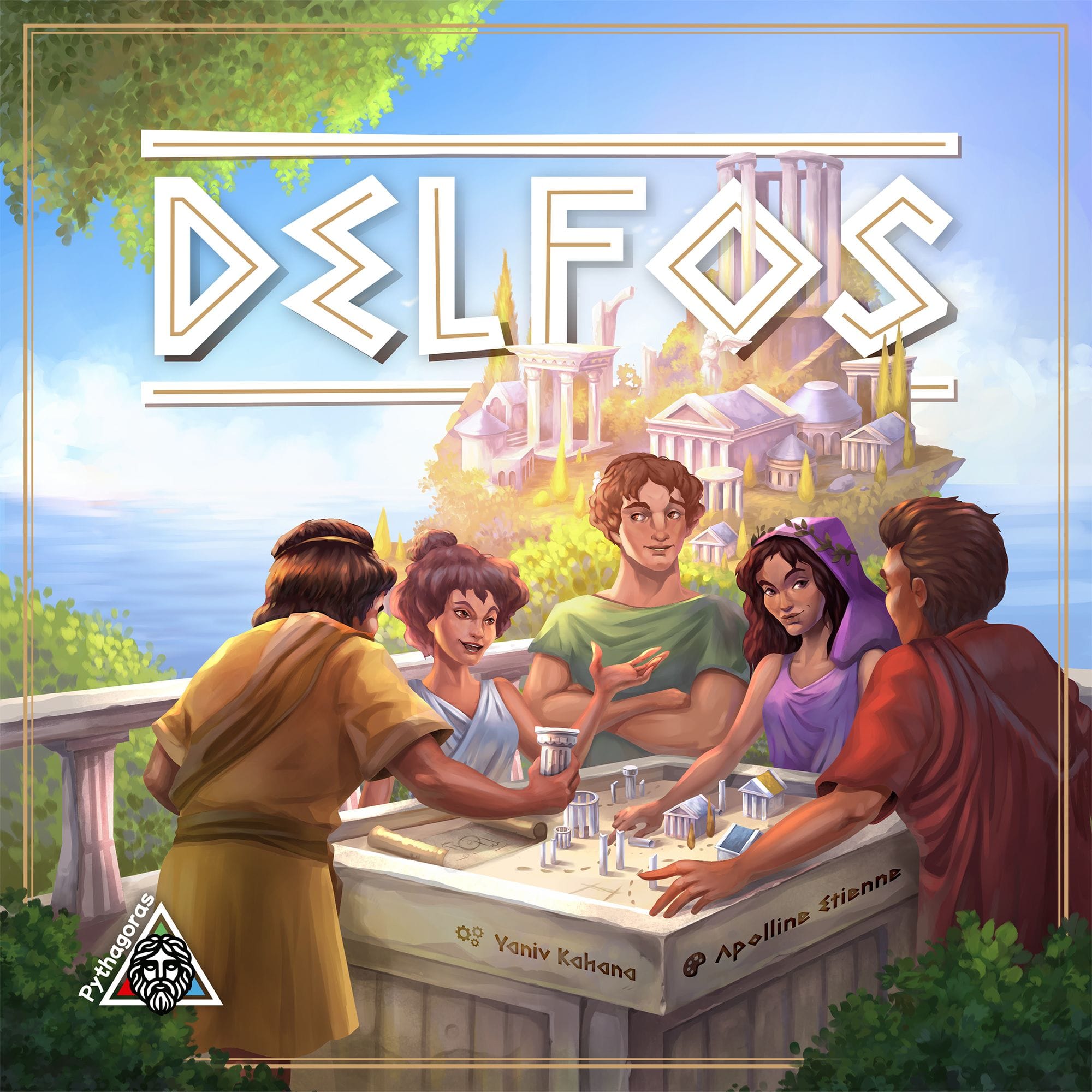
In Delfos, a design by Yaniv Kahana, 1-5 players will re-build the city of Delfos, a.k.a. Delphi, tile by tile over a fixed number of rounds.
To set up, lay out sixty tiles in five colors on the game board to form the ruins of Delfos. Each player claims a character showing one of the colors and has two secret goal tiles that each show one of the five colors in the game. A public scoring card is revealed.
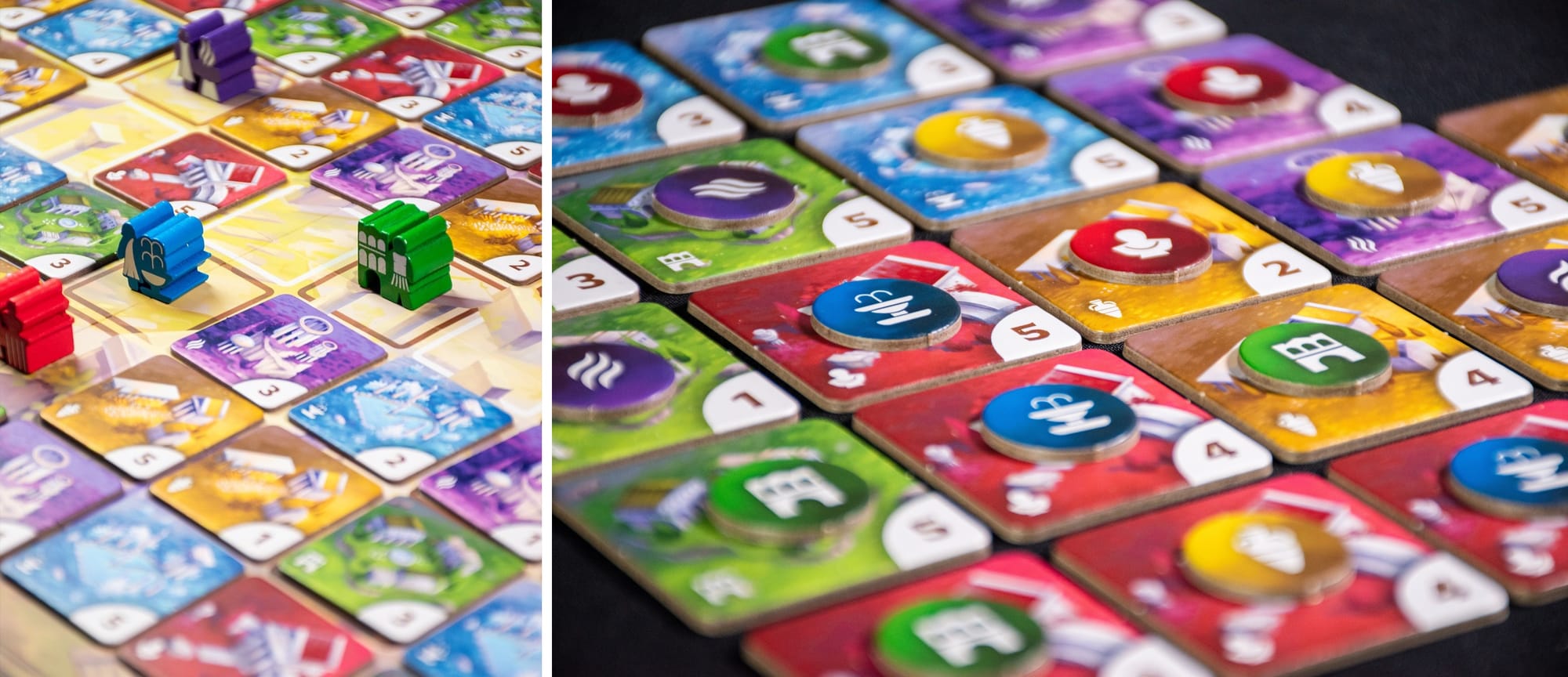
On a turn, you move one of your architect tokens orthogonally in the ruins until you reach a tile, wrapping around the game board if needed. You place one of your colored tokens on this tile, then add it to the new layout of Delfos that the players are building collectively. This layout will be restricted to an 8x5 or 9x5 grid depending on the player count, and your goal when choosing and placing a tile is threefold:
- The public scoring card highlights a region of the new city of Delfos, such as the top three rows or all tiles on the perimeter. For each tile you have placed in this region that matches one of your two secret goal colors, you score the points listed on the scoring card.
- For the largest group of tiles of each color in the new city of Delfos, whoever has placed the most of these tiles scores points equal to the sum of the values on the tiles they placed. Players who have placed the second most and third most of these tiles also score points.
- Finally, you score your character points. In the basic game, you score 3 points for each tile you placed in the new city of Delfos that is your color; in the advanced game, each character has a unique scoring rule, e.g., the yellow player scores 5 points for each yellow tile in the column with the most yellow tiles.
The solitaire mode of the game includes "Khaos" cards that serve as an automated opponent, as well as campaign goal cards that you attempt to complete over a series of games.
Want more game previews like this?
Get Board Game Beat’s free posts by email — original reporting, designer interviews, and industry news, with no tracking, no ads, and no spam.


