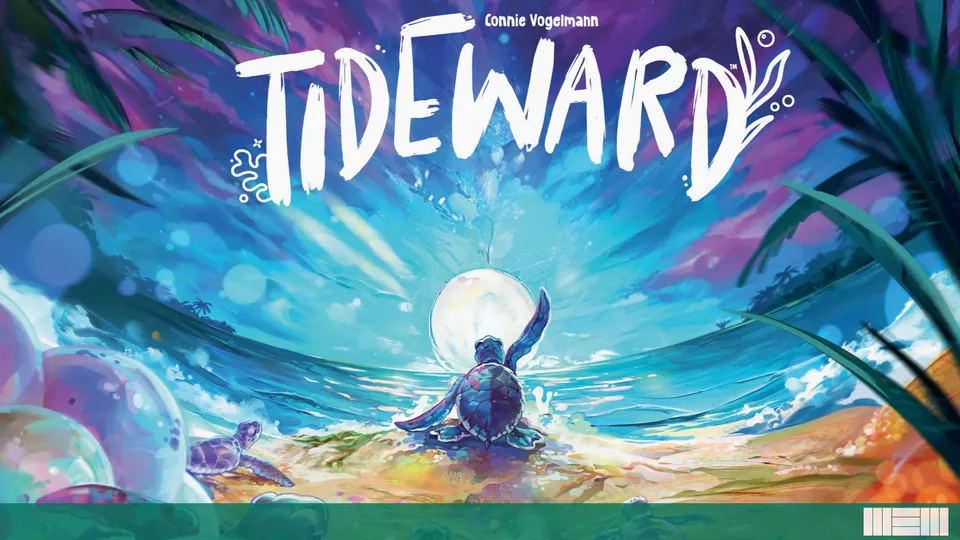
Ahead of SPIEL Essen 26, the European branch of Blue Orange Games has announced a half-dozen titles for release in early 2027. Let's do an overview of these games now, then look for more details down the road, presumably during FIJ, the annual game convention in Cannes, France that will take place in February 2027.
Got Five! Ghost
Yoann Levet's game Got Five!, which debuted in early 2026, is a fantastically simple deduction game that I've played more than twenty times on a review copy, with the game generally going over well with gamers and casual players alike. In short, during set-up you receive five tiles — one in each five colors — organized from low to high with the digits — which range from 1-60 — facing away from you. Your challenge is to determine which values you have before anyone else can guess theirs.
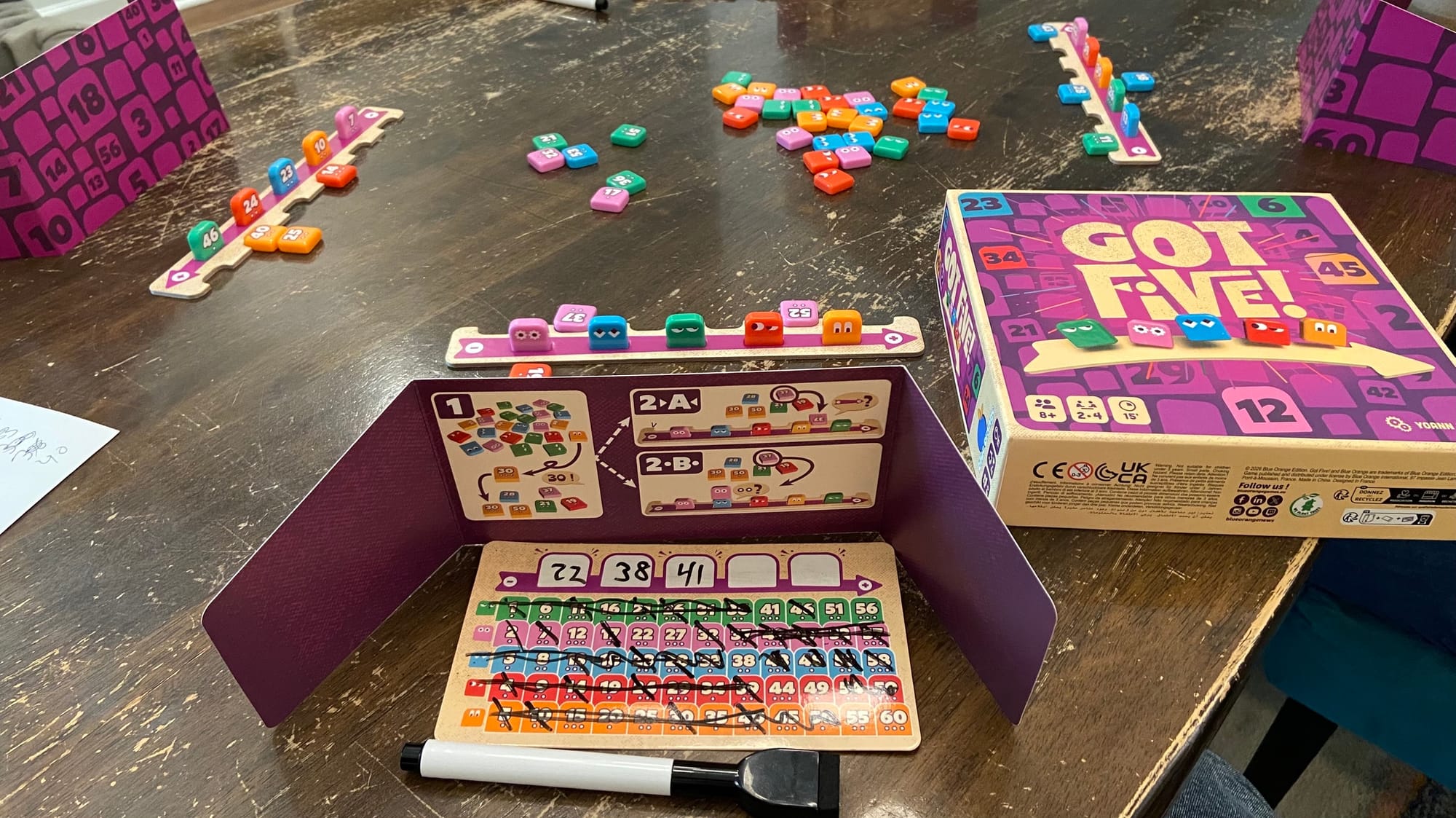
I still intend to review the game, but in the meantime Blue Orange is plowing on with an expansion. Got Five! Ghost consists of plastic, ghost-shaped shields, and you use them to cover the lowest and highest tiles on an opponent's board before placing their rack in front of them — which would make gameplay far more challenging since you can often derive a decent chunk of information from the order of your tiles.
For a more challenging game, you'd cover the middle ghost as well. (After that, play with your eyes closed and guess numbers at random.)
Fifty Shells
Claude Leroy has designed many abstract strategy games over the past four decades, with Gygès — his best-known game — having debuted in 1985. His designs rarely have settings, but Fifty Shells has a modest one: Walk on the beach, and pick up a valuable collection of shells and pearls.
In this 2-4 player game, fifty shells numbered 10-59 are stacked on the game board. On a turn, choose the top shell from a column, look at its tens digit, then move the shell orthogonally that many spaces. You can cross empty spaces, but not retrace your path. To end your turn, collect the shell you moved and the shell that was covered. (If none of your available shells can move, collect any two shells from the board.)
Consecutive numbers form 1-3 pearls, and when only two shells remain on the board, the game ends. Whoever has the most pearls wins, with the tiebreaker being whoever has the longest string of consecutive numbers.
Drop Maze
Many BOG titles for younger players have toy-like components, such as Laurent Escoffier's Block Ness, which I reviewed in 2021. Drop Maze, which is from the design team 7Towns, falls into this category.
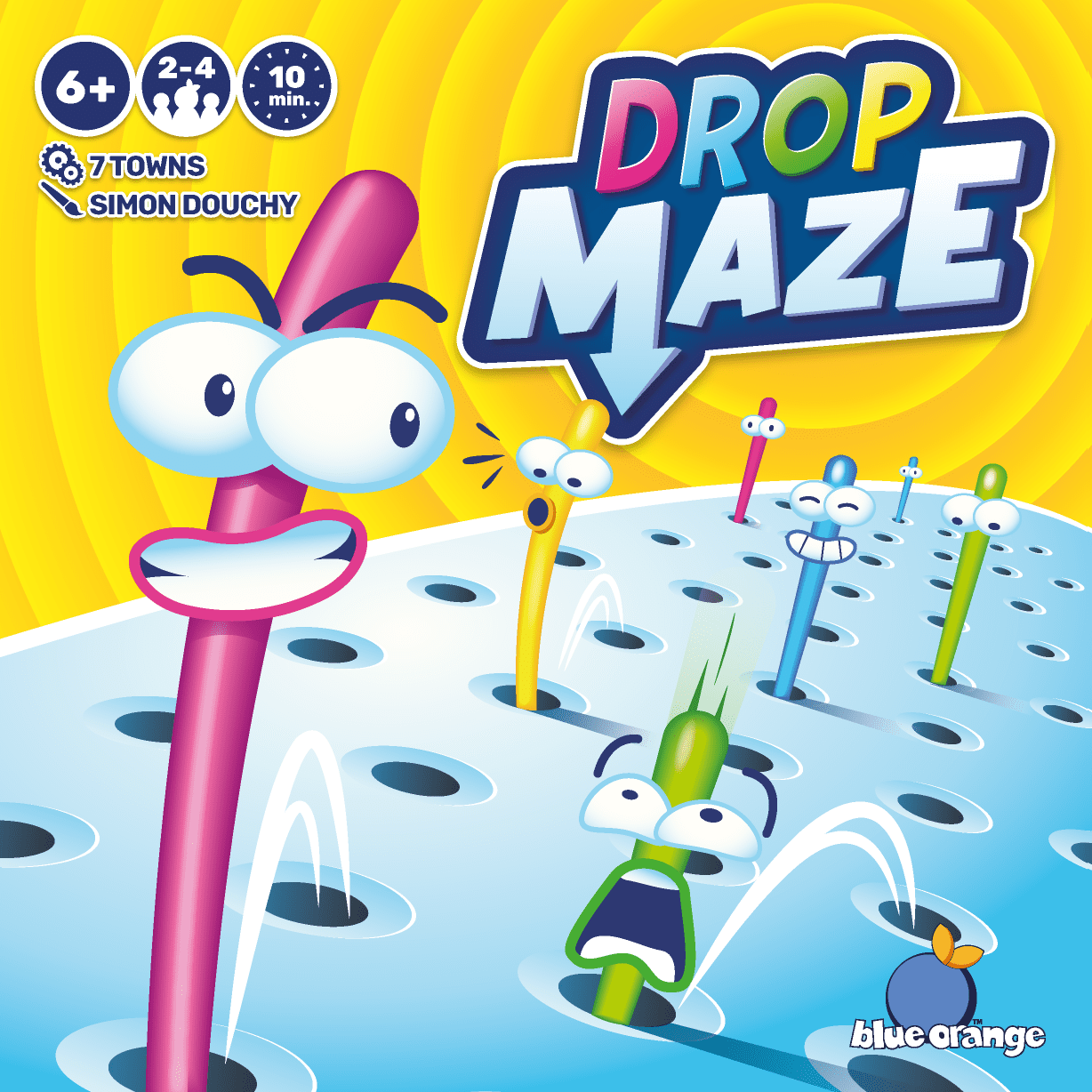
The game board has 49 holes, with the hidden surface underneath featuring pits that you can fall into. Players take turns either adding a stick to a hole in their starting line, moving a stick on the board to an adjacent space, or placing a blocker in a free space. If your moved stick falls into the box, that stick is gone. (I'd like to imagine that the doomed stick will now support another stick that jumps onto its head, but I don't know whether that's true.)
Lose all your sticks, and you're out of the game. Whoever first reaches the opposite side of the game board or outlasts everyone else wins.
Castle Pop
Castle Pop comes from debut designers Rinat Alima of Onion Design Lab and Tom Dor, and it also features a wealth of plastic for play.
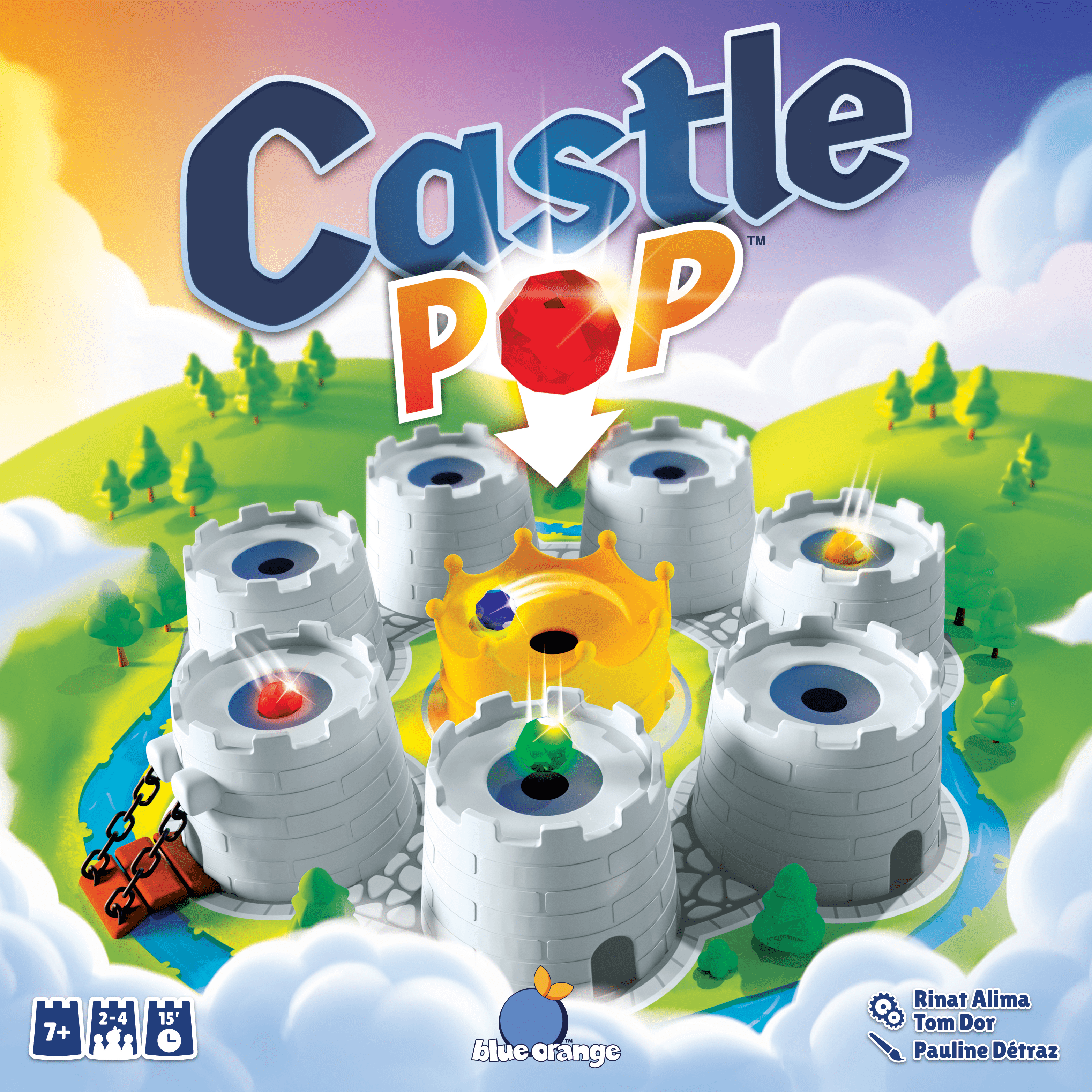
Castle Pop's game board features seven castle towers surrounding a golden crown. Each player has a supply of colored gems, and on a turn you drop a gem into one of three unlocked towers, with your choice determining what is unlocked for the next player. Once all the gems have been dropped, you reveal the contents of each tower; whoever has placed the most gems moves one of those gems to the central crown...but in a tie for most gems, whoever has the second most gems in a tower places their gem in the crown instead.
Players retrieve their remaining gems, and whoever won tower 7 starts the second and final round, which is resolved the same way as the first. Whoever then has the most gems in the crown wins, with control of tower 7 giving victory to its holder in case of a tie.
Check It If You Can
Each BOG release line-up has one party game on it, and Check It If You Can checks that box on its early 2027 list. The game debuted in 2024 as レンソウビンゴ ("Rensou Bingo") from Arclight Games, and now this design from Namiki and Soma will have a French and English release as well.
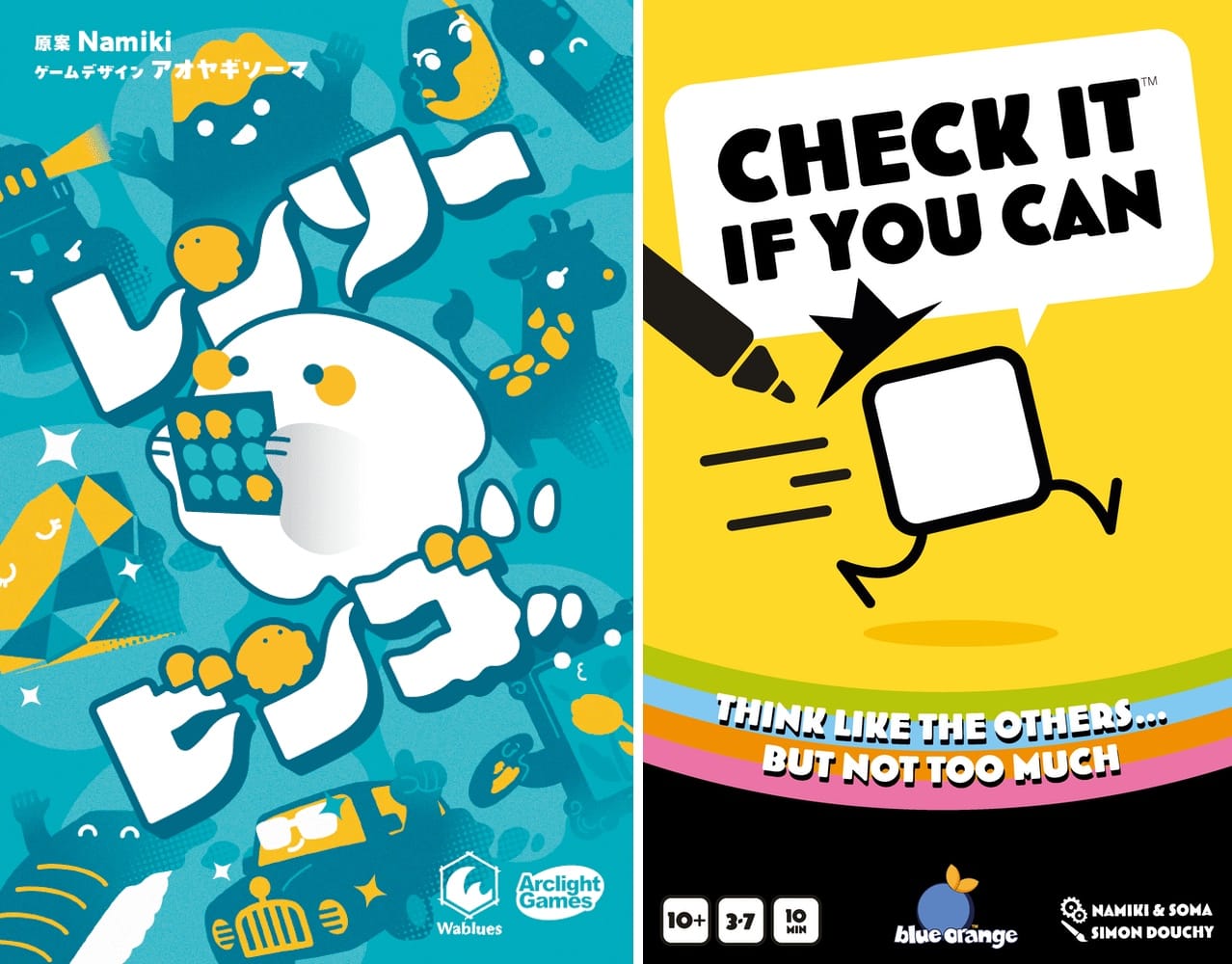
Each of the 3-7 players has a bingo card, and whoever first checks off an orthogonal or diagonal line on their card wins. How do you check boxes? By matching the right number of people on a turn.
Players take turns being the "caller", drawing a theme card and choosing a theme for the round, such as dog breeds or words that start with specific letters. Everyone writes an answer, then you reveal them, seeing how many other players also gave this answer. If you have a number on your bingo card matching this value, you can check it off. (Your card also has checks for your left- and right-hand neighbor.) You can mark only one box on a round.
Mimi Dice
In addition to one party game, BOG typically features one real-time game in its line-up, and for early 2027 that is Mimi Dice from Josep M. Allué and Dani Gómez.
To set up, spread thirty cards on the table, with each card showing a pose by the cat Mimi on its visible side and a surprise on its other side. Someone rolls the Mimi die, then everyone races to grab a card showing the pose rolled, with the fastest correct player revealing the surprise on the back of the card. Did you find kittens? Great — they're worth points at game's end, whereas mouse points must be given to another player and the dog is returned to the table. When someone has five cards, you tally points.
Want more game announcement coverage like this?
Get Board Game Beat’s free posts by email — original reporting, designer interviews, and industry news, with no tracking and no spam.