I just wrote about Peer Sylvester's game Upland & Prairie, which will debut in September 2026 from Osprey Games and be featured at SPIEL Essen 26, so let's now take a peek at another design coming from Sylvester: Infiltrados ("Infiltrators"), which Spanish publisher doit games will demo at SPIEL Essen 26 ahead of a Q4 2026 release.
Infiltrados, says Sylvester, "is a social deduction game for 3-6 players that is my take on micro games — games with only a few cards and cubes. I like social deduction, but I always felt there is not enough deduction in them. In Infiltrados, you are actually doing things, and what you are doing, i.e. your actions, are what people can use to deduce which of two teams you belong to."
How Infiltrados Works
In the game, players secretly receive a unique identity card identifying them as a member of the secret agents or the underground mafia, with each card showing two actions. Each player also grabs a random cube from a supply of red, yellow, and blue cubes.
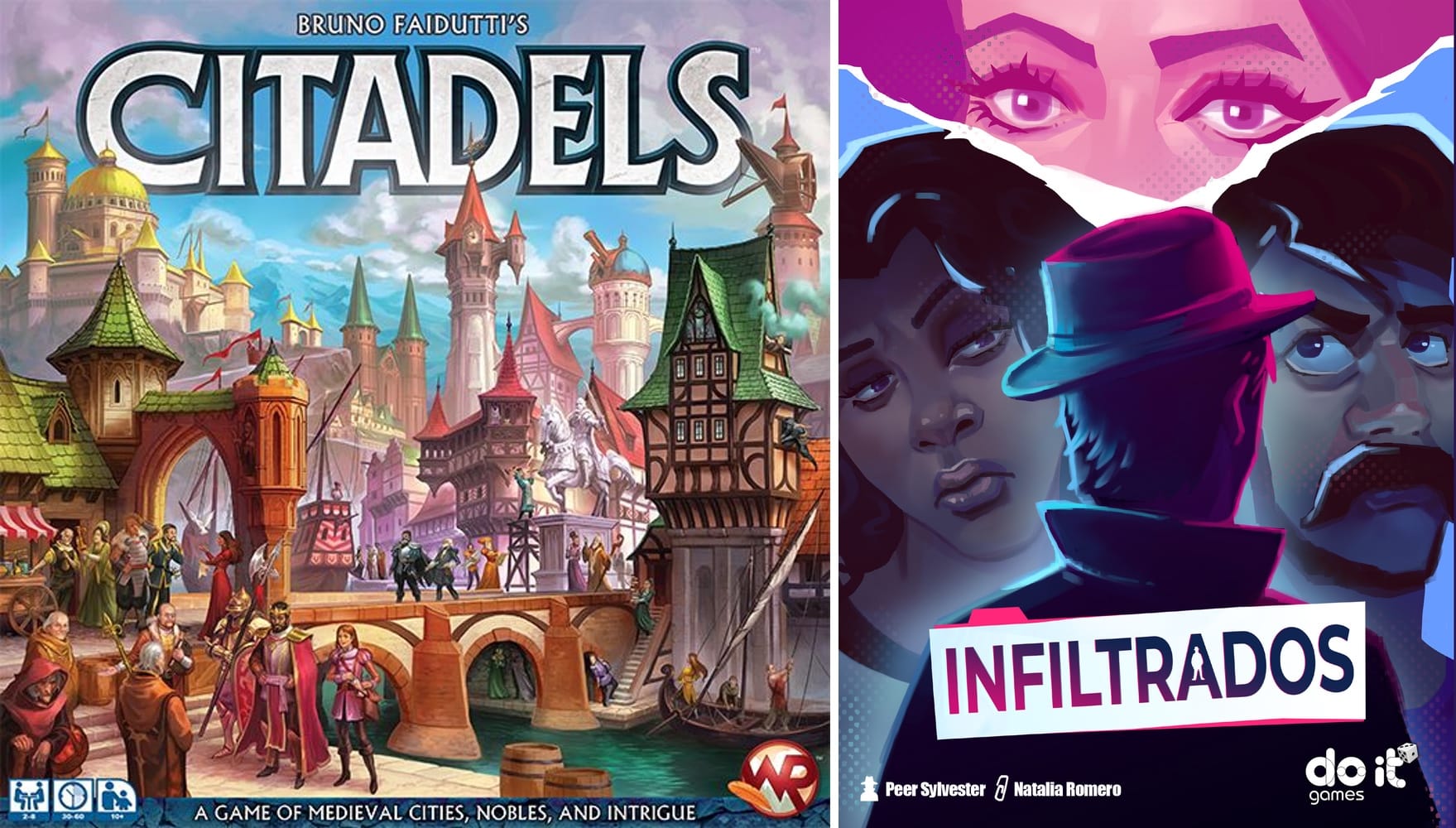
At the start of each round, players choose action cards in the style of Bruno Faidutti's Citadels, with the first player discarding an action card at random, then choosing an action card from those that remain.
Each other player in clockwise order does the same. The starting player then calls out numbers — 1, 2, 3, etc. — and when your number is called, you carry out one of the two actions on your card. One action always relates to taking cubes from the supply — one of each color, two red, one red and a color of your choice — and the other action does something else, such as looking at a player's identity, preventing one player from acting that turn, copying another action, or (possibly) stealing cubes from a player.
Cubes are important for two reasons. First, at the end of the game, you pool all of the cubes on your team and score 1 point for each set of red, yellow, and blue. Who's on your team, and are your colors balanced for maximum scoring? That's part of what you need to figure out.
Second, cubes grant abilities. You can steal from a player only if you have more yellow cubes than they do. If you have the most red cubes, you go first in the round, which lets you know which card is out of play. And if you're a secret agent, you can try to arrest someone if you hold more blue cubes than your target.
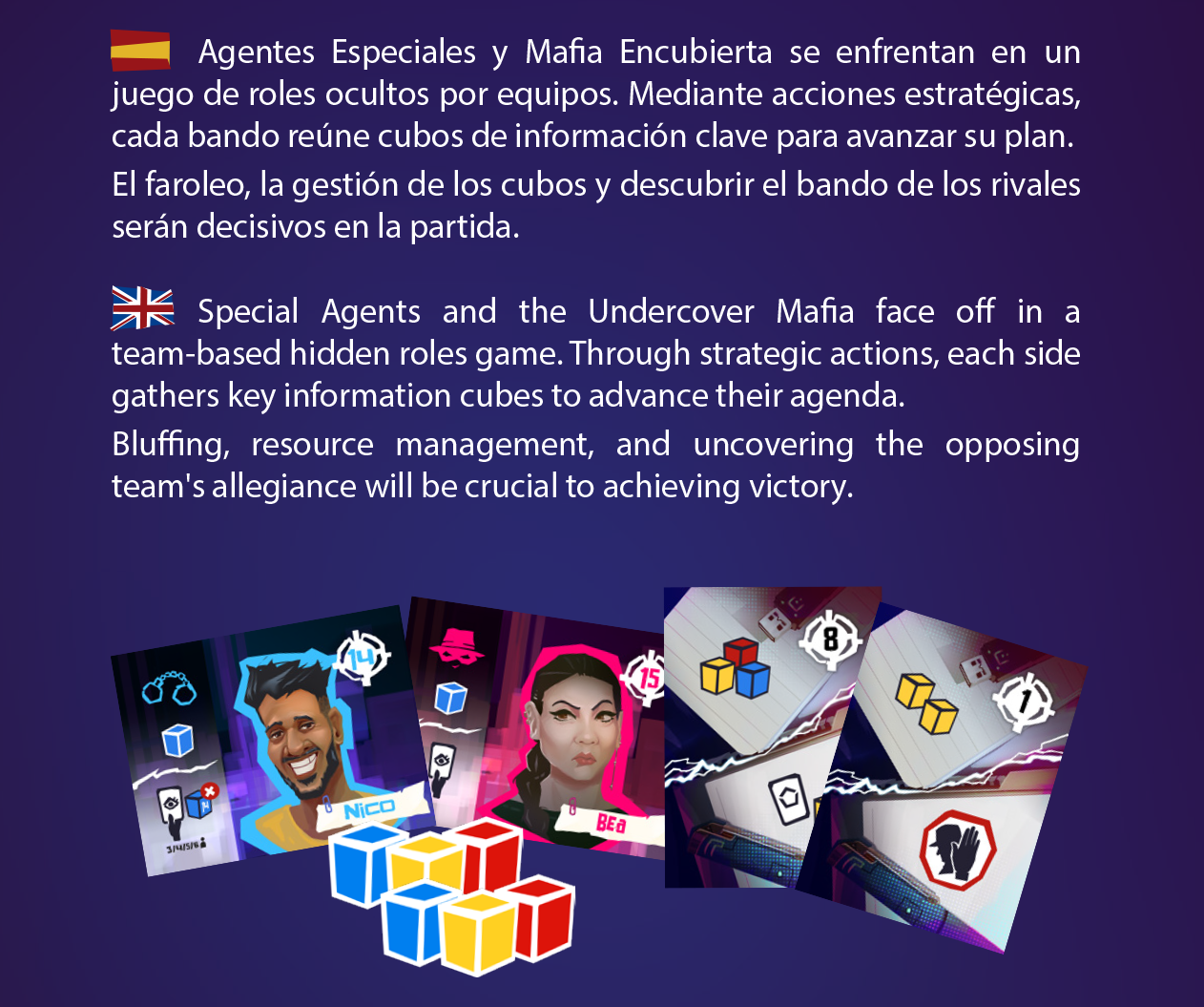
To make an arrest, you must reveal your identity — which means you can do this only once per game — then identify your target, who reveals their identity. Once your identity has been revealed, you still choose an action card at the start of a round, but you can perform only one of the two actions on your identity card.
The identity cards have higher numbers, so they resolve after the other actions. They also introduce new abilities: Nico and Bea, shown above, can reveal another player’s identity. Nico is a secret agent, so he can still reveal mafia players after his lone arrest attempt; Bea is part of the mafia, and by revealing agents, she can keep them from trying to arrest her teammates.
When all cubes of a color have been claimed or one team's members have all been revealed, the game ends. In addition to scoring for cube sets, the agents score 1 point for each mafia member they arrested and the mafia scores 1 point for each team member who's unarrested. (A bot balances play in games with three or five players.)
"Which card you have taken and how you've used it gives other people clues of what you are trying to achieve", says Sylvester. "The game is surprisingly easy (and quick) to play, and it has levels. It's also maybe the only game of mine I'm actually good at, usually knowing all of the roles before anyone else...which doesn't always help."
Want more game previews like this one?
Get Board Game Beat’s free posts by email — original reporting, designer interviews, and industry news, with no tracking, no ads, and no spam.