

I've written about Korean publisher Playte, which started business as OPEN'N PLAY, for years — well, a decade really, as parent company Gameology Inc. was established in 2016. Time flies like a banana!
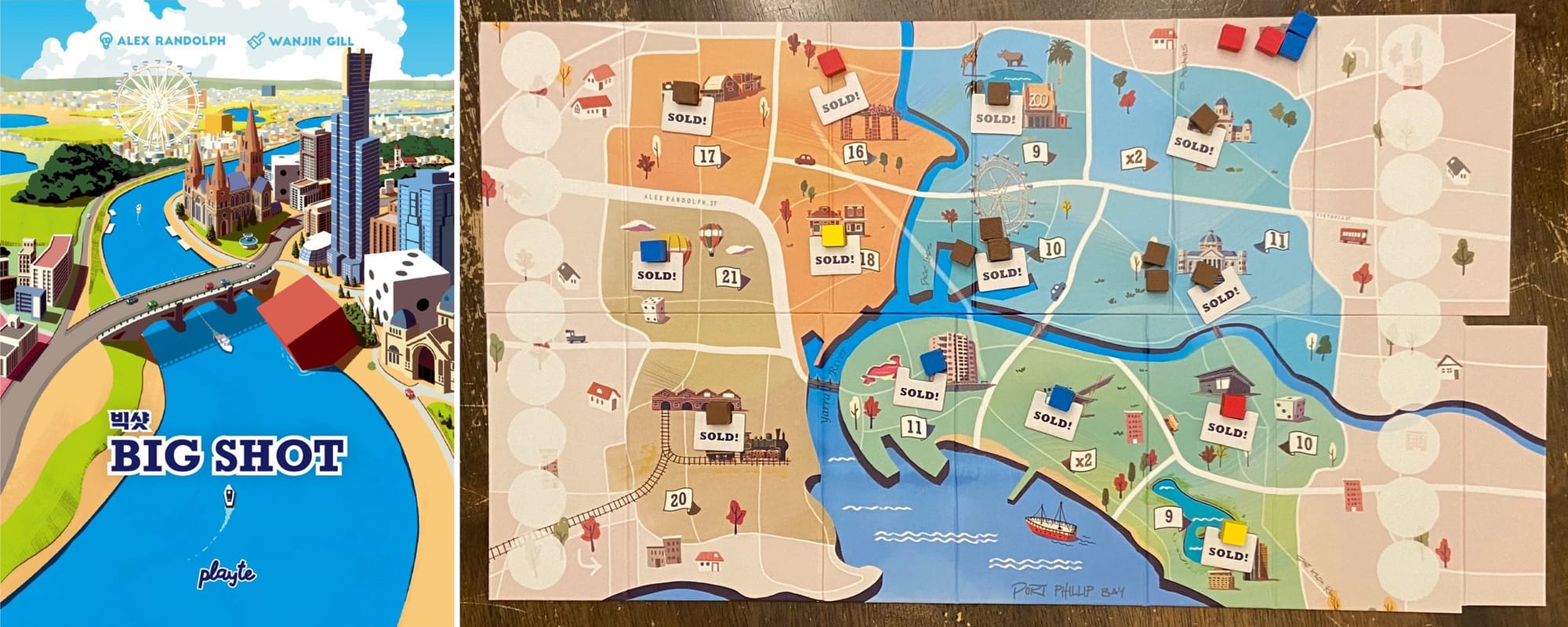
Head of Gameology Junghee Choi seems fascinated with old-school German games, which you might think of as Eurogames minus all the multiplayer-solitaire designs, that is, games with simple rules and a high degree of interactivity, and he's brought many decade-old designs back to print, including one of my favorite games: Alex Randolph's Big Shot, which first appeared in 2001 and which I reviewed in 2025. [Disclosure: Playte is an advertiser on Board Game Beat.]
Choi has been fanatical about packaging games in the smallest boxes possible, with the company's Lboard format transforming the game's box into a game board, as with the aforementioned Big Shot, which features a double-layered game box that unfolds into the game board depicted below, with miniature magnets on the edges of the game box layers so that the board stays together.
In May 2026, I posted an overview of the titles Playte was bringing to Game Market Spring 2026 in Tokyo, and ahead of SPIEL Essen 26 here's another round-up of new (old) titles from Playte that will be available at that show, whether via pre-order or directly on site:
- The Birth of the Post is a new edition of Thurn & Taxis, a game by Karen and Andreas Seyfarth that won Germany's Spiel des Jahres award in 2006. In the game, players collect and play cards to create connected routes of cities in order to mark those cities as served, thereby earning points. Through smart (and fortunate) use of the four special abilities in the game, you'll ideally craft routes that help you work toward several goals at once.
- Manila is a Franz-Benno Delonge design that first appeared from Zoch Verlag in 2005. You're trying to become the richest player with each round of the game starting with a bid for harbor master, who determines which three of four goods will be loaded onto boats that might be delivered, thereby increasing the value of those goods. Everyone bets on the outcome of the boats, while also influencing their movement.
- Leo Colovini's Carolus Magnus debuted in 2000, and it's a game in which you fight for control of paladins (which come in five colors), while the paladins (and, by extension, you) try to claim control of territories. By controlling territories, you place castles in the playing area, with adjacent territories that you control combining in order to strengthen your might — or make a more inviting target for takeover by someone else.
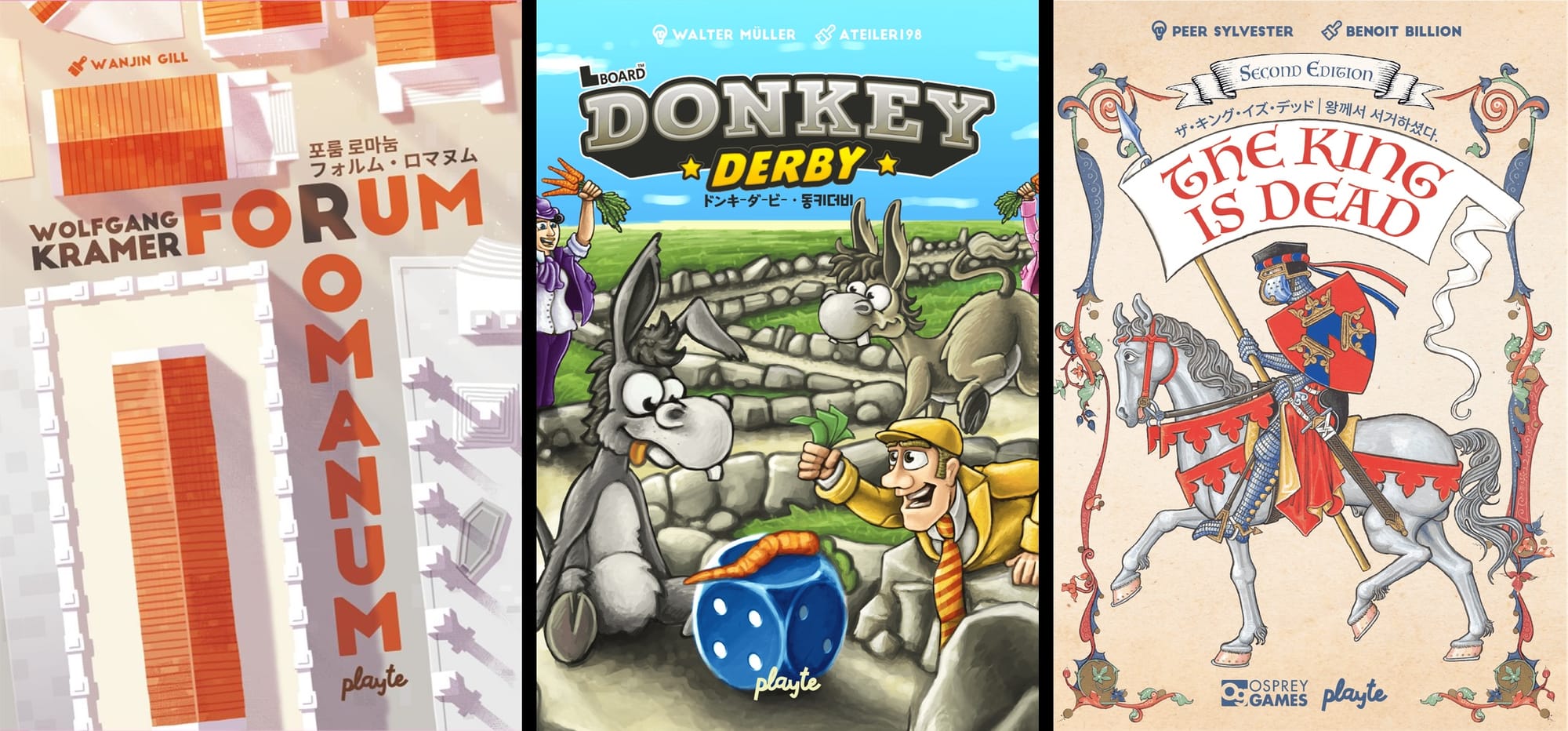
- Forum Romanum dates to 1988, with this Wolfgang Kramer design crossing area control with tic-tac-toe. Each turn, you place one of your pieces on the board or move a piece already on the board, and every space on the board is part of a vertical line, a horizontal line, and a room (and sometimes a diagonal line). Whenever a line or area is filled for the first time, whoever has more pieces in it than anyone else scores points, while those with the fewest pieces (including zero) lose points. Ties aren't resolved until players move pieces, which you're often forced to do thanks the small number of pieces.
- Walter Müller's Donkey Derby first appeared in 1989 as Favoriten before franjos Spieleverlag re-branded the game in 2016. This race consists of alternating betting and moving rounds; first, each player can place one bet on one of five donkeys, then the first better that round rolls a die five times, moving a different donkey after each roll. When three donkeys have finished, players score based on who they bet on and how early they placed those bets.
- Peer Sylvester's The King Is Dead, which first appeared in 2007 as King of Siam, is a minimalist game in which you play cards to affect which of three factions — if any — controls regions in the UK, with you trying to pick up followers along the way to be in control of the winning faction — again, if any — at game's end.
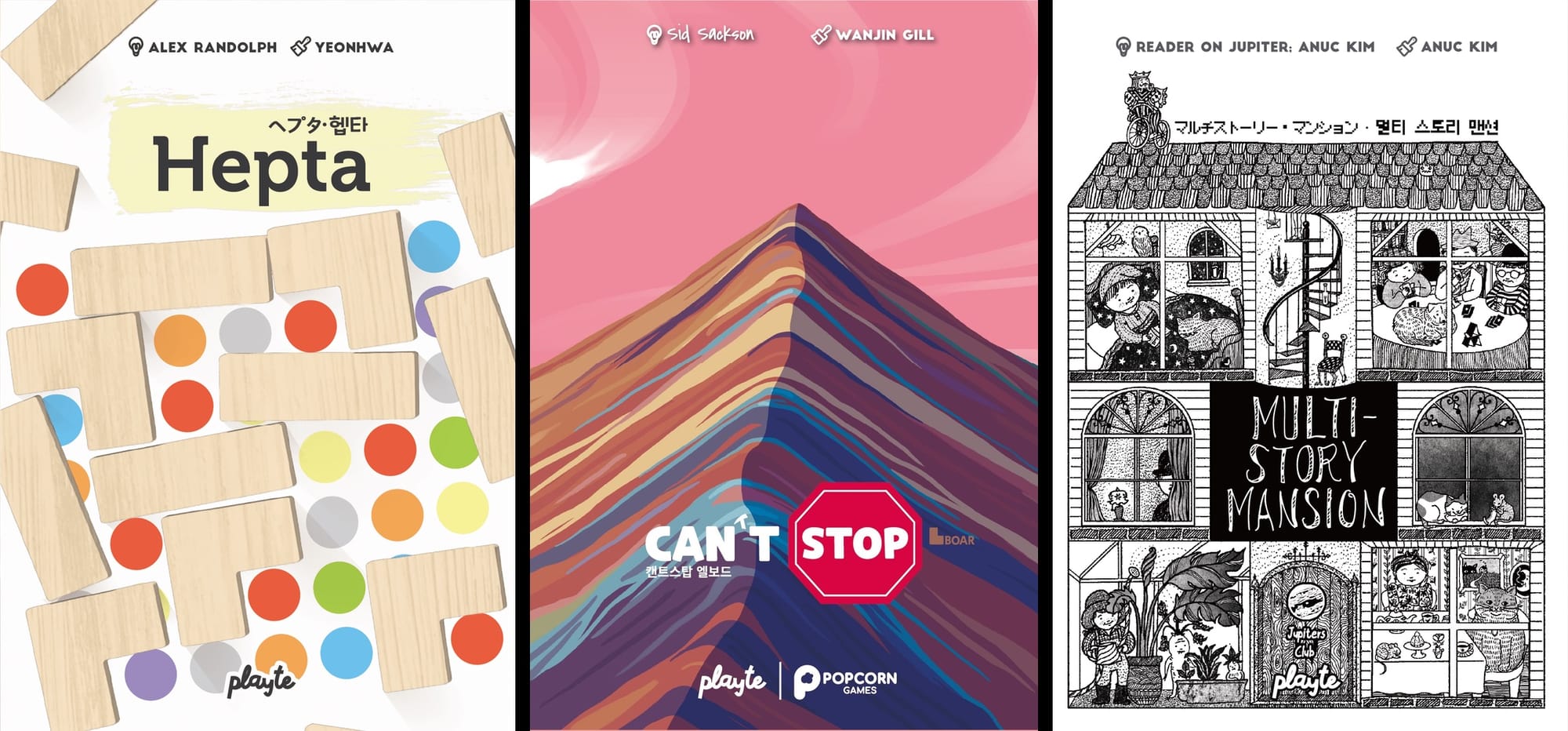
- Hepta from Alex Randolph dates to 1974, making it (I think) the oldest of Playte's reprints in this batch of titles. The 7x7 game board shows seven spots of seven colors, with one player taking the "I" tiles and the other the "L" tiles, with each tile covering three spaces. One player names a color, then players take turns placing a tile on the board that cannot cover the named color. Whoever can't place a tile loses. Alternatively, you can play this as a puzzle, placing all fourteen tiles on the board to leave revealed the seven spots of one color.
- Playte continues to release new editions of Sid Sackson's Can't Stop, with the themed edition above featuring artwork that depicts Vinicunca, a multi-colored mountain in Peru.
- Not all of Playte's releases are older games. As far as I know, Multi-Story Mansion, a.k.a. Many Stories Mansion, debuted at Game Market Spring 2026 from Korean publisher Jupiters Club, and now Playte is making the game available on a wider scale. In this climbing card game, cards come in five suits that correspond to a pattern, such as the aforementioned I and L tiles. As your played card combinations are beaten or as they win a round, you "drop" them into your mansion — which starts with only a multi-colored door — in order to create patterns that match what is on the cards, e.g., three pink cards in an L shape. Your score at game's end is the number of patterns you've built multiplied by the height of your mansion.
- Finally (for this post), Playte has a new edition of Wolfgang Kramer's Dance of Ibexes, for which I did a video review in 2024. Why a new edition? Because Playte has figured out how to fit everything in smaller packaging, so it's done just that.
Want more game announcements like this one?
Get Board Game Beat’s free posts by email — original reporting, designer interviews, and industry news, with no tracking, no ads, and no spam.


