▪️ On June 8, 2026, Jim Butler, CEO of Paizo Publishing, detailed how the bankruptcy of Diamond Comics has impacted the company and the steps it's taking in order to stay in business. An excerpt:
In January [2025], our longtime book‑trade distributor, Diamond Comics, declared bankruptcy. Diamond handled Paizo products for major retailers like Amazon, Barnes & Noble, and Ingram, and our agreement with them was based on consignment (meaning we paid to ship products to their warehouse and were only paid when those products sold).
When Diamond collapsed, the situation became far more complicated:
• JP Morgan Chase claimed a lien on all products stored in Diamond's warehouse, including nearly $10 million in Paizo inventory. We cannot currently access this inventory, pending ongoing litigation.
• Paizo and dozens of other publishers have been in court ever since, fighting to reclaim our own products.
• Diamond's exclusive contract prevented us from immediately moving to a new distributor, even after they stopped selling our books. A judge terminated that contract earlier this year, but Diamond has appealed, delaying resolution.
The result has been devastating. Paizo lost nearly $2 million [in 2025], had to write off nearly half a million in additional sales covered by the bankruptcy, and book‑trade sales remain far below historical levels. While sales through Paizo.com and hobby retailers have grown over the same period, they have not been sufficient to offset these losses.
In short, Paizo is laying off a dozen employees, changing how it handles scenarios for Pathfinder Society and Starfinder Society, halting payment for Foundry VTT modules for Organized Play scenarios, and partnering "with Independent Publishers Group to rebuild our book‑trade presence".
ICv2 has been covering the details of Diamond's disastrous recent years, as with this March 2026 article by editor-in-chief Milton Griepp about creditors' efforts to reclaim their inventory.
▪️ On June 16, 2026, Ravensburger announced that it had acquired a stake in Margarete Steiff GmbH as a strategic investor. Steiff, for those who don't know, is not a game company, but the originator and manufacturer of the first teddy bears, with high-quality products that are still on the market today. (My son got a Steiff bear as an infant that is still in great condition and ready to be passed to his kids at some point.)
This isn't game news as such, but both companies are located in Germany's Baden-Württemberg state and were founded within a few years of each other — Steiff in 1880, Ravensburger in 1883 — so perhaps this merging was inevitable. The press release states (in translation) that "The alliance between the two companies strengthens the Ravensburger Group and expands its strategic horizons, while simultaneously opening up opportunities for potential synergies for Steiff", so don't be surprised should Steiff bears start bearing blue triangles in addition to the traditional "knopf im ohr" (button in the ear).
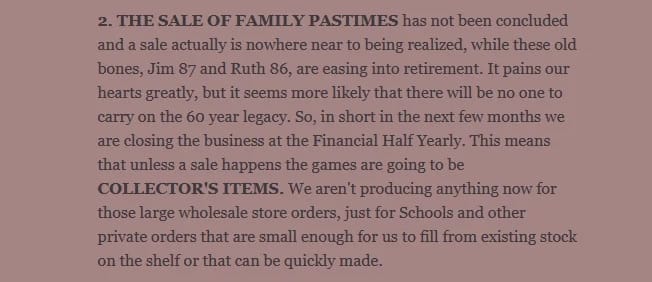
▪️ On Reddit, user y-r-u-scared posted the June 2026 newsletter from Canadian publisher Family Pastimes, which started in 1972 and has published 140 titles, all of which are co-operative games. Founders Jim and Ruth Deacove, who are ages 87 and 86 as of mid-2026, have been looking for a company buyer since at least 2021, but have yet to find one, so they plan to close their business before the end of 2026.
For background on how Family Pastimes came to be, turn to this 2000 article that Jim Deacove wrote for The Game Journal. Here's an excerpt:
Competition is an effective tool for classroom management, for realizing various academic goals. In the short run, this is the devilish attraction of the competitive technique. You get those quick, short-term results. It's messy and takes too much time to take the co-operative route which tries to nurture action through understanding. I can get my daughter to clean her room by setting up comparison/competition images with her neat friend, Amanda. Tanya will clean up under that kind of pressure. But will she understand what cleanliness, punctuality, etc. are about if I go on doing that to her? I no longer think so...
We were forced to change the rules on many of the games we had at home. We changed Scrabble around and instead of keeping individual scores we kept a family score. Just that simple rule change created subtle shifts in the dynamics of the game. Some examples... We allowed each other to use the dictionary freely. We permitted helping each other to spell words. We didn't hide behind our tokens. Not only did we expose them, but we even traded them. Finally, instead of using my cunning to maximize my own score with the treasured letters X, Q, Z, etc. and burying them so no one else could use them, I now could still be ingenious by using the letter well, but also play it so as to create opportunities for others. Let me tell you that I felt a thousand times better using my mind to assist and share rather than as a weapon.
Why the good feeling? The reason is simple. Our initial impulse to play a game is social; that is, we bring out a game because we want to do something together. So how ironic it is that in most games we spend all that energy and effort trying to bankrupt someone, destroy their armies, or in other words, we try to get rid of the very people we just invited over to play with.
That same Reddit user shared attachments sent by the Deacoves that list the value of equipment, games, and materials on hand (approx. CA$400,000), along with the provision that any purchaser must guarantee that only co-operative games will be published under the Family Pastimes name.
In an email to me, Jim Deacove writes, "Asking a little (100,000 CDN) for a lot...just want to put the business into good hands." The Deacoves have run the Family Pastimes business from their farm, but Jim Deacove writes, "it looks like someone wants to buy the farm but not the business, so it is likely the business will have to be moved."
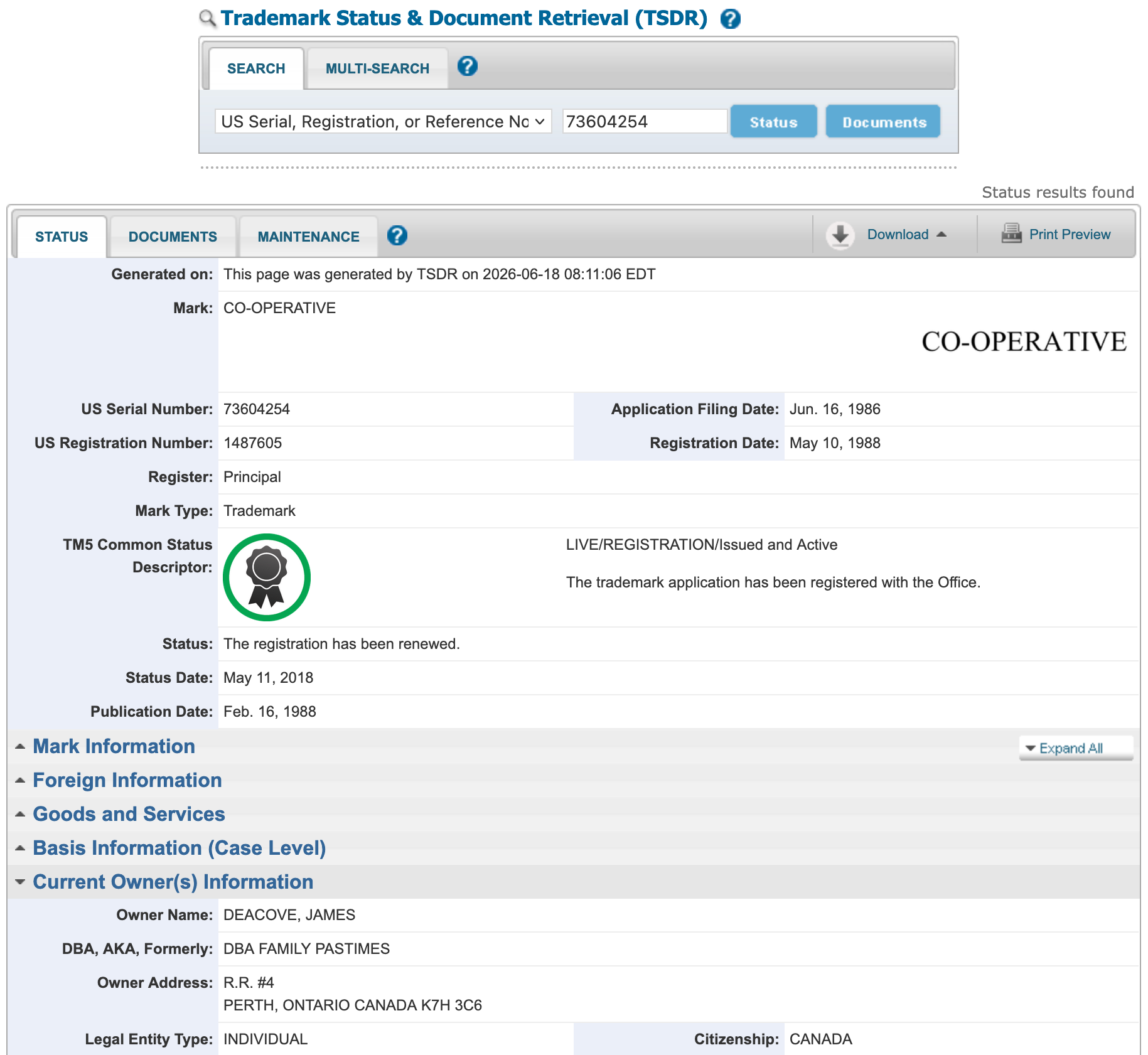
Oh, and Jim Deacove holds the international trademark on the wordmark "CO-OPERATIVE", which he registered in 1988. That registered trademark will be included in the deal as well.