The passing of Cocktail Games' Matthieu d'Epenoux had me looking at French games this past weekend, which prompted the realization that I had never published an item from Spielwarenmesse 2026 since I was waiting for game rules from another company to complete the other half of the post...then I continually ignored the draft of that post as it became one of those things that's there, yet invisible, something about which you keep saying, "Ah, yeah, I need to finish that", then don't.
The same lesson arrives again and again, day after month after year: Why wait, especially when you can talk about what excites you?
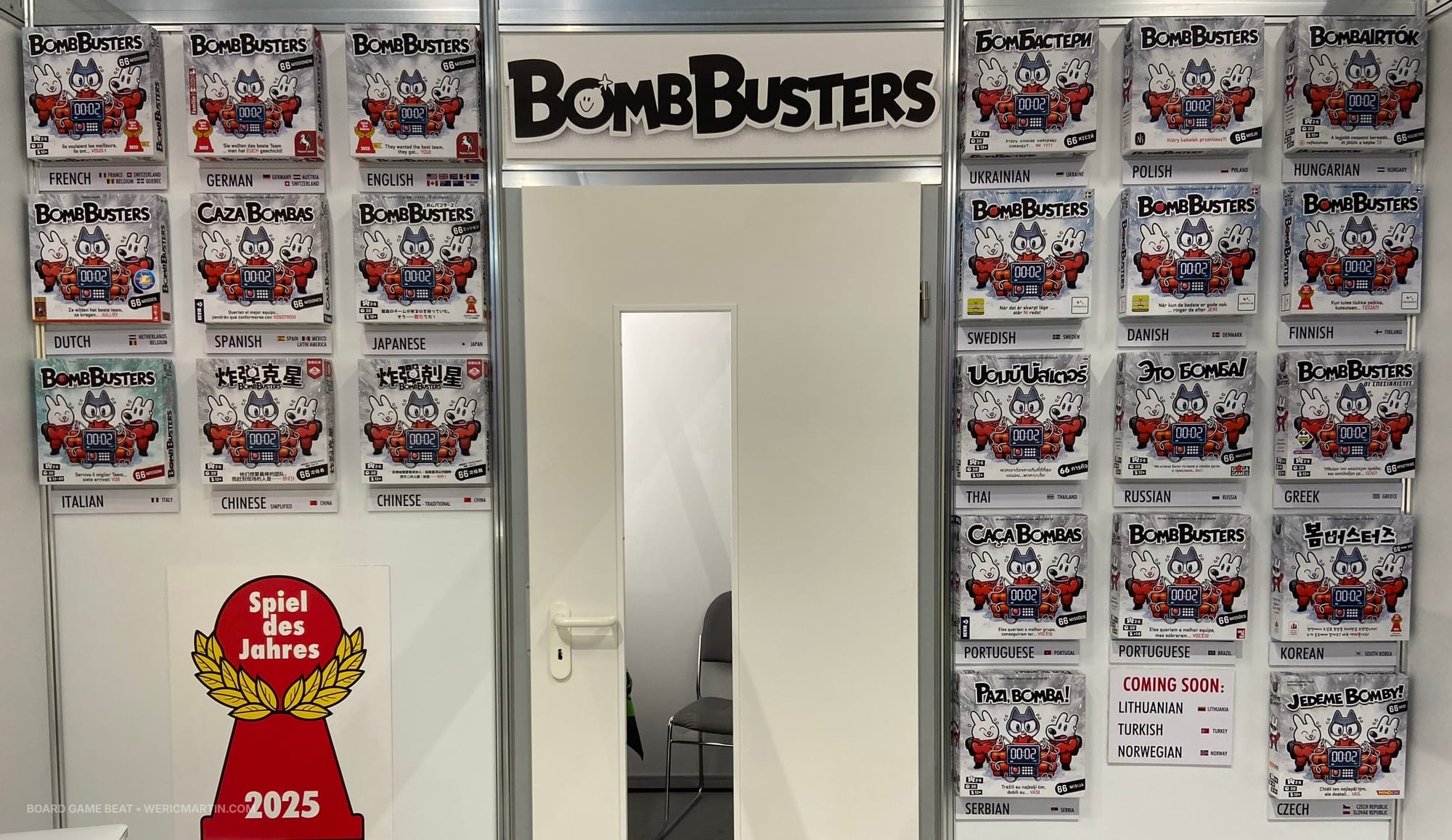
At Spielwarenmesse 2026, French publisher Cocktail Games featured Hisashi Hayashi's game Bomb Busters front and center. Having twenty-three language editions on the market is impressive within a year of it winning the 2025 Spiel des Jahres, with three more language editions on the way...and who knows? Perhaps contracts for additional languages were signed during the fair.
(I slipped news of a Bomb Busters expansion and deluxe component kit into yesterday's post, which is what led me back to this post-in-progress.)
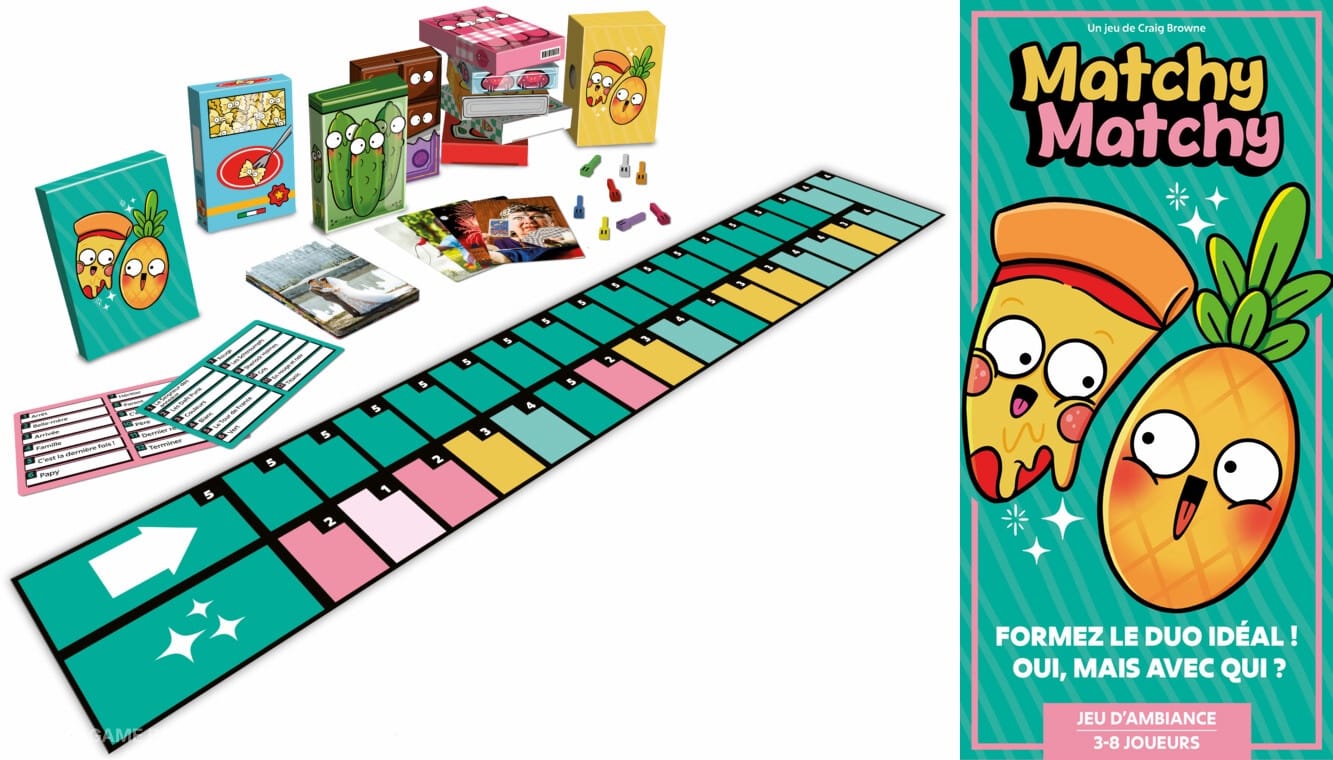
As for "new" releases, in March 2026 Cocktail Games released Matchy Matchy, a new edition of Craig Browne's 1995 party game Compatibility, which Cocktail has been publishing in various forms since 2010.
In the game, which is ideally played with teams of two players, a new theme is revealed each round, then you and your partner each choose 1-5 illustrated cards from your identical decks, then arrange them in order starting with the cards most appropriate for the theme, then you reveal your cards. If the two of you have placed the same card in the same rank — that is, you both placed the nurse dressed as a clown in the second position for the topic of "irony" — you move your token three spaces on the track; if you chose the same card but ranked it differently, you move your token two spaces.
Each round, the location of your token indicates how many cards you pick, and the closer you get to the goal, the fewer cards you (usually) draw.
With an odd number of players, one player serves as the guiding star that everyone else tries to match, but who doesn't score themselves. Whoever reaches the end of the track first must marry the star and commit themselves to living together for no less than fifteen years.
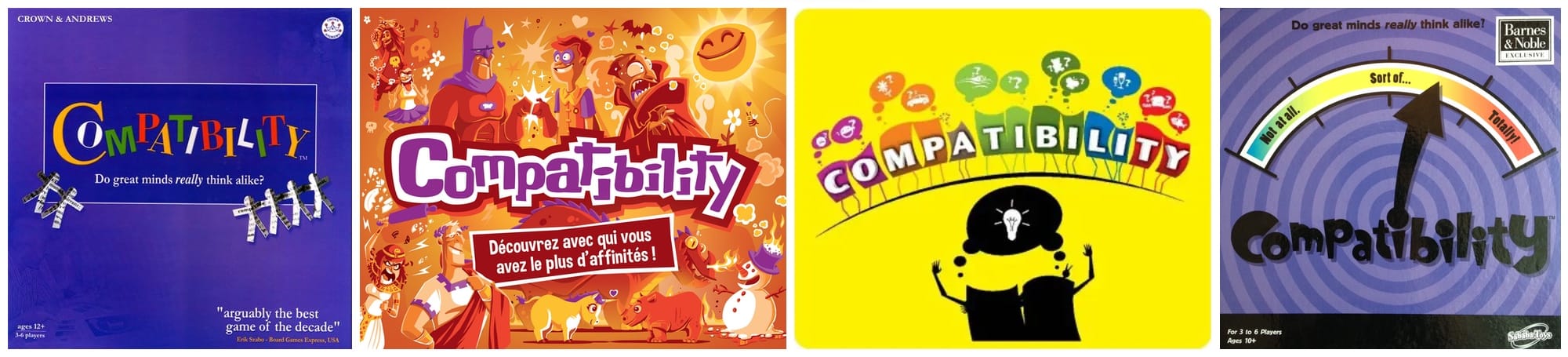
I've played Compatibility a couple of dozen times and think it's an ideal party game, whether you're playing with friends or people you've just met. It has the basic "think alike to score" pattern of many party games, with rules you can teach during the first round of play, getting to the action immediately.
The one house rule I suggest: Whenever a team has an exact match, each teammate discards that card from their deck. I like this because some cards have more utility than others, so when one of those cards is removed, a team has to find other cards to fit a topic, which favors more interesting choices over more obvious choices. (I've also purchased different editions of Compatibility so that we can play with different sets of images, which is another way to shake up gameplay.)
Publisher Big Moustache Games debuted in 2025 with Lenny Landau's Opération Zèbre, which falls into the "get your teammates to guess something" end of the party game pool.
The core challenge is that a player looks at a card with lines of text that describe a person, a place, a work of art, etc., with a "suspicion value" to the right of each line. That player crosses out as many lines as they wish, then notes the value of the remaining lines on a score card. If the teammates guess the subject of the card, great! They can ask for a hint, which will cost a bit more suspicion, but the cost of that might be less than the penalty for guessing incorrectly.
In co-operative mode, you try to complete three rounds of play, with each player cluing a card in each round; in competitive mode, you try to score more points than the other team by gathering less suspicion and intercepting answers that opponents fails to get.
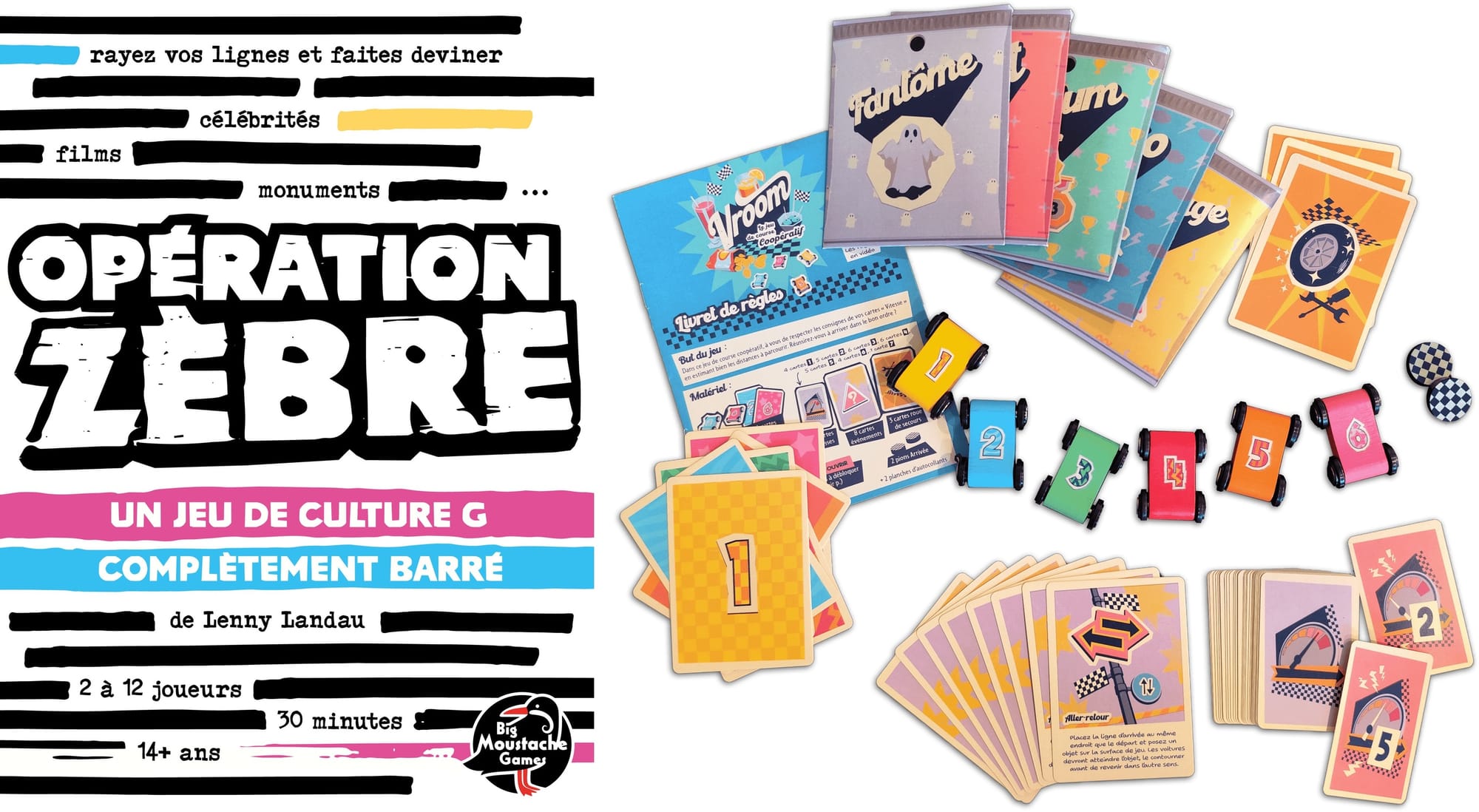
On May 22, 2026, Big Moustache Games released its second title: Vroom, a party game for 3-6 players by Antonin Boccara that also hits the "think alike to score" vibe, although you could think of it more as a crossover between The Gang and The Mind. (Perhaps these titles could collectively be tagged as "gangmind games".)
In Vroom, you and your fellow players will complete three races, with each race consisting of five rounds. You receive a random speed card from 1-7 each round, but you can't reveal your values to one another; instead you take turns moving your car toward the finish line in what you think is the appropriate amount. No car can pass the finish line before the fifth round, and at least one car must pass the finish line by game's end.
After five rounds, reveal the sum of a player's speed cards starting with the car farthest in the back, ideally revealing a sum equal to or higher than the previous sum. If you mess up, remove the fewest number of cars necessary to make the order work, losing a spare tire for each mistake. If you can't discard a spare when you need to, you lose.
At the start of the second and third races, you reveal an event card that affects play, such as "Round Trip", which requires players to navigate their car around an obstacle and finish the race at the starting line.
Vroom includes five booster pack modules — Podium, Boost, Weather, Departure, Ghost — that you can open and introduce once you've won a game or two and feel the need, the need for speed...y expansions packed with the base game.
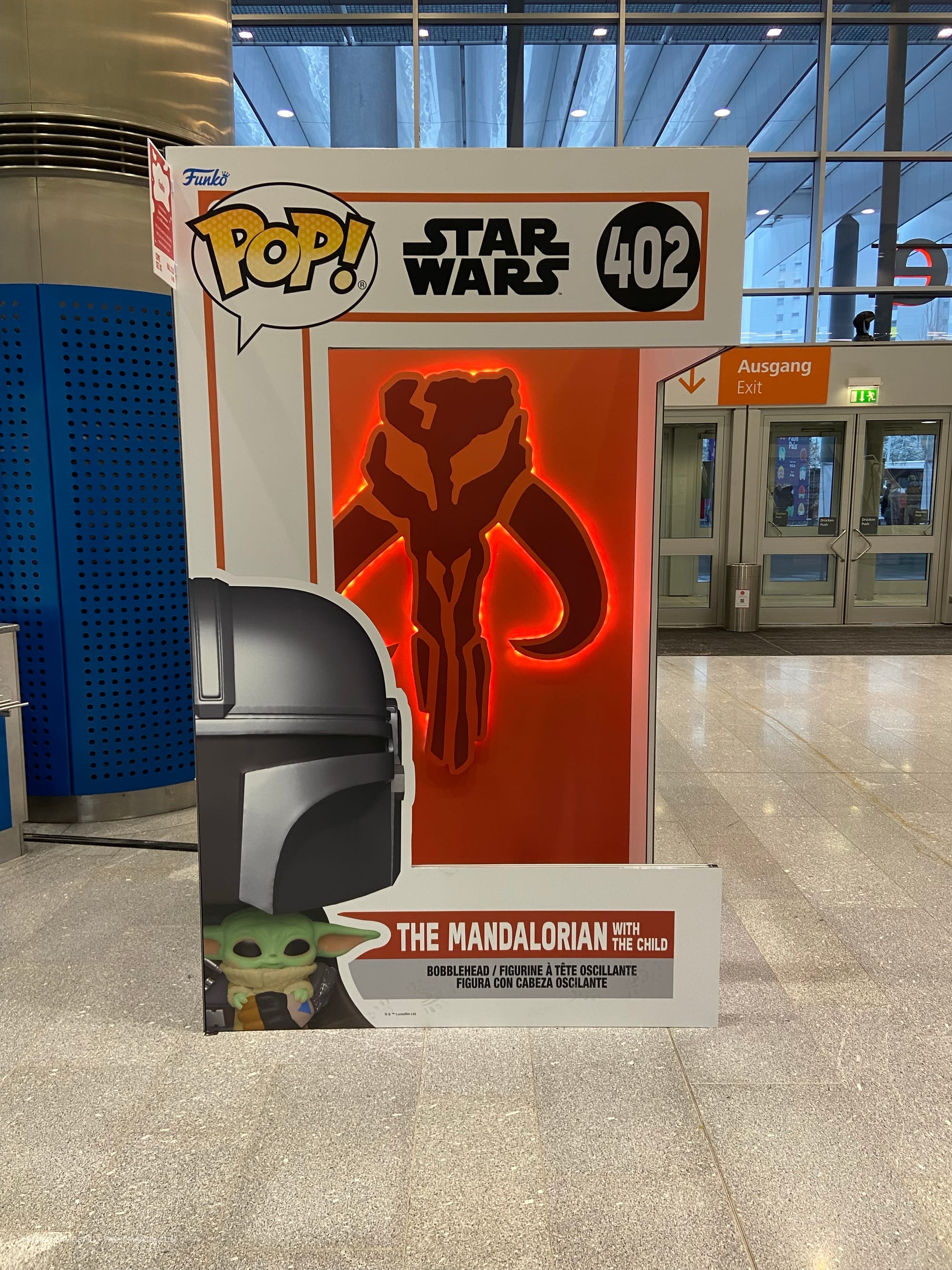
Maybe it's me, but I don't see the appeal of a promotional prop like this. You get to pose in a human-sized Funko Pop! box bearing branding for "The Mandalorian", yet it's just going to be a picture of you in this box looking nothing like The Mandalorian. It doesn't even feature a Grogu on a string that you can use as a prop.
I saw folks posing in the box, so clearly some are attracted by the idea, but I think I was born without the proper fan gene because I don't see the attraction.