▪️ The winners of the 2026 Mensa Mind Games have been announced, with the seven 2026 Mensa Select games being:
- A Place for All My Books, by Alex Cutler and Michael Mihealsick (Smirk & Dagger Games)
- Critter Kitchen, by Alex Cutler and Peter C. Hayward (Cardboard Alchemy)
- Fromage, by Matthew O'Malley and Ben Rosset (Road to Infamy Games)
- Galileo Galilei, by Tomáš Holek (Pink Troubadour)
- Got Five!, by Yoann Levet (Blue Orange Games)
- Things in Rings, by Peter C. Hayward (Allplay)
- Twinkle Twinkle, by Ammon Anderson (Allplay)
In case you're not familiar with the Mensa Mind Games event, once a year Mensa members gather somewhere in the U.S. to play a variety of games submitted by publishers. Publishers must pay to submit their games, so the event is not open to every game released on the U.S. market.
If the process works the same as in the early 2000s when I attended, attendees receive a list of games that they're required to play and judge, with the option to play and judge any other game on hand as time allows. Thus, just as not all games are present, not all games are played and judged equally. That said, the award still carries weight with retailers and buyers in the U.S. market.

▪️ Through May 10, 2026, the Palazzo Arese Borromeo near Milan, Italy is hosting 0-99 Design Per Gioco, which it describes as "an exhibition that explores the board game as a cultural product in its evolution over time".
The exhibition includes thirty ancient games from around the world, well-known games from the twentieth century, modern games created in the 1990s and later, and a feature on how artificial intelligence will impact game design. Two rooms are dedicated to the life and work of Alex Randolph.
Check out this Instagram post from the museum for a brief video tour of the exhibit.
▪️ On Don't Eat the Meeples, Matt Montgomery makes an argument for "How SCOUT influenced climbing games".
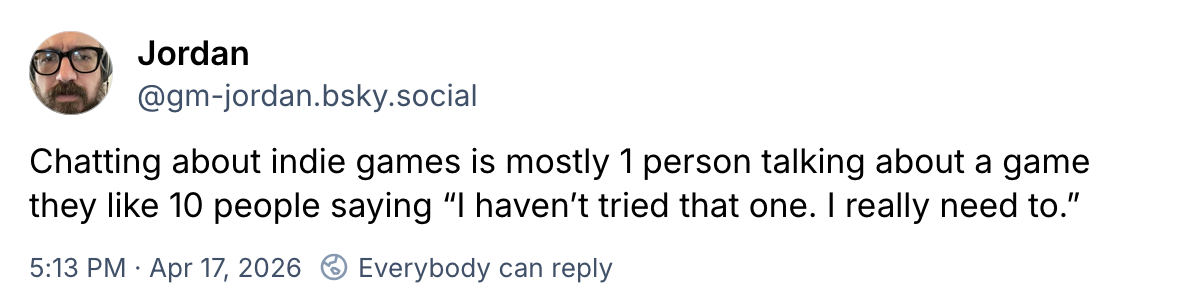
▪️ I saw the above on Bluesky, and while the individual was talking about video games, it's also applicable to tabletop games (and books and movies and...).
▪️ In early April 2026, Cambridge University Press published Robert J. Madden's article "Probability in the Pleistocene: Origins and Antiquity of Native American Dice, Games of Chance, and Gambling". (HT: Mitchell Thomashow) Here's an excerpt from this article, which focuses on two-sided dice used by Native Americans:
This article undertakes to...dispel the uncertainty surrounding the identification of prehistoric Native American dice in two ways. First, it addresses the problem of accurately identifying prehistoric artifacts as dice by using the voluminous record of historic Native American dice compiled by Culin (1907) to derive an objective, morphological, attribute-based test for more confident identification of prehistoric examples. Second, it uses this morphological test to identify prehistoric Native American dice in the North American archaeological record, tracing their appearances over time and space. The combination of these two datasets enables new insights into the antiquity of Native American dice, games of chance, and gambling, and the implications of their appearance in the deep past.
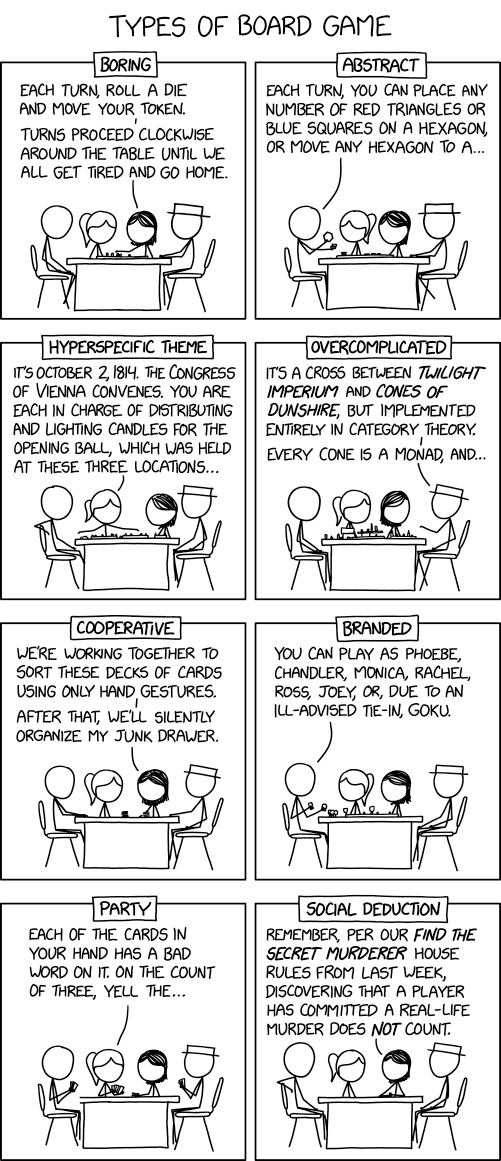
▪️ On April 20, 2026, XKCD surveyed the board game landscape: