

People ask how I organize game announcement posts. Sometimes I use a theme — e.g., solitaire play, games from country X, games debuting at convention Y — and sometimes I spot one game from a publisher, then another, then another, and I realize I could just write about them in one go instead of possibly spreading them out over multiple posts.
This is one of those latter posts, starting with an overview of BLORP!, a tile-laying game from Garth Kauffman and Smirk & Dagger Games that I played at GAMA Expo 2026. As you can see in the image above, each player builds their own BLORP, drafting one of four tiles on a turn and adding it to their display with colored edges matching. You score 2 points per tile for the largest BLORP in each color at game's end, and while the tiles won't always co-operate, you can "stitch together" two or more BLORPs via trumpets that face one another. If you zoom in on my display:
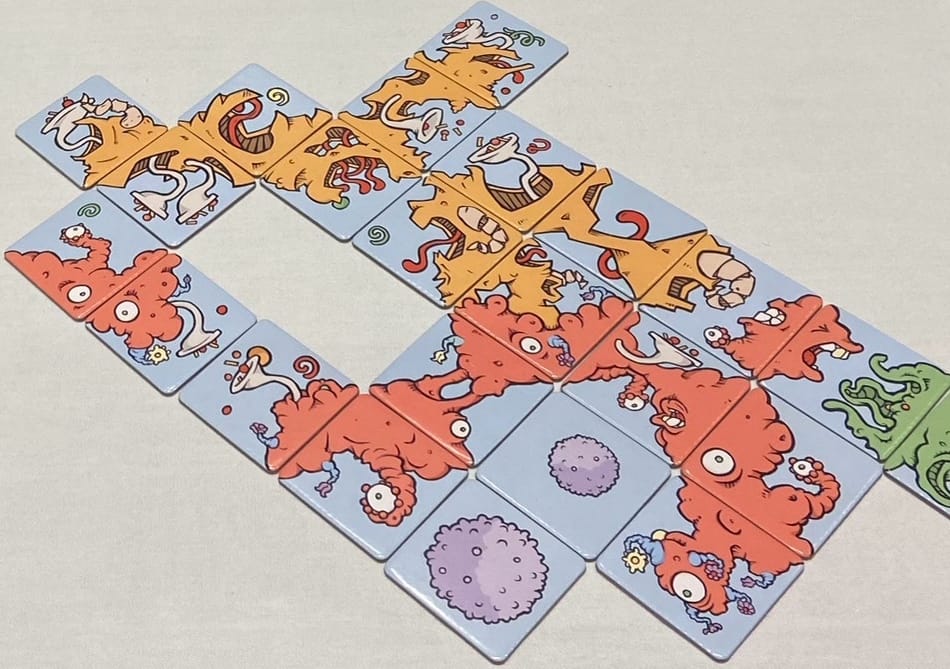
You'll see two separate orange BLORPs, but because they each have a trumpet shooting confetti at one another, they're considered a single unit — and you can chain trumpet connections through different colors of BLORPs, as well as through a confetti cloud that allows four trumpets to toot together.
Smaller BLORPs in a color are 1 point per tile, and spores are 5 points if surrounded orthogonally.
Changing a few letters, we move from BLORP! to boop., a two-player-only game from Scott Brady that's already had two standalone spin-offs — BOOoop. and boop the Halls! — with a third arriving in 2026. While boop. is a luck-free abstract strategy game, Boop Shuffle blends the randomness of card draws with gameplay similar to the original.
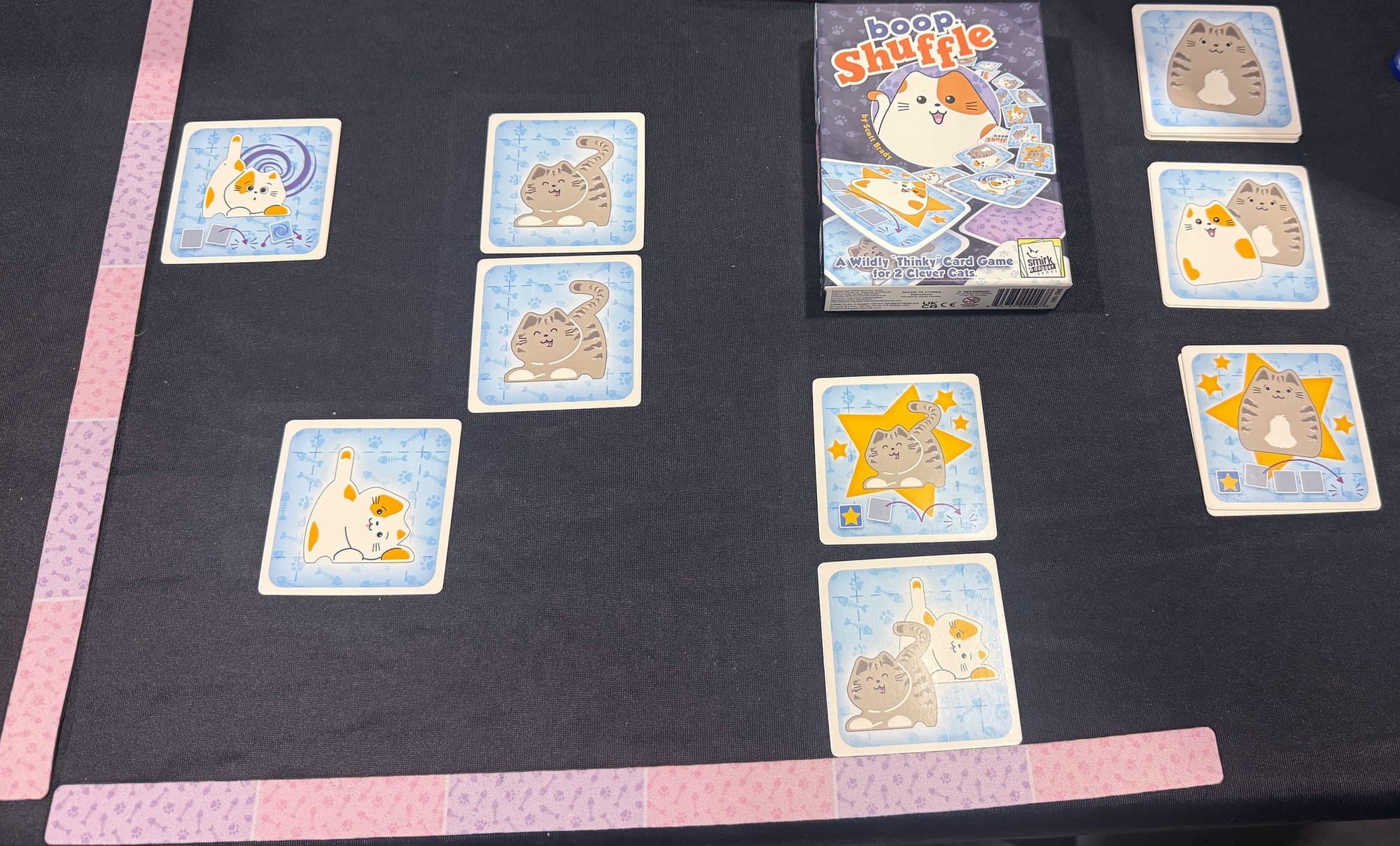
Each turn you draw from the deck, which initially is filled with kittens in two colors and a couple of wilds that feature both colors, then place the card diagonally or orthogonally adjacent to at least one other card within the 6x6 grid. Unless it has another card behind it, each adjacent card gets "booped" one space away from the card just placed, possibly throwing it outside the grid and onto the discard pile.
If you create a line of three kittens in your color, remove those cards in the grid from the game, then place three cats in your color from the reserve (seen at right in the image above) onto the discard pile. You want to upgrade kittens ASAP because to win the game you must get three cats of your color in a row.
A few special cards — wilds, supers, scaredys, and a lone blankie — throw a few twists into the game, and you can also play with a "floating" 6x6 grid that is defined and re-defined during play based on where you place cards.
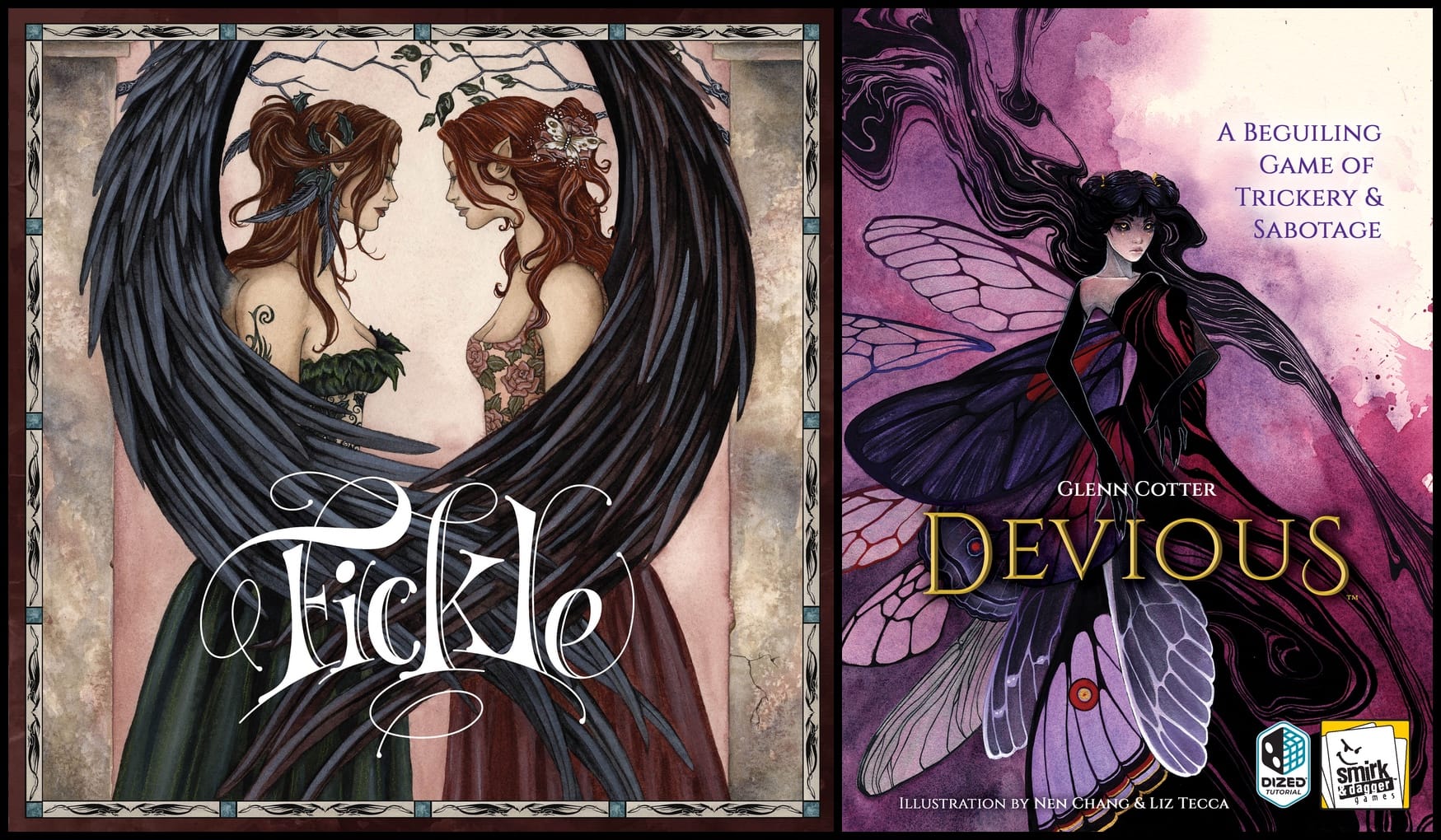
Devious is a new edition of designer Glenn Cotter's card game Fickle, which BARD Games crowdfunded in 2019. During this 2-6 player game, each player creates an alliance of fairies in front of them, using their powers — and making smart/lucky choices — to score as many points as possible.
The hook of the game is two-fold. In each of five rounds, you draw three cards from the deck, place them in an order of your choice, then set them face down in front of a neighbor. At the same time, each player draws the top card, then decides whether to keep it or discard it; if they keep it, they discard the other two cards, with all discards being face down to preserve the mystery. All players who discarded the first card draw the second and again decide to keep or discard, getting the remaining card.
Thus, you're gambling on what's in the pile and how your neighbor might present cards to you. Each game uses six types of fairies out of thirteen in the box, with fairies having one-shot abilities or endgame scoring modifiers. Players each carry out the ability on their fairy, which might add or remove to your alliance or an opponent's alliance, swap cards, and so on.
At game's end, if you have a single fairy of a type, you score points equal to its rank (1-5), while two fairies of a type are worth 0 points, three or four is negative points equal to your highest rank, and five or more is worth points equal to the sum of their ranks...but you don't score anything else.
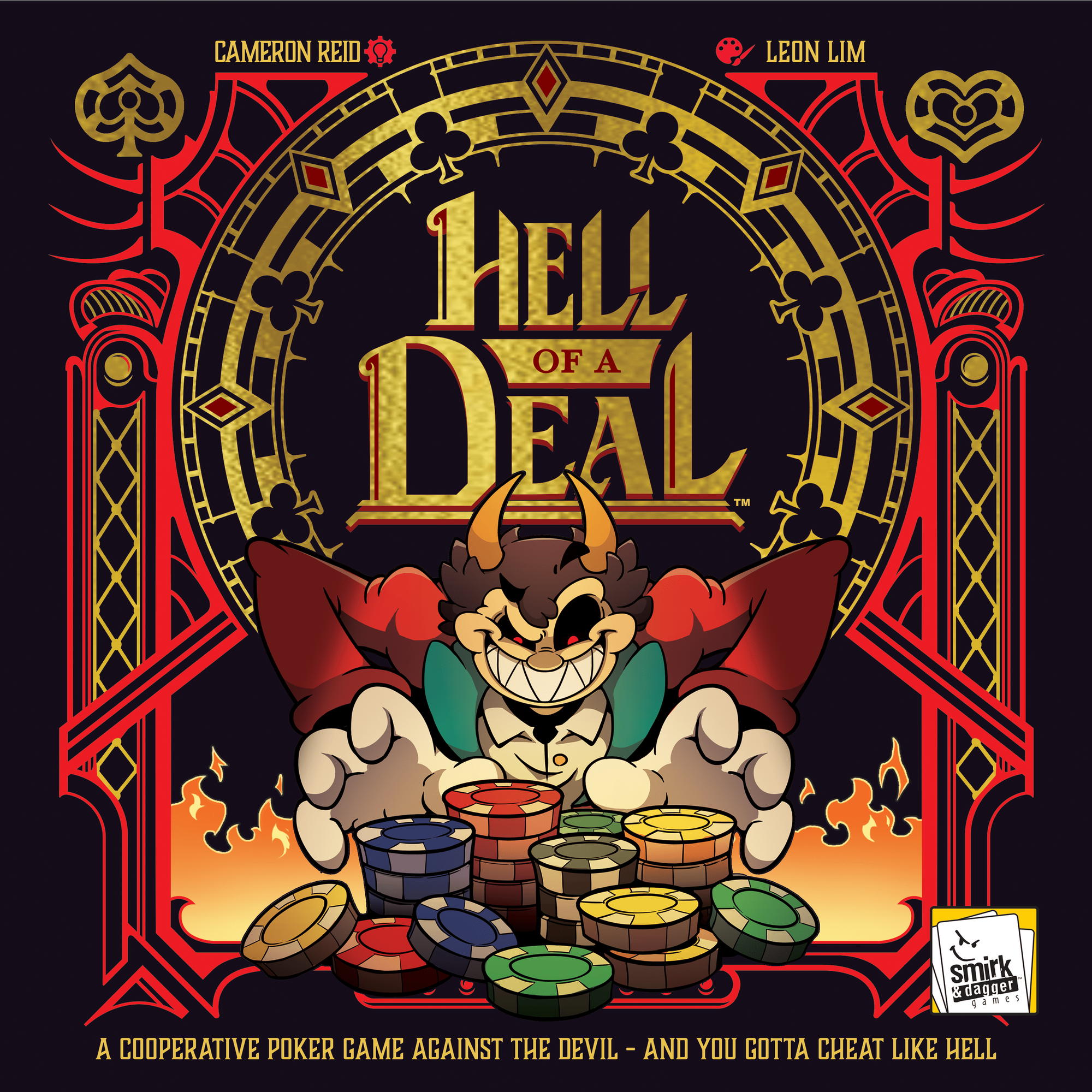
While the three titles above are rather small, in April 2026 Smirk & Dagger Games crowdfunded Cameron Reid's Hell of a Deal, a 2-4 player co-operative game in which you play poker against the Devil and various minions from Hell. Here was the component spread on display at GAMA Expo 2026:
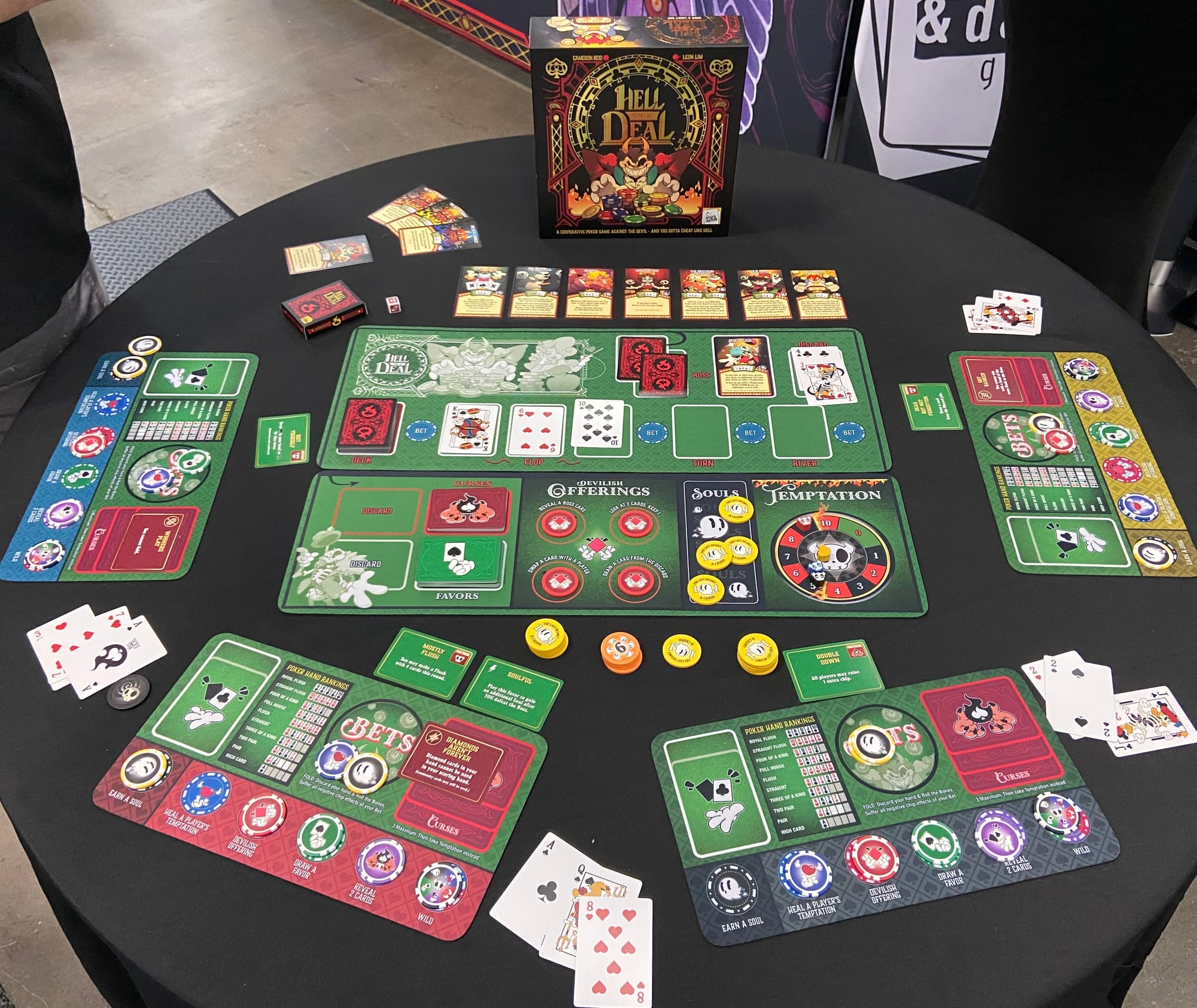
Gameplay is along the lines of Texas Hold'em, with players getting three hole cards instead of two (although at most two can be used in your final hand), then seeing three cards on the flop, a fourth card on the turn, and the fifth card on the river. Your goal each hand is to beat the boss, with the first four rounds having you face one of ten random minions, followed by "Nick Hauss" (the devil in disguise?), then one of three versions of the Devil.
After each set of cards — hole, flop, etc. — is dealt, each player in turn order either bets one of their available chips or folds. Two chips allow you to earn a "soul" — the game's currency — should you beat the boss in this round. Other chips allow you to draw a favor card, with these giving you a variety of benefits; heal a "temptation" (more on that later); reveal two of your cards; or use one of four "devilish offering" abilities depicted on the dealer mat. You could reveal one of the boss' hole cards, for example, or swap a card with a fellow player.
After the final bet/fold, you reveal all cards. Each boss you face has a default hand on their card — two pair, three As, a straight, etc. — and they use their default hand unless their hold cards give them something better. If you beat a boss, you receive souls if you bet for them; if you don't, you lose souls from your reserve and gain temptation or curses, depending on which chips you bet. Curses give you random handicaps, such as diamond cards in hand can't be used, while temptation is an endgame trigger.
If two players have 10 temptation, you lose the game — and if you're at 10, any temptation you gain in the future must be taken by another player. The other losing conditions are no one winning against the Devil and not being able to pay souls should you be beaten by the final two bosses.
Smirk & Dagger Games went to press almost immediately after the crowdfunding project ended, with an expected debut for Hell of a Deal at Gen Con 2026 and a retail release in September 2026.


