

On Sunday, our prayers are announced, and more trick-taking games are announced. Well, that's what it seems like anyway, and we'll start with an oddball design in which you don't have a hand of cards:
▪️ Rascally Rabbits is a 2-6 player trick-taking game from Sunrise Tornado Game Studio that designer Ta-Te Wu plans to crowdfund in July 2026. [Disclosure: Wu has reached out about advertising on Board Game Beat.]
The game plays over three rounds, and at the start of a round, you place a dry-erase garden card behind your screen. These cards have a grid of numbers in five columns and three rows; the columns are topped by five vegetables, and these vegetables are also placed at the left and right of the rows, with the row spaces containing the numbers 1-16. An image might help:
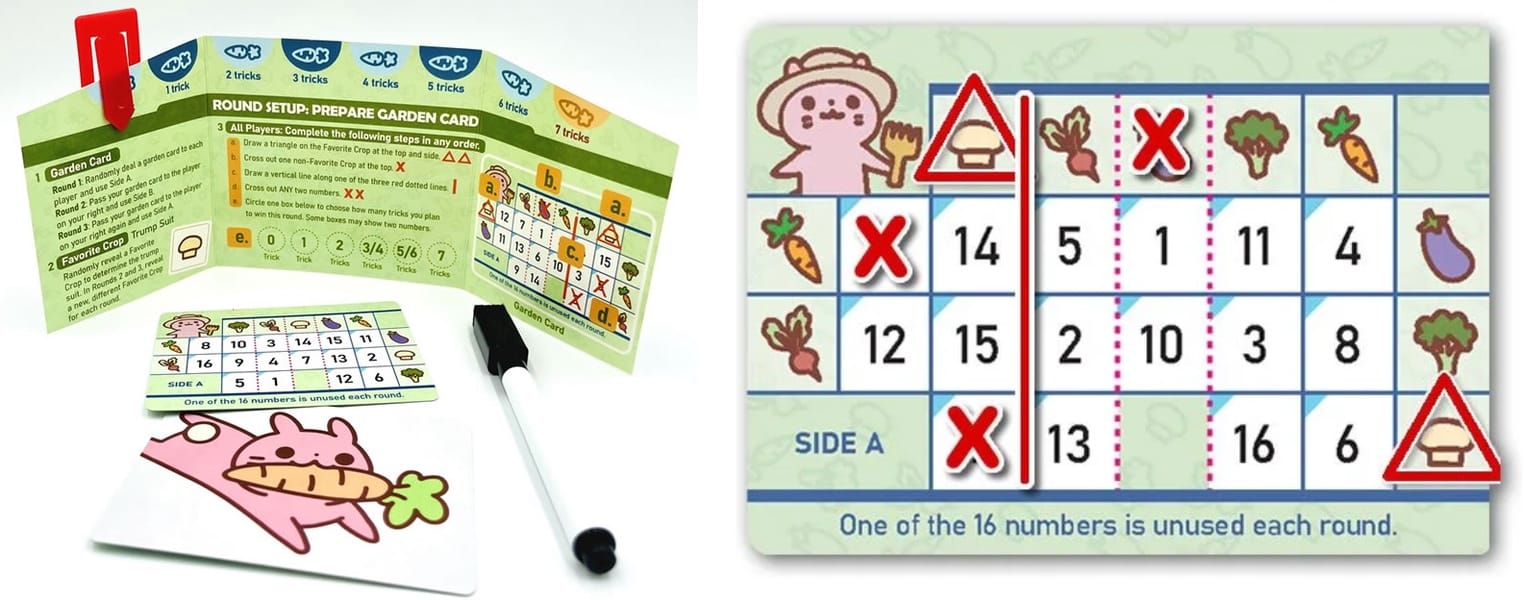
To set up for the round, reveal a "favorite crop" card to determine trump for the round, and mark that vegetable (mushrooms in this case) on your card. Mark out a non-favorite vegetable atop a column, draw a solid line on one of the three vertical dashed lines, then mark out two numbers in your grid.
By doing this, you've set up your hand of fourteen "cards" that are read both vertically and horizontally. In the garden card above at right, for example, you have trump mushroom values of 16, 15, 14, 13, and 6. (Lucky flip for you on the favorite vegetable!) For carrots, your values are 14, 8, 6, and 4 as the vertical line determines which numbers "belong" to the veggie on the left and which belong on the right. You also Xed 7 in the upper left corner to "short" yourself one carrot.
Most numbers belong to two suits, but only radish has 12 since that number isn't in one of the five columns, and 10 is solely in broccoli since you Xed the eggplant at the top of the column.
Finally, estimate the number of tricks you will take out of thirteen, marking that at the bottom of your screen.
After this, the trick-taking mostly follows standard rules. The lead player chooses a value and suit to play — maybe eggplant 4 — then each other player must play a value in that suit, if possible. (Mark off each number as you use it.) If someone doesn't have the lead suit, they can play any suit. The highest-valued favorite vegetable wins the trick, if such a veggie is player, and otherwise the highest-valued vegetable in the lead suit wins, with the winner leading the next trick.
If you play the same number and crop as another player, they're considered higher than you and you circle a rabbit icon on a separate board in front of you. If you take zero tricks in a round, you score points based on the number of circled rabbits, but if you score 5+ rabbits, you cannot score this way again for the remainder of the game.
After the thirteenth trick, the round ends, and players score points based on the number of tricks they took; if you matched your bid, you check off that round, and at game's end, you score 0-13 points for having 0-3 checks. In a final twist, if a player collects a seventh trick, the round ends immediately. Pass and flip garden cards ahead of the second and third rounds, after which whoever has the most points wins.
Having read the rules a few times, I now understand the details of how to play, but honestly I have no idea how to play. The concept seems so out there!
▪️ At SPIEL Essen 26, Friedemann Friese of 2F-Spiele will release Fishing 2, a trick-taking game for 3-5 players that's very much like 2024's Fishing, but different. If you're not familiar with Fishing, you can read my overview from 2024 (or watch this video I made), or you can not skip the next paragraph.
The game lasts eight rounds and generally follows standard trick-taking rules. At the end of a round, you score 1 point per card claimed, then shuffle those cards, place them under your existing personal deck (if any), then draw cards for the next round. In effect, this round's fish become next round's chum, so you often ride a tide of winning, then you're stuck with loser cards that others dumped on you. If you can't fill your hand from your deck, you draw new cards from the ocean stack, which introduces "better" cards, so you want these cards, but to get them you can't score many cards!
Fishing 2 works the same way, but "blowfish, two trump colors, and new buoys create a fresh game experience" as they come out of the ocean stack. [Disclosure: 2F-Spiele hired me to edit the English-language rules for Fishing 2 and its new edition of Fearsome Floors.]
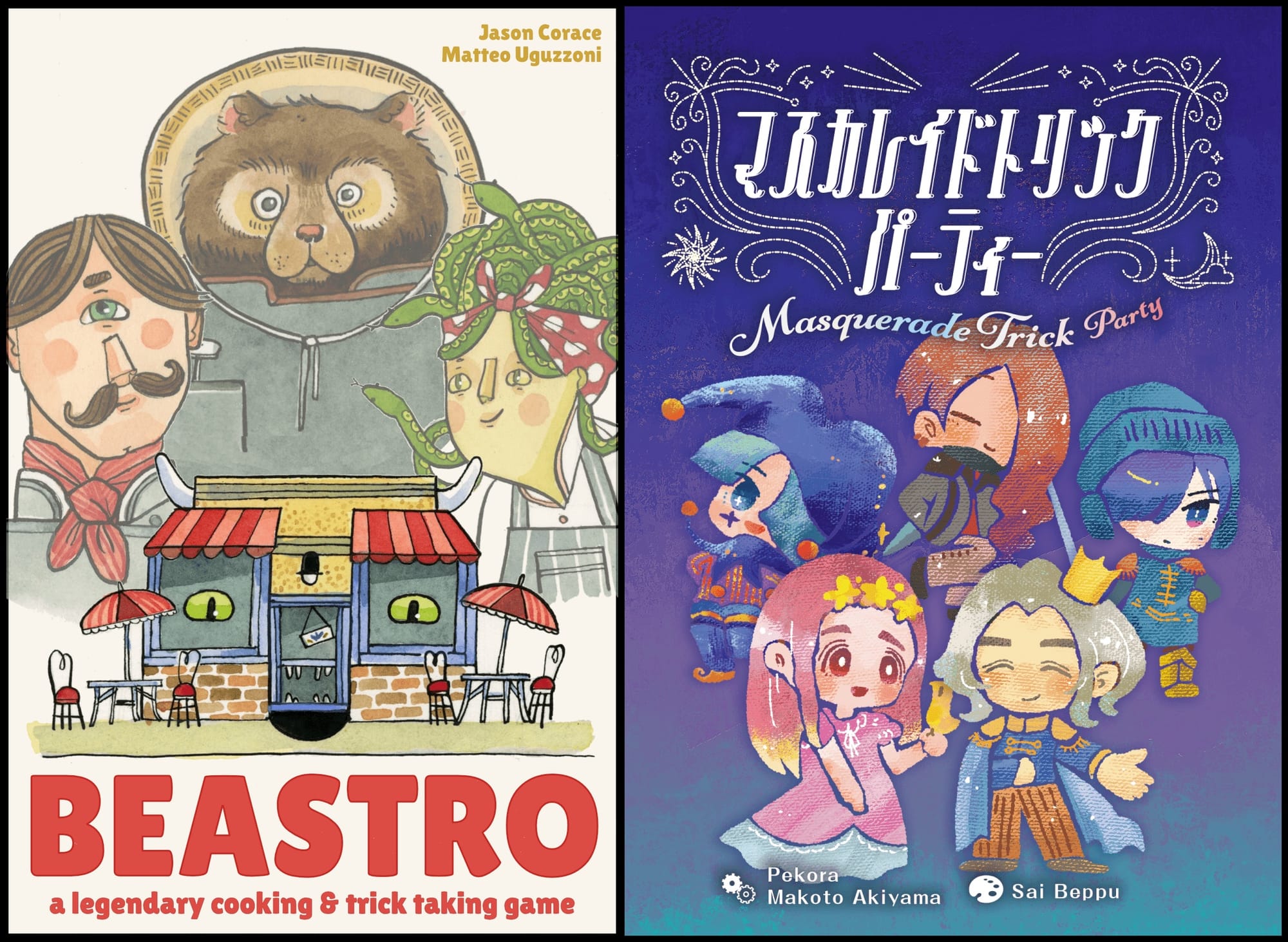
▪️ To continue with animal-based settings, Beastro is a team-based trick-taking game for 3-6 players from Jason Corace and Matteo Uguzzoni of Hello Mountain that debuted during Indie Games Night Market at PAXU 2025 and is now available on the publisher's website.
In each of three rounds, players start with a hand of cards from a deck that contains numbered cards in four suits as well as sabotage and secret sauce cards. In an initial wager, each player puts out a numbered card with the highest card determining the round's "head chef" and with the three lowest-valued cards getting to nix one of the suits, with the remaining suit being trump. (Secret sauce cards beat all cards, including one another.)
The head chef distributes role cards to the other players face down, with secret chefs trying to score with the head chef and line cooks wanting to take them down. Each player also receives a character with a one-shot ability.
The head chef team needs to take more than half the tricks — or half the tricks and less sabotage than the other team — to win the round. Sabotage can be played at any time and costs the holder at round's end 1 point...and possibly the entire round.
▪️ Everyone visibly becomes a character in Beastro, but in Masquerade Trick Party — a 3-5 player game from Makoto Akiyama and Pekora that Mysboard Games will have at Game Market Spring 2026 — everyone takes on a secret role, such as knight, jester, prince, and princess.
Each role has a day mission and a night mission. The day mission relates to tricks taken, with each player starting with a hand of ten cards in five suits. Standard trick-taking rules apply, but you want to pay attention to who's fighting for which tricks because your night mission is to identify your target, and you need to know what those roles are trying to do in day to help you succeed at night.
If only one player completes their day and night mission, they win, and if multiple players do so, whoever has the lower role number wins since they had a more challenge day mission. If no one does, you check who won their night mission, and if necessary you look at completed day missions.


