

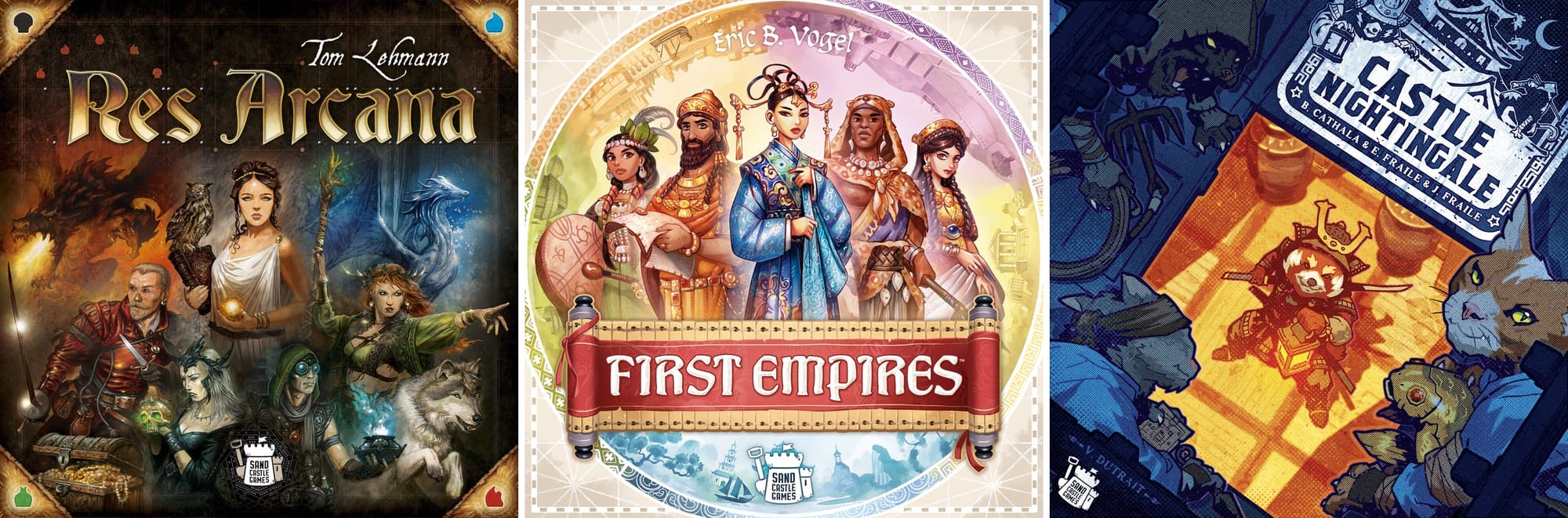
Publisher Sand Castle Games launched in 2019 with Tom Lehmann's Res Arcana, then followed up in 2022 with Eric B. Vogel's First Empires (my review) and in 2026 with Castle Nightingale from Bruno Cathala, Eliette Fraile, and Jérémy Fraile. Releasing three games in seven years is a much slower pace than most publishers, so I was surprised to see another Sand Castle title announced for release in January 2027. So soon! Who would have thought?!
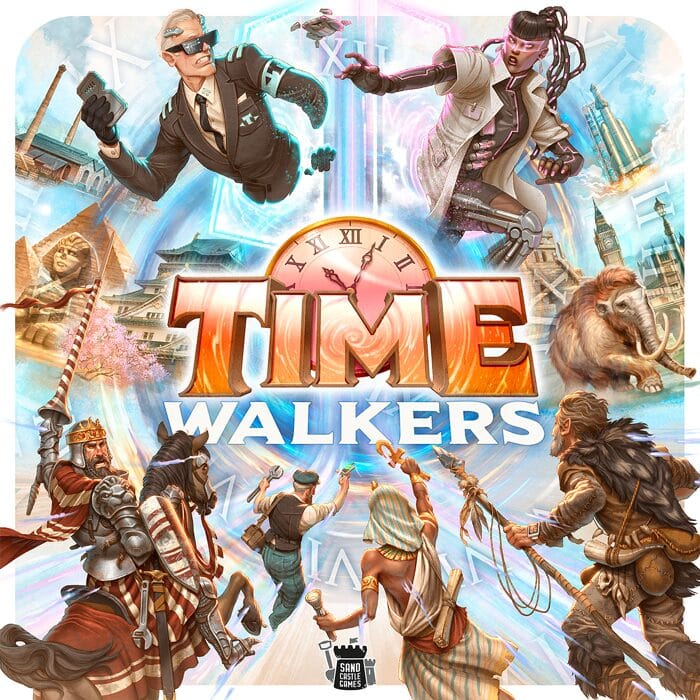
That said, the designers of Time Walkers — Alexandre Aguilar and Benoit Turpin — note in the rules that they've been working on this game for more than four years, so it's not like they've rushed it to market.
Time Walkers iterates on the flip-and-write game design genre to pit two players as competing temporal agencies who are trying to modify history to their liking, and as in other games that tackle this setting, you will compete in multiple eras of history simultaneously, with your choices affecting what both players can do.
To set up, place the four era game boards — prehistory, antiquity, middle ages, modern era — in a row, then place a "temporal rift" game board over the edges of adjacent era boards. Each player starts with a deck of four cards, and sixteen cards — four for each era — are shuffled, with three cards placed in a river. Eight rift tokens valued 1-4 are placed face down.
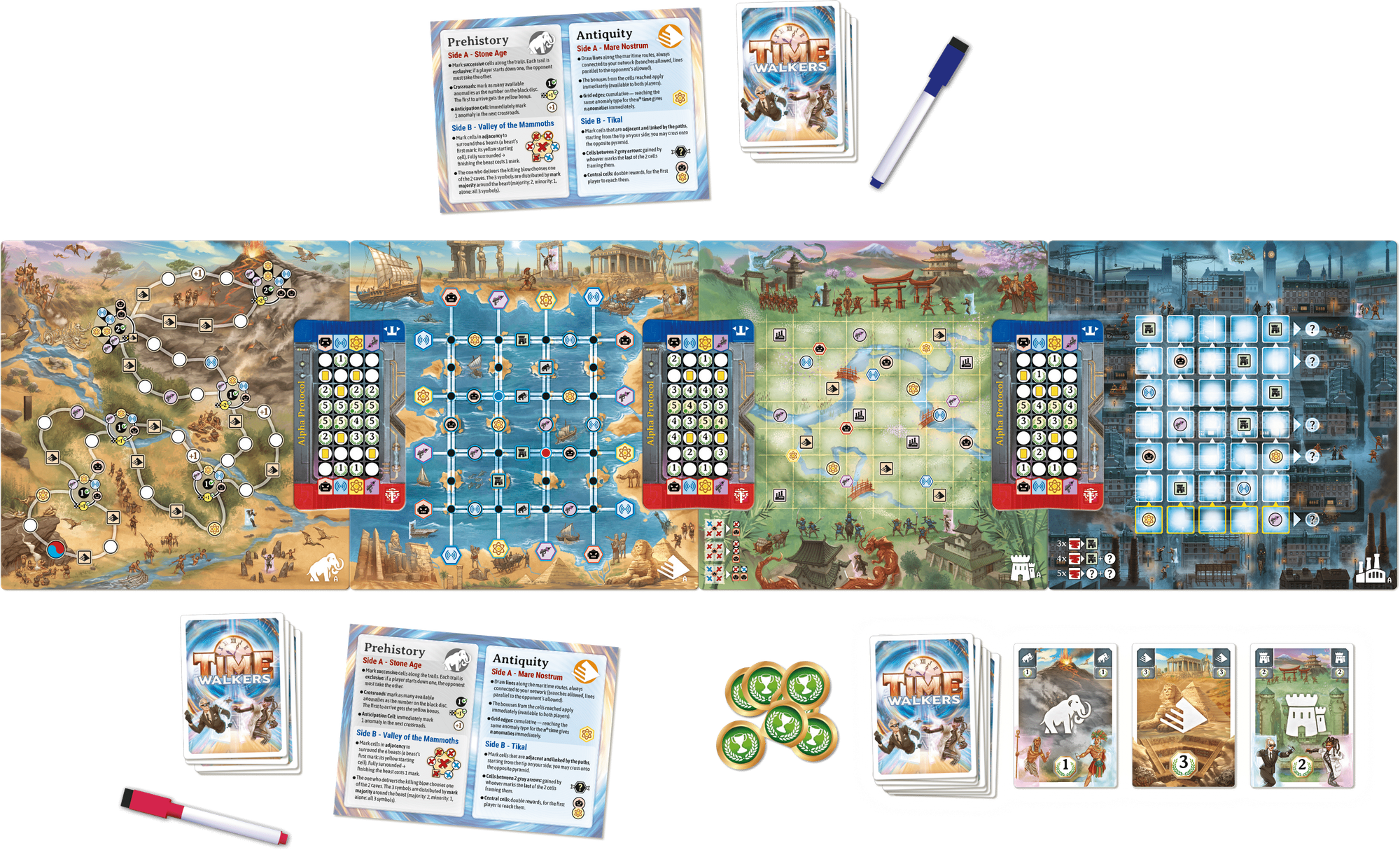
On a turn, you each draw two cards from your deck, then give one of those cards to the opponent. In player order, you place your two cards, one by one, face up in front of you by era, making as many marks on the matching era board as the number of cards from that era in front of you.
You mark each era board following different rules — along two divergent paths in prehistory, always adjacent to your previous marks in the middle ages, from the bottom up in the modern era, etc. — and when you mark anomaly symbols on an era board, you then advance along that specific anomaly path on an adjacent temporal rift board...and by doing that, you can add new cards from the river to your deck, score points, and collect rift tokens.
When your deck runs out, you shuffle all the cards in front of you to form a new deck, and you'll give away half of those cards as you go through it the next time, so don't get too attached to them.
When the final rift token is claimed, the game ends, with players summing points from rift tokens, temporal rift boards, and the cards in front of them.
As you might expect, both the era boards and the temporal rift boards are double-sided, with different movement rules for each era board, which are labeled with fun titles such as "Mare Nostrum", "Industria", "Shogun", and "Valley of the Mammoths". How Easter eggy...
The B-side for the temporal rift boards introduce a gem system in which each time you circle a gem, you choose between taking the highest point symbol yet unclaimed or a new card from the river — and getting new cards has the added bonus of letting you play first in the next round.
Want more game announcements like this one?
Get Board Game Beat’s free posts by email — original reporting, designer interviews, and industry news, with no tracking and no spam.


