

Portuguese publisher MEBO Games uses a blue-and-yellow color scheme on the two new titles it will feature at SPIEL Essen 26, and that's not the only similarity between these designs. Here's an overview of how to play each game:
Crescendo
I demoed Christwart Conrad's 2-6 player card game Crescendo at Origins Game Fair 2026 courtesy of licensee Arcane Wonders, which will release the game in North America in 2026. In case you missed that post, here's a recap:
The deck contains cards numbered 1-100, and to set up you place nine cards in a row in the order they are dealt to you. Each card shows one of three number ranges on the back — 0-58, 45-84, and 74-100 — along with one of three symbols. Your goal is to get your row of cards in numerical order.
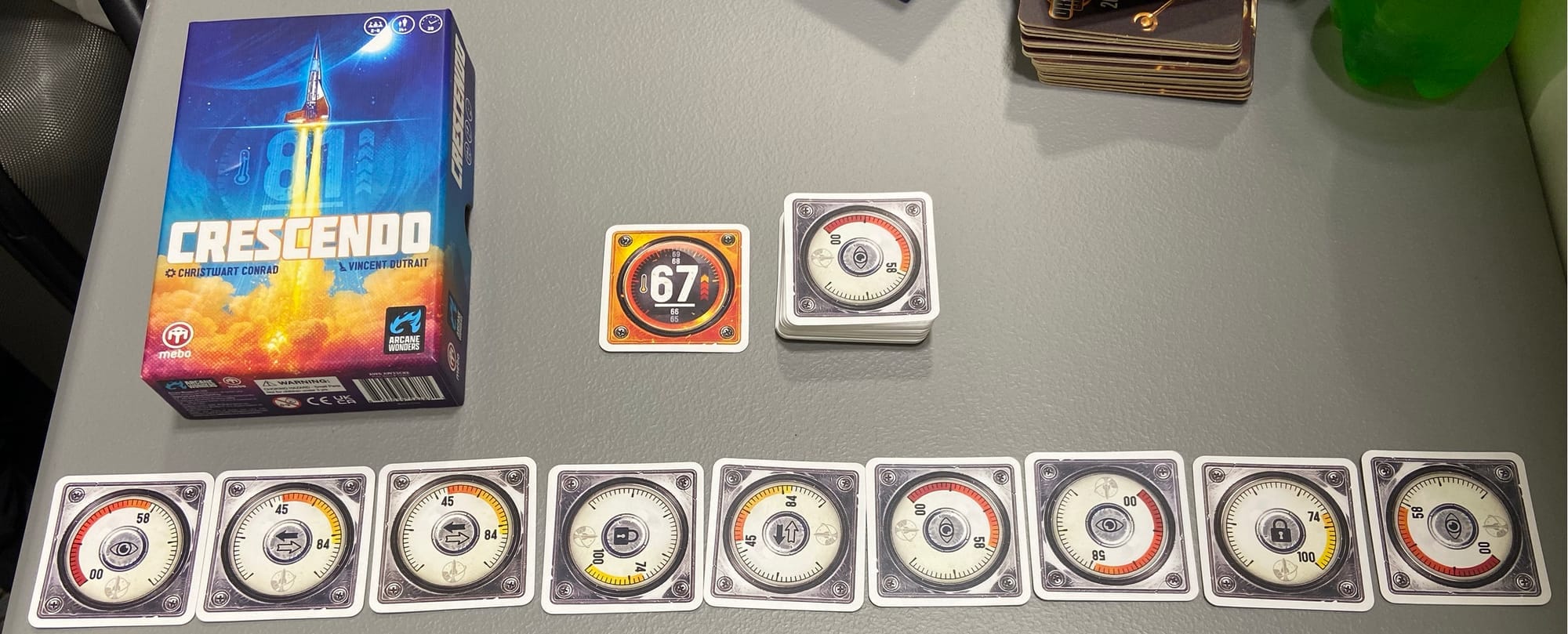
On a turn, you can take the top card of the deck or discard pile, look at it, then either discard it or swap it for one card in your row, discarding the replaced card. Cards placed in your row this way stay face down, so you must (brace yourself) remember which cards are where.
The number ranges give you an idea of whether a card might be roughly in the proper location, but the ranges overlap, so a 74-100 card might be lower than a 45-84 card. Whenever a player discards, if you think you have a card with a number at most two digits away — in the example above: 65, 66, 68, or 69 — then you can call "Number!" and flip that card in your row face up. If you're correct, you remove that card from your row, scoring 1 point for it at the end of the round, in addition to giving you less to organize; if you're wrong, you draw a card and stick it in your row without looking at it. More work for you!
Instead of drawing, you can use the power of the deck's top card: peek at a card, swap one of your cards with an opponent's card, or turn one of your cards face up to lock it in place, which makes it ineligible for future swaps.
If you feel everything is in order, instead of taking a turn you can call for the end of the round. Each other player takes one last turn, then you reveal your row. If all your cards ascend in numerical value, 6 points for you; if not, -3 points, plus -1 for each card that's out of place. Other players score 3 or -1 points, with bonus points for correct "Number!" calls. Play three rounds, then place the winner on a rocket...or perhaps the loser. Depends on whether you're rewarding them with a trip to space or banishing them from future games. Your call.
Âmbar
Putting numbers in order is also at the heart of Âmbar, a 2-4 player game from Nuno Santos, who debuted in 2024 as the co-designer of Floresta — also from MEBO Games, also licensed by Arcane Wonders — with Przemek Wojtkowiak.
In Âmbar, you're presented with four types (colors) of amber with values from 1-6 and with four copies of each tile. To set up, shuffle all the tiles face down, then each player creates a row of ten face-down tiles. Sound familiar? Yes, this is similar to Crescendo, but gameplay differs and this game (pretty much) lacks a memory element since you'll be turning tiles face up during play.
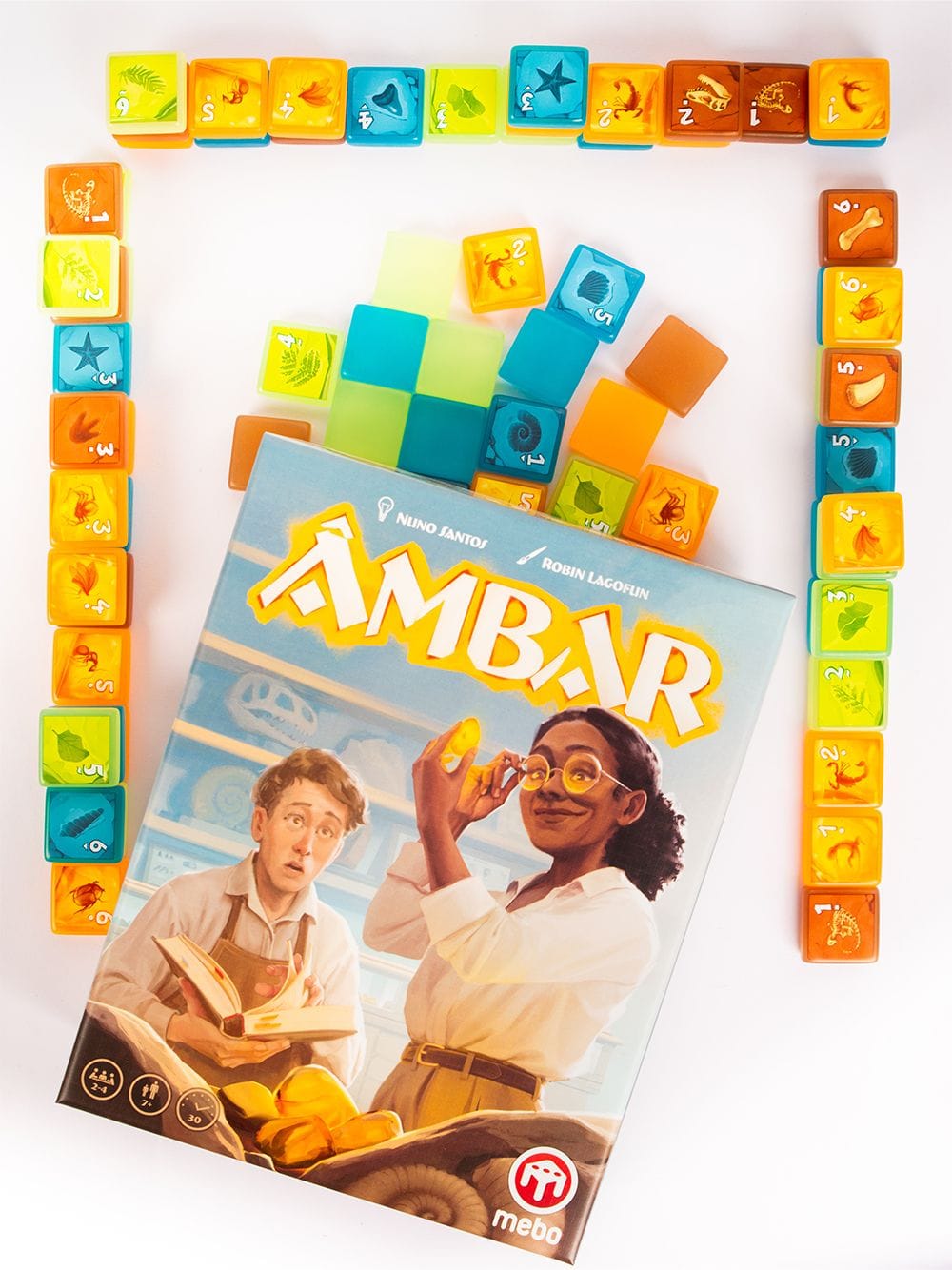
On a turn, you can take a face-up tile from the excavation pool (as long as you don't have that tile already visible in your row), or you can reveal a face-down tile; if that revealed tile is already in your row, your turn ends, with the tile remaining face up, and otherwise you can take it.
When you take a tile, you can do one of two things with it:
- Replace a face-down tile in your row with the face-up tile, then reveal the face-down tile and place it in the excavation pool, or...
- Place the face-up tile on top of another face-up tile in your row as long as the column in which it's placed will not be two tiles higher than both adjacent columns (or the lone adjacent column).
In either case, each tile in your row must be greater than or equal to the closest tile to its left that shows a number. (Face-down tiles are ignored when checking.)
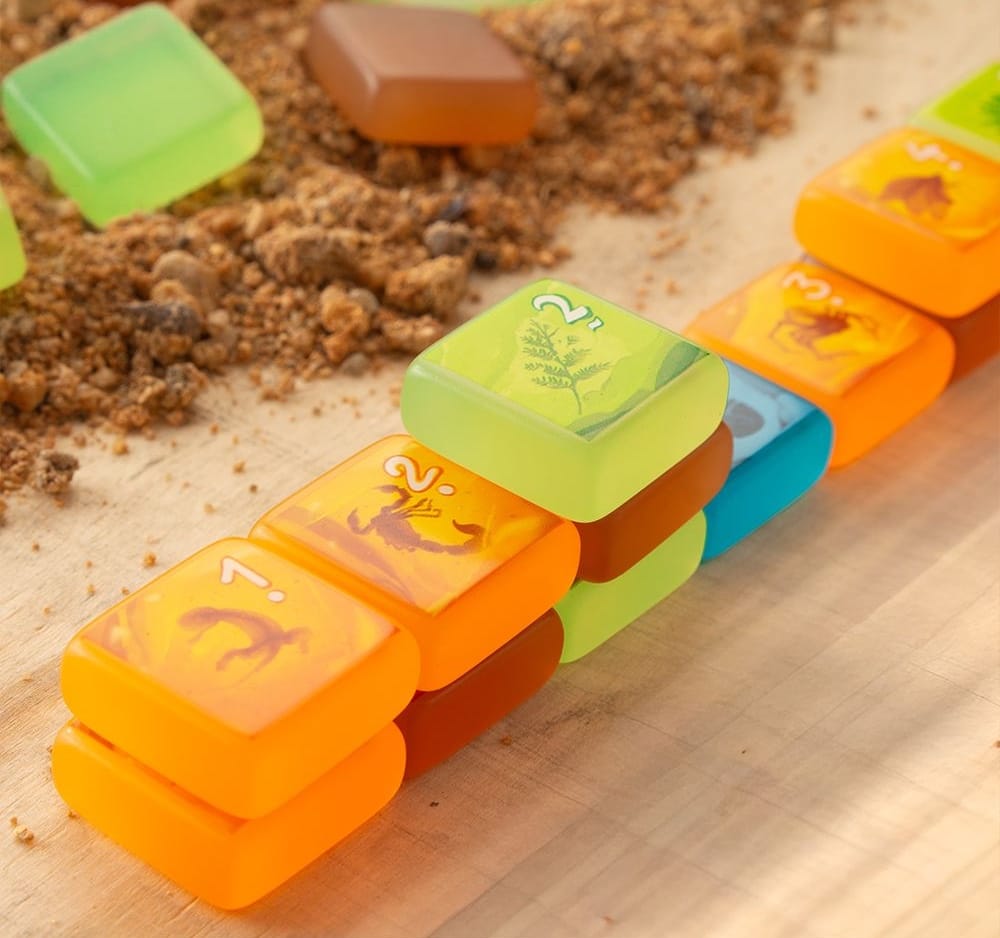
When you place a tile, if it's one higher or lower than an adjacent tile of the same color, you take another turn. In the image above, for example, you could place a green-1 on the yellow-2 or a green-3 on the blue tile next to the green-2 to gain a free turn; if you had placed the green-3, you could now place a green-4 on the yellow-3...assuming that half visible green tile on the right edge isn't also a 4.
Once all the tiles are face up in the pool, players keep taking turns until they all pass consecutively, then whoever has the most tiles on their row's second level wins. If players are tied, compare their third levels, their fourth levels, etc.
Note: Dirt is not included in the box, so if you want to create a thematic excavation pool, you must supply your own.
Want more game announcements like this?
Get Board Game Beat’s free posts by email — original reporting, designer interviews, and industry news, with no tracking, no ads, and no spam.


