

If you don't live in Korea, you might have a hard time checking out games from Happy Baobab, but this publisher attends the SPIEL convention annually, giving players worldwide a chance to check out their wares. Here's what Happy Baobab is bringing to SPIEL Essen 26:
해녀: Sea Divers of Jeju
In 2017, Japanese designer Hisashi Hayashi released Rattaneer through the OKAZU Brand label he runs with his wife, artist Ryo Nyamo. In that game, you represented a crew of pirate mice that hunted for treasure each round by secretly selecting which parts of the land and ocean they wanted to visit. The catch is that after all pirates (and deck hands) have been placed, if you don't have a continuous chain to the starting point, you don't take your action.
Happy Baobab has licensed this design, but changed the setting of 해녀: Sea Divers of Jeju to have a more meaningful connection to its (primarily Korean) audience. "해녀" is the Korean word "Haenyeo", which means "sea women", and that term refers to female divers in the Korean province of Jeju. From the rules:
[These women] dive without using oxygen tanks or other special equipment.With only simple tools such as a bitchang (iron bar), galgori (hook), or jeongge-homi (sickle), they collect conch, abalone, seaweed, and sea mustard. Sometimes they even catch fish with a spear.
A typical dive goes down about 5 meters, and they usually stay underwater for around 30 seconds before coming up. Skilled Haenyeo can dive as deep as 20 meters and hold their breath for over 2 minutes.When they return to the surface, they make a unique whistling breath sound called "sumbi sori", which has become a symbol of Jeju's ocean culture.
In 2016, Jeju Haenyeo culture was officially listed as a UNESCO Intangible Cultural Heritage of Humanity.
This 2016 video about Haenyeo from UNESCO is fascinating!
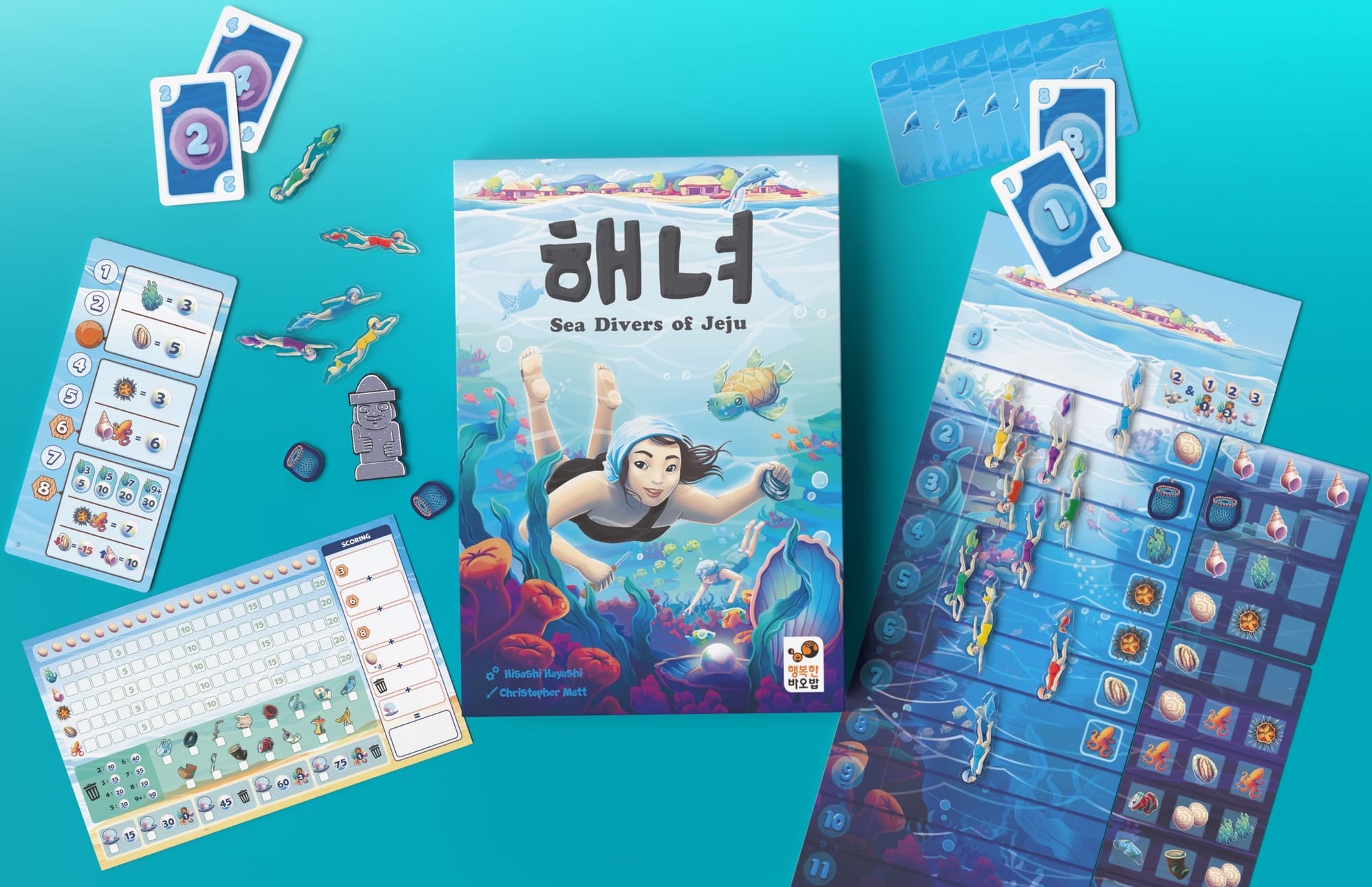
Now instead of moving across the water with pirate mice, you're diving deep into the water with haenyeo. You no longer have to mess with a separate supply of deck hands to extend the chain as each diver now covers two of the twelve zones numbered 0-11.
Everyone chooses zones for their swimmers secretly, then they reveal their zones and place their heanyeo on the game board with the diver's head in the chosen zone. As long as the human chain goes from 1 to wherever your head's at, you get rewards from the zone to the right of your head — netting items one at a time if you share the zone with others and taking everything if you're alone. Reach the bottom, and you grab a pearl.
You record goods collected and trash hauled from the ocean on your personal score sheet, with eggs giving you the chance to grab marine life of your choice or add a third diver to your team. The goods available change in each of the eight rounds, and you use one of eight scoring metrics each game.
Metro Bingo
Metro Bingo is the latest iteration of Yoshihisa Itsubaki's game Streams, which debuted in 2011 from publisher/game store Sugorokuya and which was first licensed in 2012 by French publisher Moonster Games. Here's my description from 2012:
Streams consists of pens, score sheets, and bakelite tiles numbered 1-30, with two copies of #11-19 and one wild. Gameplay is similar to Bingo in that someone draws a tile, then everyone must mark that number on their score sheet. This sheet contains a line of 20 spaces to be marked, and while these spaces can be filled in any order, if you can place them in non-descending order — identical numbers placed side-by-side don't break a stream — you'll score points. The longer the stream of ascending numbers, the more points you'll score.
Once twenty tiles have been drawn and the scoresheets filled, players tally their points for each stream of non-descending numbers, and the high score wins.
Streams has been licensed multiple times since 2011 — appearing as 20 Express, Digit'y Do, Numerama, Schlingo Bingo, among other titles — and gameplay remains the same in Metro Bingo, but with the box now containing four maps for increased variety of play.
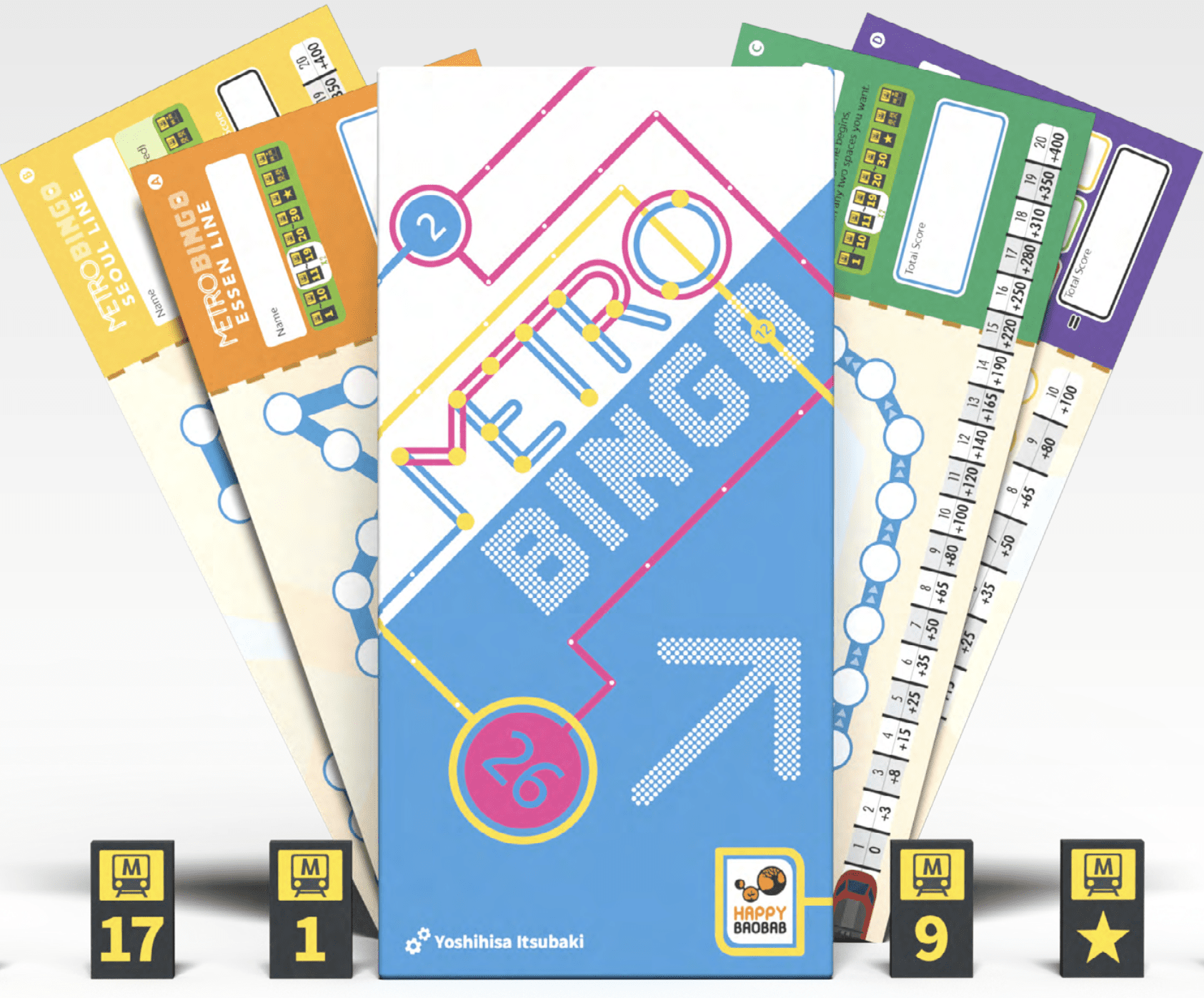
Instead of having twenty spaces to fill in a straight line, you can choose the circular Tokyo line (presumably representing the Yamanote line) or the Seoul or Paris lines, which have two and three crossing paths that comprise 28 spaces instead of 20. The tiles also include two new special effects: one that removes two randomly drawn tiles from play (letting you know that those numbers are out of play), and another that puts two numbers in play on the same turn, with each player choosing the one they want.
I'm surprised that this game has gone through so many iterations without becoming an evergreen, but maybe "thoughtful bingo" isn't a thing that the market wants...
Beasty Council
Designers Gary Kim, Hope S. Hwang, and Yohan Goh work together frequently as GAT Game Studio, with their biggest success to date being Odin, which won the 2025 As d'Or, France's "game of the year" award. (Goh wrote a designer diary about Odin in March 2025, and I reviewed their game This Bed Is Mine in July 2024.)
Beasty Council is a card game for 2-4 players with dual-use cards that's played over four rounds. Cards come in three colors (red, blue, green) with three types of animals (lion, fox, elephant) with values ranging from 3-10 and with a scoring condition on each card. Players start with three cards in hand.
At the start of each round, 6-10 cards are placed in the plaza, then players take turns either:
- Taking a card from the plaza and adding it to their hand, or
- Playing a card from their hand as a representative in front of themselves, then optionally picking up a card from the plaza that matches the color or animal that they just played and adding it to their hand.
As soon as only one animal remains in the plaza, that animal becomes the Chair for the round, and each player scores points equal to the value of their representatives of the same animal type, e.g., if a lion is Chair, all lions score.
After four rounds, you may play a card from hand as a representative, then for each representative, you see how well the cards that remain in your hand meet that representative's scoring condition. From the rules:
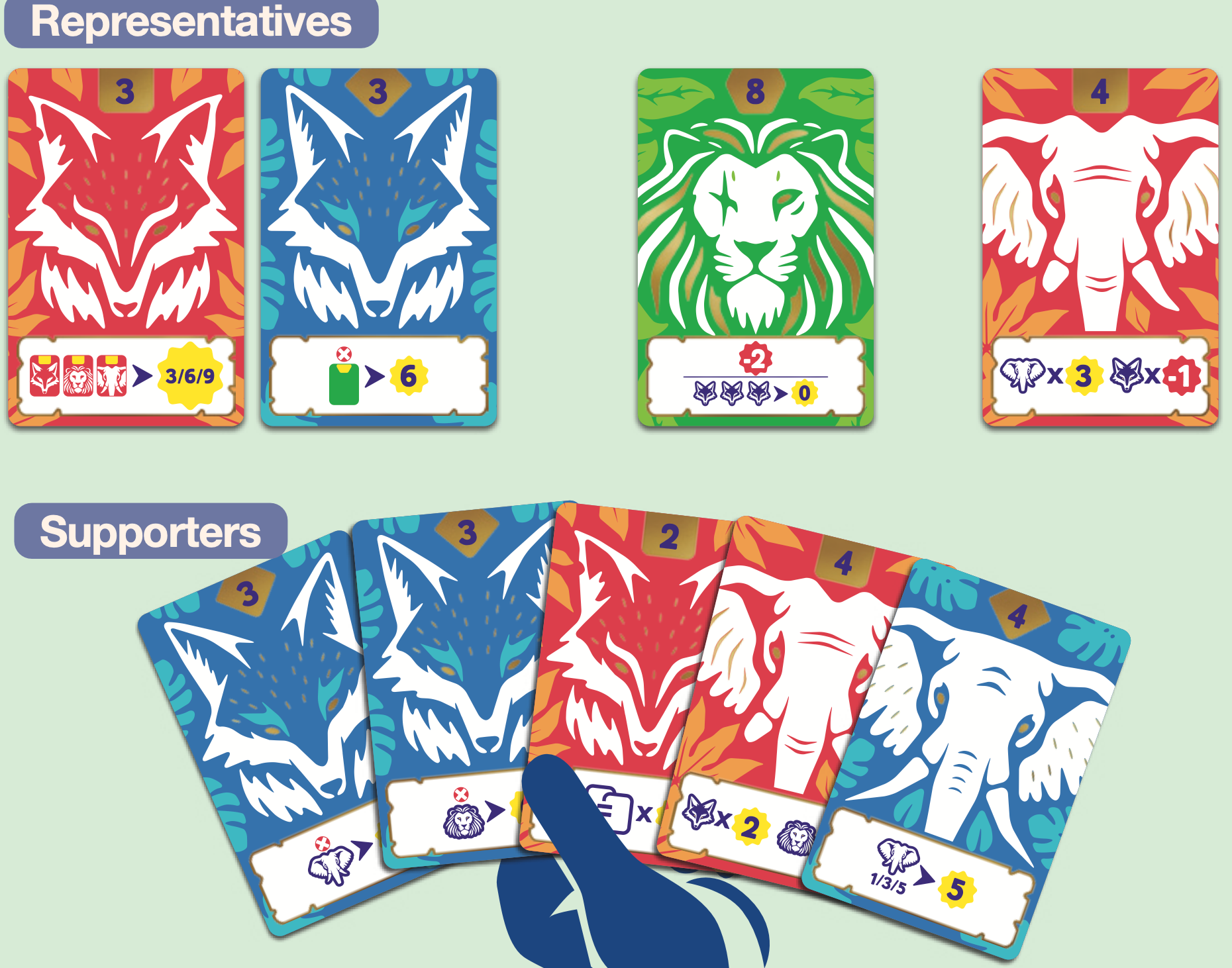
- The red fox scores you 3/6/9 points for having 1/2/3 different red animals, so you score 6 points.
- If you have no green cards, which you don't, the blue fox earns you 6 points.
- The green lion causes you to lose 2 points unless you have three foxes in hand.
- However, those three foxes cost your 3 points from the red elephant, but you score 6 points from the two elephants in hand.
In short, the representatives (potentially) score you points during the round, while setting up your endgame scoring conditions, and your turn options allow you to balance the number of representatives in play versus how many supporters you hold. Seems like a winner along the lines of Castle Combo, which I reviewed in September 2024.
Travel Fold It
Travel Fold It is a new version of a Yohan Goh design that debuted in 2016: Fold-it. That game is a decade old?! Time rushes ever onward.
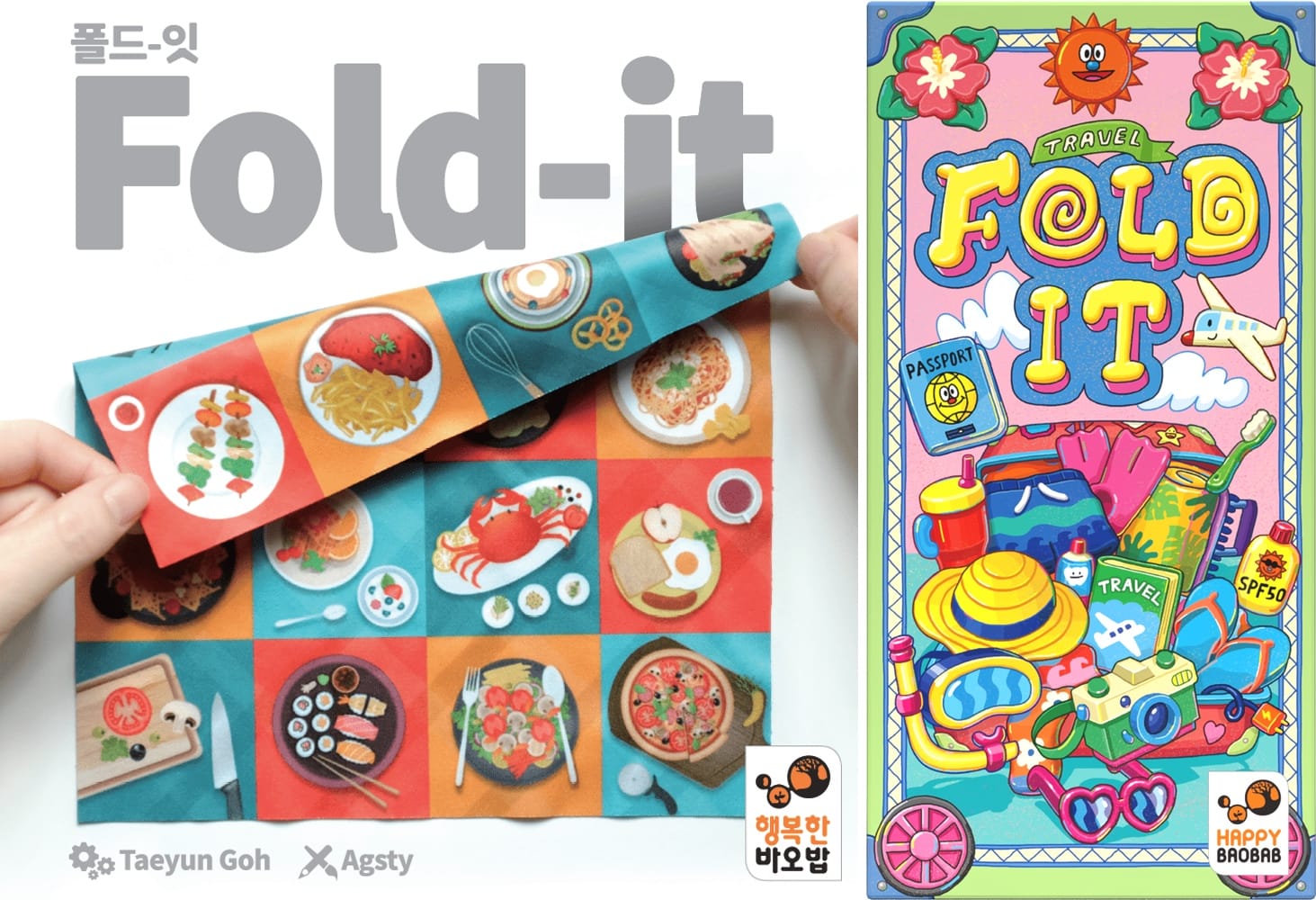
In the game, each player gets a cloth divided into sixteen squares in a 4x4 grid. At the start of each round, you reveal one card fewer than the number of players, then everyone races to fold their cloth so that only the images visible on one card show on your folded cloth. If you do this and the card is still available, grab that card.
Once all the cards have been grabbed, everyone double-checks the work of everyone else, and if you folded correctly, you keep the card; if not, you discard it. In the Travel version of the game, which goes to six players instead of five, whoever didn't grab a card takes the "burst suitcase" necklace, and if they score a card next round, they take a bonus card from the deck.
Once a player has at least six cards, the game ends, and players tally points on their collected cards.
Hop Around
To continue with another new edition while (sort of) ending back where we started on Jeju island, Hop Around is a new edition of Jeju Island, a game by Gary Kim, Yeon-Min Jung, and Jun-Hyup Kim that debuted in 2015 and that I reviewed in 2016.
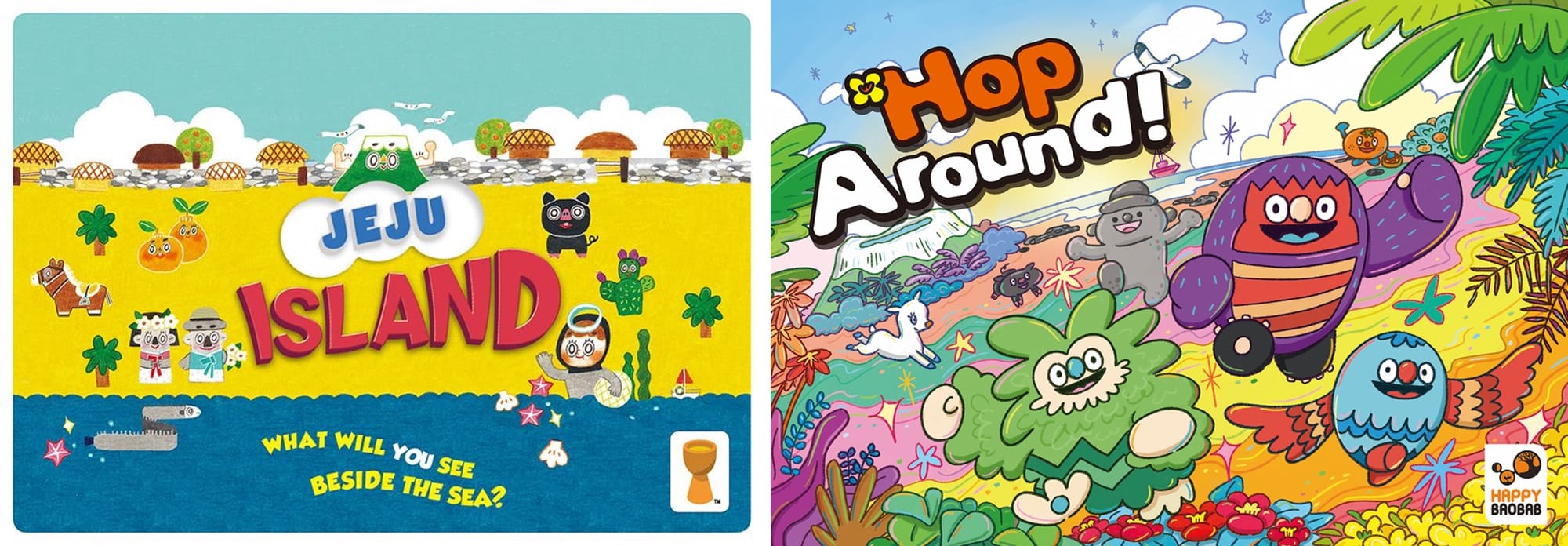
The game board features six (in Jeju Island) or seven (in Hop Around) stacks of tiles, with player tokens and neutral tokens being seeded next to these stacks. On a turn, mancala-style, you pick up all the tokens next to a stack — with at least one of your tokens being present — then drop them one by one in clockwise or counterclockwise order next to other stacks. After doing this, for all players, if your token is on the top of a pile, take the tile from the stack next to your token.
Alternatively, instead of moving tokens on a turn, you can spend tiles you've collected to take one of the five score cards on display. Some cards are just worth a bunch of points, while others are worth a few points while also giving you a permanent tile to use when claiming score cards in the future.
When enough stacks are empty or the final score card has been revealed, the game ends, and players tally their points.
Want more SPIEL Essen 26 previews like this one?
Get Board Game Beat’s free posts by email — original reporting, designer interviews, and industry news, with no tracking, no ads, and no spam.


