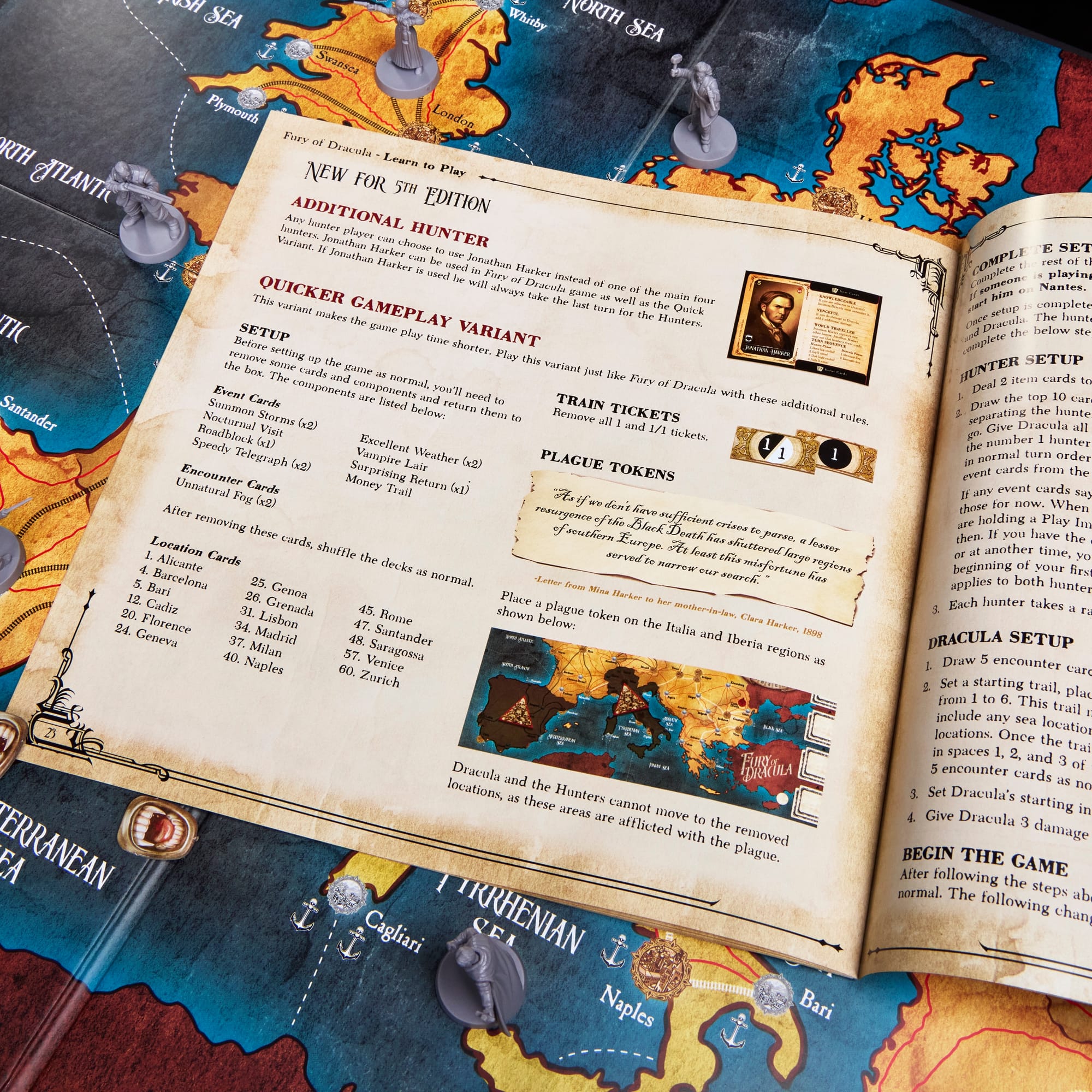
"Death and taxes" — every April 15 that phrase runs through the heads of U.S. citizens as we contemplate what we owe our government and what our government owes us in return, but instead of thinking about taxes today, I propose that we think only about death...or rather undeath. After all, the king of undeath is due to return in a fresh new form thanks to Avalon Hill's plans for a fifth edition of Stephen Hand's Fury of Dracula.
More specifically, Avalon Hill will have copies of Fury of Dracula: 5th Edition at Gen Con 2026 available for demo or purchase, with the game hitting retail outlets on September 1, 2026.
Games Workshop first published The Fury of Dracula in 1987, and this design has appeared in three other editions over the past four decades. The details of gameplay have changed during that time, sometimes in radical ways thanks to the work of developers Kevin Wilson and Frank Brooks, but the core of the game remains the same as in the original release: One player takes the role of Count Dracula and moves secretly throughout Europe, while the other players represent characters from Bram Stoker's novel who are trying to hunt him down.
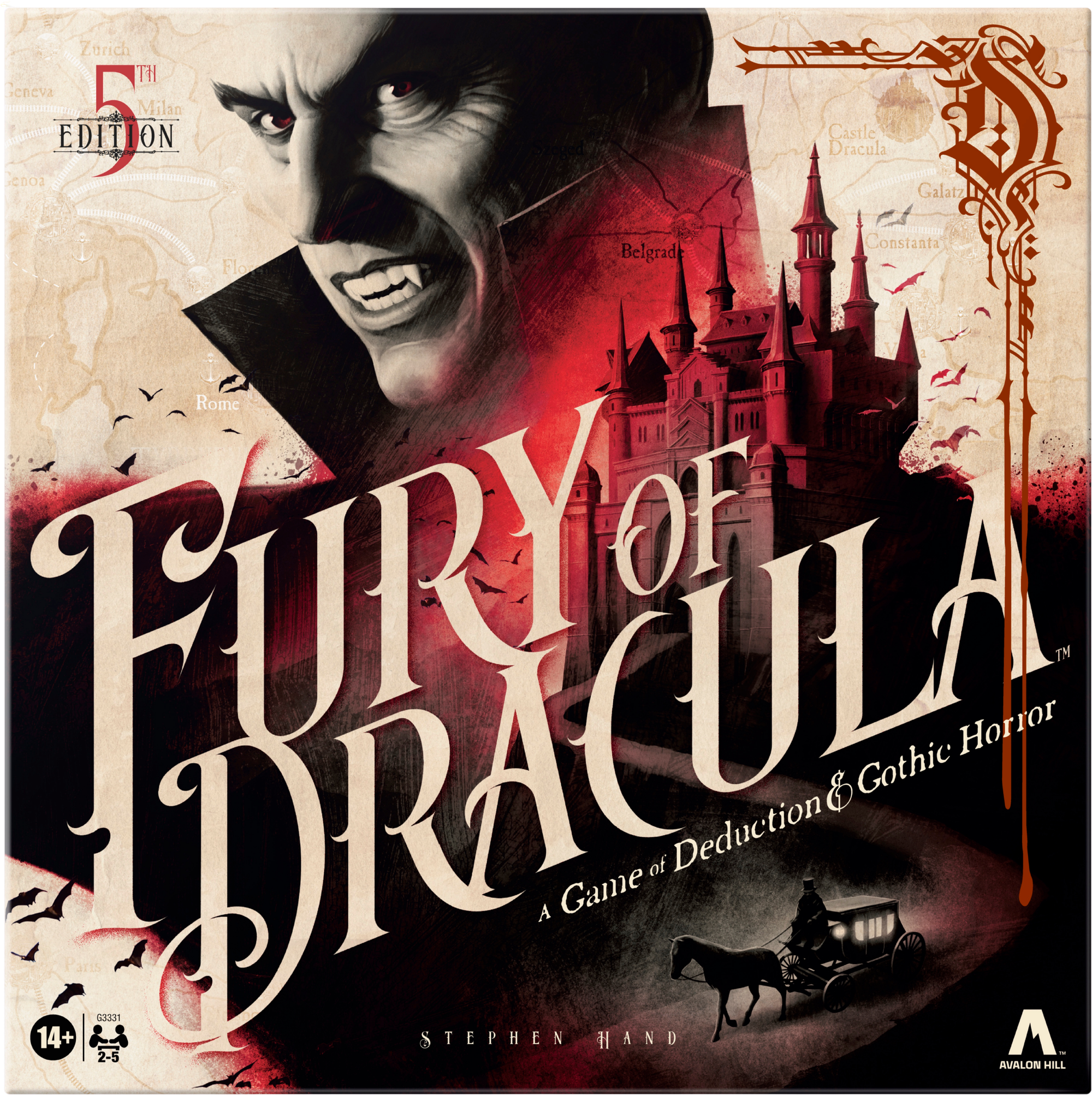
I've reviewed the rules of Fury of Dracula: 5th Edition thanks to advance information from Avalon Hill, and gameplay seems largely identical to the third edition that Fantasy Flight Games released in 2015 and that WizKids re-released in 2019 with new art and graphics. To summarize:
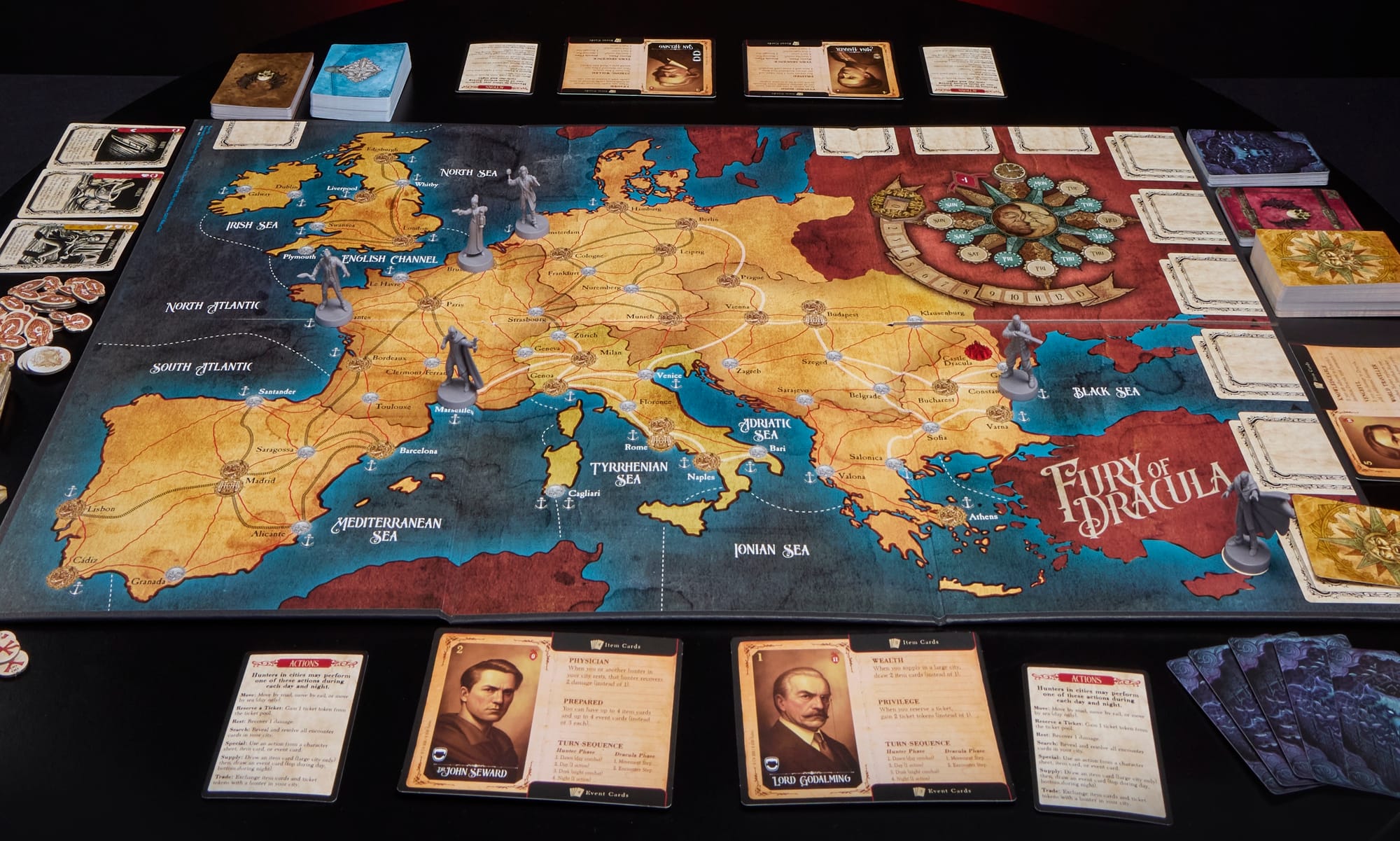
Count Dracula starts in a secret location that he chooses from a deck of location cards, placing that card on the first space of the trail — a row of six spaces on the game board seen on the right side of the image above. No matter the player count, the other players take four of the five characters and start them in designated locations. Each character has unique powers that will help them hunt Dracula, survive his attacks, or otherwise gain advantages.
The hunters' goal is simple: Kill Count Dracula. To do that, they'll equip themselves with items and make plans with one another while moving through and around Europe by road, rail, and sea in search of the Count.
Count Dracula's goal is more abstract: increasing his influence in Europe to 13, a task he completes by defeating hunters and awakening new vampires. On each of his turns, he moves to a new location by first sliding all cards on the trail one space to the right, then choosing a new location from the deck and adding it face down to the trail. To finish his turn, he chooses an encounter card from his hand and places it face down on the new location.
Like this kind of board game coverage?
Get Board Game Beat’s free posts by email—original reporting, designer interviews, and industry news, with no tracking, no ads, and no spam.
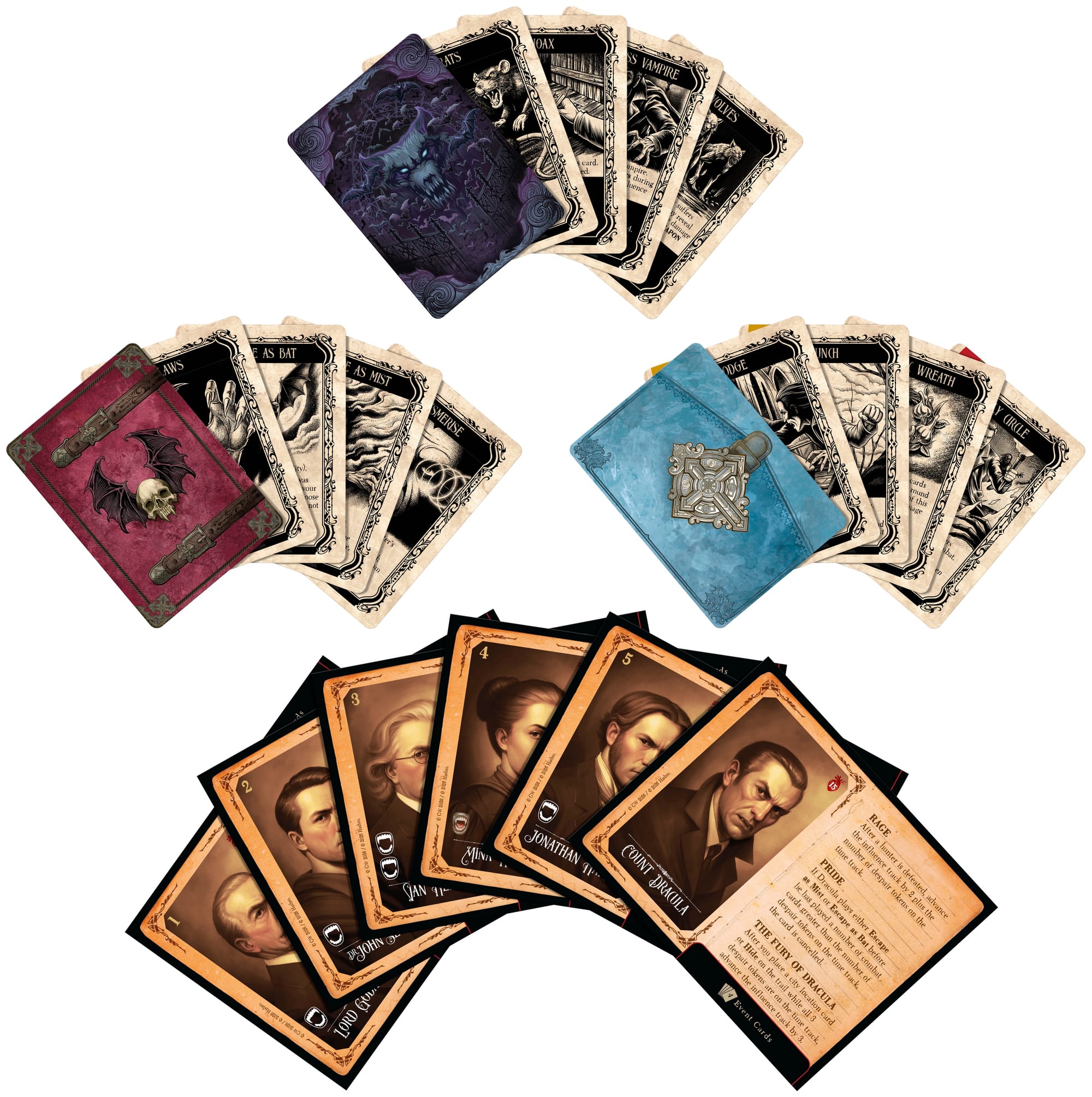
Each space on the trail is called a hideout, and if a hunter ends their movement on a city where a hideout is located, Count Dracula must reveal that location card, giving the hunters a clue as to where he might be.
If he wishes, Dracula can ambush that hunter by revealing an encounter card on that hideout and carrying out its effects; he might not wish to, though, as many cards have special "matured" effects that take place should the card reach the end of the trail and move off of it. For example, three new vampire cards are among Dracula's twenty encounter cards, and if these mature, they increase Dracula's influence by 3. (At the same time, they clear out hideouts on the trail, decreasing Dracula's immediate threats, while simultaneously erasing where he has traveled.)
Even if Dracula doesn't ambush a hunter, that hunter (or another one who arrives on the same space) can choose to search a location in order to reveal encounter cards and overcome those threats before they mature.
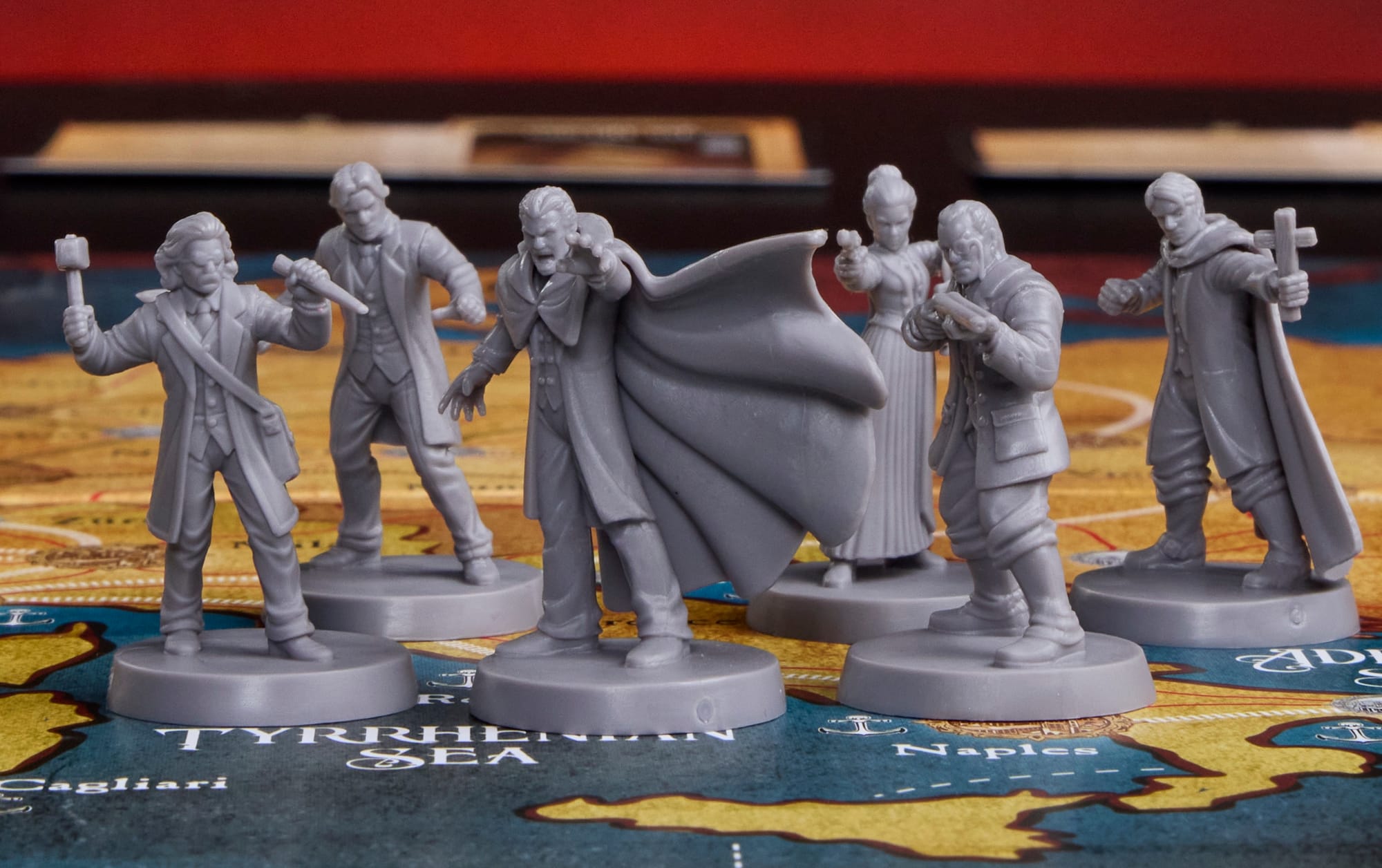
Hunters take two actions each round, first in a day phase when they can choose from seven actions, then in a night phase when movement is prohibited but all other actions are allowed. If a hunter moves onto Dracula's current location — or Dracula moves to where a hunter stands — they engage in combat at dusk (after the night phase) or at dawn (after Dracula's actions).
During combat, each hunter involved takes three cards in hand — dodge, punch, and escape — along with any items they possess, while Dracula draws five cards from his thirteen-card combat deck. Each player chooses a card, with the hunter trying to anticipate what Dracula might do and play a card that will nullify the attack. If that doesn't happen, Dracula carries out his card, then the hunter does the same. (If multiple hunters are in a space, Dracula interacts directly with only one of them, but the other hunters will get their licks in just the same.)
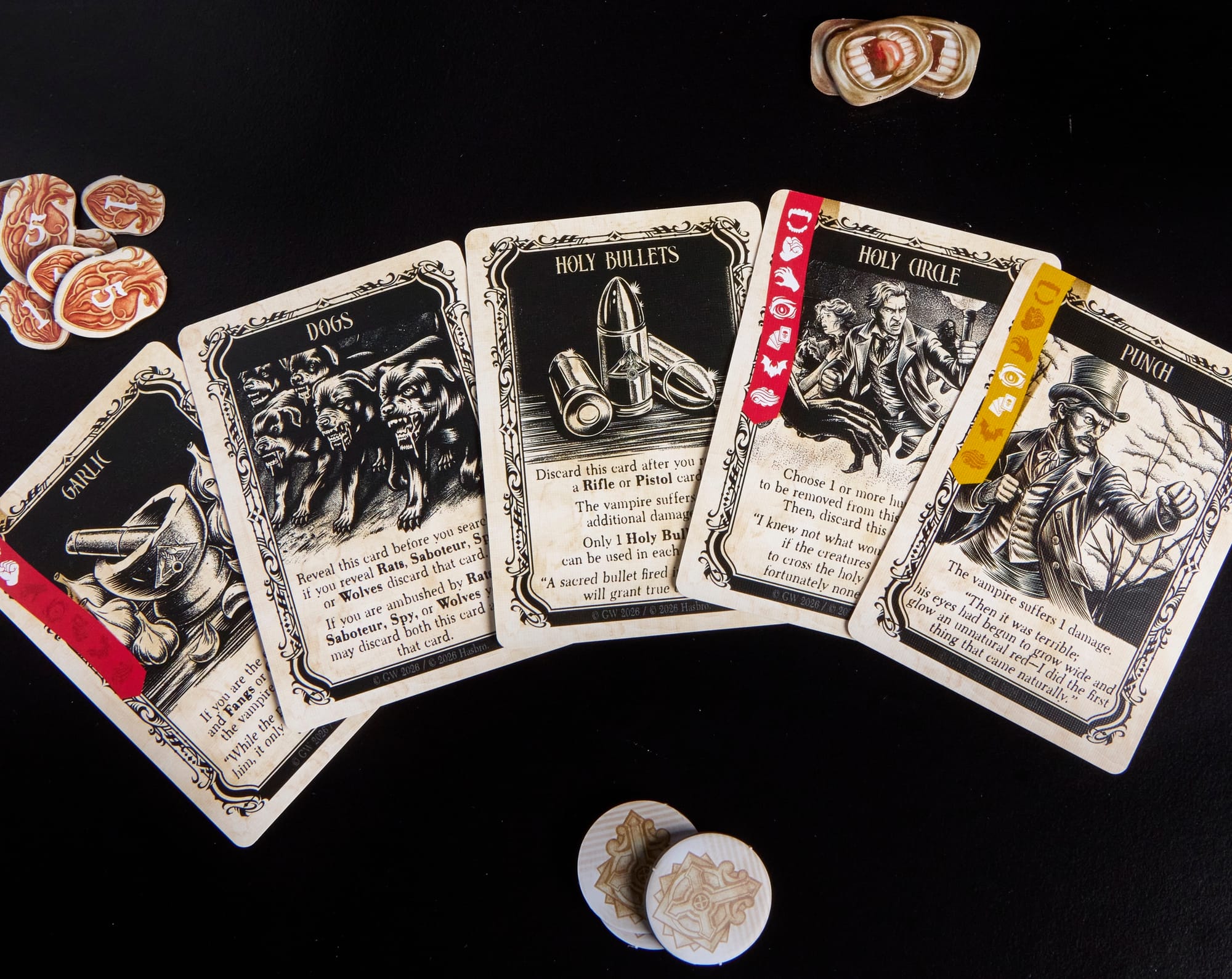
Hunters can be bitten or damaged, and if they're wounded enough, which varies by character, they must retreat to a hospital for recovery, losing all of their holdings in the process, with Dracula's influence increasing thanks to (I presume) all the hospital workers gossiping about his work.
Dracula can be damaged as well — and if he takes 15 damage, the hunters win — but he can also flee from combat by resolving the right cards in the right circumstances, with combat automatically ending after six bouts.
Gameplay starts on a Monday day phase, and after Sunday night — one week of activity — despair starts to set in, with Dracula gaining more influence each time he takes out a hunter. After three weeks, despair hits its peak, with Dracula gaining influence each time he places a location card, so hunters can't dawdle in their investigative efforts.
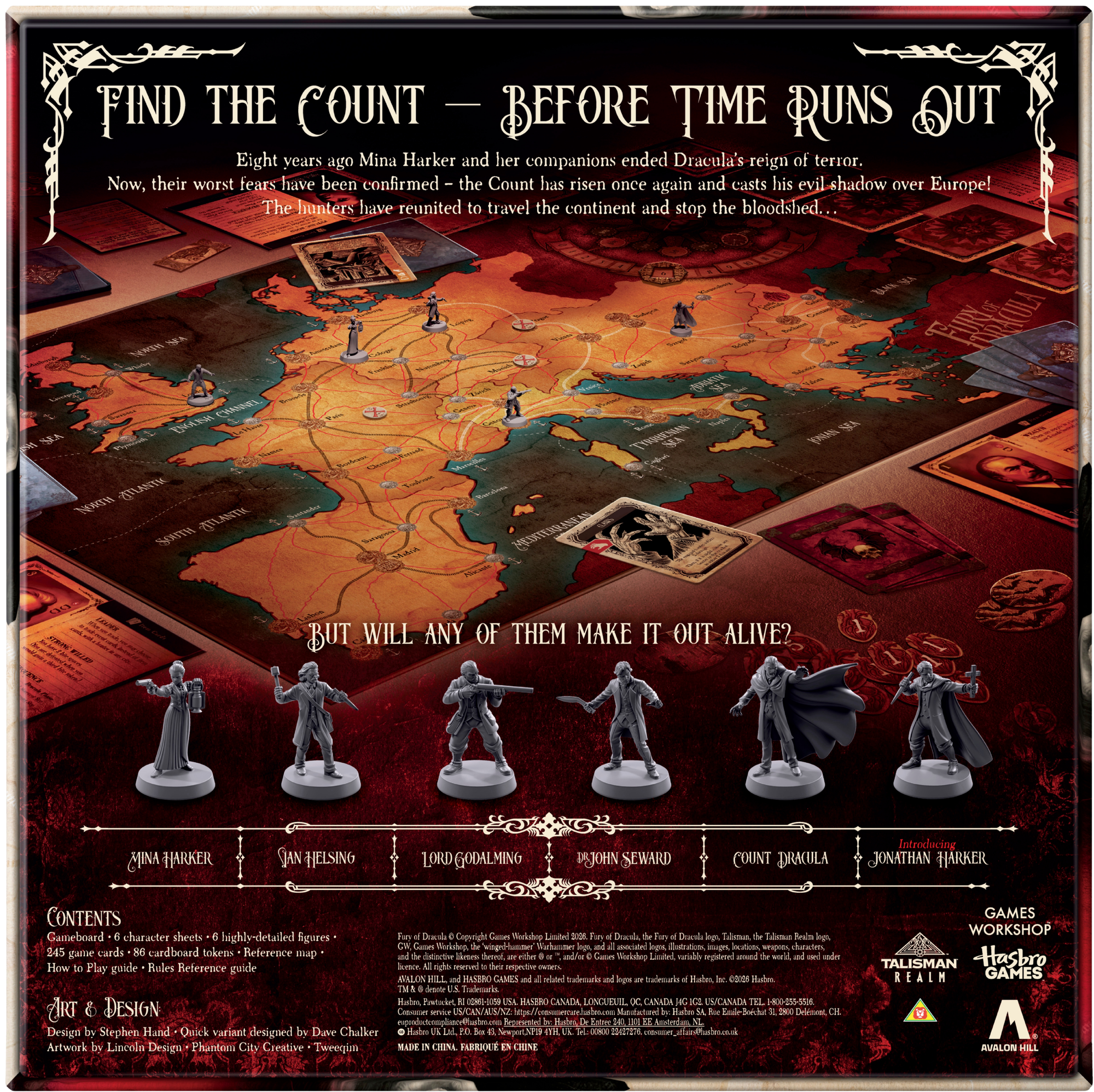
I'm skipping plenty of rule details — how hunters can trade items, how hunters travel by train, how Dracula is damaged when traveling by sea, how certain tokens (bats, fog, roadblocks, etc.) are used, how Dracula can retreat to his castle to heal himself at the cost of revealing his location — as those elements seem unchanged from the most recent editions of the game and you can futz over such things once you have the game on the table.
As in the 2015/2019 editions, the rules suggest you play a game or two to familiarize yourself with everything, then add in more abilities for Dracula: power cards he can place on the trail for special abilities (at the cost of neither moving nor placing an encounter card); the ability to move location cards and their encounter cards from the trail to lairs (instead of maturing them), thereby allowing you to play extra encounter cards and set up more dangerous ambushes; and rumor tokens that can either gain Dracula extra influence or dupe hunters into searching the wrong locations.
As far as I can tell, the one new element in the rules is the introduction of a "quicker gameplay" variant courtesy of Dave Chalker: Italy, Spain, and Portugal are off limits due to plague; the lower-value train tickets are removed so that hunters can move farther; hunters move directly from port to port for a train ticket instead of through individual sea zones; hunters start with two items; ten event cards are distributed to hunters and Dracula at the start of play; and Dracula starts with a hideout on each space in the trail, with an encounter on his three most recent locations.
Other minor changes take place — e.g., Castle Dracula can't heal damage, one despair token is on the board, and Dracula starts with 3 damage and 2 influence — to mimic a game that's already finished one week of play, while also removing cards and actions that would, in effect, turn back the clock. Makes sense given that while Dracula may be undead and unable to age, he's also not getting any younger. Time keeps moving for us all, and death waits at the end of the trail...