

Another week, another round-up of Japanese games thanks to publishers prepping for Game Market Spring 2026, which will take place near Tokyo on May 23-24.
▪️ At this show, designer Toshiki Sato of the doujin circle Sato Familie will debut Slopes of Bordeaux, a tile-laying game for 1-5 players that kind of lets you play with the four-color theorem, while also being a modern Euro design in that everyone drafts tiles and builds their own thing.
The tiles in this game are one of the fifteen types of monohedral convex pentagons that can be used to tile a plane, which each tile featuring angles of 60º, 90º, 120º (twice), and 150º. The tiles come in four colors, with more purple than blue, green, and orange, which occur at the same frequency.
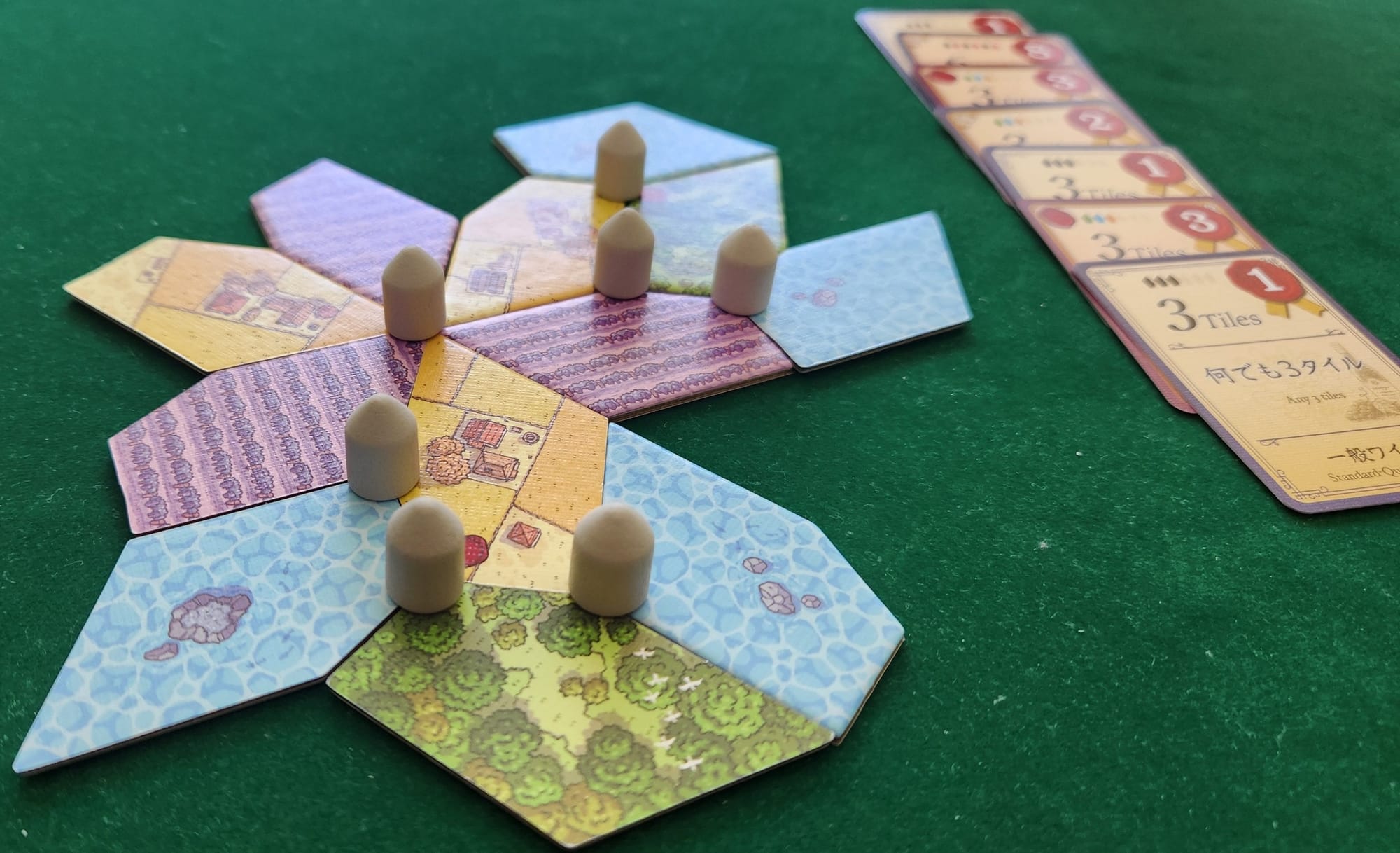
On a turn, take one of the four tiles on display or draw from the bag, then place that tile in your tableau with all adjacent edges being placed against edges of the same length; that is, every vertex on a tile will connect with vertices on other tiles, never in the middle of an edge. Purple tiles can be adjacent to other purple — and you'll want to make that happen — but no other color can be adjacent to itself.
When you "complete a circle" by filling the gap where vertices meet, you mark that point with a wine cellar and take a wine card. The more tiles in a "circle", the more points you score, and if you use the right combination of tiles — as with the orange, blue, and green meeting in the bottom center of the image above, or the three orange in the six-vertex circle — you score an even more valuable high-quality wine card.
When you enclose a tile completely by placing adjacent to its fifth side, you take another turn, drawing only from the tiles on display, and this might bring you another additional turn, and so on.
When the tiles or wine cellars have run out, the game ends, with whoever has the largest string of connected purple tiles receiving a bonus to add to the sum of their wine cards.
▪️ In the rules for Slopes of Bordeaux, Toshiki Sato notes that the game was created in collaboration with Oink Games CEO Jun Sasaki, so let's turn to that company next. [Disclosure: Oink Games is an advertiser on Board Game Beat.]
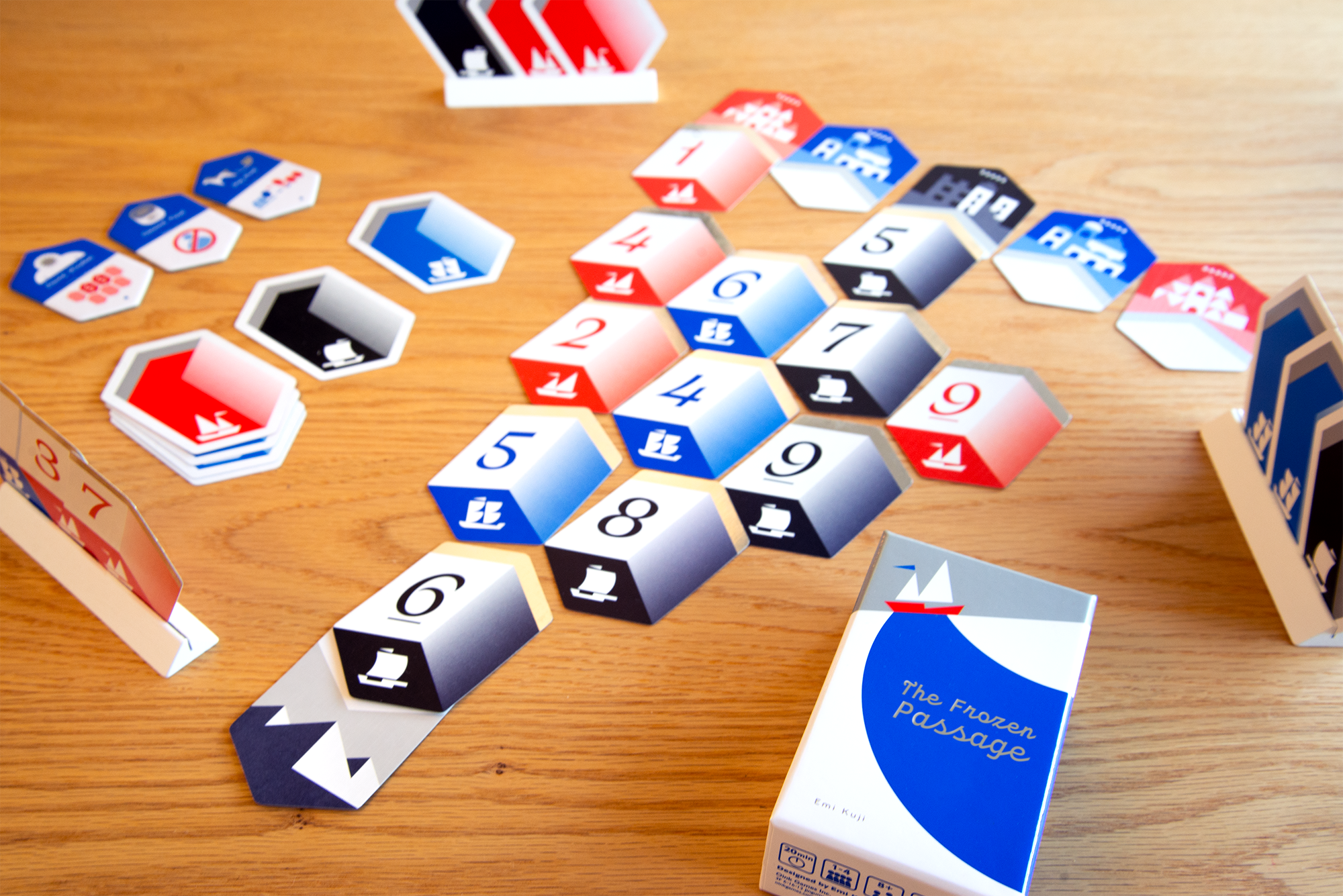
Oink Games has announced two debuts for Game Market, with The Frozen Passage being a co-operative game by Emi Kuji in which 1-4 players recreate the search for the Northwest Passage by trying to play hexagonal numbered cards in three colors to form a viable pyramid.
To start, each player receives three cards and places them in their stand from low to high; card backs show their color, so you have some information about what others hold. The game begins with only a blank starting card and five blank goals on the table and three face-down cards in the market.
The first player plays any card on the starting card (then draws a replacement and re-arranges their hand if needed), and the color of this card must now "chain" to the final row. In general, the value of each card in a row must ascend, and a card placed on the end of a row needs only one card to support it, while cards in the middle of a row require two cards as support. If you complete a fifteen-card pyramid before someone can't play, you win. Six items that provide special effects are included, with three in use each game.
To make the game more difficult, you turn some or all of the goal cards face up, and the five cards in the final row must match the color of these goals, as shown in the image above.
▪️ Oink's sister company Panpas released Jun and Goro Sasaki's Compress in a 2-4 player edition in 2025, and now Oink Games will debut a 1-7 player edition at Game Market.
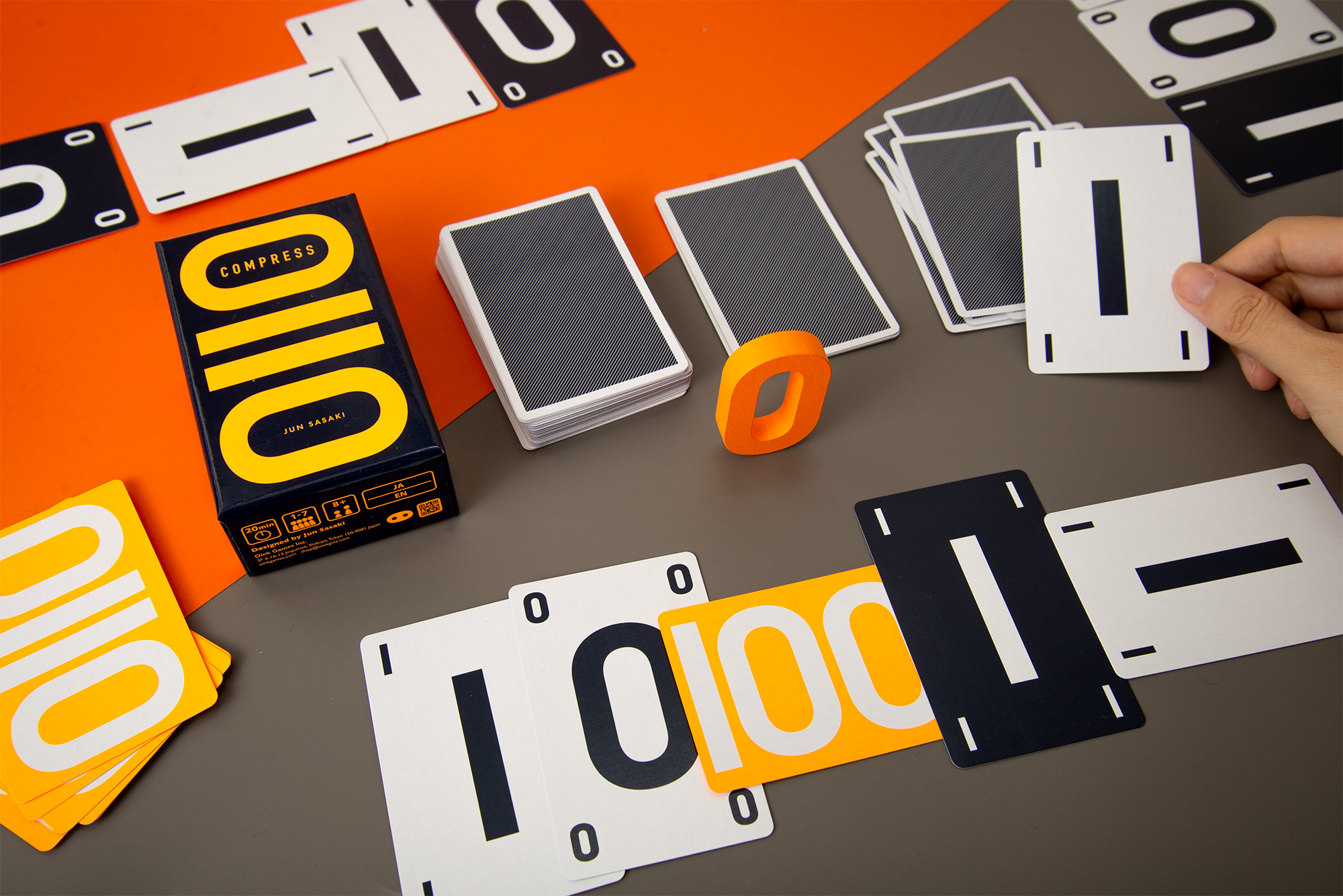
Oink calls Compress a record-keeping game, not a memorization game, but memory skills will be needed in a way you might not expect. During play, you'll together create a sequence of 0s and 1s with white or black backgrounds, and you each have exactly eight cards available to track what that sequence is. How will you turn, overlap, and position cards in order to keep that sequence straight?
More specifically, you start with eight cards in hand. On the game's first turn, the active reveals a card in hand to all players, places it on the memory pile, then draws a card from the deck. Each turn after that, the active player starts their turn by naming what's on top of the memory pile, revealing it, then moving that card to the "checked memory pile". If the memory pile is now empty, slide the checked memory pile to the memory pile. End your turn by revealing a card from your hand and adding it to the memory pile.
In effect, you collectively create a sequence that will keep reversing over the course of play as the pile empties, then is reset. If you make a mistake, you receive a penalty card showing 1001 on one side and 0110 on the other. That card might aid your record-keeping efforts, but if you receive a second one, the game ends, and whoever has the fewest penalties wins.
The Frozen Passage and Compress will be available at retail in Japan on May 29, 2026, then will debut in the U.S. at Gen Con 2026 and in Europe at SPIEL Essen 26.
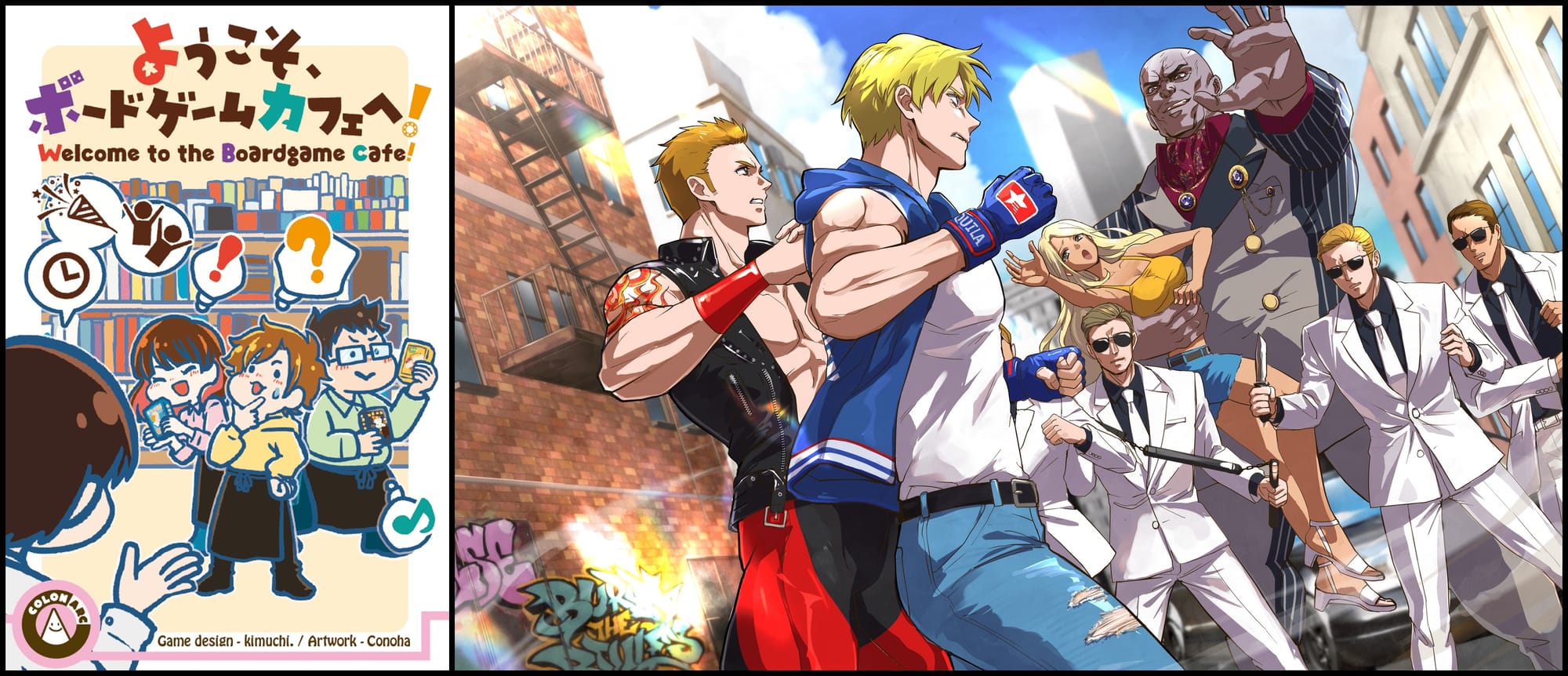
▪️ At the Nagoya Board Game Market in late March 2026, Kenichi Tanabe of COLON ARC introduced Welcome to the Boardgame Cafe!, a design by kimuchi, who owns the ゆこる (Yukoru) board game café in Sapporo, Hokkaido.
This design is more a recreation of real life than a game, with one player representing the staff of the café and others representing customers who are coming in to request games that meet certain conditions: player count, playing time, a specific aspect of gameplay, etc., and the café staff is trying to satisfy these demands as much as possible.
At Game Market Spring 2026, Tanabe plans to release five small expansions created by other gamestore owners who are contributing requests that customers have made in their stores. (Tanabe presents an overview of the owners and their submissions here.)
In the end, this might only be a good training tool for those working in game stores, but you could also use it to compare your game knowledge against others...assuming you read Japanese, that is.
▪️ Kuro of Manifest Destiny will debut the 1-4 player co-operative game Fatal Fight, a deck-building game with a scrolling, "beat 'em up" video game vibe. Here's an overview from the publisher:
Each player controls one of six wildly different characters, and the game is played over three stages, each ending with a boss battle. In the rounds prior to the boss, new enemies will enter the scene from any of the six entry points, and players work together to defeat them, suffering damage from those who remain.
Players can pick up items from the stage to use as throwing weapons or to heal themselves. Additionally, players start with a small deck of skills, but will level up after each stage, adding new skills in their deck and leveling up their characters.


