

Here's another sampling of games being crowdfunded that you can consider now or put on a list to check out later once they reach stores should you be one of those "never crowdfunding" types.
The Adventure Store
In late August 2026, I previewed Mathias Cramer's Strange Creatures, which blends trick-taking and deck-building, and here's another game mixing these two mechanisms: Taylor Reiner's The Adventure Store, which Inside Up Games crowdfunded in September 2026.
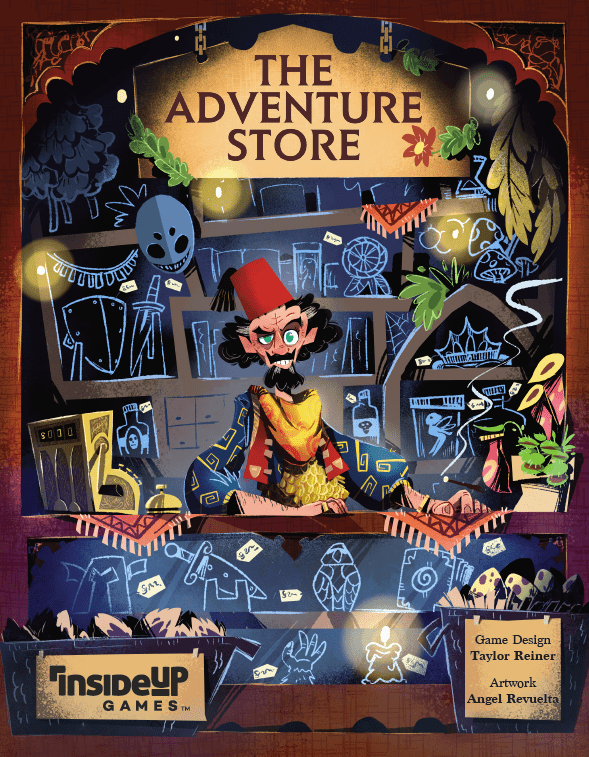
The Adventure Store lasts eight rounds, called "trials", and you score points each trial based on how many tricks you take. You each start with the same deck, but you use only a portion of it in each trial, so you won't have the same cards in hand as other players — and once you finish a trial and score, you enter a shopkeeping phase in which you buy new cards for use in later trials, with each trick you win during a trial giving you $5 to spend.
As with other trick-taking games, the details are in the wrinkles of gameplay. Each player starts with three augment cards in their deck that add 1 to a suited card when played with it — and if you play the same value as the previous player, you can play again as long as the "bonus" card is in the same suit as what you first played.
Playing extra cards can help you win tricks, of course, but the game also gives a 2 point initiative bonus to whoever empties their hand first. On top of this, this player buys first at the store, can place purchased cards on top of their deck instead of in their discard pile, and starts the next trial.
You want to win tricks in order to have money to spend, but if you "shoot the moon" by winning no tricks while lasting to the final trick — that is, you don't empty your hand before another player — you win first place in the trial instead of whoever took the most tricks.
Junk Wax, Tattoo Stories, and Mr Oswald's Puzzle Society
U.S. publisher 25th Century Games wrapped a crowdfunding campaign for Tigris & Euphrates, Lobby Snacks, Payback Club, and English-language editions of seven(!) imported designs on 31 July 2026, and it's already teasing its next Kickstarter project, which will feature two original titles, a new edition of an older title, and six(!) imported designs yet to be announced. I often describe the modern game market as "hungry" due to its seemingly insatiable desire for new games, and Chad Elkins at 25CG is doing his best to keep that market's plate overflowing.
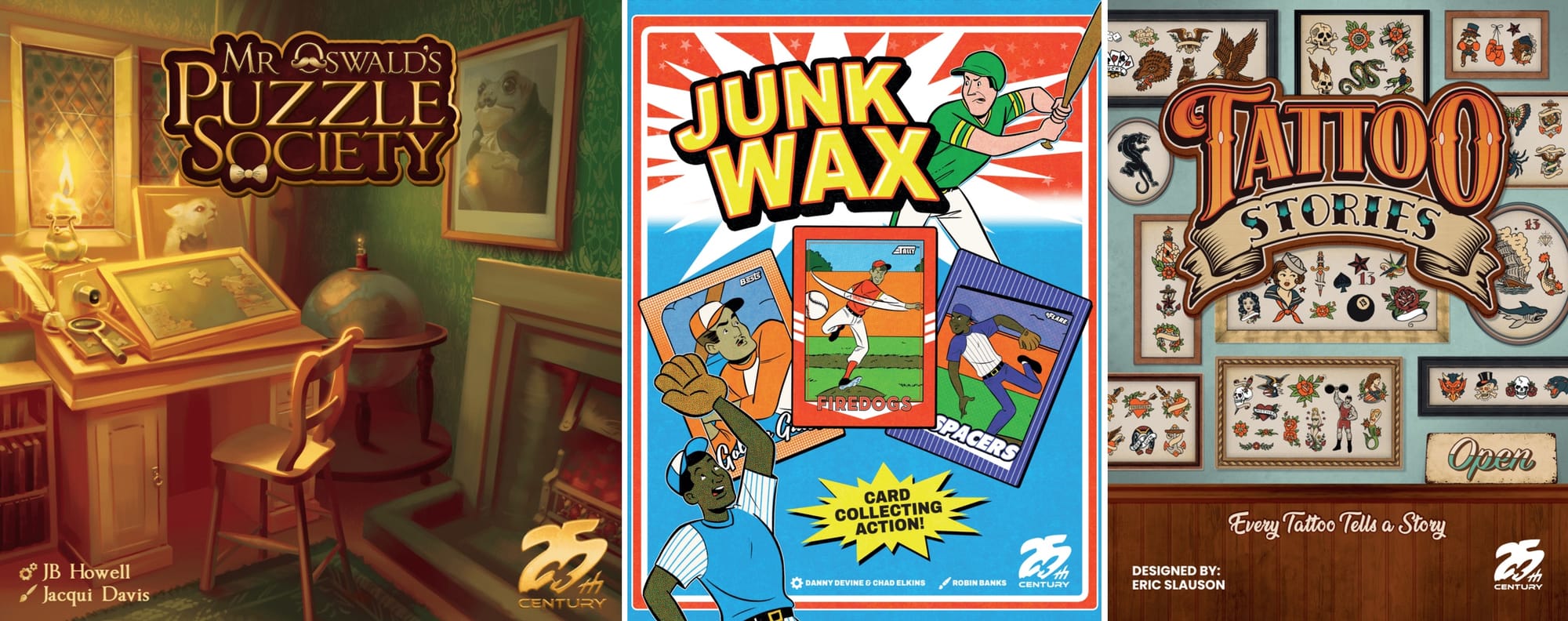
Here are short takes on the three 25CG titles revealed to date:
- In J.B. Howell's Mr Oswald's Puzzle Society, 2-5 players must plan "Puzzle Society" game sessions, including "who will attend, at what hour, and where they sit at the game table according to the puzzles Mr. Oswald has created".
- In the dice-driven game Junk Wax from Danny Devine and Chad Elkins, 2-4 players will be drafting baseball cards from the "Junk Wax Era" of the late 1980s and early 1990s, then using those players to compete in teams, ideally performing well and driving up the value of their cards. (I managed a comic book and sports card store from the late 1980s to mid-1991, and I remember how Upper Deck sparked a surge of "innovations" from competitors.)
- Eric Slauson's Tattoo Stories, which debuted in 2019 from USPC, will return to market in a new edition that boosts the player count to 4-12 and adds four variant game modes. The gist of the game is that in each round a tattoo shop customer presents the artists with five prompts, and the artists have three minutes to ask clarifying questions while drawing a customized tattoo, with the customer awarding each card to whichever artist nailed that aspect best.
Through the Mountains, Triskel, and 5 of a Kind
Another U.S. publisher that blitzes crowdfunding campaigns is allplay, which has a project running through 12 November 2026 that features, like 25CG's project, two original titles and a new edition of an older title:
- Reiner Knizia's Through the Mountains features the same gameplay as his 1998 title Through the Desert: On a turn, place two creatures on the shared game board to extend your existing caravans. The main twist of this game is that the hexagonal playing area includes valleys the size of three normal spaces. Multiple caravans can occupy a valley, allowing you to cross paths with an opponent and keep going, scoring points as you connect valleys. Connecting to a temple lets you place a third animal that turn — 50% more yak! — and the reverse side of the game board challenges you to pick up a variety of food and goods.
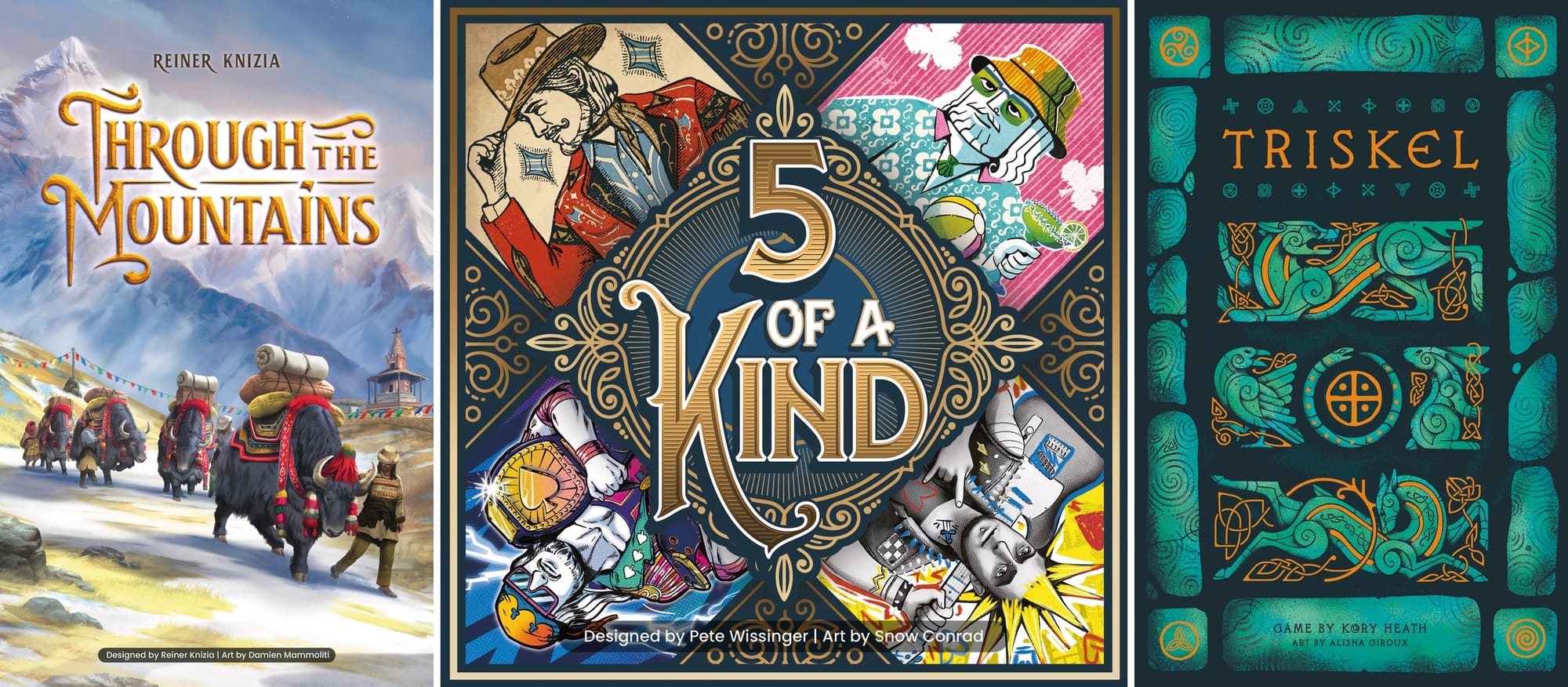
- Somewhat mirroring The Adventure Store is Pete Wissinger's 5 of a Kind, which adds deck-building to a shedding card game. Each turn, you either play a stronger combo (single card, x-of-a-kind, run, full house) than what's on the table, play a bomb (five-of-a-kind, straight flush, or "flush house"), or pass. When you pass, you can (1) fill your hand to nine cards, (2) draw two cards, then discard two, or (3) trash a card from your hand, then take a card from the market. When all players pass in turn, you grab the points in the pot, then start a new meld. If you empty your hand, you draw nine cards immediately, and each time you must shuffle your discards, you score points, so you want to shed as quickly as possible.
- Triskel is a new version of Kory Heath's game Uptown, which debuted in 2007 and which I wrote about in detail in a 2024 tribute to Heath. The gist of the game is that you take turns placing tiles in a 9x9 grid, trying to create as few clusters of connected tiles as possible. You can replace an opponent's tile with your own — as long as you wouldn't split their cluster — but capturing tiles like this will worsen your score.
Latitude
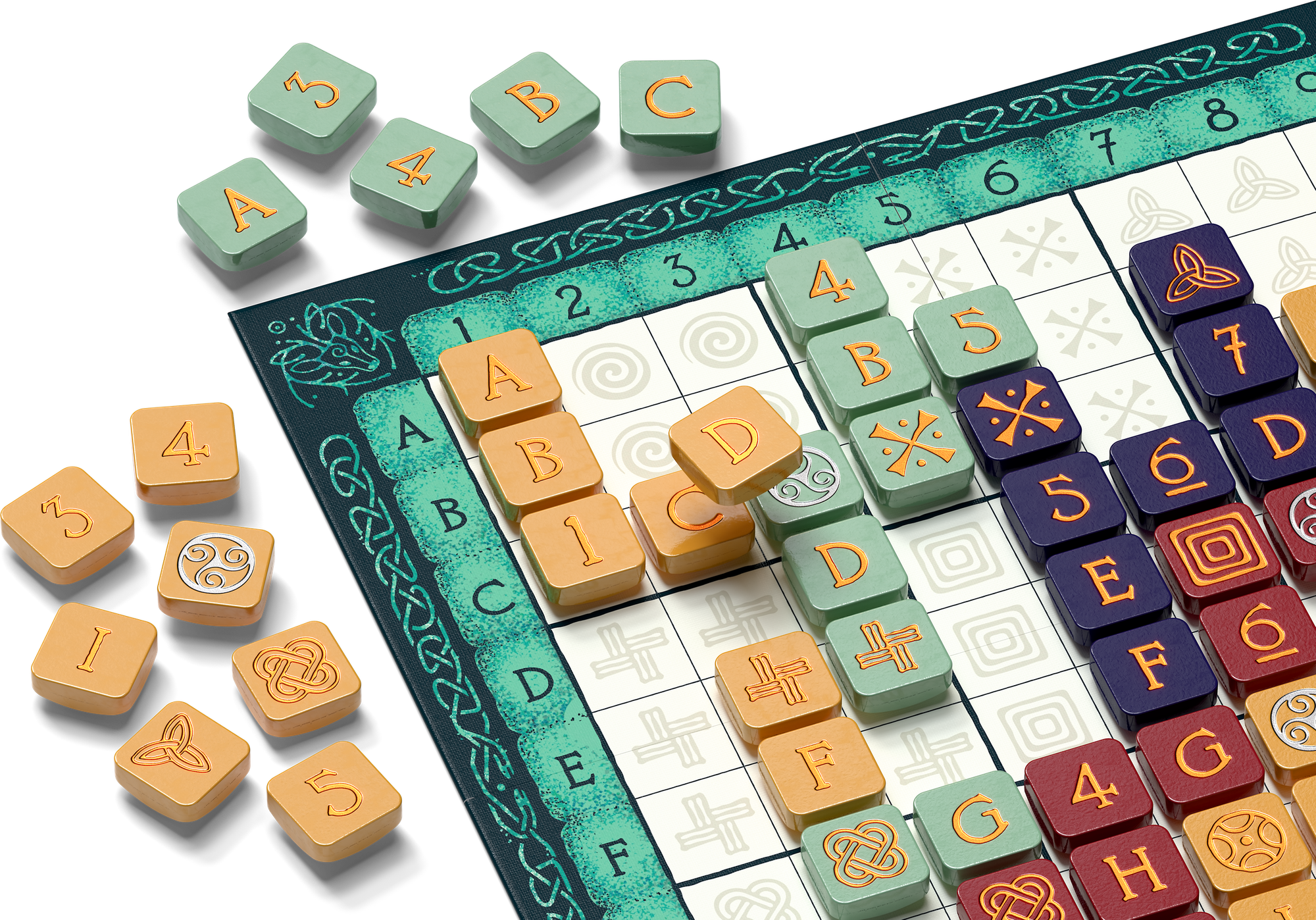
Andrew Juell's Latitude from Radical 8 Games — which is crowdfunding through mid-November 2026 for release in Q4 2027 — is another design in which players take turns placing tiles on a shared game board, but in this game, your goal is to anticipate the final size of an area once it's complete.
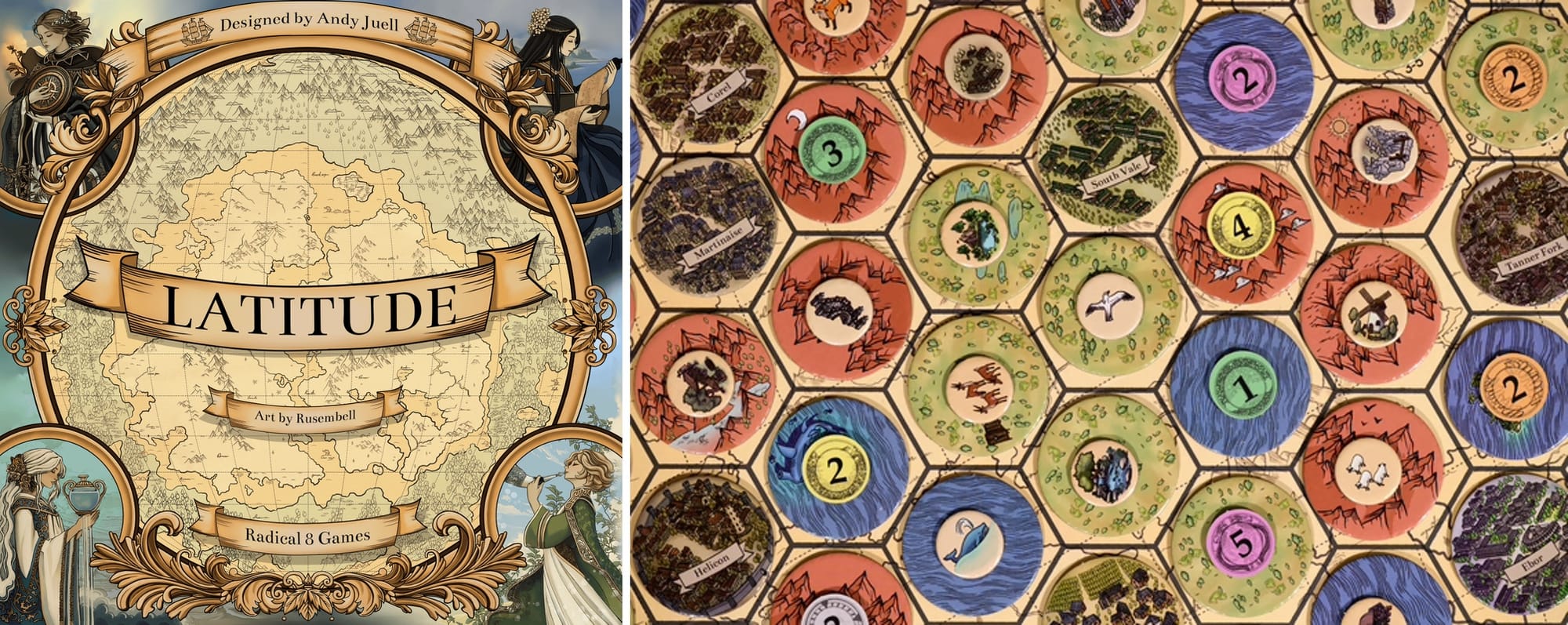
In more detail, on a turn you place one of three types of landscape tiles — mountain, grass, or water — on the game board, then place a token from 1-5 on that tile. If a terrain consists of more than one adjacent tile, the tiles can't have the same number on them, and you can't place a tile that would create a terrain of more than five connected tiles. Once a terrain is complete, that is, it has five tiles or is surrounded and can't grow further, flip all number tiles that don't match the size of the terrain face down.
When no one can play because the board is full or their only number tiles would match those already in a terrain, the game ends, and players sum their face-up numbers on the game board.
Want more game announcements like this?
Get Board Game Beat’s free posts by email — original reporting, designer interviews, and industry news, with no tracking and no spam.


