

Through 27 August 2026, crowdfunding site BackerKit is running "GameFiesta!", a special campaign that focuses on games developed in South America, Central America, and Spain (along with one game from Thailand for unexplained reasons), so I thought I'd highlight a few of these titles for folks who live outside of those regions.
Dungeon Crawlers
One fun way to create dad jokes — I mean, game ideas — is to treat metaphorical terms literally, thus Juan Esteban López Lozano's Dungeon Crawlers puts 2-5 players not in the position of adventurers wandering through a dungeon, but instead of snakes wandering — I mean, crawling — through a dungeon. (BackerKit link)
Dungeon Crawlers, which comes from Colombian publisher Bogotá Board Game, is a take on the Snake video game genre in which each player controls a snake that continually grows as it moves, with you trying not to run into yourself or others. In this game, you:
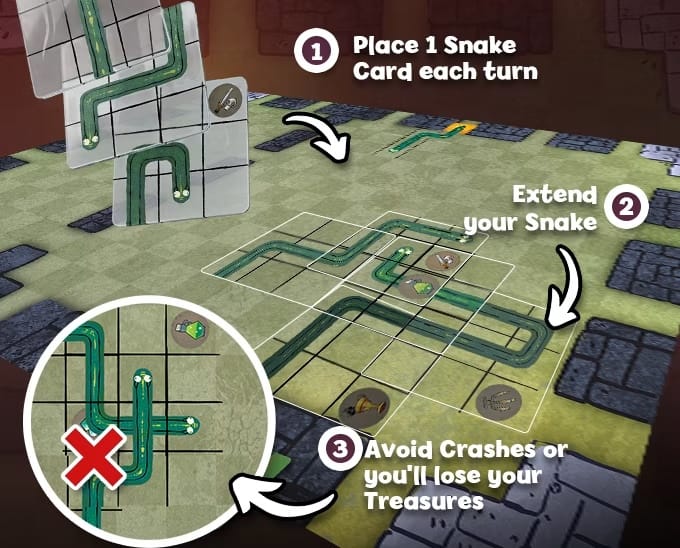
You have a hand of four translucent snake cards, and when growing you want to pass over treasures to pick them up (by wriggling underneath them, I suppose). Cards sometimes add new treasures to the board, along with tokens that provide special effects, and if you manage to squeeze your head into an exit, you claim the treasures you hold, which are worth 1 or 2 points, then you place your tail in a new entryway to start crawling again. Crash into any snake or the wall, and you lose three cards from the head-end of your snake.
Whoever first scores their 10th point wins.
The Path of the Priest
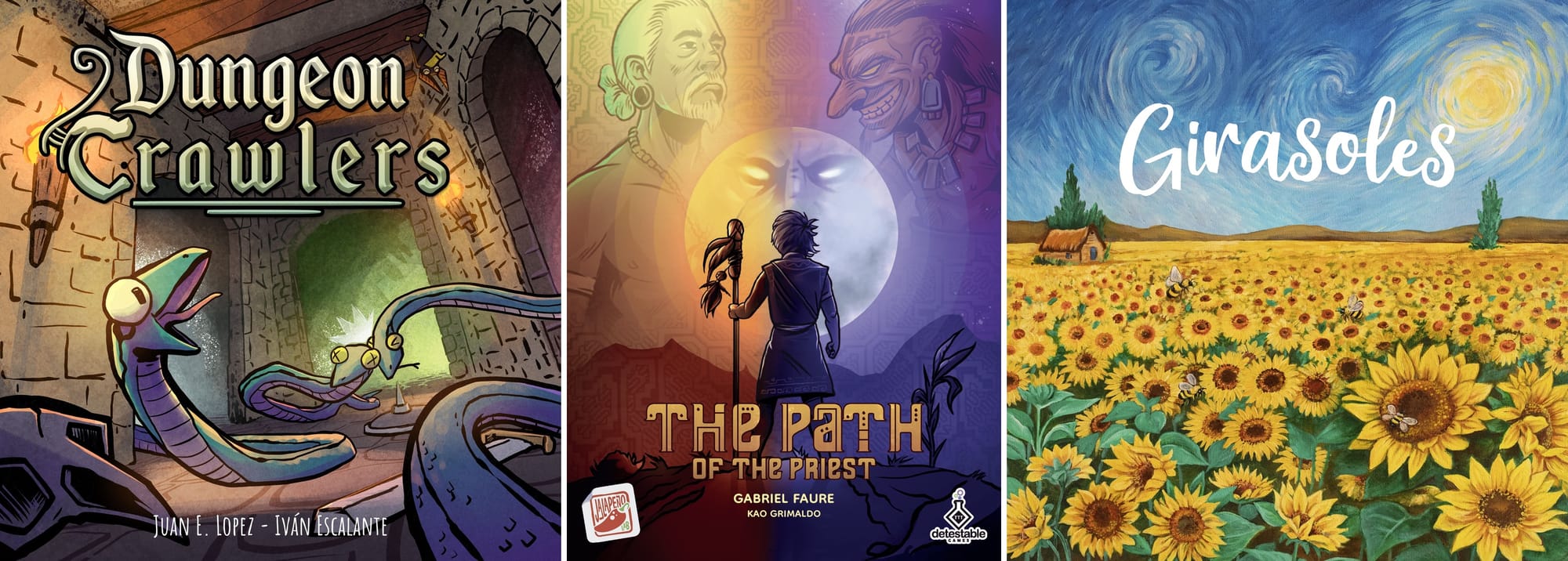
Gabriel Faure's The Path of the Priest is a solitaire game from Mexican publisher Jalapeño Lab in which you want to move your apprentice next to the deity in order to complete your training. (BackerKit link)
To start, shuffle the eight true masters and six false masters, then lay them out in a row, with the apprentice at the left end and the deity on the right. On a turn, choose a true master in the line, then use one of its two powers, after which you must resolve the powers of all of the false masters. These powers will move cards, swap cards, remove cards, place a card in a specific position, and so on.
If you can't choose a true master because they've all been removed, or the apprentice moves past the deity, you lose. To win, at the end of your turn, the apprentice must be to the immediate left of the deity.
Sunflowers
Argentinian publisher Colorido Juegos released Girasoles ("Sunflowers") in 2025, and now it's bringing out this 2-4 player tile-laying game in English. (BackerKit link)
Each player has a 6x6 game board, and each turn you'll place a tile of a single square or two connected squares onto your board. As you create and add to color groups, you'll move ahead on the sunflower path based on their presence in those groups, and whoever is farthest on this path at the end of the first three rounds chooses one of two new objective cards.
These three objectives will join three fixed objectives, and you'll all six of these objectives at game's end, along with bees, ladybugs, and leaves, each of which has its own scoring criteria.
Monster Nursery
Mexican publisher NAAYAAN debuted in 2025 with Reyes de la Rosca ("Kings of the Rosca"), a set-collection card game in which you're all eating Three Kings Bread on Epiphany and trying to end up with the fewest baby Jesus cards.
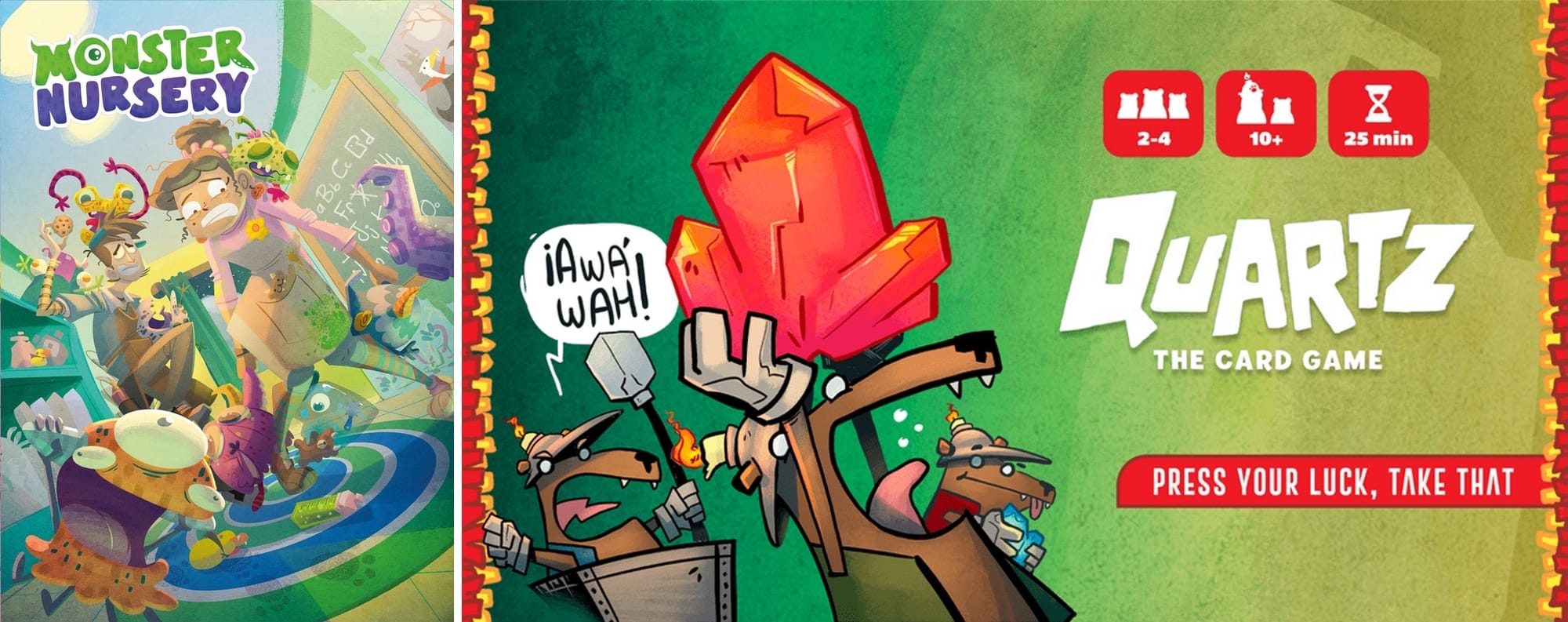
NAAYAAN's second title is Monster Nursery, a 2-6 player dexterity game from Manuel Garza Lopez that will have you balancing little sleeping monsters on various body parts where they find it most comfortable to nap (your head, your shoulder, the back of your hand, etc.), while also trying to take care of the monsters' needs by touching various objects in the playpen without dropping (and waking) those who sleep. (BackerKit link)
Quartz: The Card Game
Brazilian publisher Grok Games released Sérgio Halaban's Quartz: The Card Game in Portuguese in 2023, and now the game is being released in English and Spanish. (BackerKit link)
In this press-your-luck game, 2-4 players go digging for gems in a mine, trying to end up with the most valuable collection. On a turn either protect all gems of one type in your collection (keeping them safe from theft) or dig for gems, revealing cards one by one from the deck until you stop and take what's been revealed or have a cave in after revealing cards with a cave-in symbol in the same location.
Players start with five assistant cards in hand and can gain more during play. With these cards, players can force an opponent's turn to end immediately, take gems from the mine during an opponent's turn, steal gems from a collection, and more, with defense cards being able to nullify attacks or bounce them back on the original player.
At game's end, tally the value of your gems, scoring additional points for a set of four gems of the same type.
Pintó
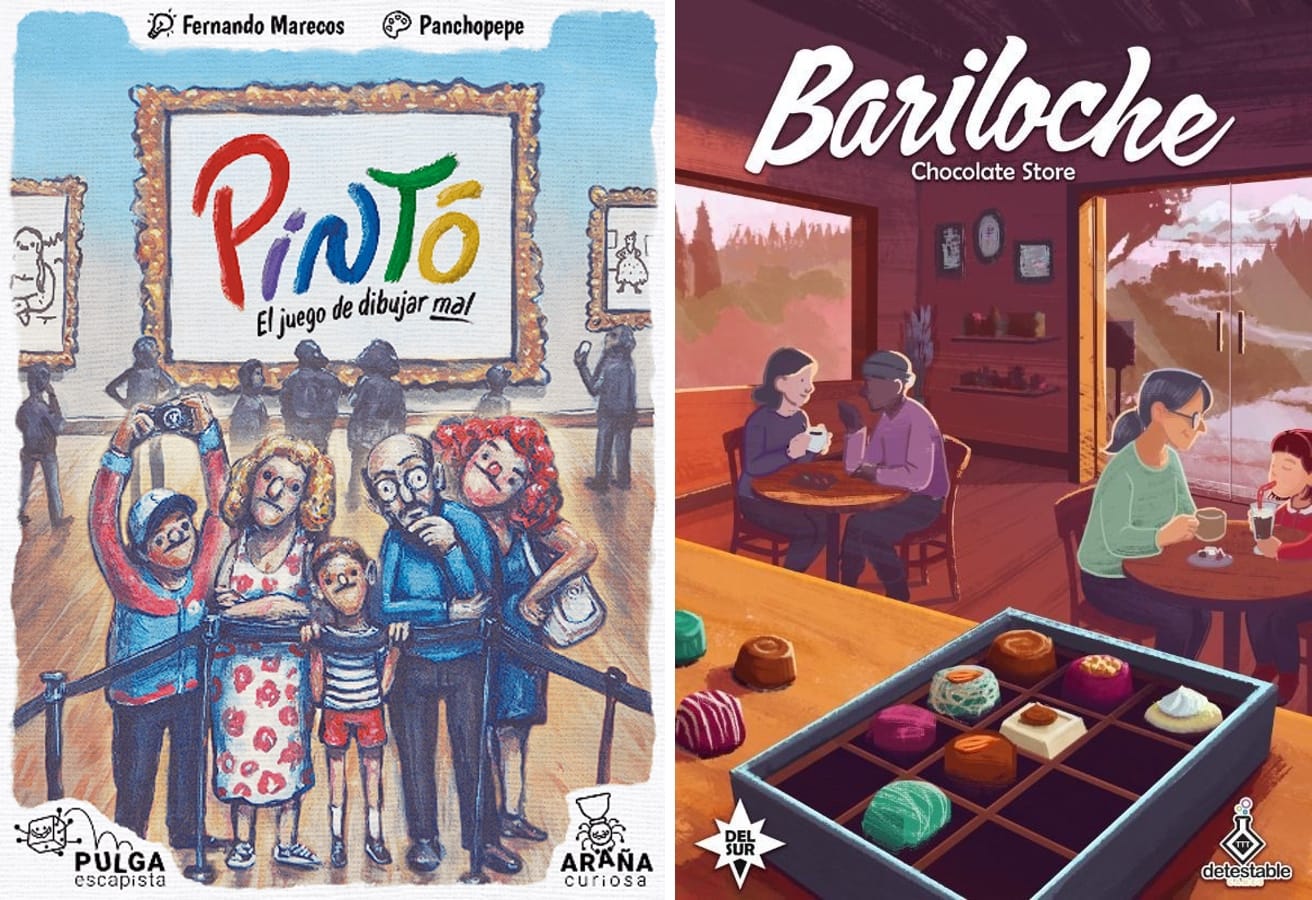
Argentinian publishers Pulga Escapista and Araña Curiosa describe Fernando Marecos' 4-8 player game Pintó in terms that will be immediately clear to many gamers: Think Dixit, but with images that you draw. (BackerKit link)
More specifically, in each of three rounds a category is revealed, then each player chooses to draw something that fits in that category, writing the thing to be guessed on the back of their drawing. Everyone secretly guesses what everyone else drew, then you reveal the answers:
- If no one guesses what you drew, you lose -1 point.
- If everyone guesses what you drew, everyone else scores 1 point.
- If only some of the players guess what you drew, then you and each of those correct guessers score 1 point for each person who guessed incorrectly.
I think the scoring method is what will make this an ideal play experience as you want to draw as incoherently as possible so that ideally only one person identifies your drawing — which should make the guesses wilder than you might otherwise expect. Everyone is drawing something of their choice from the same category though, so it seems like a "fair" system in that you do have some boundaries on what the object could be. [Disclosure: I have backed this title, which is less than 30% fulfilled at this point, so I might have to end up waiting for a licensing partner to pick this up.]
Bariloche
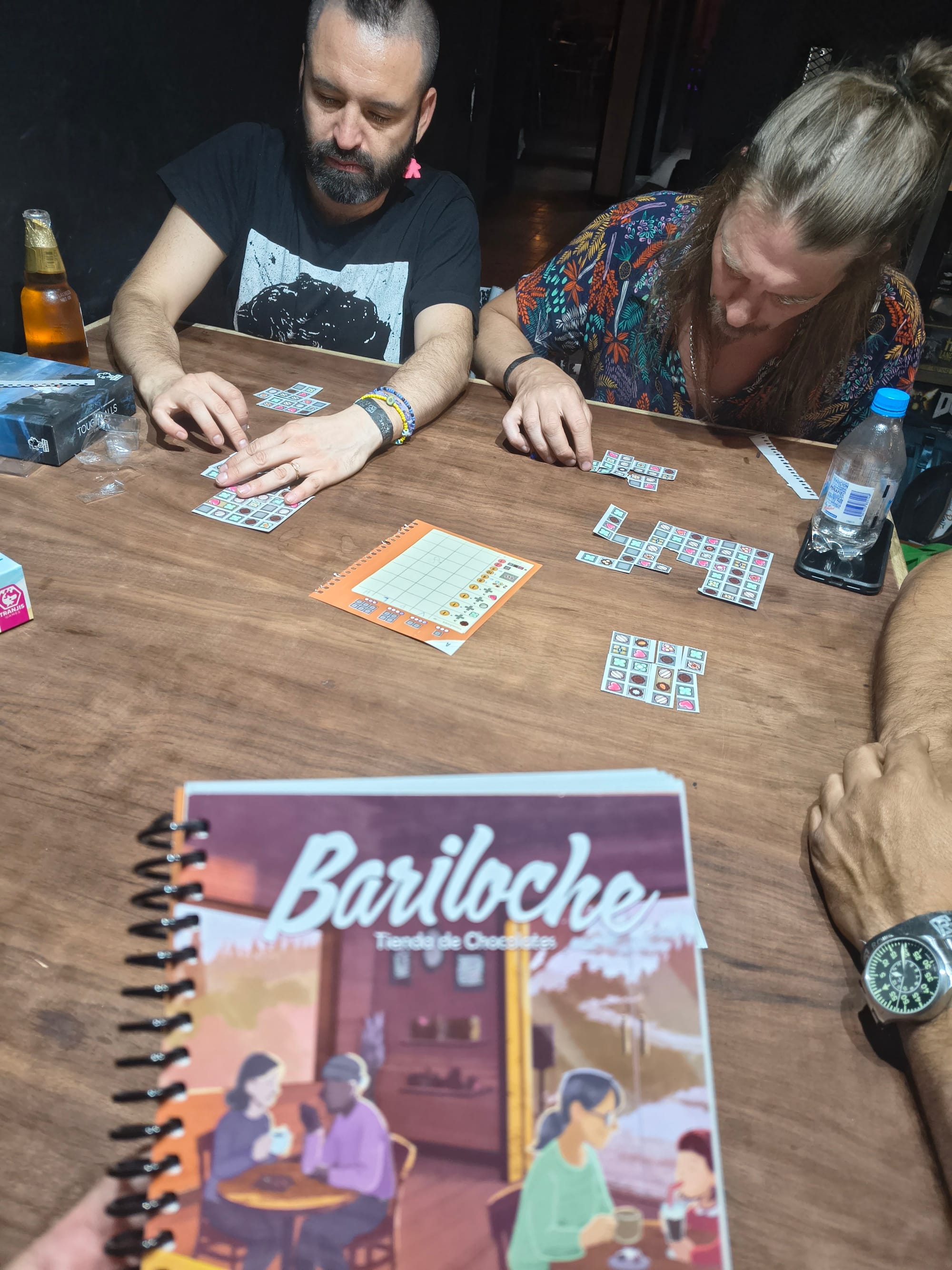
The 2-4 player game Bariloche comes from designer Martín Oddino, developer Julián Vecchione, and artist Julián Tunni — an Argentinian design team known as Del Sur — with Mexican publisher Detestable Games producing this item. (BackerKit link)
The game has you build a box of chocolates bit by bit by tearing apart bonbon sheets and assembling the treats in a bizarrely-shaped container. To start, you lay out one of the two scoring boards, then give each player a 7x10 paper sheet depicting various treats, with some of the spaces being empty.
On a turn, a player chooses the shape that all players must tear from their sheet — 1x1, 1x2, 2x2, or 2x3 — then you each add that shape to your "box" and pass your sheet clockwise. If you tear the sheet into multiple parts, you keep the smallest piece as negative points. If a player cannot tear out the proper shape or only one type of shape remains to be chosen (as a limited number of each are available), the game ends, then you tally scores.
Like this kind of coverage?
Get Board Game Beat’s free posts by email — original reporting, designer interviews, and industry news, with no tracking, no ads, and no spam.


