

"Extra Beats" posts will normally be readable only by those who subscribe at a prototype or higher tier, but for this initial one, I'm leaving it open to everyone.
I realized the other day that I've yet to post a game review on Board Game Beat. Partly that's due to being swamped with work in late 2025 and early 2026 as I finished my time at BGG and prepped this site, which resulted in me barely playing anything from December 2025 through the first half of March 2026.
More than that, though, I felt exhausted by the idea of publishing reviews on a regular basis. While I was at BGG, I frequently posted a written and video overview of a game on a weekly basis for months at a time. I'd play a game enough to feel comfortable talking about it, then I'd almost never touch that game again, regardless of how much I wanted to. No time! Got to move on to prep for the next video!
I wanted to hop off that treadmill and start playing more for fun, reviewing a game only when I felt the urge to do so. After the first hundred days of 2026, I'm finally ready to review my first game on the Beat — Yoann Levet's Got Five!, a family-friendly deduction game that's ridiculously good at what it's trying to do — but that will come another day.
First, I thought I'd run through a few other titles I've played, starting with Sophia Wagner's One Mind, which Schmidt Spiele released in January 2026. I've now played seven times on a review copy, and the experience has shined only in the last three games.
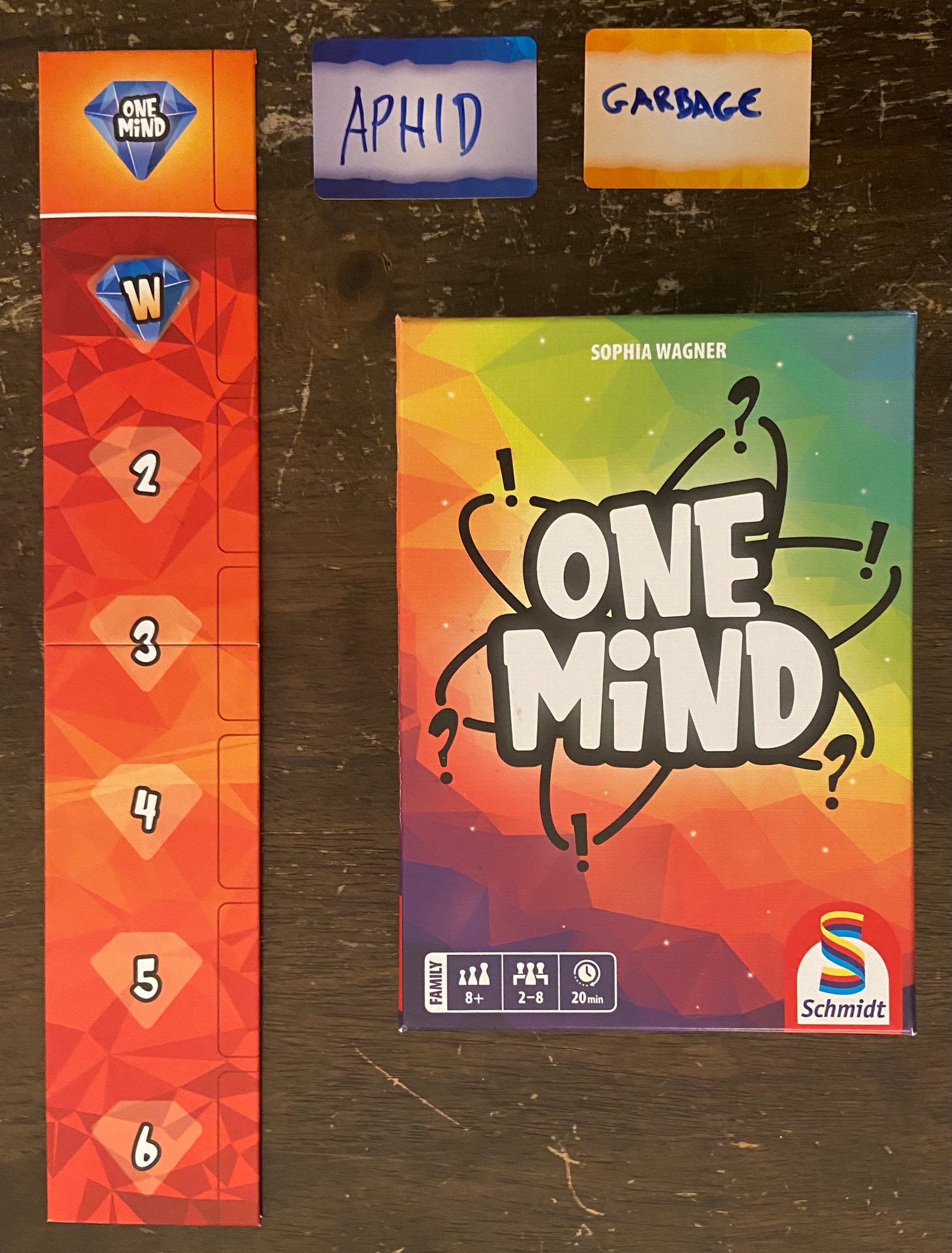
The gist of the game is that you're trying to think like the other players, as in Medium or The Mind. Before the game begins, you each draw a letter from a bag, then write a word that starts with that letter. In each of six rounds, you draw a letter tile from the bag and flip it like a coin to see whether you get a letter or a question mark, then each player writes a word (starting with the specified letter or any letter) based on the words most recently played.
Above you see the set-up for my first game, which I played with my wife, with us writing "aphid" and "garbage" for our starter prompts. What word starting with "W" would you write given these prompts?
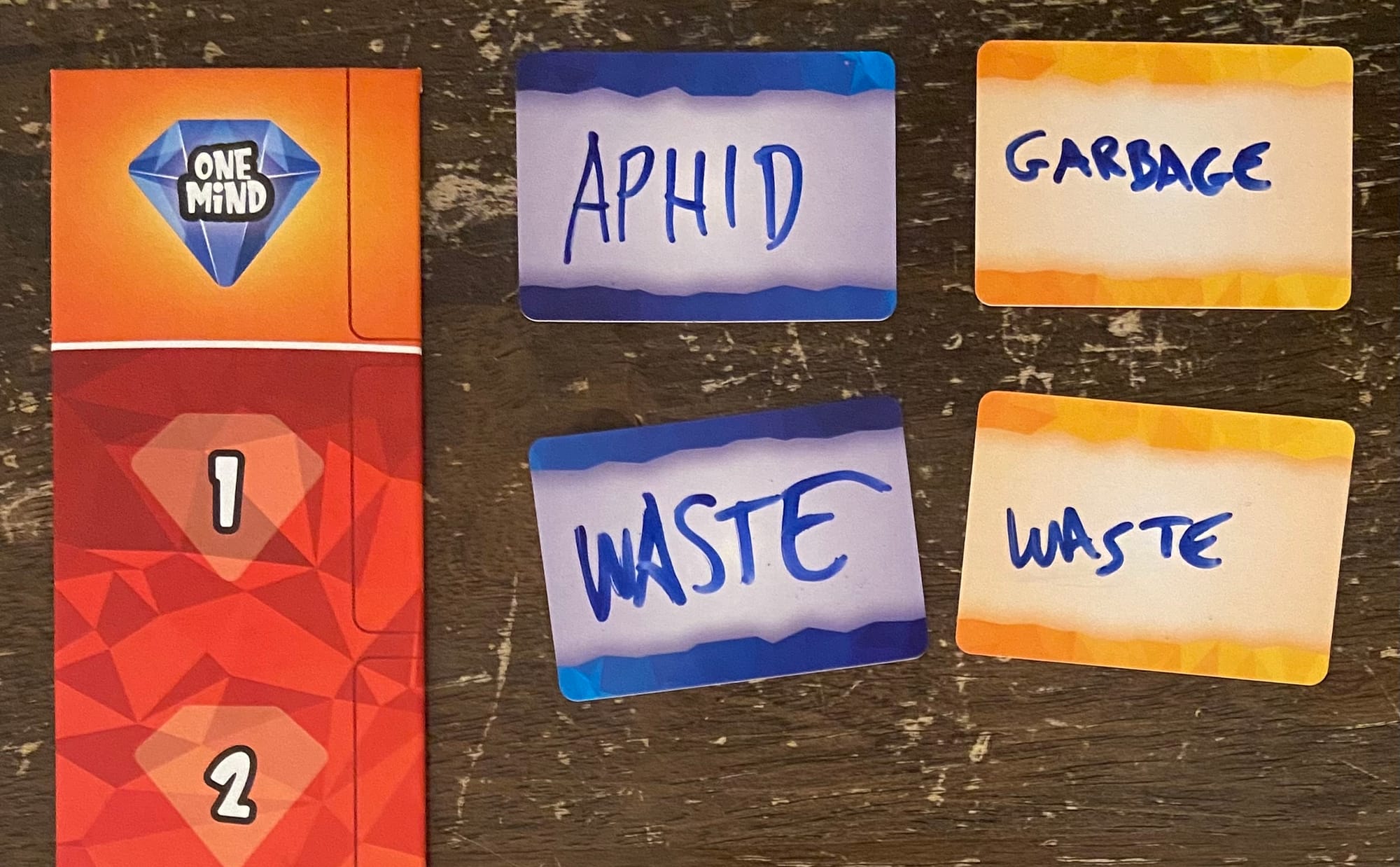
We both wrote "waste" — and a single match wins you the game when playing with only two people, so that was that. I can't even describe the experience as anti-climactic because it felt like nothing, so we tried again.
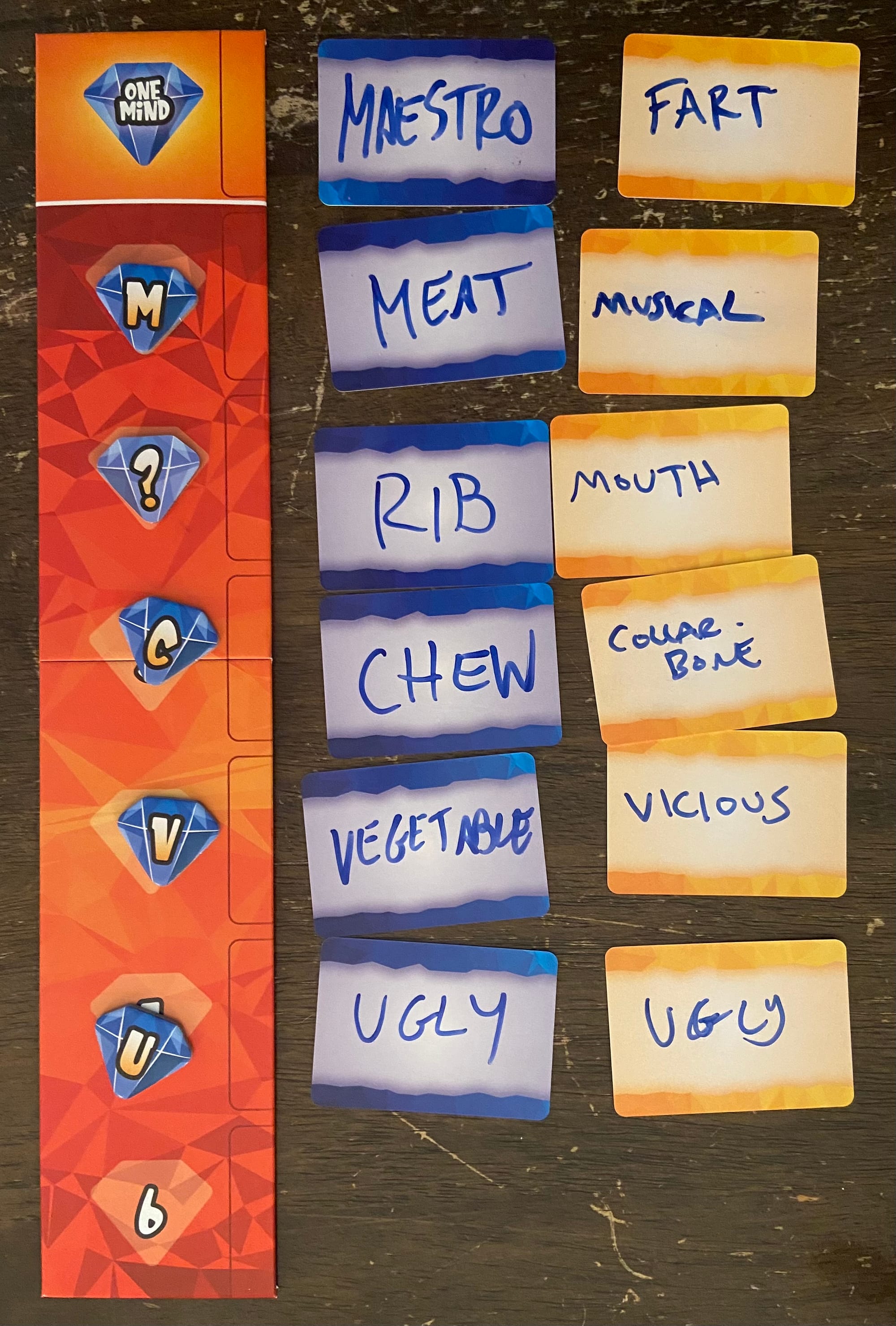
Okay, that worked better, but the experience was still relatively flat.
I tried again when a friend visited for dinner, and with three or more players, you place gems on the table based on the player count and level of desired difficulty. We chose the easy level, then my wife and I matched on each of the first two turns, which removed all gems from the pool, winning us the game.
Hrm.
As I mentioned in an April 10, 2026 post about co-operative games, my fourth experience playing One Mind was sour thanks to six people who were trying to play well and one person who was writing the most esoteric words possible because they dislike co-operative games and wanted to do their own thing. We lost with only one gem left and would have won if they weren't in the game, so in a sense we did win — but each round brought sounds of exasperation when this person revealed their word, so the last two-thirds of the game was a bummer.
At another dinner, this time with a couple who are extremely casual gamers, I brought out One Mind again, and we had a blast, playing three times in a row, winning the first two, then losing in the third game, having bumped up the difficulty twice. They loved the game and have raved about it in days since.
In short, it took five games before I landed on One Mind's ideal playing experience. Would I have given the game five chances like this in my BGG days? Not likely. Now, though, I have a better sense of who the audience for this game might be and when to bring it out next. That type of knowledge takes time, and someone churning through games single play by single play is unlikely to discover such things.
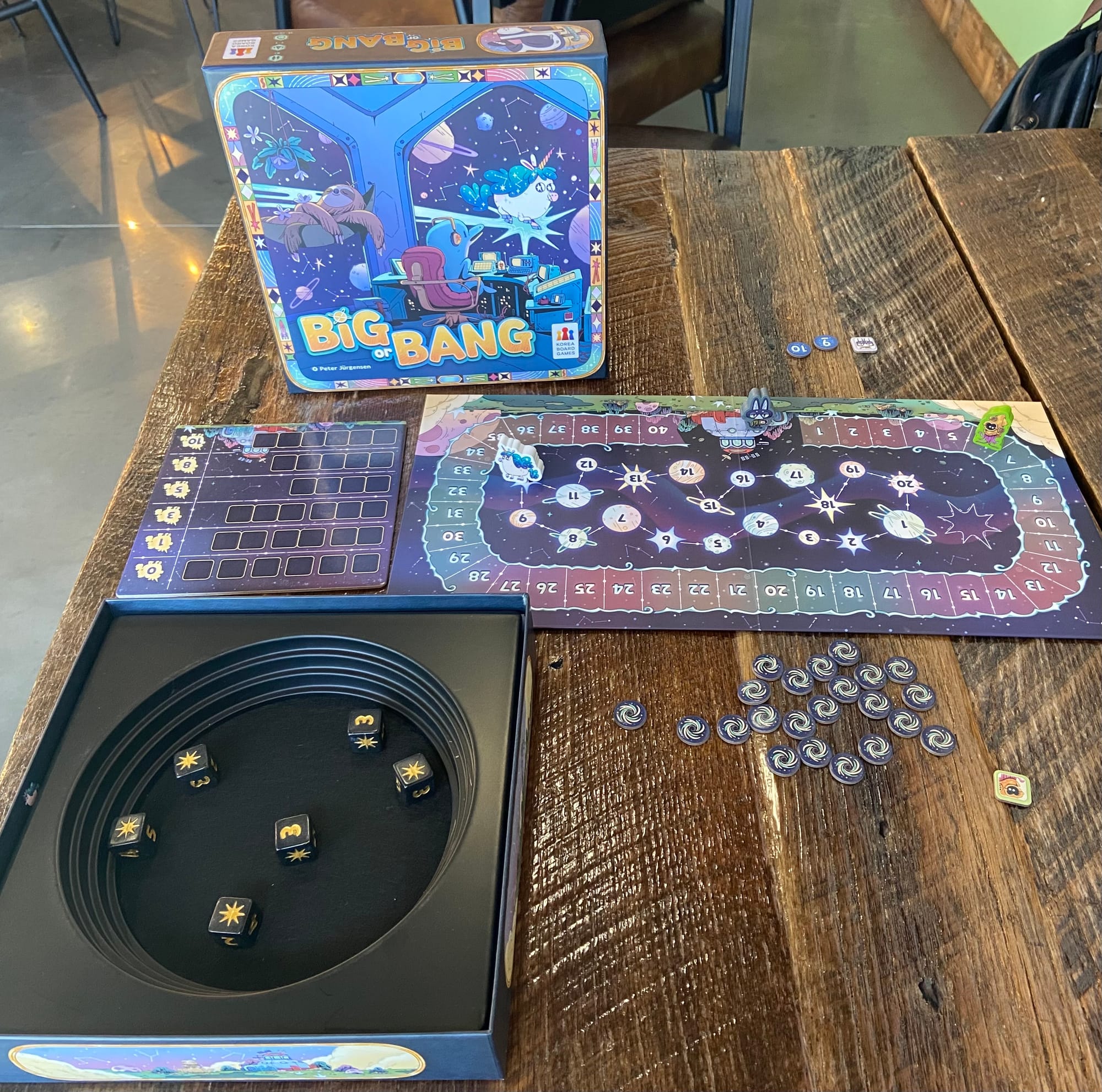
I'm having a similar experience with Peter Jürgensen's Big or Bang, which I've played four times on a review copy from Korea Boardgames. Gameplay is akin to Cosmic Wimpout and other games from that family: Roll dice, set some aside, then decide to stop and score, or roll again at the risk of busting. If you use all of the dice, you get to pick them all up and start again, adding to the points already banked.
In more detail, on a turn you roll six dice that feature a star and the numbers 1-5, then you must put aside all stars, with you optionally being able to put aside all dice of a single number as well. You bank points as shown upside down on the chart above the dice well in the image above, then stop and score points equal to the unicorn's location...or you roll again.
You must be able to put aside at least one die to avoid busting; you can always place stars aside, but you can place all of a number aside only if that number is higher than any number you've previously set aside. If you roll 1-2-4-4-4-S, you can put the 4-4-4-S aside for 5 points, but then you'd need to roll 5 or S in order not to bust. Alternatively, you could put aside only the 1-S for 1 point, giving yourself a larger window to jump through on future rolls.
If you stop and score because you're worried about busting, the next player can choose to pick up your turn from where you stopped, with the unicorn point total not resetting. Alternatively, they can reset the points and roll all six dice like normal.
When a player busts, the unicorn points are zeroed out and you receive a bust token, which has a number on the reverse side. Get two of the same number, and you discard them, scoring points equal to that number.
My two games with two players were both tense and engaging; games with three and four players have been less exciting, but I think that was more the players than the player count. I need more plays to know for sure.
Amazingly, this game lists a player count of 2-7, and I have a hard time picturing a game with 5+ players, but that might be just me as I tend to make decisions quickly in games like these and I get antsy when others take a while to weigh what seem (to me) like obvious options.
Even so, I might need a larger player count to get what this game is trying to deliver: the experience of one player stopping, then the next player continuing, succeeding, scoring and stopping...then the next player also continuing and succeeding, repeat. I understand what Jürgensen is trying to deliver; I've just yet to live it.
That said, the game does deliver the expected "press your luck" experience, with players who are behind tending to take more risks, sometimes scoring 20+ points in a single turn to bolt to victory and sometimes busting for the fourth time and ending the game with only 9 points.
After owning Wolfgang Kramer and Michael Kiesling's Up or Down for eighteen months — first with a purchased copy from Abacusspiele, then additionally with an unrequested review copy from Capstone Games — I've finally played. It was fine.
You have a circular array of six cards, and each turn you place a card from your hand between two cards, then take one of the adjacent cards and place it in your tableau. You can have three columns of cards, with each column either ascending or descending. Can't place a card legally? Rip up one column, and start a new one. Each column scores points equal to the number of cards in it multiplied by the number of cards in that column's most frequent color.
This felt like a learning game, with you trying to figure out how to get cards from your hand into your tableau, while being at the mercy of having only three cards in hand and a half-random card-drawing mechanism. More games needed...
Let's move from Up or Down? to down-up, that is, dnup, a Kei Kajino design that One More Game! first released as Revolve! in 2024, then picked up by asmodee in 2026.
As in Kajino's 2019 game SCOUT, in dnup you receive a hand of dual-indexed cards, with different values on each half of a card, and you're trying to ditch your cards ASAP. Unlike SCOUT, however you pick up your cards determines which values are up, and you can sort the cards in your hand to group like numbers together.
Your general action is to play one or more cards of the same value to the table, and when you're playing X cards, the value of those cards must be higher than a set of X cards already on the table. If you overplay someone this way, that player revolves their played cards 180º and returns them to their hand. In most cases, you have transformed their pair or three-of-a-kind into cards of varying values...which might be good for them depending on what else they have in hand.
Instead of playing, you can ditch a single card onto a set of the same value already on the table (while adhering to the "must be higher" limitation), revolve someone else's played cards and add them to your hand, and revolve all of your cards in hand.
Whoever empties their hand first scores 2 points, with the player who does so second scoring 1 point. Whoever first scores 4 points wins.
I've played four times on a review copy with 3-4 players, and it's a winner so far, with each game lasting 3-4 rounds. While dnup is not a trick-taking game, you want to treat it as such, tracking which cards have been played and who has which cards in hand. You can't get perfect info, but if you see someone transform a pair of 2s into a 7 and an 8, you better anticipate seeing those again in the future.
Also, while leaving yourself with one loser card in hand is typically a death sentence in a trick-taking game, in dnup you might be able to ditch it on someone else's set, giving you an out at just the right moment. That said, you'll often have that last card oriented in the wrong direction, missing that tiny window of opportunity. Them's the breaks!
In a mid-March 2026 post, I wrote about the "Cult of the Old", naming two games that I've owned for at least a decade without playing: Leo Colovini's Atzlán and Reinhold Wittig's Wabanti.
I vowed to play these games "enough" to get a good feel for them, and I'm making progress. Aztlán has come out only once and was a bloodbath compared to the low-body-count nature of many modern Eurogames. I need much more experience before saying more.
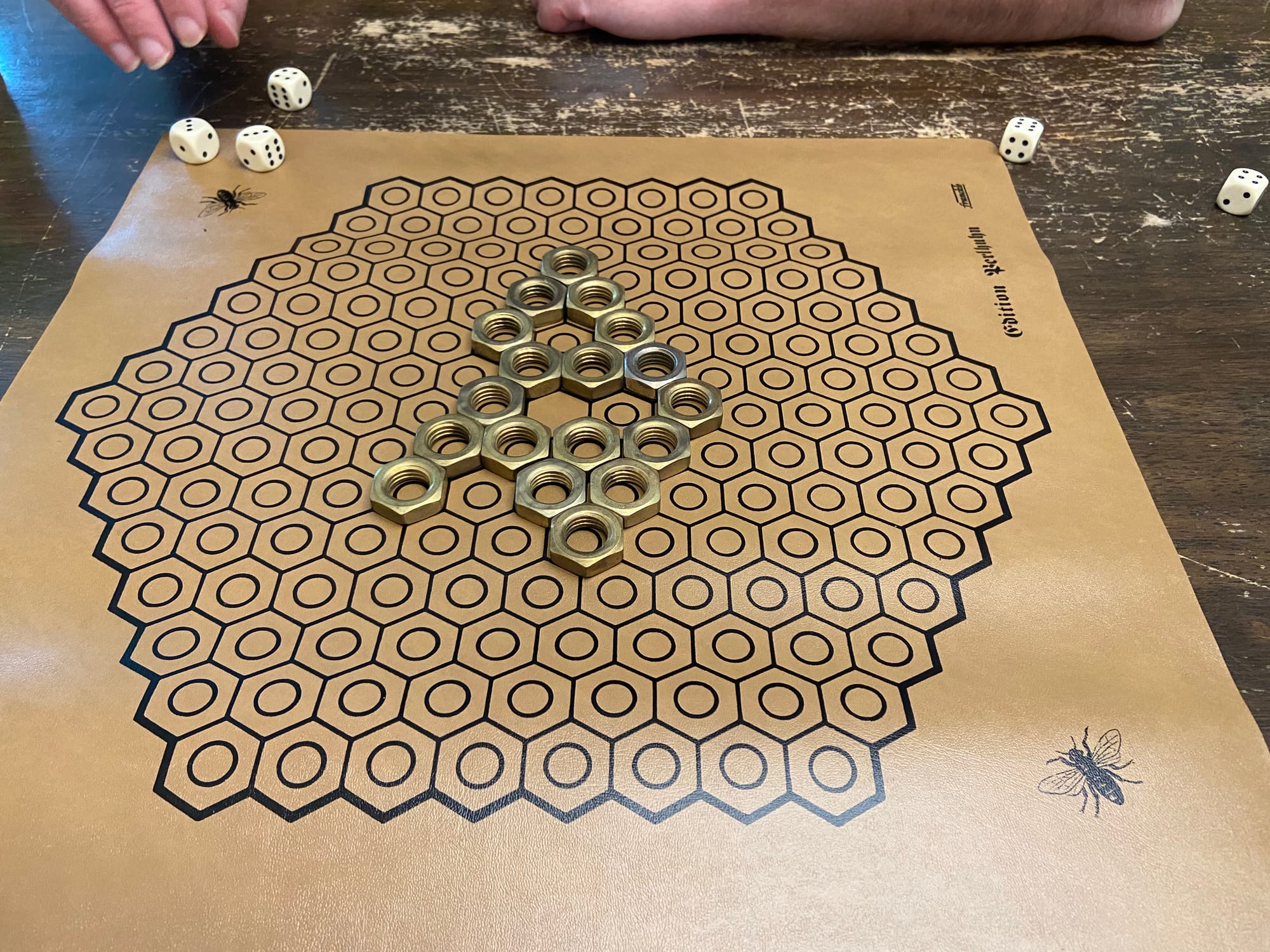
Wabanti, which I've owned for roughly two decades, has now hit the table four times, and I'm sorry that I ignored it for so long. The game is an abstract with dice, akin to Backgammon in how you might complain about bad rolls, but the challenge (as in all such games) is to see how to make the best use of the randomness presented to you.
Your goal is to move a nut to the line closest to you. On a turn, roll the dice available to you (initially five), then use each die once to make a move. With a 1, you move a nut to an adjacent space, and with a 2-6 you must jump a nut over exactly 1-5 other nuts in a row. You cannot split the pack, and you cannot move a nut with fewer than two free sides.
If you can't use all the dice available to you, next turn you roll dice equal to five minus the number you didn't use on the previous turn. Thus, a poor roll on one turn might carry over to the next turn, so even you're making a not great move, you still want to use every die you can.
Sometimes you find yourself and your opponent moving the same nuts back and forth over several turns — at least that's what I've seen so far — but ideally you can create outcroppings, peninsulas, and choke points that restrict what your opponent can possibly do. I feel like I'm just beginning to see what's possible in terms of good play.
All four games were with only two players, and I can't imagine playing with four, much less six. Again, this is possibly just my issue with slow play, but I am curious to see whether 4+ players, or even three!, would create a tornado-like feel, with nuts moving toward one edge, then swirling toward the next one and the next one.
Coincidentally, Reinhold Wittig passed away eight days after my first game. I greatly enjoyed researching his history and writing about his importance to the game industry — and I have another half-dozen of his designs on hand that I've purchased over the years and have yet to play, so I'll never run out of material for future "Cult of the Old" challenges...which doesn't reflect positively on my acquisition habits.


