German publisher Zoch Verlag has announced its late 2026 line-up, with three titles for players aged 8 and up and one for the youngsters at home.
Pocket Pisa
Zoch has a long history of balance and dexterity games — Bamboleo, Bausack, Villa Paletti, Menara, and more — and to that line it's adding Pocket Pisa, a relatively small game (thus, "pocket") from Christoph Cantzler and Anja Wrede for 2-4 players.
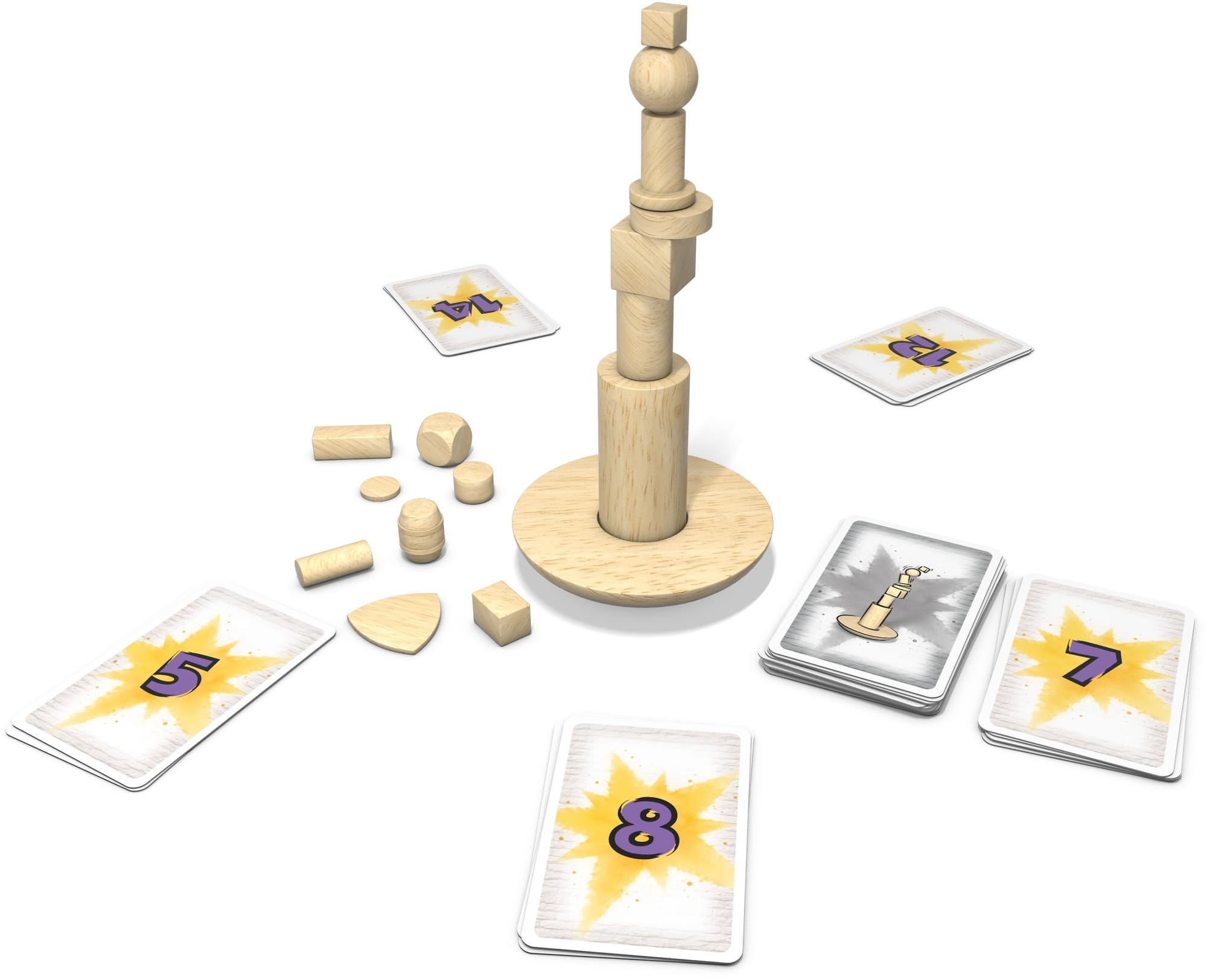
The game is played on a circular base that's rounded on the bottom, duplicating the mistake used by those who constructed the Tower of Pisa. As for gameplay, the publisher writes:
Piece by piece, the tower rises higher and higher. Along the way, players must decide whether to cash out early and collect victory stars — or keep building for even greater rewards while risking a spectacular total collapse. With every new block, both the tower and its value grow. But the higher you aim, the harder it becomes to stay balanced. One wrong move…and down goes the tower — along with your hopes of claiming those stars.
My interpretation of that description: Players bid for how high they think they can collectively build the tower, and if the tower reaches that height before it topples, you score that many points, with the qualification that once the tower reaches that height, you can no longer participate in building it. I'm curious to see whether I've come close to how the game actually plays...
UPDATE, 14 Sep 2026: A Zoch employee was amused by my misguided efforts and passed along the English rules to Pocket Pisa. Here's how the game works:
Stack the numbered cards from 1-33. On a turn, either build or pass. If you build, flip the top card into the discard pile, then add a block to the tower. If the tower stands after this placement, the next player goes; if any block other than the one you just placed falls, the round ends, with each other player in turn drawing and keeping the top card of the deck. If you pass, you draw and keep the top card, then refrain from placing more blocks this round. A few details:
- If you place the fourteenth (and final) block, you draw and keep the top card of the deck and other players who have not passed receive nothing.
- If you're the only player who hasn't passed, keep going until you pass or fail.
After the round ends, flip the discard pile back onto the deck, then start a new round. When a player has collected five cards, the game ends, and your score is the sum of your three highest cards.
Nein! Doch! Ohh!
Christoph Cantzler has a second title coming from Zoch in late 2026: Nein! Doch! Ohh!, which translates to something like "No! Really! Ohh!" and which is the second 2026 release that has you trying to guess when sand timers have run out after Jason Tremblay's Hummingbirds, which I covered in February 2026. Cue Dr. Doofenshmirtz!
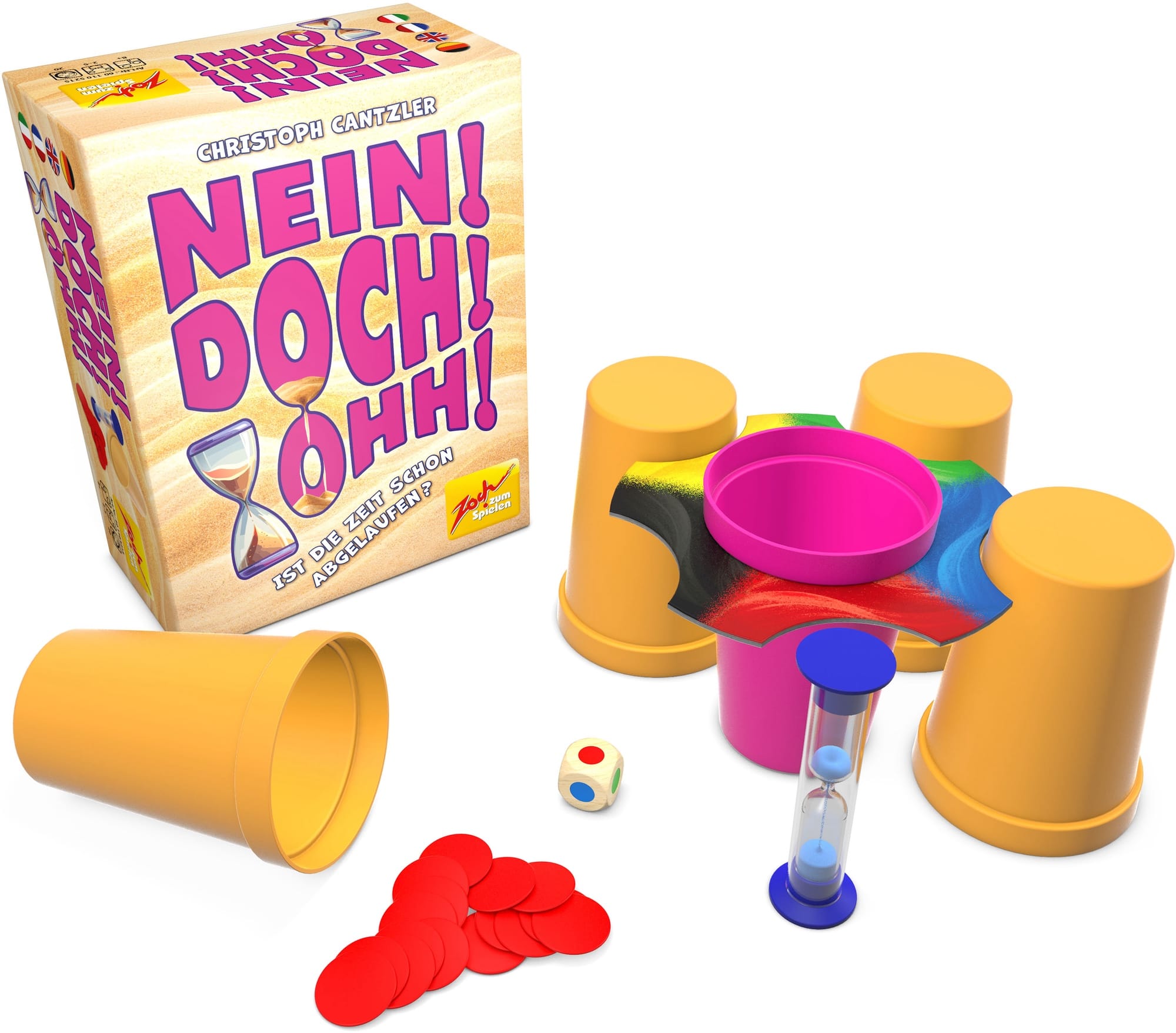
Four sand timers, each with a different duration, are hidden under cups, and on a turn, you roll the die, then decide whether the sand timer under the indicated cup has run out. If you think it has, lift the cup, throwing two of your chips into the central cup if you're correct; if you're wrong, though, everyone else gives you a chip.
If you don't think the sand timer has run out, say "No" and pass the turn to the next player — but someone can call out "Yes!" to challenge you, then pick up the cup to reveal whether you give a chip to the "Yes" sayers or they give a chip to you. Regardless of whether a timer has run out, when it's revealed, you flip it over to keep everyone on their toes. If you roll the color without a cup, slide a cup to that color; rolling white on the die allows you to choose any color.
Der Turm
The 2-5 player game Der Turm ("The Tower") is credited to BLOB Factory, a gaming studio consisting of Luca Bellini, Carlo Emanuele Lanzavecchia, Walter Obert, and Luca Borsa, but the description from Zoch Verlag is more evocative than descriptive:
Ten tower floors are available in which players can hide their precious gems — but nothing stays on the same level. Every turn, the tower's modular floors are taken apart and rebuilt in a completely different order. What was once at the top may suddenly reappear near the bottom, turning memory and orientation into a constant challenge.
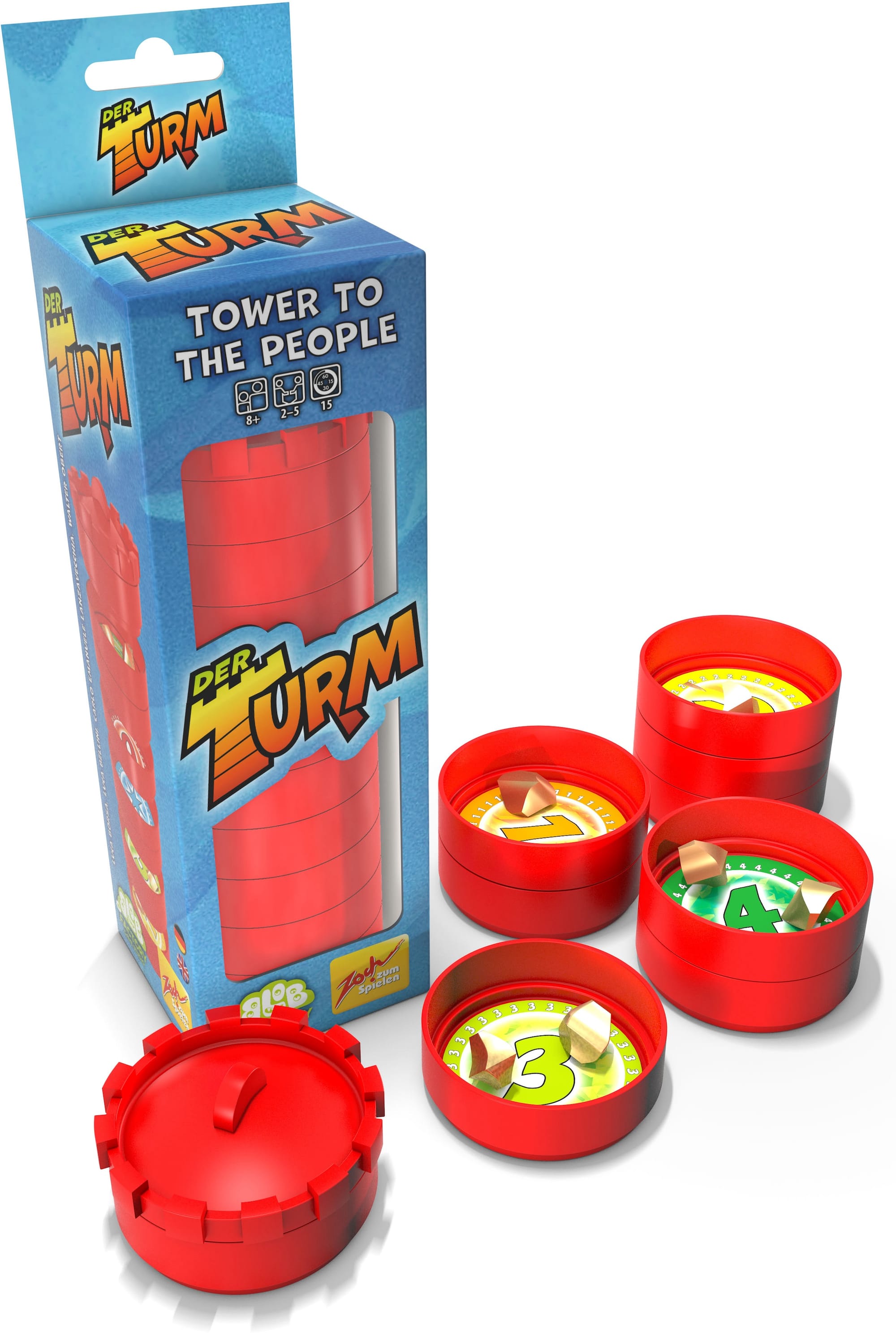
Players who can keep track of the shifting floors and follow the hidden flow of gems may stay one step ahead of their opponents as opening an overloaded compartment can backfire, sending your carefully planned progress right back to you. Victory goes to whoever manages to place all of their gems into the tower first...but this tower doesn’t accept just anything.
UPDATE, 14 Sep 2026: That same Zoch employee decided to relieve my confusion and passed along the rules to this game as well:
The floors show the values 0-4. Four gems are seeded in the tower, and the remaining 32 gems split among the players. On a turn, split the tower in two as you wish (aside from the lifting only the roof, which is disallowed). If the floor holds fewer gems than the number on the floor, add a gem to that floor. You can then split a tower in two to try to ditch another gem or end your turn.
If you ever reveal a floor with as many gems as the number on the floor, you must take all the gems from all open floors and end your turn. When you end your turn, move the roof to the top of a different floor, then stack the towers as you wish. Place your last gem to win.
One floor shows * instead of a number, and you can play without this floor to make gameplay more straightforward or use one of the four included rules for this floor to spice up the game, e.g., the * floor can hold four gems, but you must take another turn after placing a gem here.
Funkel Munkel
We'll close with a very Zoch-sounding game title: Funkel Munkel, the meaning of which eludes me beyond "funkeln" being a verb that means "sparkle". As with Der Turm, Funkel Munkel comes from an Italian design team, with Cielo d'Oro's first design credit being the 2011 title Aquileia, also from Zoch Verlag.
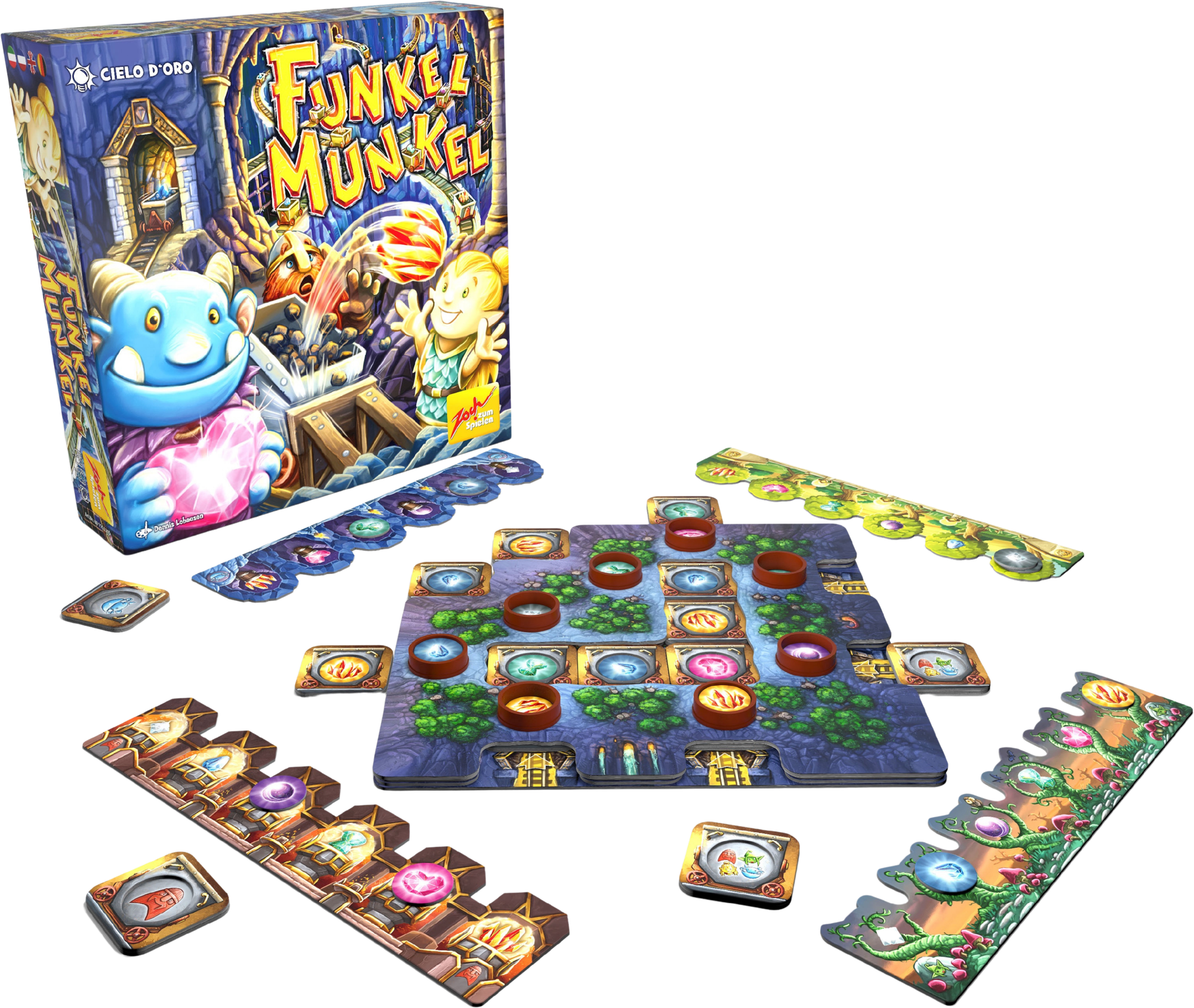
In this 2-4 player game, players will slide their mine carts between the layers of the game board. As carts get pushed into one of the four tracks, the gem token at the bottom of the stack will fall into the cart, covering up the owner's identity, so you'll need to track which carts go where so that you can ideally push your carts (or the unowned carts) out the far side, allowing you to claim the gem within.
Eventually the gem shafts at the front of the mine will empty, so the gems in the far shafts will fall into carts that are close to the exits. When a player collects all six gems or five gems of one color, they win.
Want more game announcements like this?
Get Board Game Beat’s free posts by email — original reporting, designer interviews, and industry news, with no tracking, no ads, and no spam.