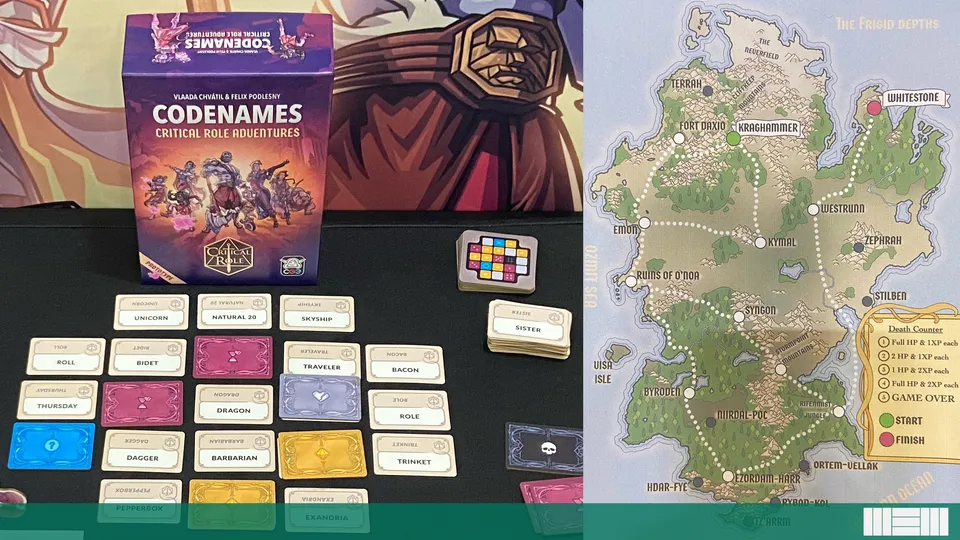
As is usually the case, I played only a few games at GAMA Expo, which took place the first week of March 2026. The show features three game nights in which dozens of publishers set up dozens of new and upcoming releases for retailers, distributors, and media to play, but I typically find myself getting fixated with a handful of creators and their titles, spending most of my time talking and little time playing. So be it.
Even so, I did play a few games, with the most intriguing one being Symbiosis, a 2-4 player card game from Jérémy and Christelle Partinico that French publisher Subverti debuted as Symbiose in 2025. A Czech edition of Symbiose also hit the market in 2025, but other publishers have caught on in 2026, with Pegasus Spiele releasing the game in German, Mandoo Games in Korean, Rocket Lemon Games in Spanish, and...Subverti in English via distribution through Hachette Boardgames USA. (Disclosure: I received a review copy of Symbiosis at a publisher event during GAMA Expo and Hachette Boardgames USA has advertised on this site.)
Symbiosis — which I played twice, both times with four players — features the same appeal as Johannes Goupy and Corentin Lebrat's Faraway and Grégory Grard and Mathieu Roussel's Castle Combo, the later of which I reviewed in September 2024. That appeal: Players take turns drafting cards from a shared market and adding those cards to their personal tableau in order to create their own scoring conditions during the game.
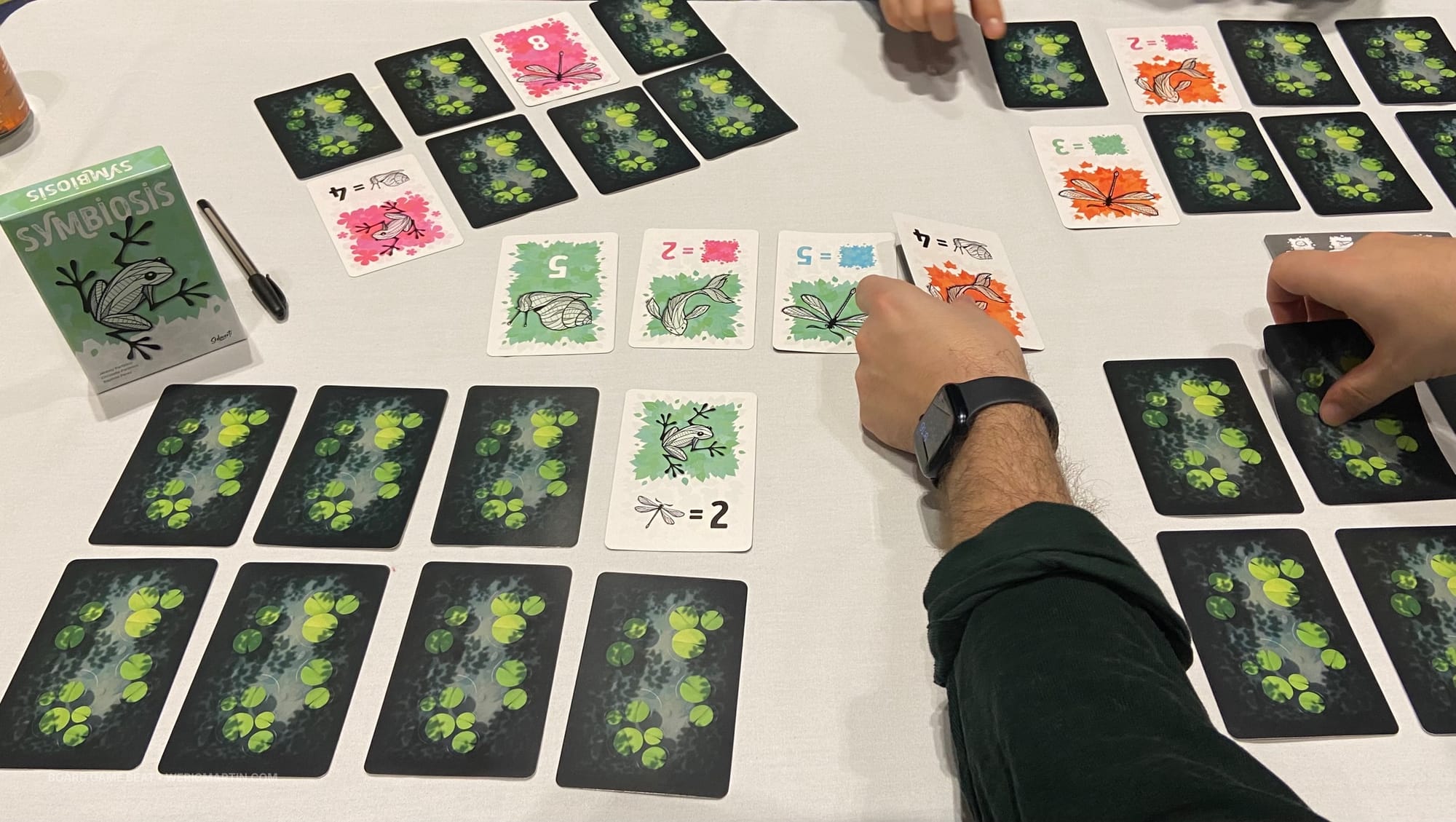
Symbiosis consists of 36 cards, with each card showing one of four colors, a creature, and either a number or a scoring condition. Each player is dealt eight cards, then arranges them face down in a 2x4 pond without looking at them. four cards are placed face up in the river, then everyone reveals one card of their choice. On a turn you either:
- Take a card from the river and swap it with a face-down card in your pond, revealing the latter card when you place it in the river, or
- Take a card from the river and swap it with a face-up card in your pond, revealing the latter card when you place it in the river, after which you flip up a face-down card in your pond.
Castle Combo has you draft nine cards, Faraway eight, and Symbiosis seven, after which you count points. As such, Symbiosis runs 10-15 minutes, slightly shorter than those other games.
The main difference between the three designs is that in the first two, you interact with players solely when drafting cards, with your score unaffected by which cards opponents take. In Symbiosis, an opponent might draft a card you want, as in the other games, but your score depends on the contents of both your display and your neighbors', so sometimes you want them to take certain cards since you'll score more from the card being in their pond than in yours.
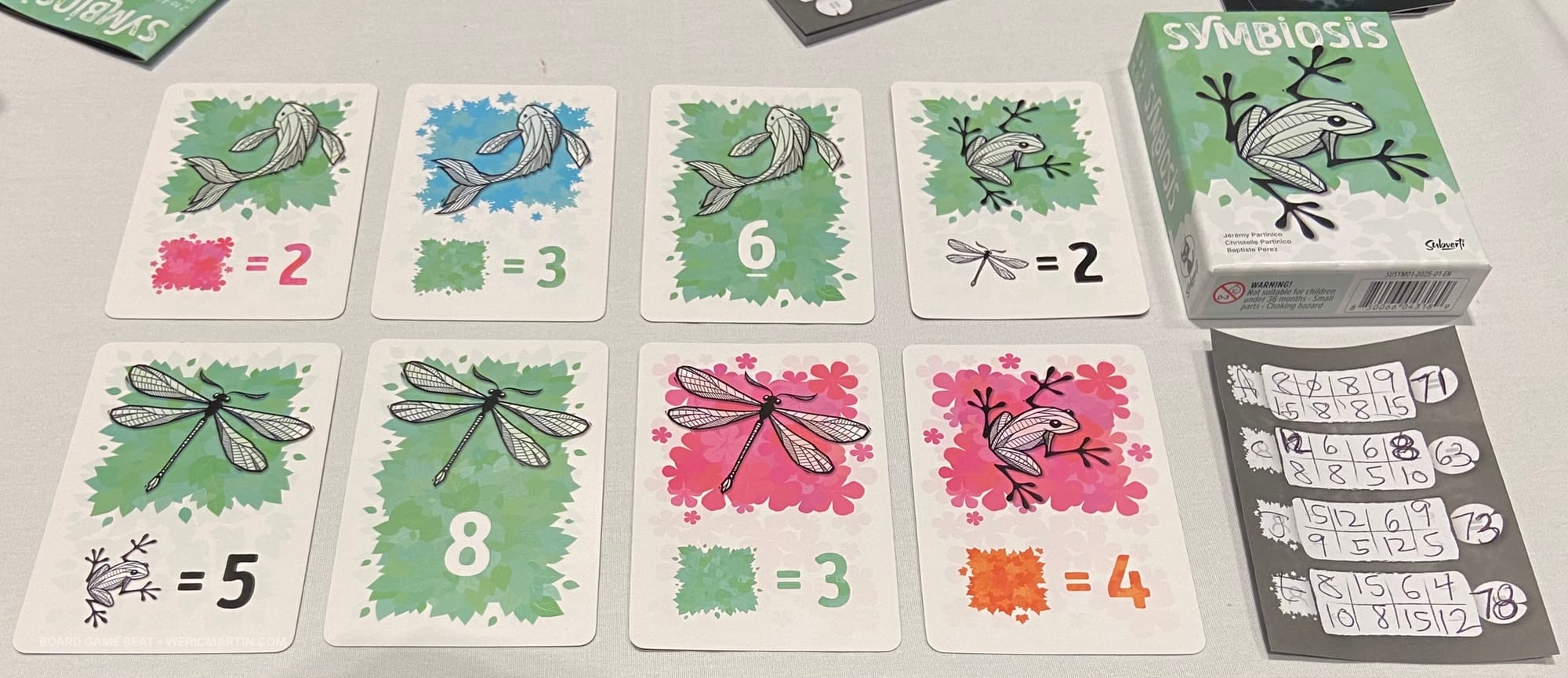
More specifically, your pond's center four cards score based on the contents of your entire pond, with cards bearing a number being worth that many points and cards bearing a scoring condition being evaluated at game's end. In the image above, I ended up with five green cards in my pond, with two cards each scoring 3 points per green card, so those netted me 15 points each. (As in Castle Combo, you score tediously with each player calculating their points for each position, but we caught multiple errors by one another, so perhaps the tedium is necessary, at least in your first games.)
The two cards on the left of your pond score based on your left-hand neighbor's pond, and the two cards on the right do the same in the other direction, although cards with a value in those slots are still worth the listed value.
Thus, everything you place in your pond affects how your neighbors score and vice versa. My right-hand neighbor skimped on dragonflies, so I would have better off with my top right two cards being swapped, but you don't have that luxury during play. You make a choice, then possibly regret it — or you take a card that the player to your left would want and end up giving them garbage while enriching yourself.
Again, you have all of seven choices during the game, so the luck factor runs high, but some of us love that aspect in game design. In fact, a friend recently told me that they thought the ideal game design was one in which luck played enough of a factor to give everyone the chance to win, but with that luck factor not necessarily being obvious. In this case, it's somewhat obvious, but I'm okay with such things.
That said, when you play with four, all of the cards are in play, so if you want, once you know the deck, you could play the odds as to what might be hiding in your pond, leading you to choose action two above so that you keep a good card for yourself and don't risk handing points away. With three players, you interact with everyone at the table instead of having a null force catercorner to you, and with two you set up a dummy player, with the two of you drafting from this dummy to create the pond that you'll score with the two cards next to it.
To continue my practice of including random photos during convention coverage, here's a poem embedded in the sidewalk near Sicilian Pizza & Pasta, which has a gluten-free pizza option on its menu that I cannot recommend as I don't think they take enough precautions handling GF dishes. (Translation: I did not have a pleasant evening after my meal.)