

Let's run through a bit more of what I saw at GAMA Expo 2026:
Publisher UP Games debuted in 2025 with Floristry, a two-player game from designers David Gordon and TAM, who co-own the company with Ammon Anderson and Greg May, and its second game — Scurry Up! — will debut in early 2026.

Each round in Scurry Up!, you secretly set your die to the space you want to visit on that round's cards, with the game lasting seven rounds and with the cards holding as many spaces as the number of players. If you go to a space on your own, you get all of the resources depicted; if you share the space with another player — and not all spaces fit two players — you divide those goods; and if more players go to a space than the number of slots available, you all fall out of the tree, advancing on the "Oops" track.
The heart-filled spaces must be occupied by the number of players depicted, in which case each player receives the depicted resources; in any other situation, no one gets anything. Resources score in different ways as shown in the lower-right of the image: the "Oops" track and flower track rewarded the two or three players who have advanced the most, berries score in sets, and ladybugs score 1 or 3 points depending on how they land when you flip them at game's end.
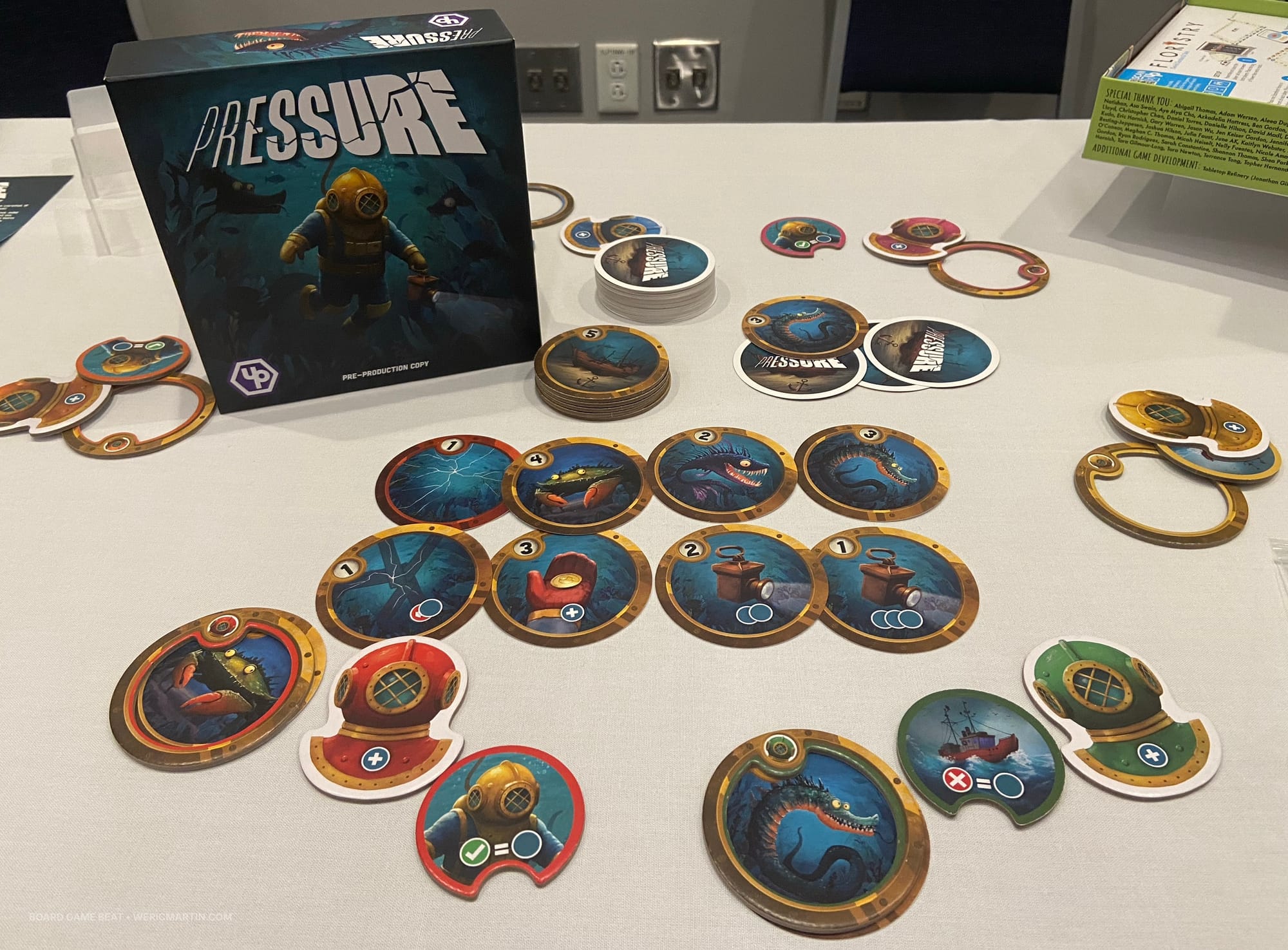
UP Games' early 2027 release, which is designed by all four company owners, is Pressure, a press-your-luck bidding game for 2-6 players. In each round, each player starts with three cards in hand, while one card is face up on the table and two face down. Each player adds two of their cards to the face down pile, then places the final card face down in front of themselves. Players then bid on how many cards they think they can flip over before revealing three leaks and busting.
As players drop out, they stack their diving helmet tokens. Once the "dive master" has been established, everyone else bets on whether or not they'll make it, after which the dive master starts revealing cards one by one. Three leaks end the dive, but tape will cover a leak to help extend a dive. Some cards count as two or three cards, pushing you deeper without risk, with others force you to reveal an extra card.
If the dive master succeeds, players draft one card from the revealed cards or face-down ones, with those who dropped out later getting an earlier choice; if the dive master fails, you reverse the drafting order. Whoever bets correctly on success or failure drafts a bonus card. Play multiple rounds.
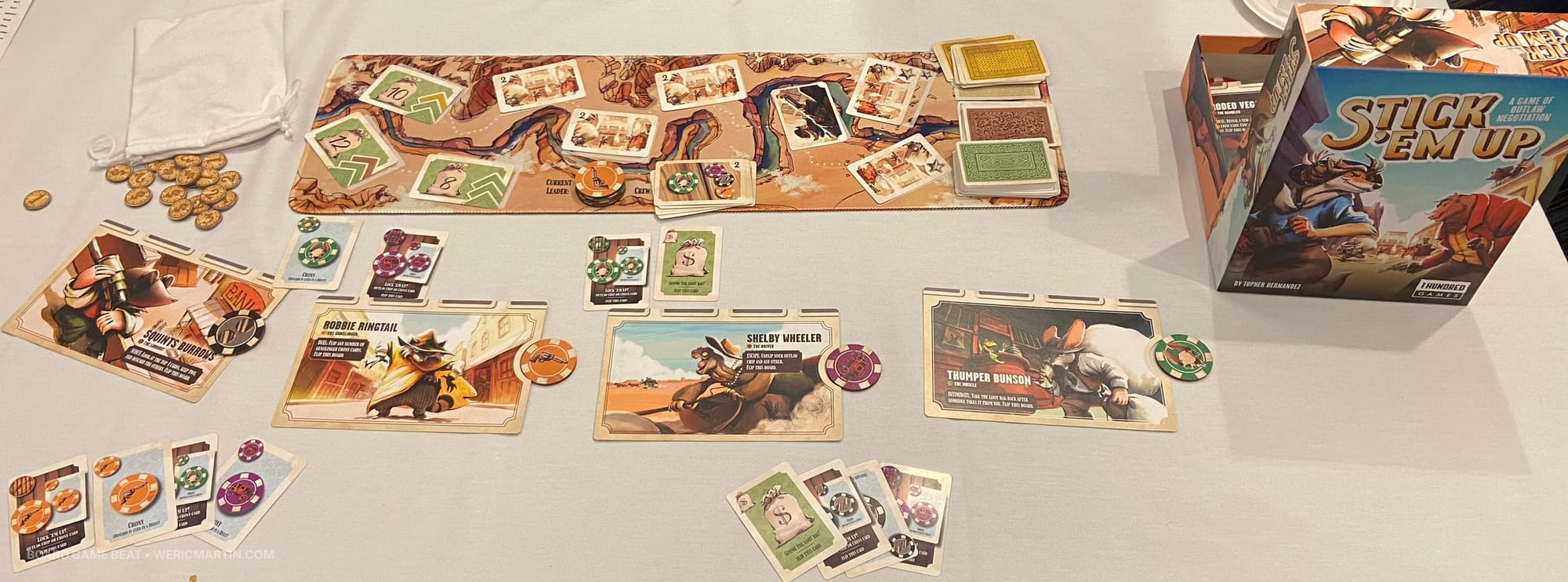
Stick 'Em Up is the debut design from Topher Hernandez and 1HUNDRED GAMES, which is also co-owned by Ammon Anderson. Interesting...
Over nine rounds, players try to get as much loot as possible, with each player taking the role of a character with a unique one-shot ability (unless you choose to ignore these for your first games). Each round, you reveal a card that shows which character is in charge of making a deal for how to split the loot — with the number of loot tokens randomly specified, and with each being worth $1-3 — and which characters must agree to be part of this deal. Players can play cards to take charge of the deal, represent other characters, and do other things.
If this sounds familiar to you, that's because Sid Sackson's I'm the Boss! from 1994 plays similarly. Hernandez says he's a fan of that design, but he added elements like one-shot powers, Cosmic Encounter-style power cards, a limit on how many cards can be played, and other modifications to make the design more suitable for his tastes.

Cats vs Cucumbers is a 2-5 player game from Ammon and Melanie Anderson, owners of publisher Levity Game Studios — yes, another Ammon co-owned company! — and it's a press-your-luck design in which you want to place cats in boxes or move them up to more valuable boxes without rolling three cucumbers and busting for the turn.
Treats score points in sets, balls of yarn have mystery actions on their reverse side, and swiping paws let you knock other cats into less valuable boxes. Each time you bust, you get a cucumber token to save you from a future bust and you reduce the "live" counter by one. Once players have collectively lost nine lives, the game ends and you tally points.
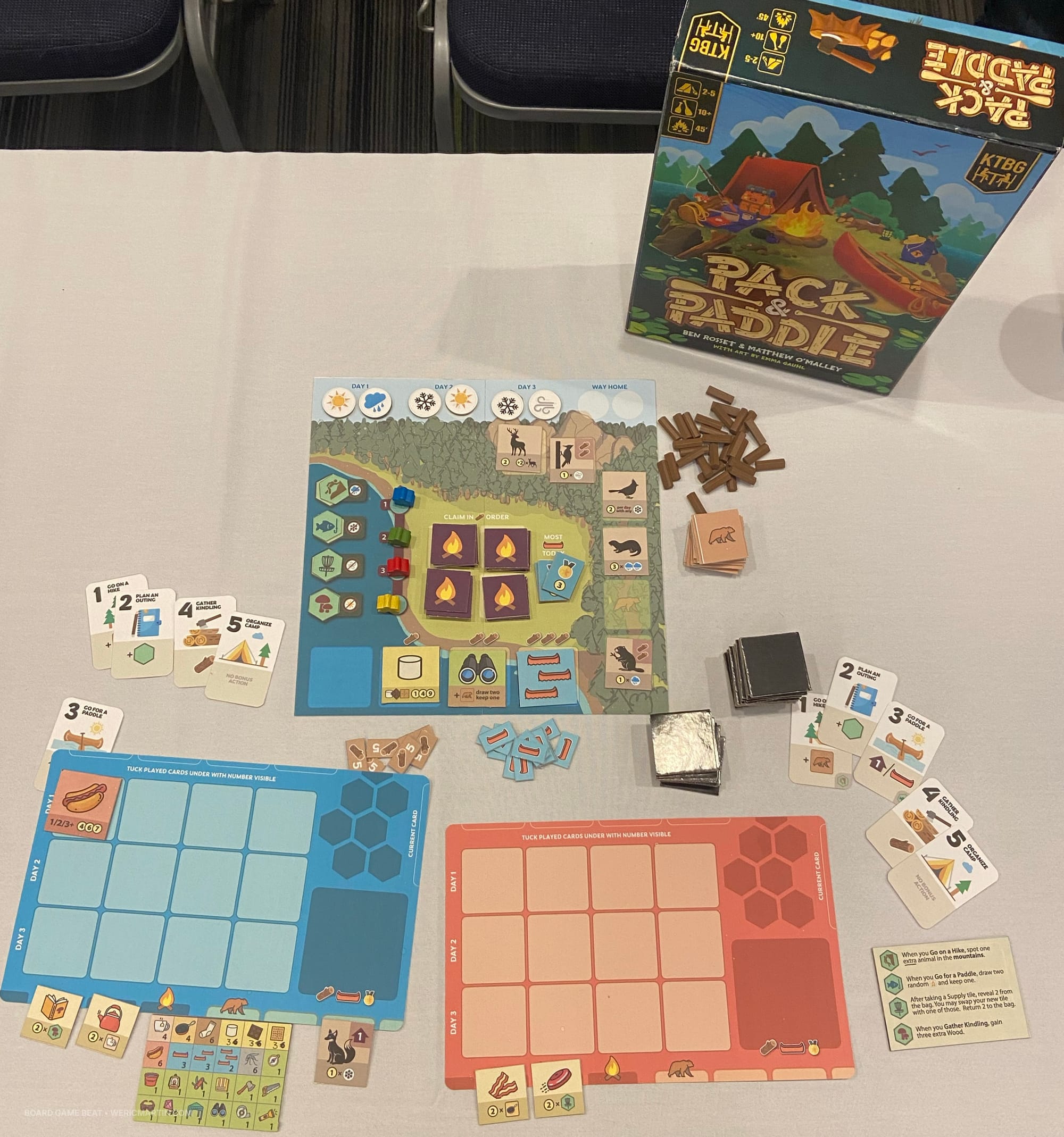
I've covered some titles from KTBG and sister company Burnt Island Games in a themed article, but Pack & Paddle — a 2-5 player game from Matthew O'Malley and Ben Rosset — didn't fit that theme, so let's get to it now.
This game will be crowdfunded in May 2026 for a planed 2027 release, and your goal is to spend three fabulous days in the woods doing all sorts of camping stuff, ideally getting first dibs at everything you want in order to make the most of the available time.
In game terms, each day you will draft four items from what's available, and for each draft you'll choose one of the five bidding cards in your hand; the higher the number, the earlier you'll draft, but drafting with lower numbers gives you a bonus tile or other action that might make waiting worth it. All spent cards are visible, so as the day progresses, you know which cards each player still had in hand.
To close, we'll look at Zach Hoekstra's Canal Houses, one of the few games I played at GAMA Expo 2026, a game that I actually played three times thanks to lunch partners who were willing to try and try again.
Dutch publisher Wulfhorn Games first released Grachtenpand in 2024, and now multiple publishers have licensed the game for release in other languages, with Gigamic handling the game in both English and French.
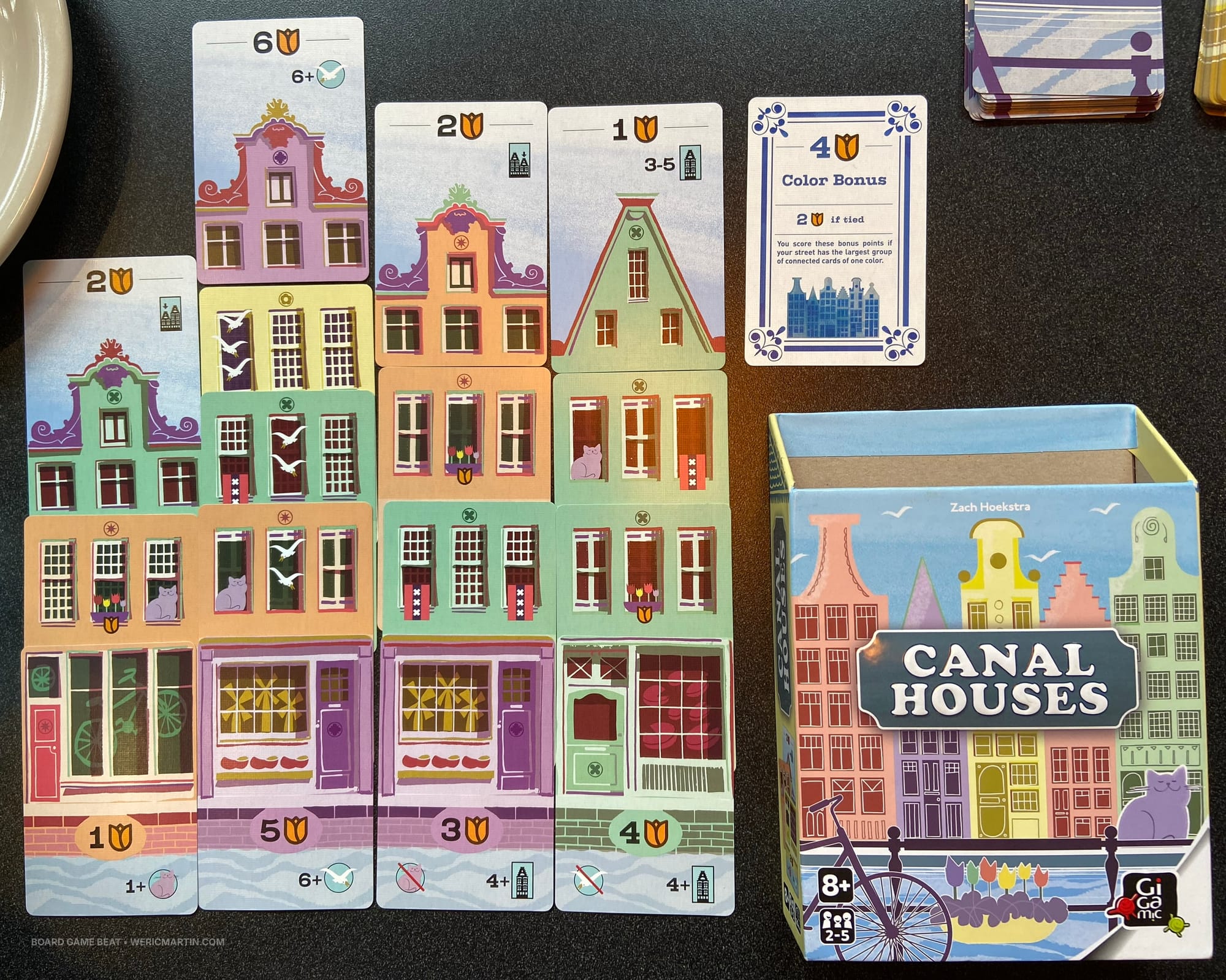
Gameplay is straightforward. Start with one building base, one building middle, and one building top in hand, and a random building base on the table. On a turn, draw a random card from one of the three decks — bottoms, middles, or tops — then simultaneously with other players add a card from your hand to your tableau. To end the turn, pass your cards to your left-hand neighbor.
You can have any number of bases, with each specifying a point value (in tulips) if you satisfy that building's condition. From left in the image above, I need a building with at least one cat, at least six seagulls, at least four cards total and no cats, and at least four cards and no seagulls. You can place any number of middle cards on a base, then close it with a top, with each of those cards also having a scoring condition.
Cards come in four colors, and whoever has the largest contiguous grouping of a color scores 4 bonus points.
As soon as someone completes their fourth building, the game ends, with everyone scoring 1 point for each flower display in their tableau and the listed points for all bottoms and tops that met their condition.
I won the first two games easily, then in the third game my two opponents (intentionally?) snatched tops that I was building toward and rushed the end of the game, burying me in the canal with a miserable score. It was good to play multiple times quickly as we all got a sense for how you need to monitor others since their choices affect what's possible for you.
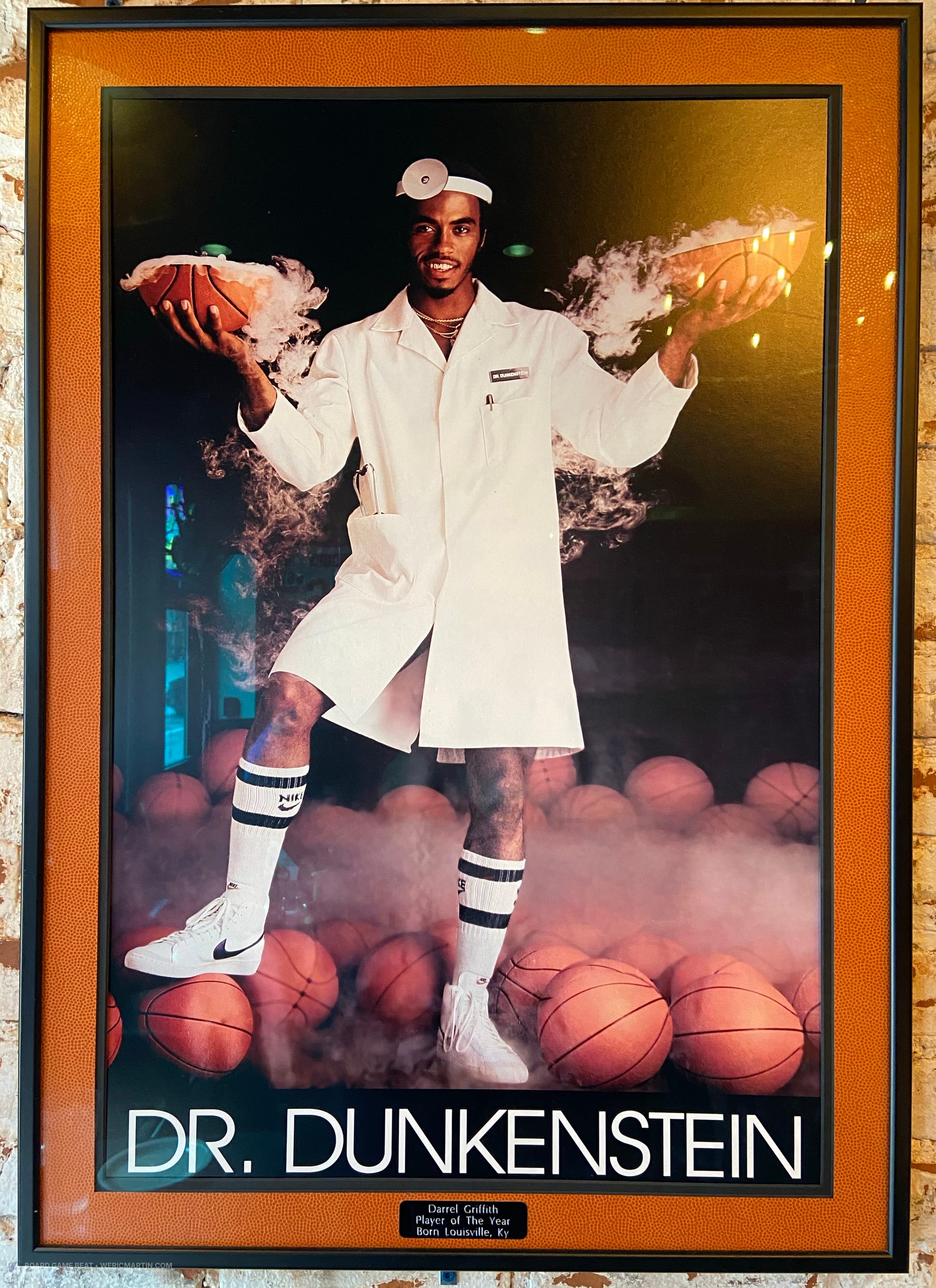
Bearno's Pizza near the Kentucky International Convention Center hosted one of the media events I attended, and in addition to handling gluten-free pizza properly, it celebrated local celebrities, including Darrell Griffith, who was the #2 draft pick in 1980 and played for twelve years on the Utah Jazz.
Once you get a nickname like this, you're unlikely to ever shake it, for good or ill...


