Ravensburger has announced its game line-up in Germany for the second half of 2026, and it will likely feel familiar to you for two reasons.
First, Ravensburger's headline titles in this line-up have been known for more than a year: Carcassonne Labyrinth, a co-design by Labyrinth's Max J. Kobbert and Carcassonne's Klaus-Jürgen Wrede that was announced during SPIEL Essen 25, and Labyrinth Chronicles, a co-design by Kobbert and Jan Truchanowicz that was featured at SPIEL Essen 25 and crowdfunded in early 2026. (Labyrinth turns 40 in 2026, so the publisher is celebrating this game that's sold more than 30 million copies worldwide.)
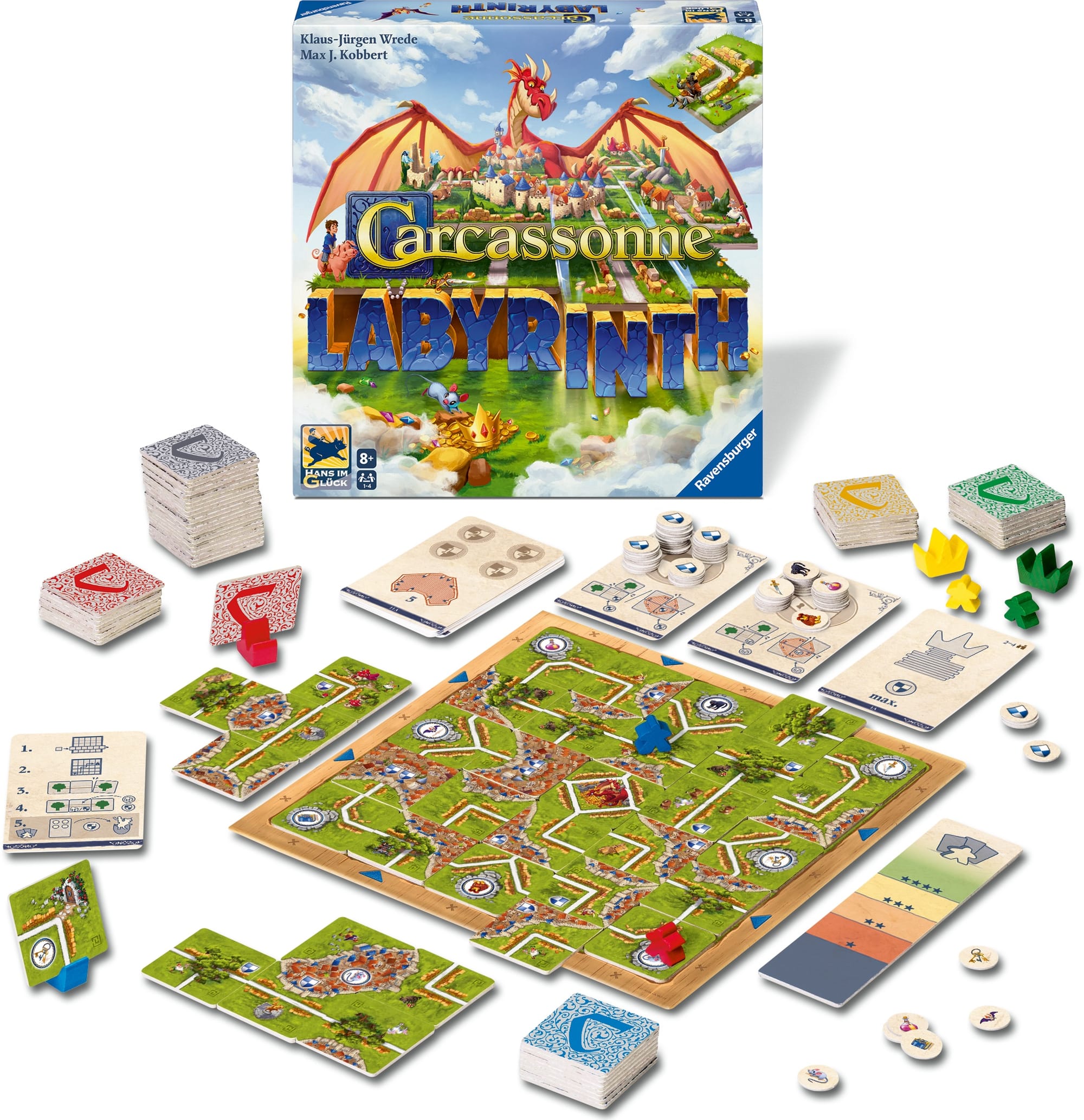
Carcassonne Labyrinth uses a scaled-down Labyrinth-style game board, with a 5x5 grid of nine fixed tiles and sixteen tiles that can slide through two pairs of intersecting lines. On a turn, you look at one of the treasure tiles from your personal stack, draw a land tile from the common stack, push that land tile into the game board (pushing out one tile), then move your meeple through the maze, ideally landing on the treasure depicted on your personal tile. If you do, you place both the treasure tile and the pushed-out land tile into your personal city; otherwise, you place only the land tile.
As you complete cities and roads in your personal layout, you gain shield and treasure tokens, and at game's end after ten turns, whoever has the tallest stack of tokens and placed treasure tiles wins. The game includes quest cards that reward you for specific aspects of building: most road loops, longest road, etc.
Labyrinth Chronicles initially plays like Labyrinth, but it features a co-operative campaign that introduces new gameplay elements.
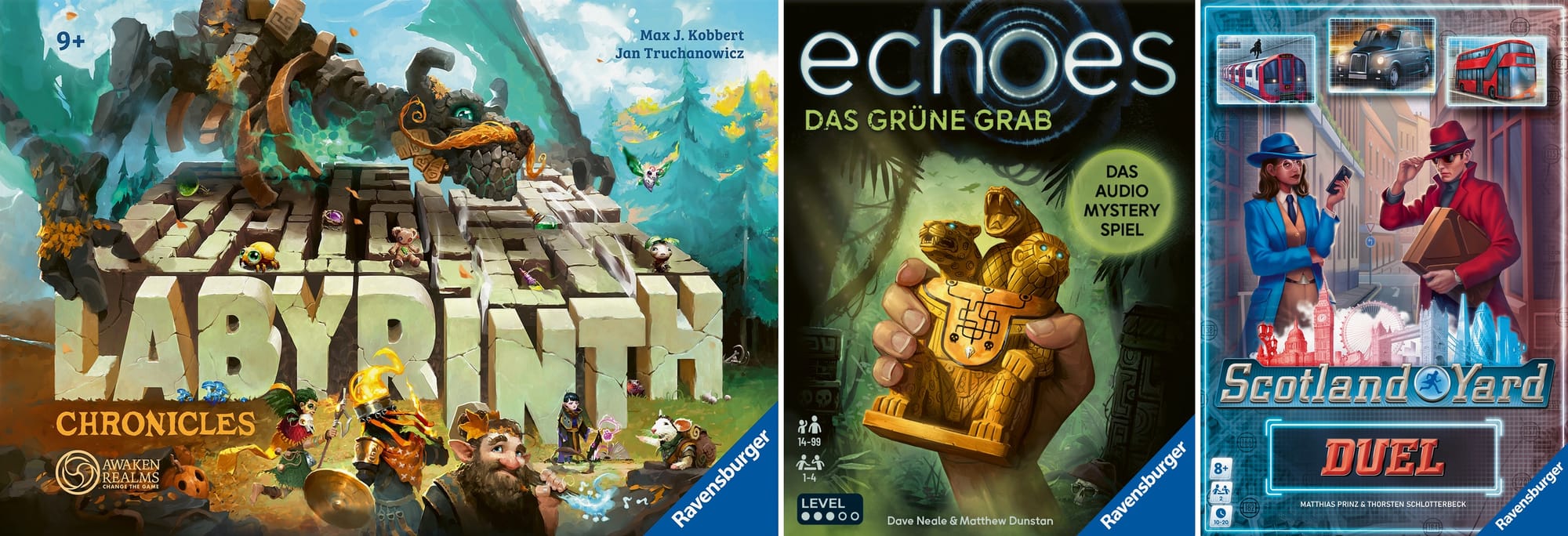
The second reason Ravensburger's titles will sound familiar is that most of them are spinoffs or sequels of long-running game series. For example, echoes: Das grüne Grab is the newest audio mystery title from Dave Neale and Matthew Dunstan — the thirteenth title in the echoes series that started in 2021 — with players trying to find out what happened to a missing jungle expedition.
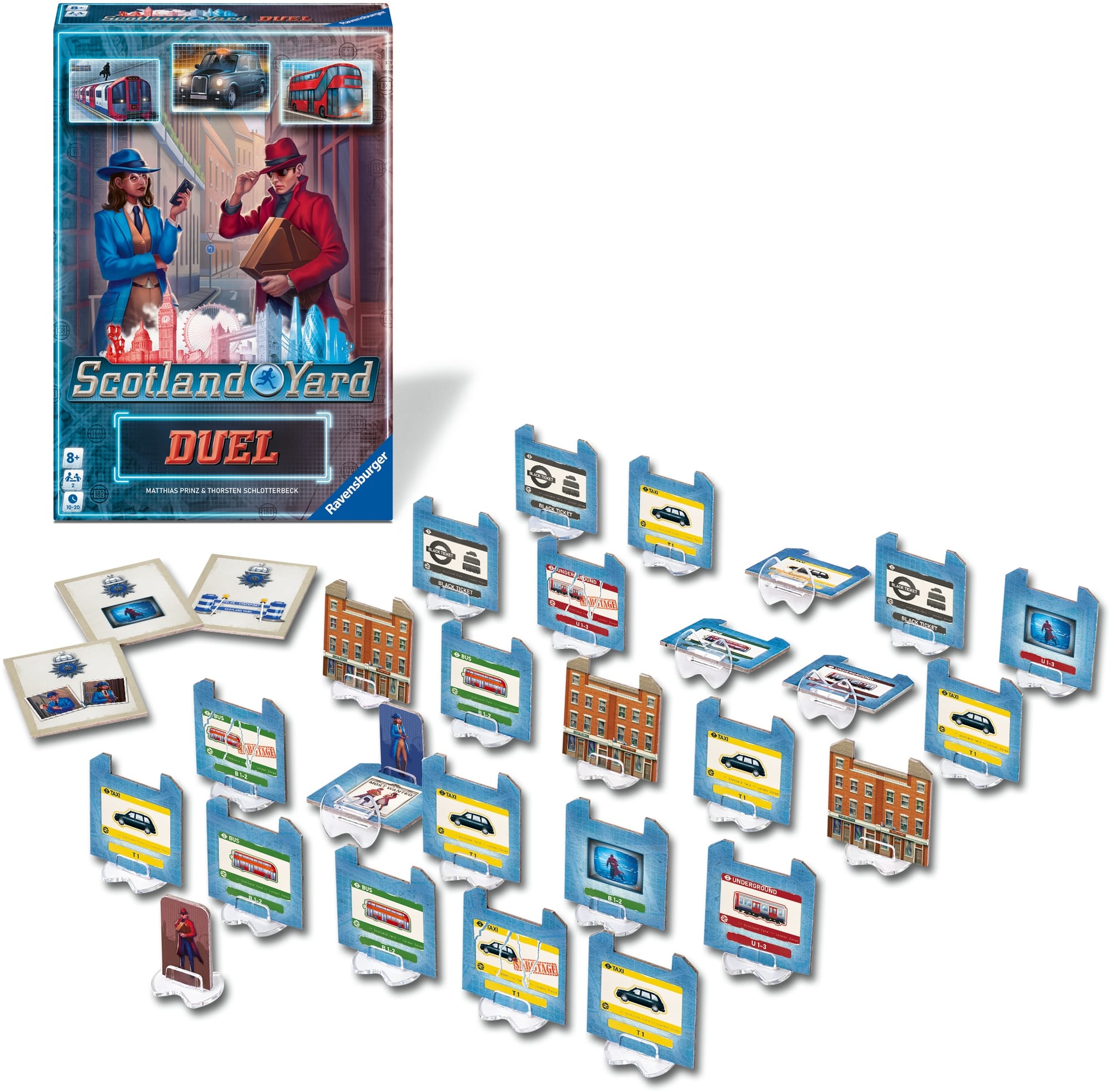
Scotland Yard Duel is a two-player game by Matthias Prinz & Thorsten Schlotterbeck and the latest spinoff of the 1983 Spiel des Jahres-winning Scotland Yard.
As you might expect, Mister X is once again being chased through a city by a detective, but now that city consists of 25 vertical tiles in a 5x5 grid. The detective starts in the central row, which includes three Scotland Yard tiles, by revealing one of the tiles in it. The transportation revealed on the tile determines how many spaces Mister X can move in the grid and how far apart the tiles are that Mister X can swap, after which the detective also moves based on the tile they revealed. If the detective reveals three sabotaged locations or cannot move on their turn, Mister X wins.
Each turn in Jack and Andrew Lawson's 2004 game Make 'n' Break, a player reveals cards from a pile, then tries to recreate that image with ten colored blocks as quickly as possible, scoring for each image they re-create before time runs out. In this relaunch edition of the game, players now compete simultaneously to build structures out of eight blocks, scoring points based on the order in which they finished.
Horrified: Dungeons & Dragons – Ravenloft from Peter Lee and Nick Tourville will see a German edition in November 2026, with this being the sixth standalone game since Horrified debuted in 2019. The English-language edition of the game includes the fabulous tagline "You will be mist" that refers to both the vampiric powers of the main villain and the notion that you'll probably be killed during play. The tagline of the German edition — "Der Nebel verschlingt alles" ("The fog devours everything") — lacks that pizazz, although my non-native self could be missing wordplay here.
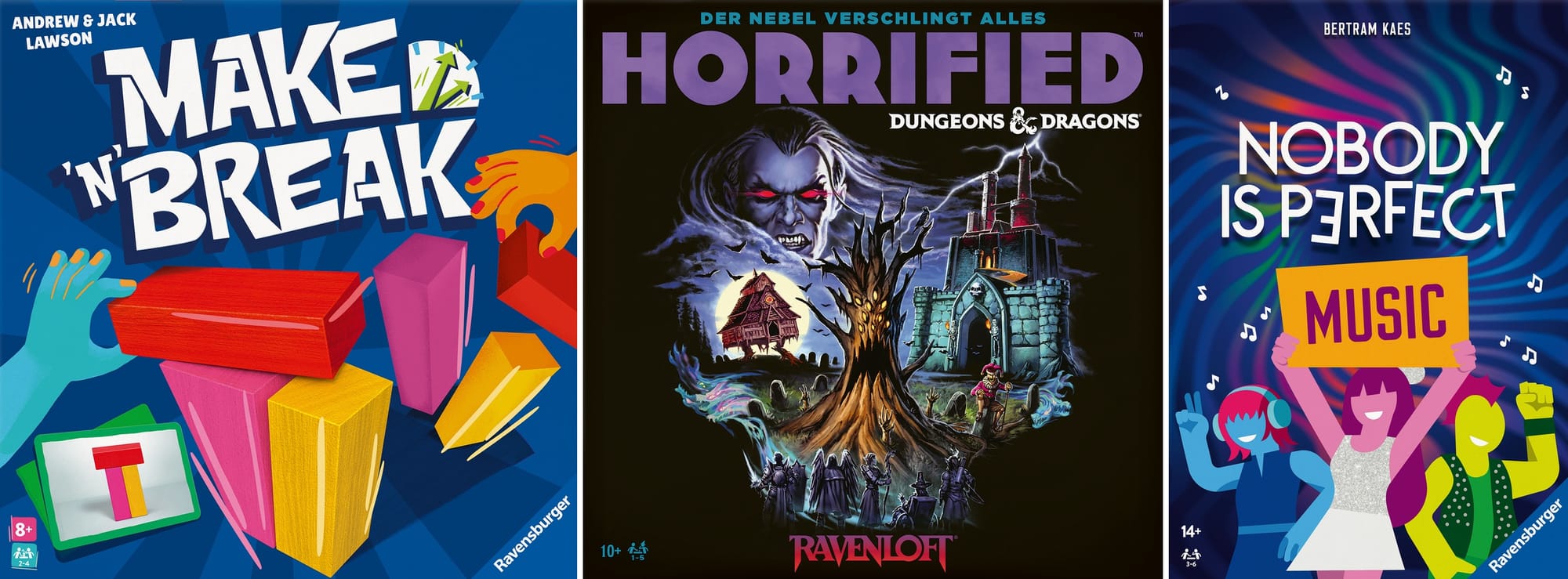
Bertram Kaes' Nobody Is Perfect: Music is the newest title in the Nobody Is Perfect game series that debuted in 1992. Gameplay is along the lines of Balderdash or the "Dictionary" party game, with players being confronted with trivia or questions, then making up answers that will hopefully trick other players into believing their answers are the truth.
Wer stiehlt mir die Show? Buzzer Edition can be used as an expansion for 2025's Wer stiehlt mir die Show? from Jens Merkl or played as a standalone game, with players once again playing a tabletop version of a German quiz game on TV.
Minecraft: Digging Down, which is also from Jens Merkl, is the latest release in Ravensburger's line of Minecraft-based games, which started with 2019's Minecraft: Builders & Biomes. In this co-operative game for 2-4 players, you're trying to use equipment to explore caves and complete objectives without running out of torches as that signals game loss.

Tap 4 is a card-shedding game along the lines of Palace that Marilyn Dick and Dorene Mills self-published in 2019, with The Op Games picking it up for mainstream release in 2026.
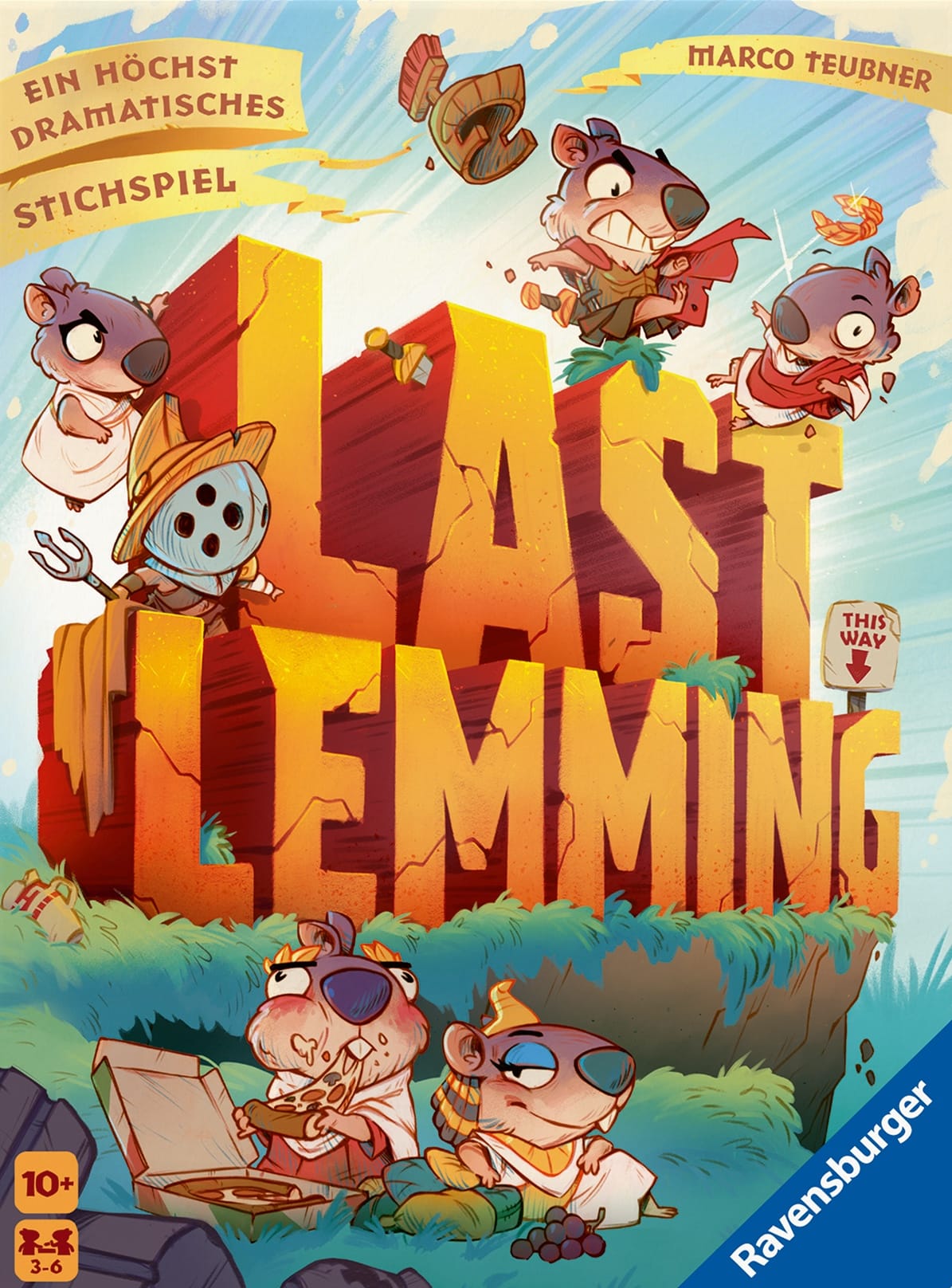
Finally, we come to what I think is the only original title in the lot: Last Lemming, a trick-taking game from Marco Teubner, who's probably best known for titles like My First Carcassonne, Safranito, and Dodo, and who has only one other trick-taking game on his BGG designer page — 2008's Ochsen Soxen.
In this game for 3-6 players, you're trying to move your lemming as close to the edge of the cliff as possible without falling over...unless you have time to scoot to the front once again.
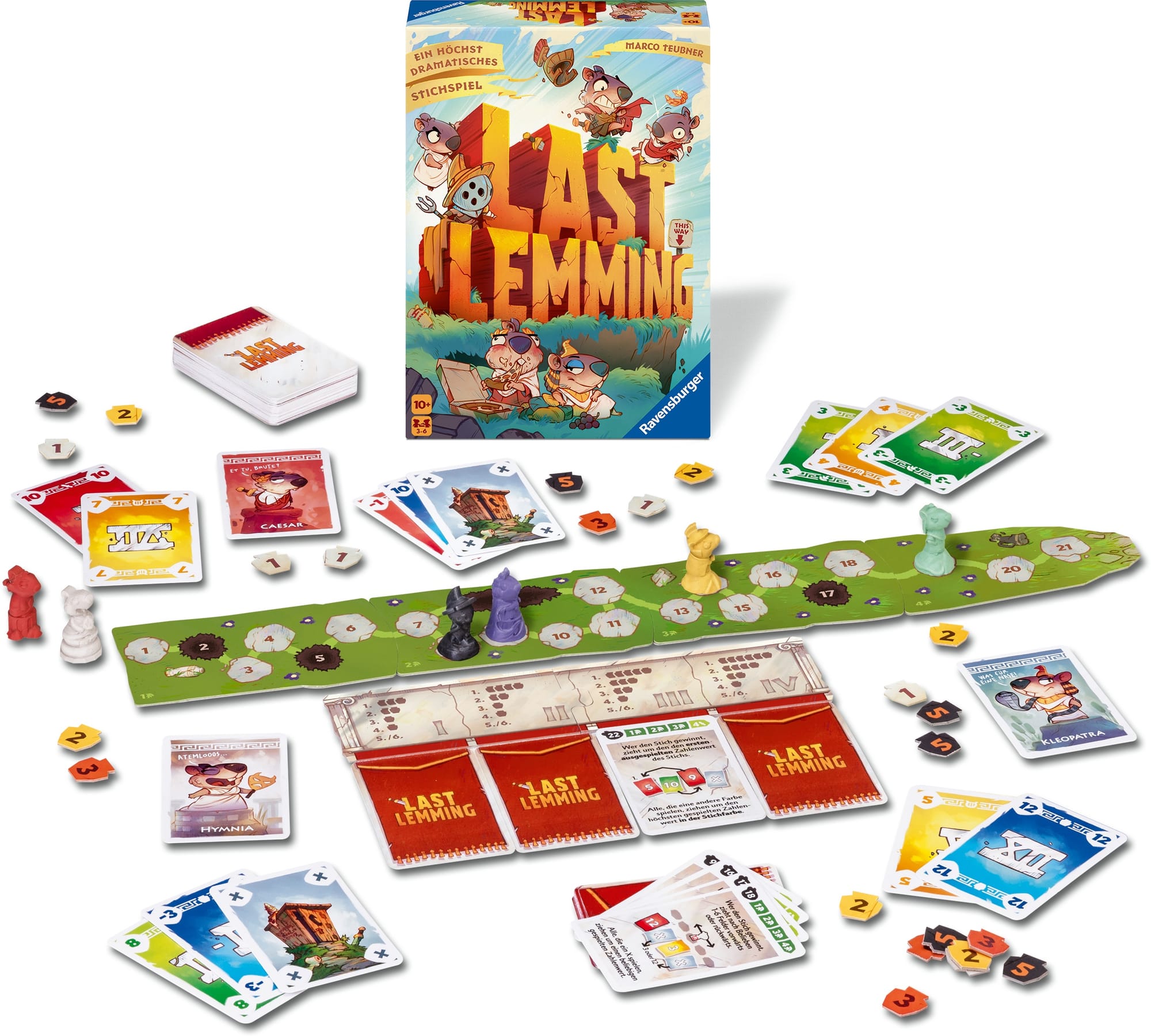
The game lasts four rounds, and in each round you receive a hand of twelve cards, then discard four of your choice. One player will lead a card, and everyone else must follow suit, if possible, although you always have the option to play an X in your hand to bow out of a trick.
Whoever played the highest card in the suit led wins the trick and will lead the next one. More importantly, they move ahead on the shared track as many spaces as the number they played. Whoever played the second highest card in the suit led also moves forward a number of spaces equal to their played card. If you land on someone, you push them forward one space. If you land in a hole, which is present on some of the double-sided track boards, you go back to start. Also, if you win a trick with a negative number, you move backwards instead!
The game includes 22 rule cards, and you use a different one each round, with some wildly changing who moves and how far. One of the rule cards depicted below, for example, states that the winner of the trick moves as many spaces as the card first played in the trick, while anyone who played off-suit moves as many spaces as the highest card played in the suit led. Another rule card lets the winner move 1-6 spaces forward or backward as they choose, while anyone who played an X moves forward as many spaces as one of the played values.
Why does moving matter? After eight tricks, the round ends and players score points based on their position among all the lemmings, with points escalating as the rounds continue. Whoever earns the most points wins and can push everyone else off a cliff to celebrate their victory.
Want more game announcements like this?
Get Board Game Beat’s free posts by email — original reporting, designer interviews, and industry news, with no tracking, no ads, and no spam.