

In late January 2026, I wrote about Swiss publisher Helvetiq's 2026 line-up, but what I didn't know then is that the company had announced only titles coming in the first half of the year...then at the 2026 Spielwarenmesse toy and game fair it also revealed a few games due out in the second half of 2026. Sneaky.
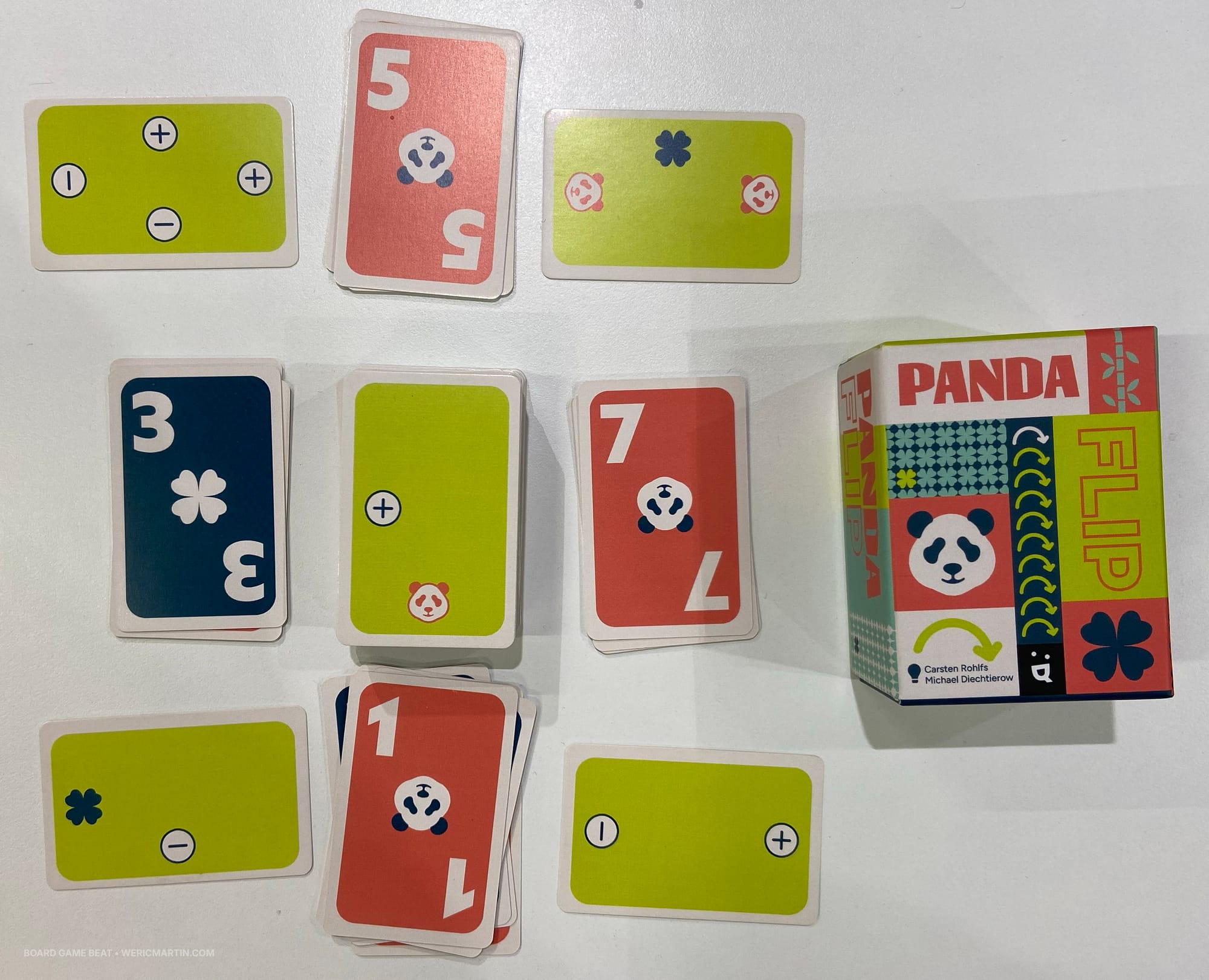
Panda Flip is a 2-5 player press-your-luck game from Michael Diechtierow and Carsten Rohlfs in which you want to collect the most cards. On a turn, flip the top card of the deck onto one of the valid discard piles; in the image above, the central deck is surrounded by four discard piles, but because the top card has only two symbols on it, you can flip that card only left or down. Do you think the card will be higher than a 3, with the card values ranging from 1-7? Then flip it left onto the 3 — or do you think it will be a panda, with the deck having equal numbers of panda and clover cards? If so, flip it down.
If you're correct, you can stop and collect the cards in the pile that you just flipped into, after which you flip the top card of the deck to start that discard pile again, or you can flip again. I've shown the backs of a few other cards so you can get a sense of what's possible. If you're wrong, the card goes into the discard pile, your turn ends, then the next player goes.
One twist: If the number being flipped matches the number being covered, that player removes that number of cards from a player's score pile, thereby allowing everyone to pick on the perceived leader in this 10-15 minute game.
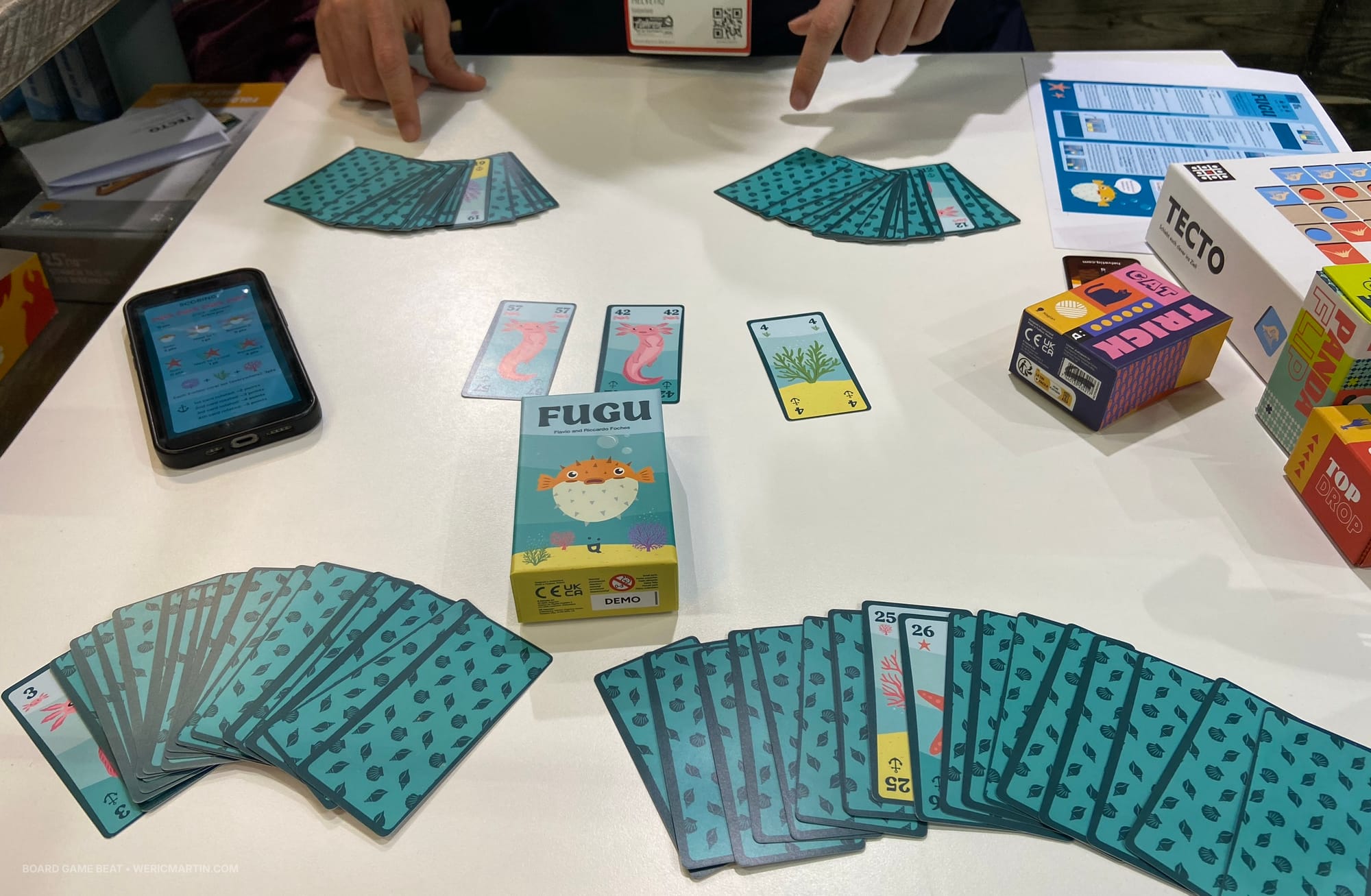
Fugu is a card game for 1-4 players from Flavio and Riccardo Foches that will have old gamers saying, "Ah, yes, I remember playing Rack-O when I was young", with that comparison being both fair and misleading. To explain...
Each player starts with a face-down hand of cards, with three cards face up in a shared market. On a turn, pick a card in the market, slide it into your hand where you think it should go based on its numerical value, then pick a face-down card on either side of the newly placed card and place that card face up in the market. Thus, no new cards are introduced to the game, yet a new card comes into play each turn.
You must arrange your cards from low to high, so if you end up with 14 next to 38, you are placing nothing with the numbers 15-37 in your hand for the remainder of the game...except that you can rotate a card and place it in your hand upside down out of order. You still can't place it between the 14 and 38 since you'd have no face-down card to discard, but you can make use of "bad" numbers.
What are you trying to do? Place axolotls in groups, place fugu — which is the Japanese word for "blowfish" — between only coral and starfish, surround starfish with coral, and collect coral in all three colors. The more you do this, the better you score. Upside-down cards are worth negative points, but if you can't (or don't want to) place a market card on your turn, you have to quit the game, so maybe the good points will offset the bad.
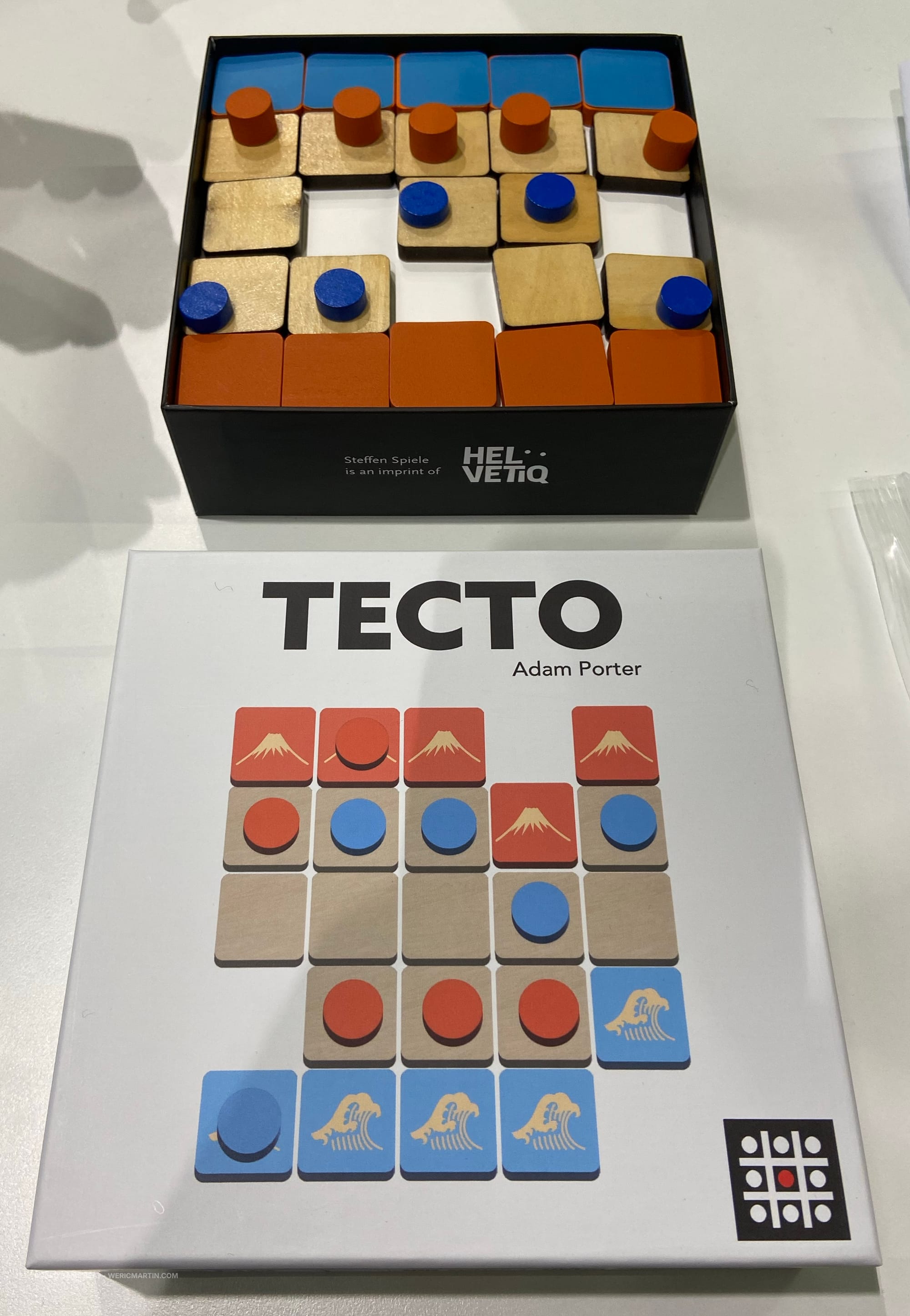
Adam Porter's Tecto will be Helvetiq's next title in its Steffen Spiele abstract game line; well, the next one after Alto, which I wrote about in the earlier post.
In classic abstract strategy game fashion, you want to be the first player to get your pieces on the opponent's starting line. On a turn, slide a tile as many spaces as you wish, pushing any other tiles in front of it, then move one of your pieces, either sliding it as many spaces as you wish across empty tiles of the same background color or moving it from a tile of one color to an empty tile of another color.
By chance, designer Steffen Mühlhäuser, who previously owned and ran Steffen Spiele, was in the Helvetiq booth to show a prototype, so I got to play him in Tecto, with him winning one turn before I would have. We both repeatedly forgot about the forced slide, jumping ahead to the token moving, so I think neither of us played particularly well, overlooking ways to optimize both actions.
One thing to note: The opponent's starting line is not fixed! Yes, I need to move my blue tokens onto the blue spaces, but I can just as easily move a blue space toward me as move a blue token away from me.
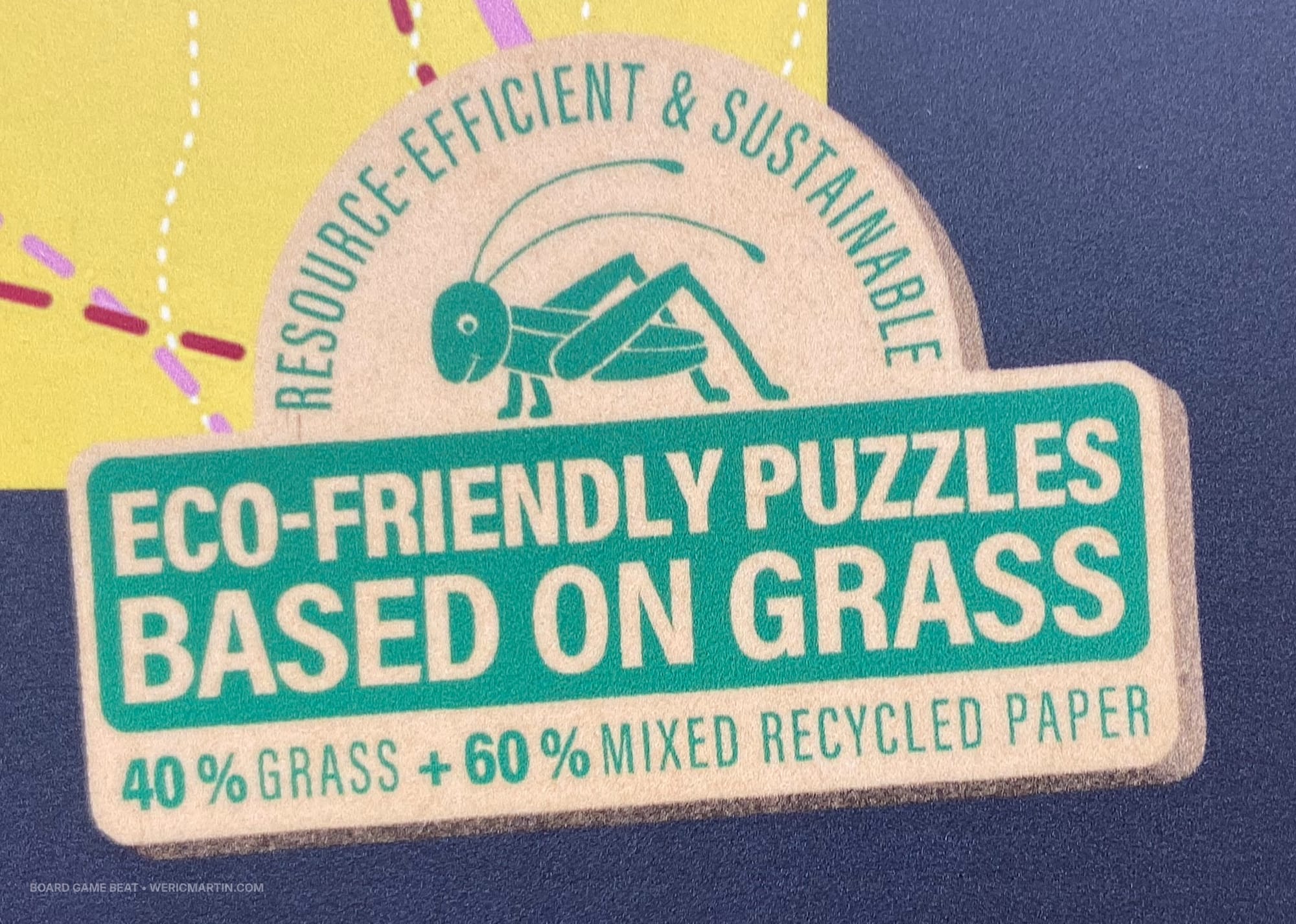
While at trade shows, I take lots of pictures in the "I'll look into it later" category, such as the one above. Paper made with grass? That was new to me, but searching led me to this April 2024 article on Birkner's Paper World, which is summarizing material from Graspapier.de, which is a site run by Creapaper, which calls itself "The Grasspaper Company", which was also responsible for this article in Sweets Processing, a publication of the Sweets Global Network, about how creapaper can serve as an alternative to plastic film in the packaging of food.
Anyway, here's an excerpt from that April 2024 article:
The production of grass paper differs fundamentally from the production of conventional paper made from wood. The starting material is dried grass, which is processed into so-called pellets. These grass pellets are then further processed into grass fibers in a purely mechanical process. In contrast to pulp production from wood, the natural adhesive lignin does not have to be chemically removed. As a result, the manufacturing process is very energy-efficient and requires minimal water and no chemicals at all.
The grass fibers obtained in this way are then mixed with fresh fibers from wood or waste paper. The grass content in the finished paper is at least 30% but can also be up to 50%, depending on the intended use.
That said:
[G]rass paper is not a panacea for the environmental problems of the paper industry. Since paper production is generally energy and resource-intensive, it is still most environmentally friendly to reduce paper consumption overall and consistently recycle paper.


