While the booths at the Spielwarenmesse toy and game fair are the main attractions, much of the business activity takes place in less prominent locations, with designers, publishers, distributors, and retailers meeting wherever they can find a space to sit.
On Thursday, January 29, 2026, in the morning hours at the SpieleCafe before people were crowding in for, you know, food and drinks at the café, I grabbed a table and met a few of these publishers, including Shadi Torbey of inPatience.
Let's start with inPatience's biggest title for 2026: Karnivorous, a 1-4 player co-operative game from Inka and Markus Brand that will debut at SPIEL Essen 26. This game is a heavily reworked version of the Brands' 2012 game Star Wars: Angriff der Klonkrieger ("Attack of the Clones") from KOSMOS.
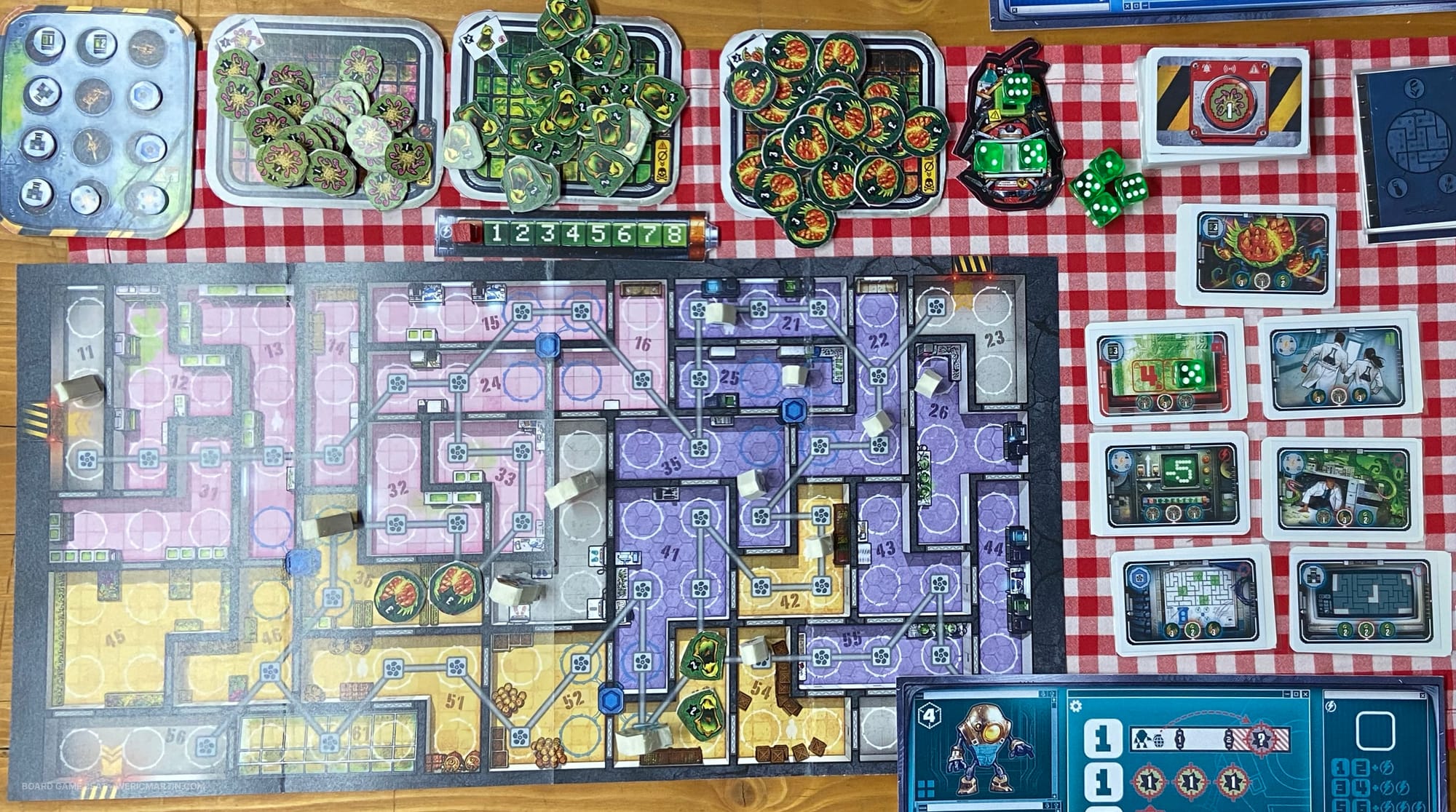
The gist of the game is that each round you all roll dice, then allocate them one by one to various actions that will keep carnivorous viral plants in check before they wreck the lab or grow out of control. Each player has a few unique actions on their player board, along with ones shared by all, and you'll use these actions to move robots in the lab, help scientists flee to safety, fight existing plants, gain energy, complete objectives, and more.
At the start of the game, the board is seeded with plants of strength 1, 2, and 3 in random rooms, then objective cards are laid out for the round. Some of the objectives in the image above are to free the gray areas of plants (already done!), clear the four spaces adjacent to the blue nodes of plants (we've just completed that task), use five energy (which means we need to get energy first...hmm), place a 4 and a 5 on the card (the thematics of which I leave to your imagination), and help two scientists out of the lab (and two are already near a door).
Each objective shows three plant values on it, and at the end of the round, for each value still visible you reveal a new room card and fill all spaces in it with new plants of that value. If you complete the objective, you flip the card over...and still must resolve the middle plant value. That's right; you can't escape viral growth, only slow it down. What's more, if you don't eradicate all of a plant in a room, it will grow there as well.
Another aspect of the objective cards is that the upper-left corner shows one of four elements in the lab control board, which is at the upper left of the image. Each objective you fail destroys a copy of the depicted element, and if you lose enough of them, you've lost the game. You also lose if you need to place a plant in the lab, but that supply is empty.
The title coming in June 2026 from inPatience is also a new edition of an older game, with Mazing being an updated version of Jim Deacove's 1982 game Maze from his own Family Pastimes company. (Like inPatience, Family Pastimes — a Canadian publisher that debuted in 1972 — releases only co-operative games.)
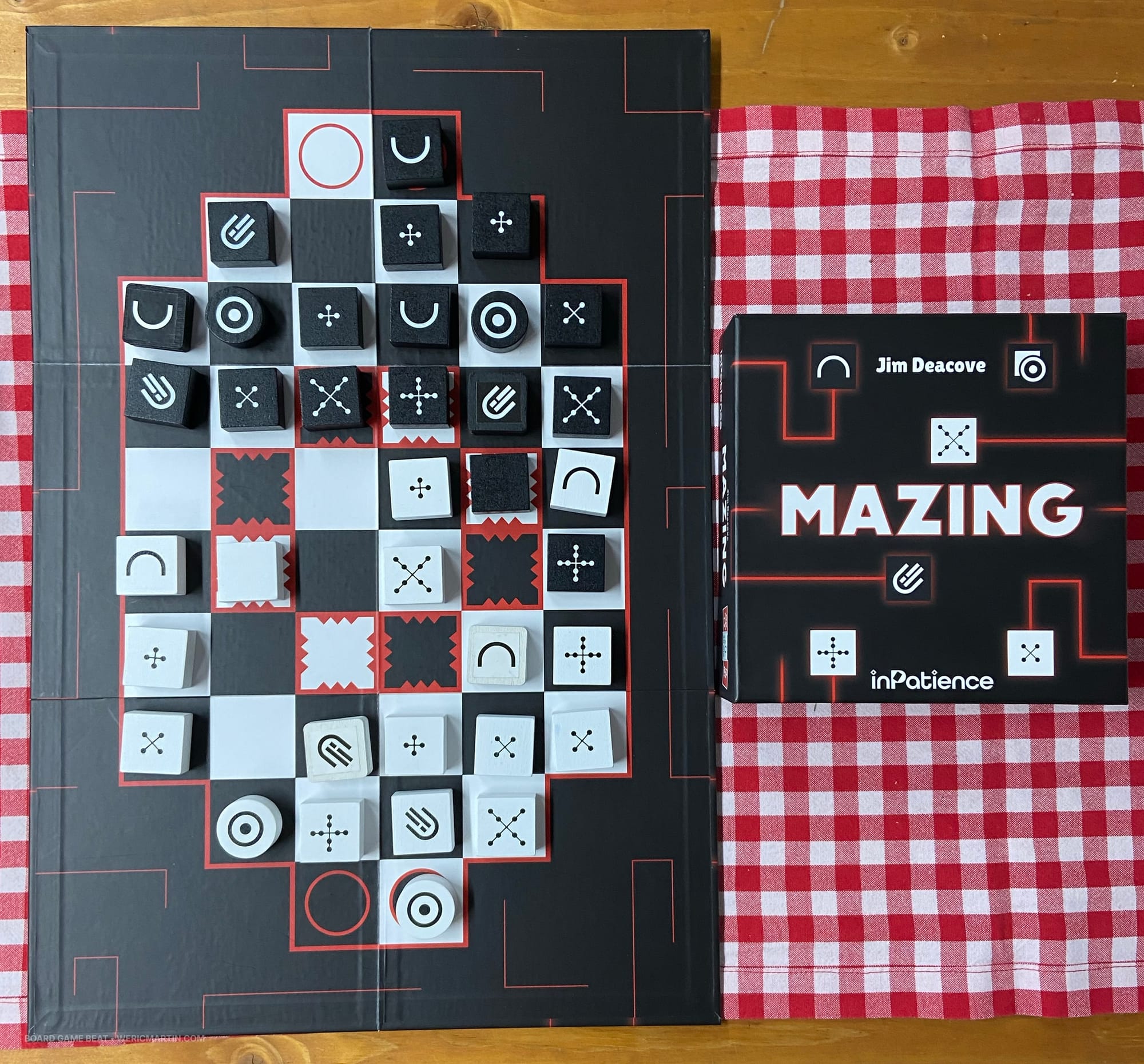
Your goal in Mazing (and in Maze) is for each player to move their messengers (the round tokens) across the board and onto the spaces at the opposite end. Unfortunately, these messengers start the game blocked by three rows of randomly-placed square tokens, each with a symbol indicating its possible movement, such as move diagonally exactly two spaces (with movement being blocked by other pieces) or jump over one or more pieces in a straight line, landing on the first open space.
Players alternate taking 1-3 actions on a turn, with an action being the movement of one of your pieces. You must try to clear a path for both pairs of messengers, with a messenger moving diagonally like a bishop in chess. Complications arise because only the specified "hoppers" (with the black rainbow) can move over occupied spaces. What's more, if a piece moves into a red-bordered space with serrated edges, you flip it over and it becomes a barrier for the rest of the game.
Finally, each player has three meteors, and these tokens move exactly once, crashing into any empty space and making it an inaccessible wasteland.
Torbey and I played several rounds before needing to move on to other things, and I found the puzzle of the game fascinating...and I initially missed that everything I was doing made it harder for Torbey to move his own pieces. Yes, you want to march across the board, but more importantly you don't want to prevent your teammate from doing the same, so you must imagine the board from their direction in order to keep traffic flowing.
The back of the Mazing game board features a more challenging layout with a larger number of serrated death boxes. As with all inPatience releases, you can play Mazing as a solo game, but that consists solely of you taking turns for both sides of the game board.

Finally, or rather firstly, inPatience will debut the next two titles of its "Min'inP" game line at the FIJ game fair in Cannes in late February 2026. These titles are:
• Mayor of Chicago, a 30-minute solitaire game from Xavier Georges in which you attempt to claim the title role. Each turn, you draw a city card, then decide whether you will expand your knowledge of the Windy City by placing this card as part of the map, or hire the assistant depicted on the back of the card to benefit from their special power or scoring abilities. Only by managing shrewdly your resources and the powers of the assistants will you be able to gather enough votes to be elected.
• Freigard, a 15-minute "deceptively simple game of risk taking and hand management" for one player from Reiner Knizia. Each turn you either score (if possible) your hand of three cards, or draw one card (then discard one) to improve your hand. If you're too greedy, you risk burning through your deck too quickly, but settling down too often might not get you the powerful army you need to defeat the "Walking Castles" that are invading the peaceful land of Freigard.