

This Boardcast is sponsored by Board Game Beat.
The Boardcast is audio narrations of select articles. Listen to all episodes (or find out how to get them in your favorite podcast app) here.
Prototype+ members can access an ad-free version here. You can also listen on your favorite podcast app using the private invite and link you received via email. Lost your link? Email admin@wericmartin.com.
Multiple publishers featured escape room-based games in 2016: ThinkFun with Escape the Room: Mystery at the Stargazer's Manor and Escape the Room: Secret of Dr. Gravely's Retreat; Spin Master with Escape Room: The Game; Stay at Home Werewolves with Escape Room in a Box: The Werewolf Experiment (with Mattel picking up this title in 2017); Space Cowboys with Unlock!: Escape Adventures (although only in prototype); and KOSMOS with three titles: The Pharaoh's Tomb, The Secret Lab, and The Abandoned Cabin, each of which was branded under the label EXIT: Das Spiel, that is EXIT: The Game.
Ten years later, escape room-style games are a regular feature in the game industry, with dozens of such titles being released annually from publishers of all sizes — but only two of the originating series still exist: Unlock!, which has had a couple of dozen designers creating stories within the series, and EXIT: The Game, which has been almost entirely the work of the husband-and-wife design team of Inka and Markus Brand.
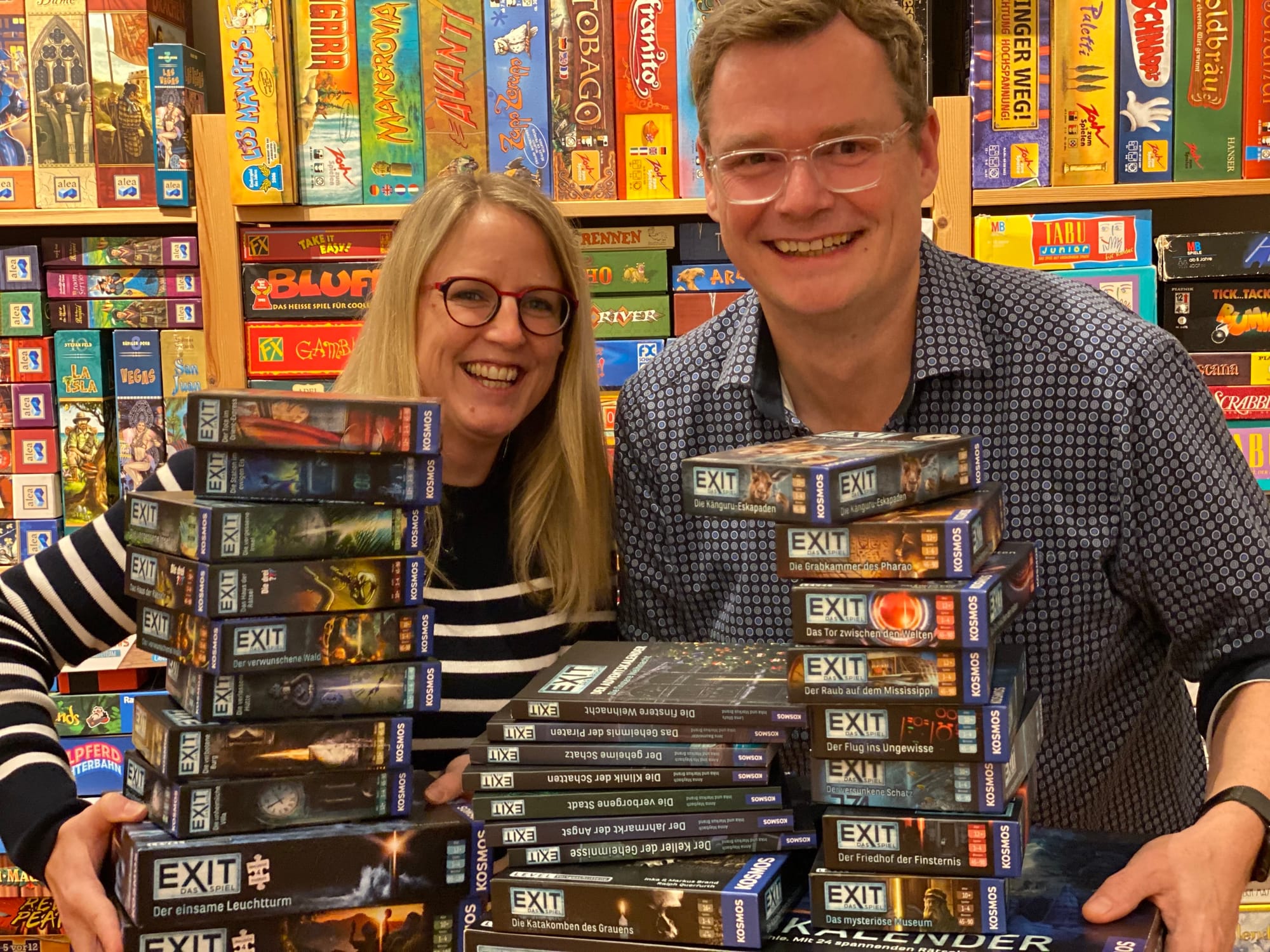
The Brands have published many other well-received games — such as Village, Rajas of the Ganges, Noch mal!, and The Rise of Queensdale — but these days their name is synonymous with EXIT, which might not be surprising given that KOSMOS has published more than 80 EXIT-branded titles over the past decade — books, puzzles, advent calendars, and of course the original "escape room in a box" designs — with those titles having sold 30 million copies across 35 countries in 24 languages.
Escaping Categories
When these escape room-inspired titles debuted in 2016, I was working at BoardGameGeek and the admins debated internally whether these titles should be listed in the BGG database. Are these designs, in fact, games? In the end, they snuck into the database the way that many puzzles do: by including a win/loss condition or a scoring system based on elapsed time.
For the Brands, this type of distinction isn't important. In an email interview, they wrote: "To us, EXIT is more an experience than a game. That's at least what we try to convey in the games when we develop them. We hope that the people playing our game get the chance to dive into the stories. It's always important to us that all the riddles match the stories in our games for that exact reason. We don't want anything to feel 'out of place'." (I'll note that just as the Brands have designed all of their games together, starting with the publication of Guatemala Café and Summertime in 2006, they asked that all quotes be attributed to both of them.)
Even if EXIT is meant to be primarily an experience, you can score yourself once you've finished based on how much time has elapsed and how many hint cards you used to reach the end. The Brands say that the scoring system exists for two reasons: "First, we are Germans and (especially in the beginning) our target market was mostly Germany — and we Germans don't play games for fun. There needs to be a way to measure your success! Therefore a star rating game!"
The more important reason relates to the original inspiration for EXIT. Says the Brands, "Since the time you take to escape plays a big role in escape rooms, to us it was important to implement that element into our games. We wanted to ensure the 'escape room feeling' is also conveyed to the people playing at home." That said, timing and scoring is optional if it will detract from the experience.
First Steps
The concept for EXIT originated thanks to Ralph Querfurth, a game editor at KOSMOS, and Sandra Dochtermann, who was an intern at the company in the mid 2010s. In a press release, Querfurth writes, "It all started when I became aware of one of the first escape rooms here in Stuttgart in the fall of 2014. During a conversation about it with my colleague Sandra Dochtermann, the idea came up to implement it as a board game." Concept development is a regular part of the job for internal editors at KOSMOS, and they pitched the idea to program managers.
Meanwhile, the Brands had a history of publishing games with KOSMOS, such as the aforementioned Summertime, Der Goldene Kompass, Monster Trap, and La Boca. In December 2014, they visited an escape room for the first time and talked about the experience with their editors, so they seemed like the right creators to take on this concept.
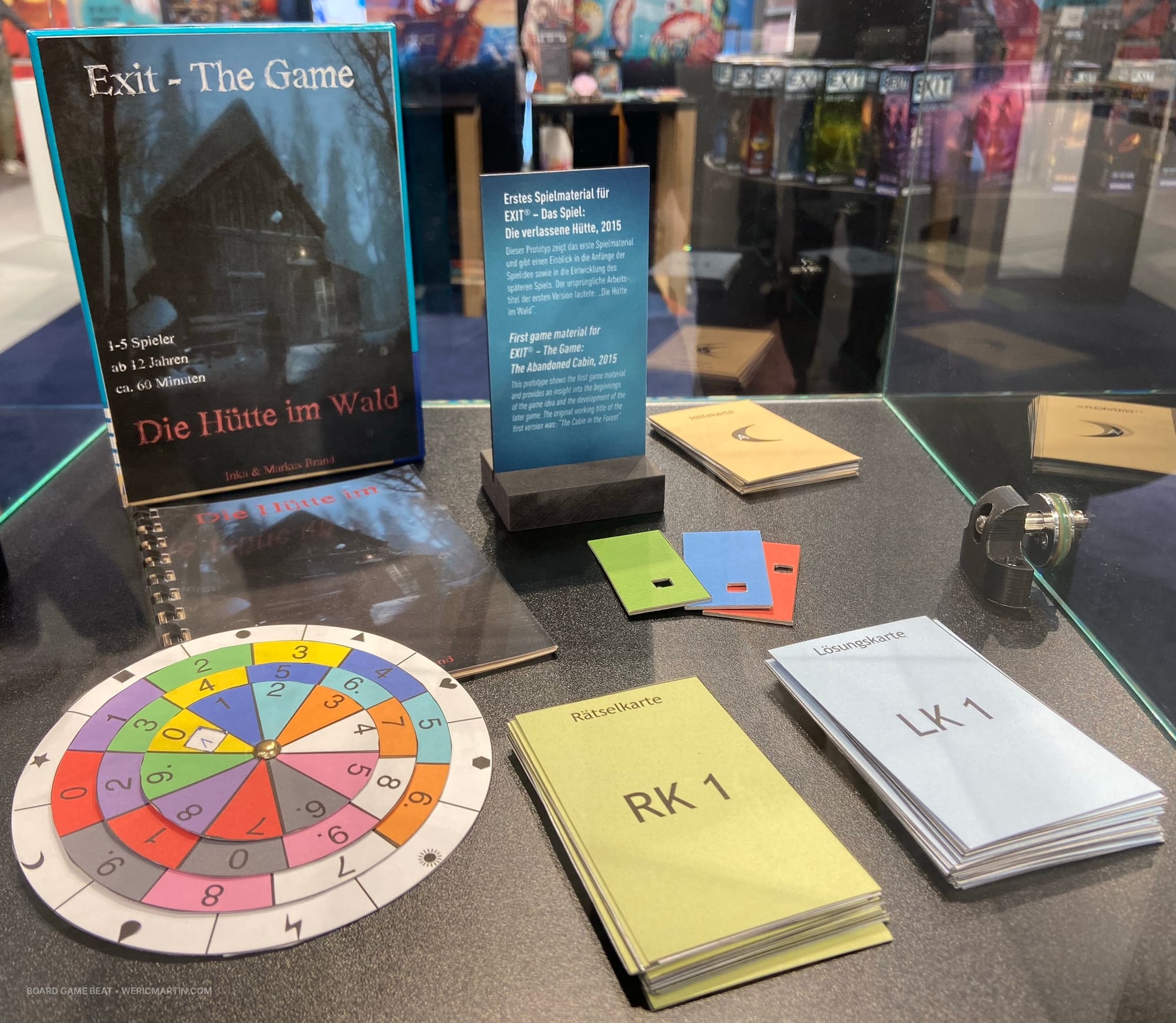
The first EXIT trio was well-received and went on to win the 2017 Kennerspiel des Jahres — an award from Germany's Spiel des Jahres jury for somewhat more involved games — over the other two nominees: Raiders of the North Sea and Terraforming Mars. That accolade, along with sales success, of course, has fueled new entries in the EXIT series over the past decade.
Says the Brands, "The expansion of the product line wasn't our idea. KOSMOS came to us and asked if we would be interested in developing books. The idea for the puzzles and advent calendars, however, came from us later on. We have always enjoyed the work on EXIT and therefore obviously said yes." They continued:
Different media bring different challenges. For example, in the books we can mostly use only riddles that are based on pictures; we don’t get extra material to play with. This is similar in puzzles, but the advent calendars are entirely different.
With the advent calendars, we usually pick a story that allows us to be creative in the way each "room" is designed. Every room can get a new design, can play in a new world, which makes the process very fun.
When it comes to the books, we have no part in the story since it’s written by an actual book author — which we are very thankful for! We feel like not necessarily the narrative changes when it comes to different media, but the focus does. The books, for example, focus much more on the story whereas in the games we mostly use the solution cards to implement parts of the story. The advent calendars are a mix of both. Since people usually play one room a day, we can afford to add more text than we usually would for every riddle. We see the story as equally important as the riddles in them.
Escape Experience
A press release from KOSMOS notes that EXIT's tenth anniversary coincides with the Brands creating their one thousandth puzzle for the series. As you might expect, with experience they've changed how they go about creating each design. Says the Brands,
We always start with an "easy" riddle in the beginning of the game to somewhat ease the players into the experience. The story of the games has also become much more important to us. We pay much more attention to incorporating riddles into the story now than we did before.
Obviously we try to think outside the box as much as possible when it comes to our riddles. We always try to leave an impression with creative and sometimes a little crazy ways to solve our puzzles. As time has moved on, we've learned about more possibilities to utilize the components of the game, but also different print styles like e.g., glow in the dark ink.
Another change is that while the Brands have had co-designers on occasion — Ralph Querfurth, for example, has five co-design credits — they now work regularly with a co-designer who has lots of first-hand experience on how EXIT gets made: their daughter Emely.
Says the Brands, "She works with us on most of the EXIT products now. She not only brings her own ideas for riddles and stories, but is really great with riddles that work with different perspectives. She thinks of a lot of riddles that are easily embedded into the story and often times originate from the story. She can also draw much better than either of us, which comes in handy when we try to bring a vision to life."
Even so, all three Brands bounce ideas off one another continually. They say, "We are getting constant feedback and critiques from each other to try to find the best way for a riddle to be displayed in a game." They also have a "riddle book" that they carry everywhere so that they can write down ideas whenever they might arise.
When Will EXIT Exit?
KOSMOS plans to release six new EXIT titles in 2026 — details below — so the product line is still going strong for now, but the Brands recognize that as in an escape room, time will run out at some point: "The success we have had with the EXIT product line has been heavily impacted by Covid. When people were stuck at home, board games in general became much more popular. Even though EXIT was already popular before the pandemic, it just increased the impact our games had."
They continue, "Whilst we assume that the number of sold units per title will decrease in the future, we will definitely keep working on them and keep enjoying working on them. We want to keep up the standard we have set for ourselves when it comes to EXIT games in the future, and we have an ever-changing list of possible scenarios for future titles, although we have set some boundaries as we try to never incorporate religion or politics into our games."
I guess we'll know the end is near if we start seeing titles like EXIT: The Dingy Closet or EXIT: Well, Here We Are Locked in Again, but until that day I hope that the Brands never run out of room in their riddle book so that they can keep us on the edge of our seat, looking for a way out.
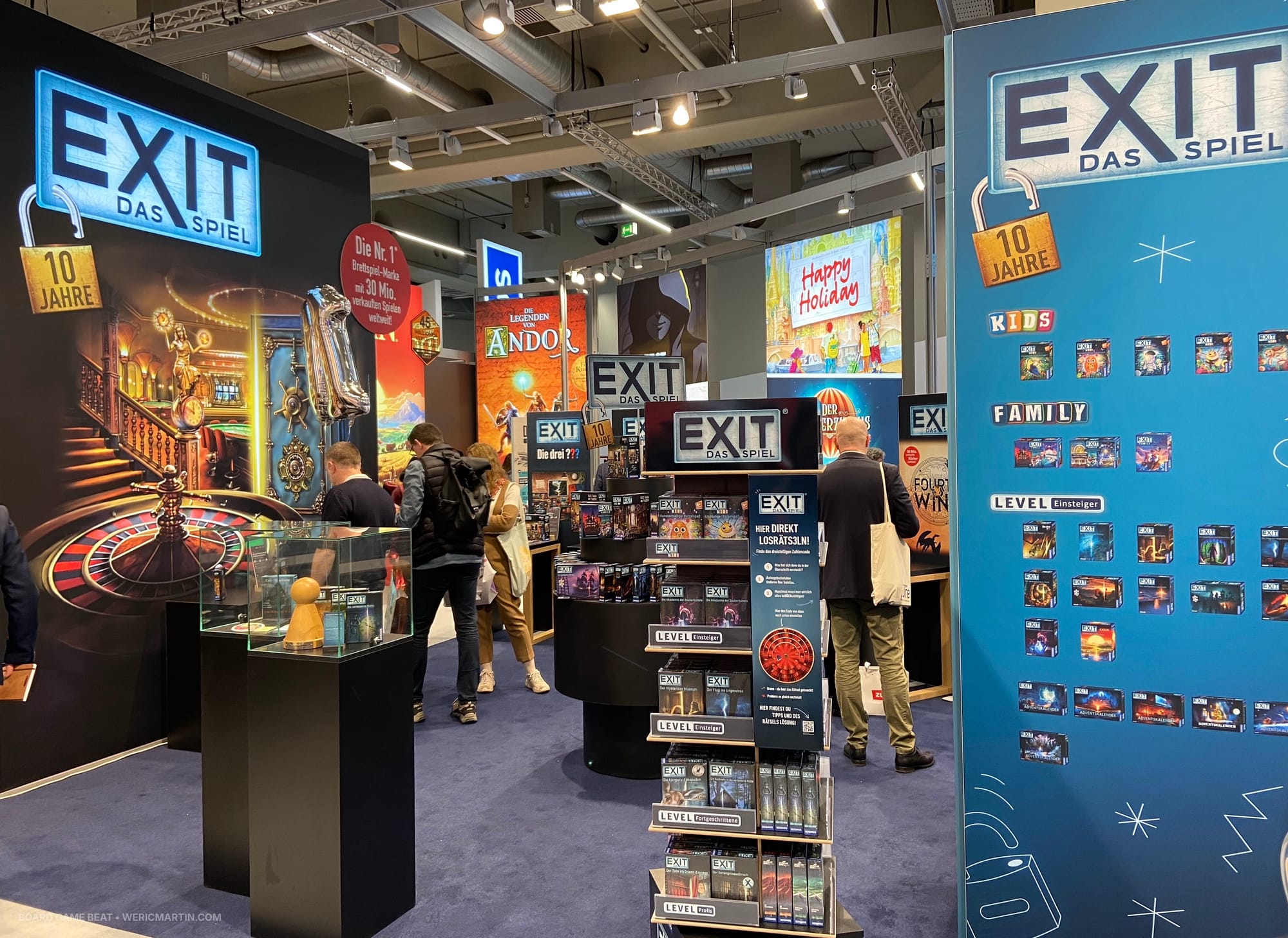
KOSMOS has a half-dozen new EXIT titles due out in 2026, and I got sneak peeks at its line-up during the 2026 Spielwarenmesse toy and game fair — although some of these peeks barely qualify as more than a sign saying "This will exist!"
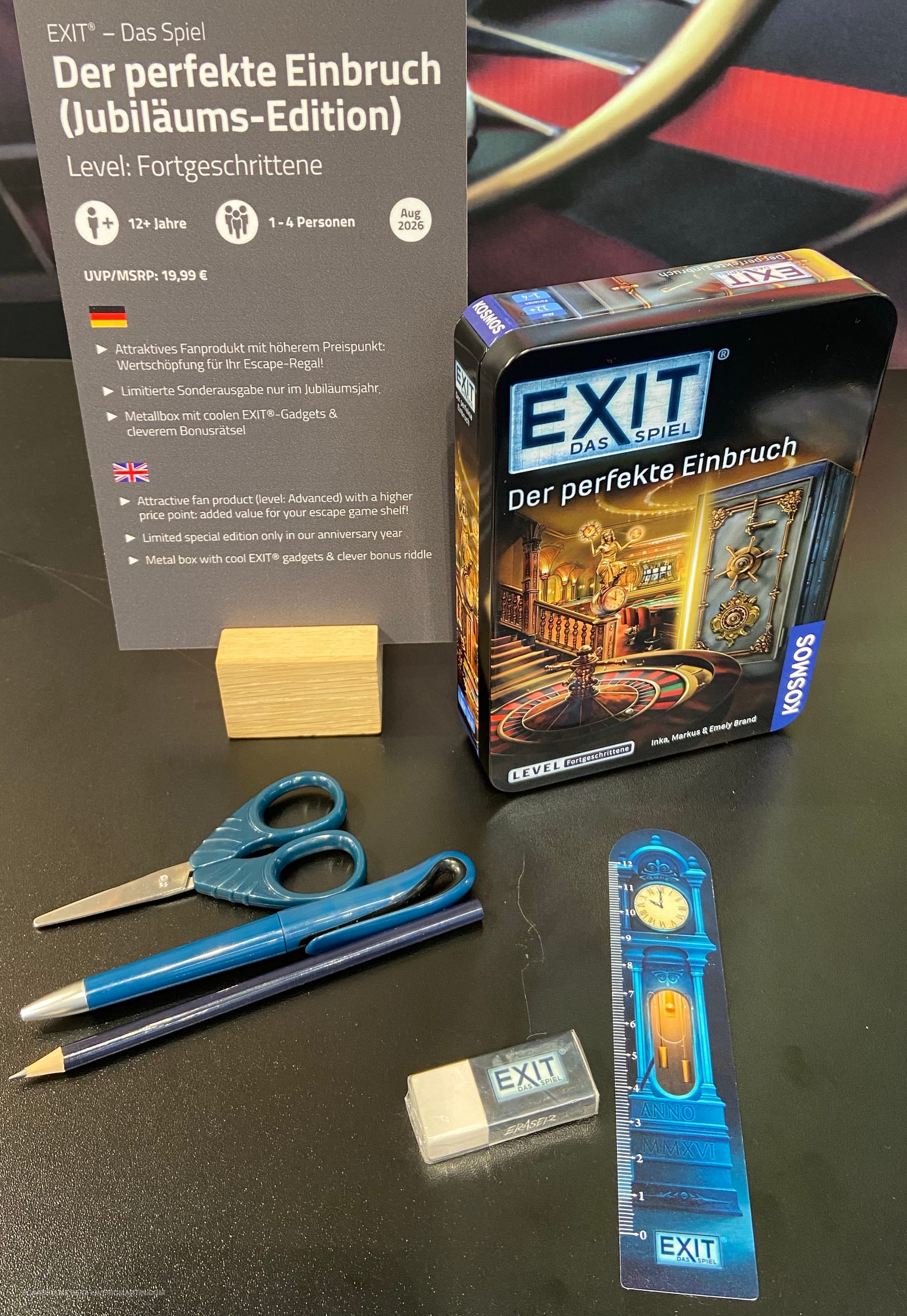
Let's start with EXIT: Das Spiel – Der perfekte Einbruch (The Perfect Burglary), which is explicitly labeled as an anniversary edition, coming packaged in a metal box and available solely in EXIT's tenth anniversary year. This title will be released in Germany on August 20, 2026. (EXIT titles typically have an English-language release through Thames & Kosmos the subsequent year, but we won't know exactly which titles will appear until they're announced.) Here is this game's setting:
Sirens wail, flashes of light illuminate the sky, and glass shatters somewhere — a brazen break-in rocks the casino! Amidst the roulette wheels and playing cards, a race against time begins. Enigmatic clues, encrypted codes, and mysterious objects must be deciphered to crack the case.
The publisher's teaser sign mentions a "clever bonus riddle" in relation to the gadgets. Might it have something to do with a misnumbered clock?
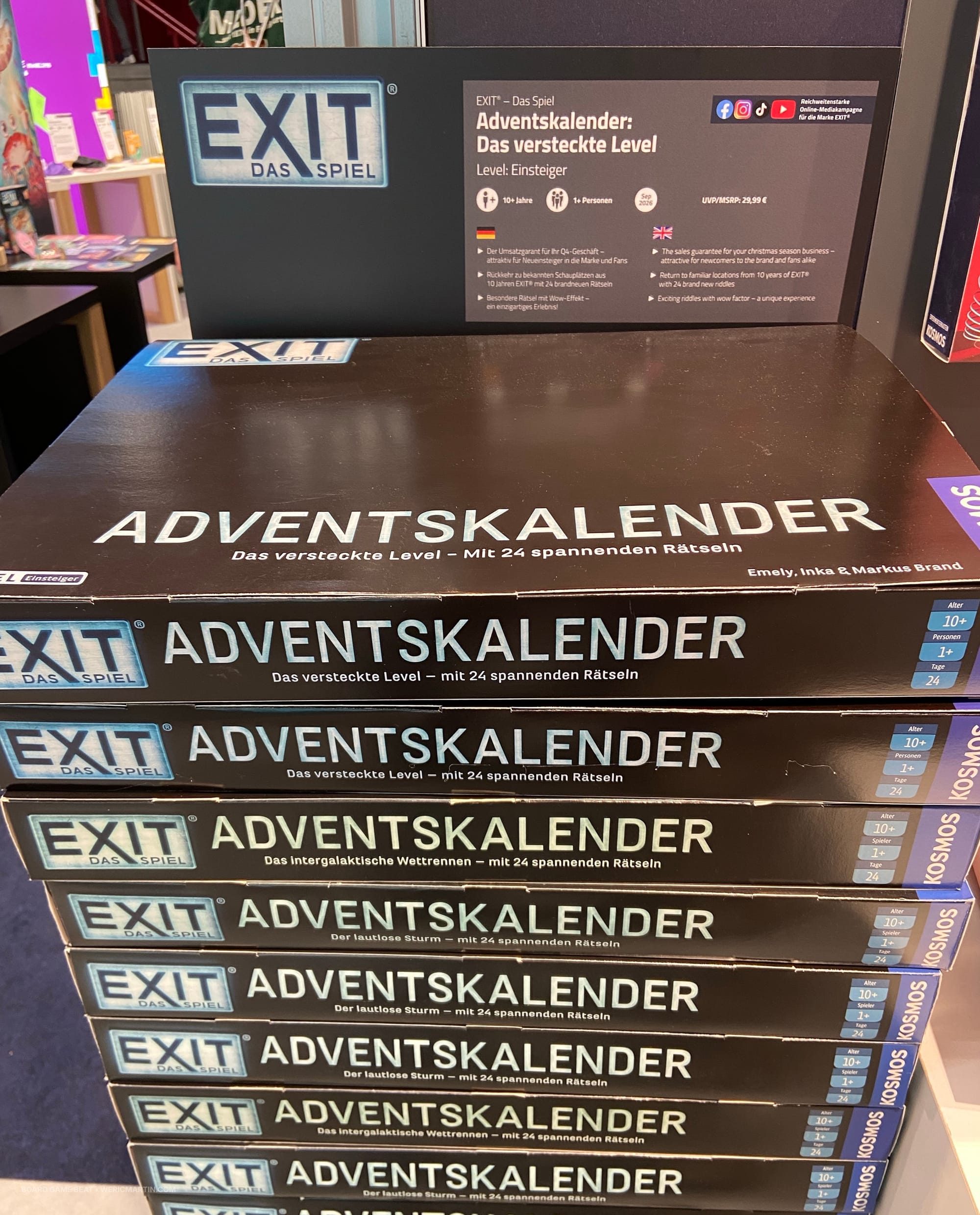
The first EXIT-themed advent calendar — The Mystery of the Ice Cave — appeared in 2020, and as is traditional with advent calendars, they have appeared annually since then, with the 2026 entry being EXIT: Das Spiel – Adventskalender – Der versteckte Level (The Hidden Level), which will hit retail on September 7, 2026.
The only info about this title is revealed on the booth sign: "Return to familiar locations from 10 years of EXIT with 24 brand new riddles." The format of this calendar will be the same as in previous years. You know which door to open on December 1, and when you solve the riddle presented by the contents inside, you'll know which door to open the next day.
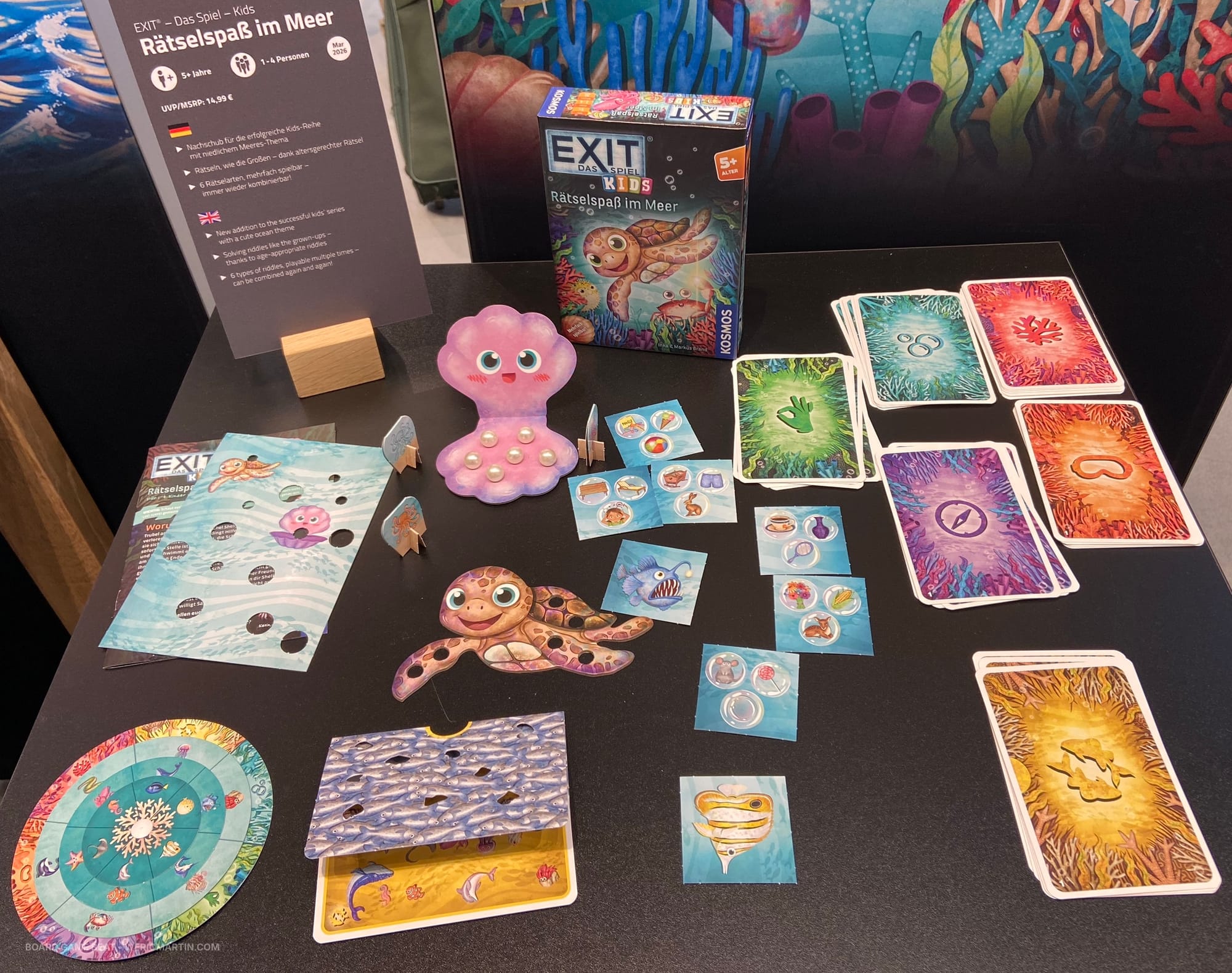
The first EXIT title aimed at children was 2018's EXIT Kids: Code Breaker, but this was a one-off title that didn't fit the EXIT brand. The "Kids" line truly began in 2022 with EXIT: The Game – Kids: Jungle of Riddles, and a new such title has appeared annually since.
The newest such title is EXIT: Das Spiel – Kids: Rätselspaß im Meer (Puzzle Fun in the Sea), which is due out in Germany on March 5, 2026. The story: "Shelly the mussel has lost her sparkling pearls, so Sam the turtle sets off with her to find them. At the far end of the reef, curious sea creatures await who will hand over the pearls only in exchange for solving tricky riddles."
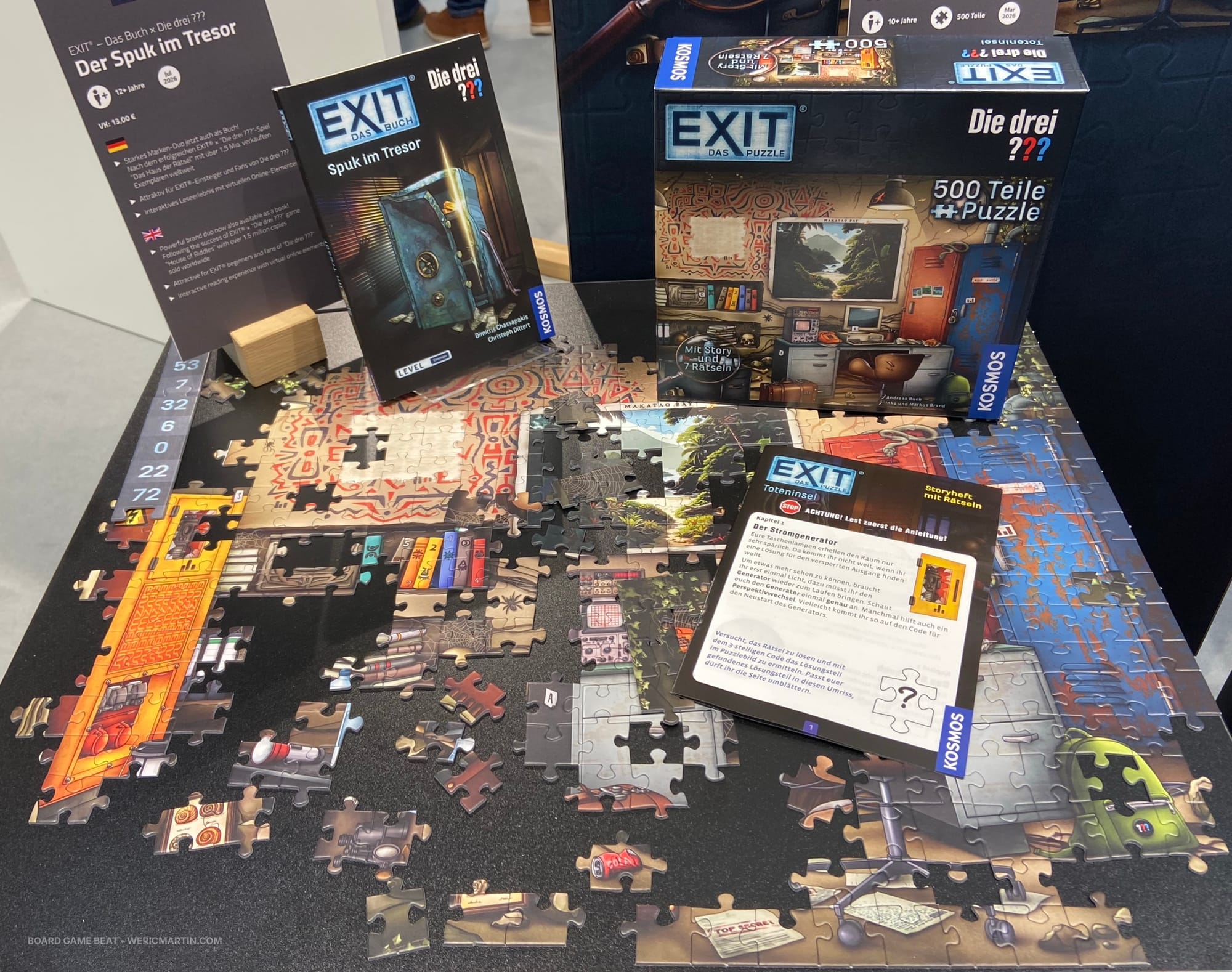
KOSMOS released four "EXIT: The Game + Puzzle" titles from 2020 to 2022, then took a break before the January 2026 release of EXIT: Das Puzzle – Die drei ???: Toteninsel (Isle of the Dead), which leans on the "Die drei ???" book series that Franck-Kosmos has been publishing since 1968, a book series that debuted in 1964 in the U.S. under the brand "Alfred Hitchcock and the Three Investigators" and a series that young Eric enthusiastically reached for once he had exhausted all of the Encyclopedia Brown titles. These books were great entertainment for a teenage boy, but I have no idea how well they've aged. In any case, here's the setting for this title:
The Three Investigators find themselves in the middle of the Pacific Ocean on the mysterious Isle of the Dead, where they are trapped in a hidden command center during a volcanic eruption. Players assemble the 500-piece puzzle, full of hidden details, and read a gripping escape story featuring Justus, Peter, and Bob. Finally, they solve seven riddles hidden within the puzzle. Will they manage to find a way out of the command center and escape the Island of the Dead?
My guess is "yes" since July 2026 will bring EXIT: Das Buch – Die drei ???: Spuk im Tresor (The Haunted Vault)...although perhaps the boys are the ones haunting the vault and you need to figure out what happened to them on the Isle of the Dead. Seems reasonable, right?
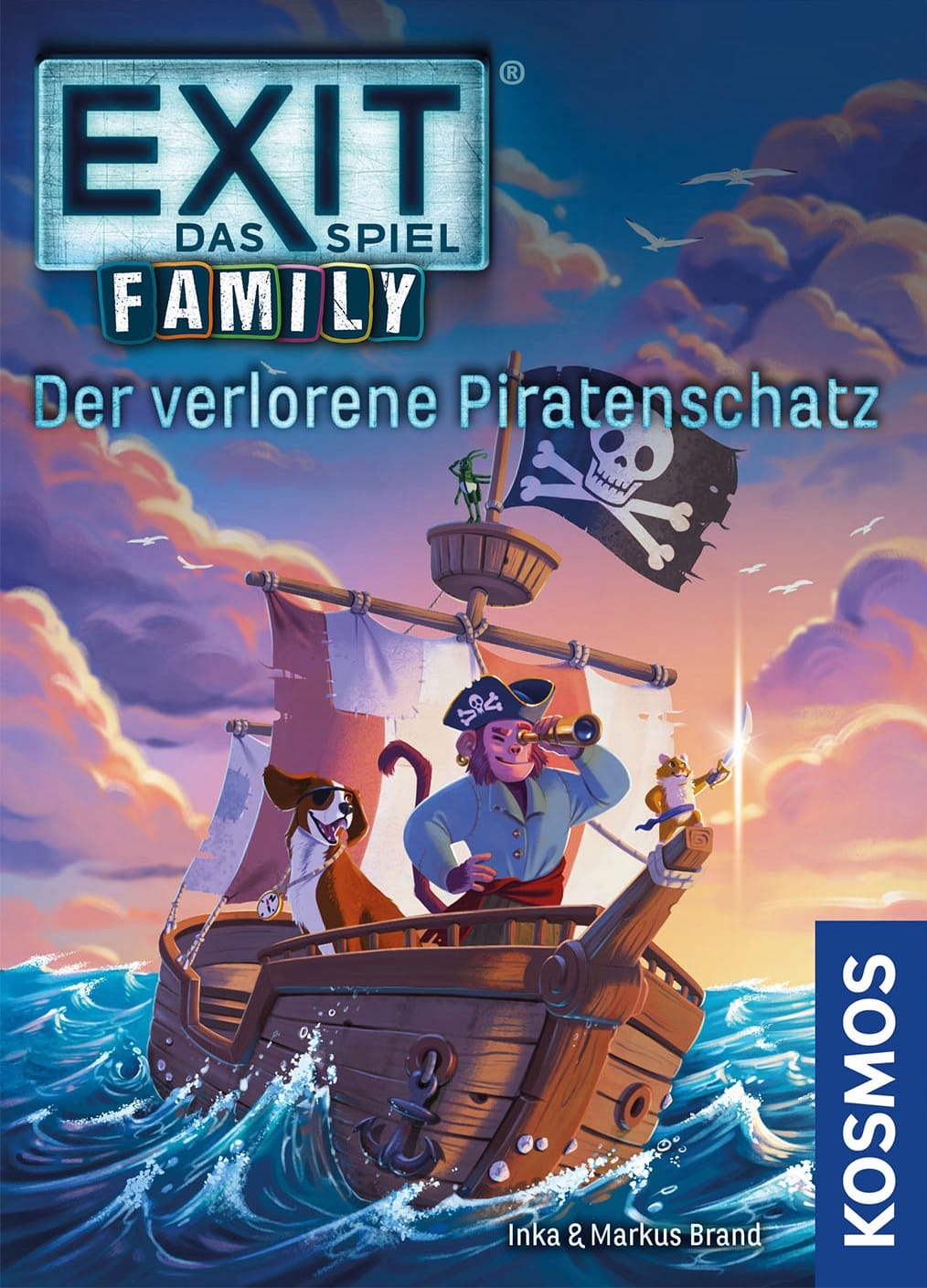
I missed seeing EXIT: Das Spiel – Family: Der verlorene Piratenschatz (The Lost Pirate Treasure) at Spielwarenmesse 2026, but I think the gist of this August 2026 release is clear: With help from the pirate monkey Skip, find the lost pirate treasure.
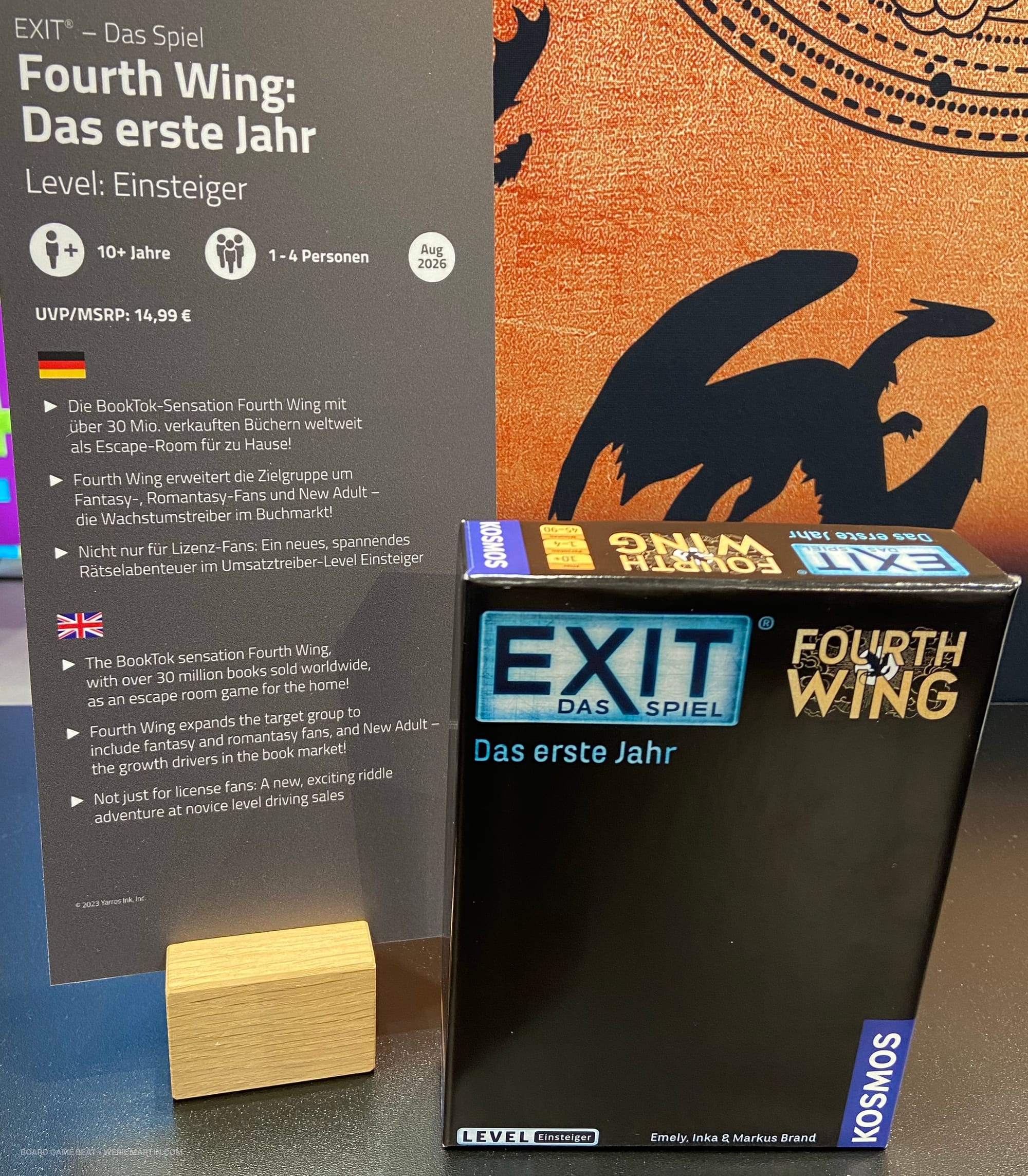
Finally, we come to EXIT: Das Spiel – Fourth Wing: Das erste Jahr (The First Year), which will debut in August 2026 and which is the fourth game I've seen using the Fourth Wing brand. Given the "30 million books sold worldwide" credit in the publisher's pitch card, I'm sure this won't be the last.


