

I've already covered the 2026 line-up of Swiss publisher Helvetiq in two posts, but it has one addition for SPIEL Essen 26, so I'll recap the list here:
- Bandido Alcatraz, by Martin Nedergaard Andersen: Co-operatively build tunnels to help a bandit safely make his way out of Alcatraz.
- Fugu, by Flavio and Riccardo Foches: Manipulate your hand of cards to build a valuable collection of sea life — axolotls in groups, blowfish on their lonesome, coral in three colors — while keeping your cards in numerical order, which seems to be a recurring theme for 2026.
- Cosmo, by Kaya Miyano: Draw cards from six decks, playing the odds to build a valuable poker hand.
- Panda Flip, by Carsten Rohlfs & Michael Diechtierow: Take turns flipping cards into discard piles, stopping to score a pile when you like at the risk of receiving nothing should your flip fail.
- Top Drop, by Simona Greco and Marco Rava: Co-operatively discard all the numbered cards in the deck, using ability cards to change direction and otherwise get yourself out of binds.
- Cat Trick, by Naigan: Take tricks in order to collect all five colors, but without collecting four of one color as you must then give those away to opponents.

In its press materials, Helvetiq mentions that Nedergaard Andersen's two previous Bandido titles — Bandido and Bandida — have collectively sold more than one million copies (880,000 for the original release and 180,000 for the spinoff). When seeing numbers like these, I'm always curious to see how many copies are listed as owned on BoardGameGeek. The Bandido game page lists 14,955 owned copies, or 1.7% of the total sold.
To repeat what I've said many times, BoardGameGeek is a central hub for gamers, but it hardly represents everyone who plays games.

Helvetiq bought abstract game publisher Steffen Spiele in 2023, and for 2026 it's releasing one new title in the line and updating another:
- Alto, by Joel and Rafael Escalante: Take turns using the action of a tile in a 4x4 grid to move the topmost disc next to that tile (or all such stacked discs). Each tile can be used twice, then you score, with each of your discs being worth as many points as its height in a stack.
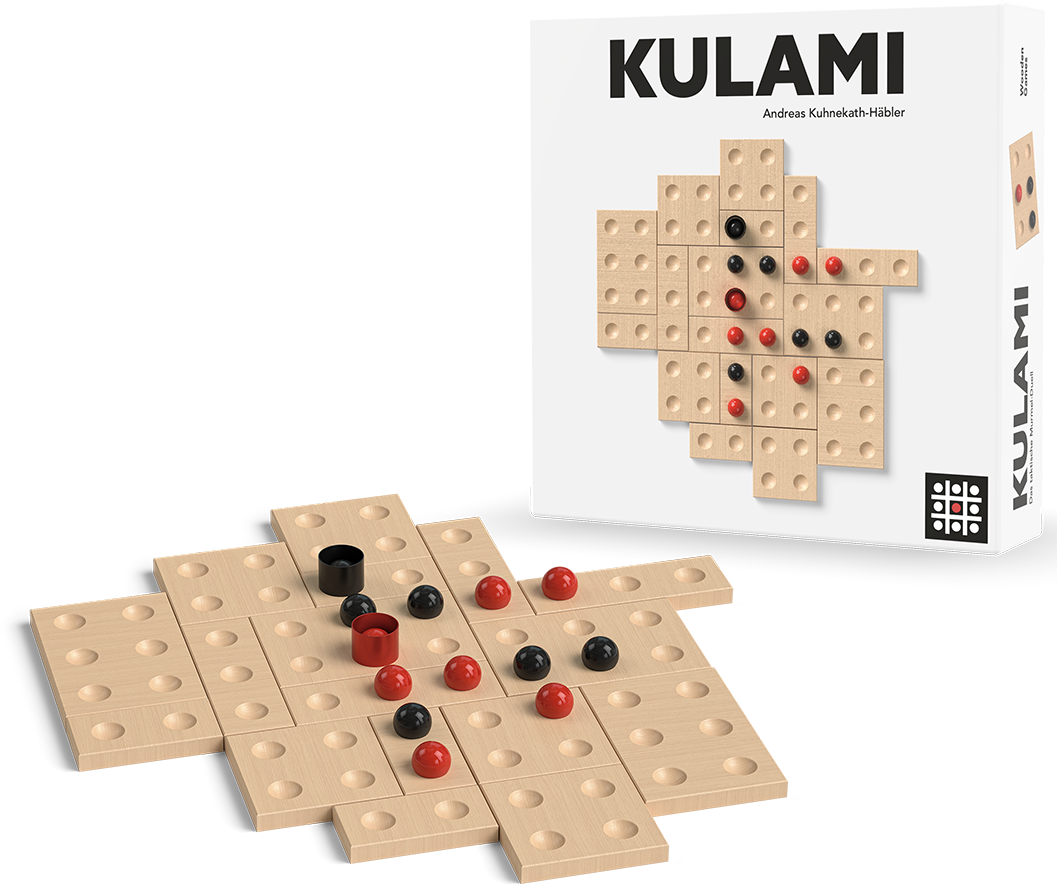
- Kulami, by Andreas Kuhnekath-Häbler: Take turns placing a marble on a board composed of rectangular tiles with 2, 3, 4, or 6 holes. The marble you place determines the row or column where your opponent must place their marble, with the two most recently played-upon tiles being off-limits. (The rings help you track what's off-limits.) When someone can't play, score 2, 3, 4, or 6 points for the boards where you have a majority of marbles.
Kuhnekath-Häbler's Kulami debuted in 2011, and it's a brilliantly simple and challenging game. Nice to see it back on the market!
Want more game news coverage like this?
Get Board Game Beat’s free posts by email — original reporting, designer interviews, and industry news, with no tracking, no ads, and no spam.


