

Nathan McNair, co-owner of Pandasaurus Games, posted this on Facebook on March 13, 2026:

In case you're wondering why shipping costs might be spiking, McNair is referring to the consequences of the United States and Israel attacking Iran on February 28, 2026, specifically Iran's decision to subsequently mine the Strait of Hormuz and not allow any non-Iranian vessels through that relatively narrow waterway.
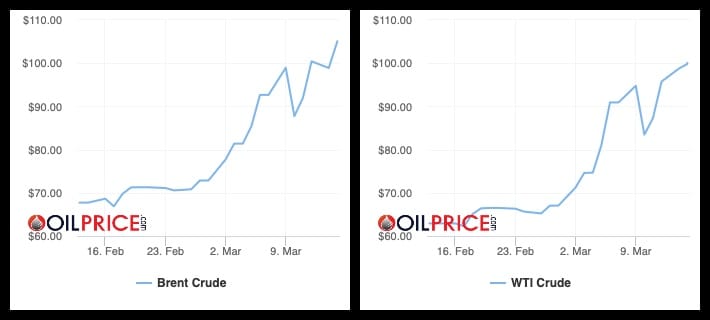
Approximately a fifth of the world's supply of oil and liquefied natural gas (LNG) travels through the Strait of Hormuz, and prices of oil and LNG have already spiked. Charts on OilPrice.com show that from Feb. 13 to Mar. 13 the price of Brent Crude has increased by 52% (from US$67.75/barrel to US$103.14) and WTI Crude has increased by 57% (US$62.89 to US$98.71).
For reference, Brent Crude and West Texas Intermediate (WTI) are the primary oil benchmarks, with "Brent Crude" being named after the Brent oilfield in the North Sea and with the Organization of the Petroleum Exporting Countries (OPEC) using Brent Crude as its benchmark.
The price of natural gas is unchanged from a month ago, but as Charles Kennedy wrote on OilPrice.com on March 5, 2026, "The global LNG shipping market has turned sharply higher in recent days, with charter rates for modern LNG carriers surging from roughly $40,000 last week to around $300,000 per day as traders scramble to secure vessels amid escalating disruption in the Middle East." In other words, the natural gas costs the same (for now), but the process of getting that natural gas will be more complicated. From Kennedy's article:
Shipping brokers say the spike reflects more than just a sudden scramble for vessels. With Qatar's production halted and tanker traffic through the Strait of Hormuz severely disrupted, traders are already preparing for longer shipping routes and tighter vessel availability. Cargoes that would normally move short distances from the Gulf to Asia may now have to be sourced from the United States, Australia, or West Africa, increasing voyage lengths and pushing up demand for LNG carriers.
Asia is expected to feel the immediate impact. Around 85% of Qatar’s LNG exports normally go to Asian buyers, with major importers including China, India, Japan, South Korea and Taiwan heavily dependent on those volumes.
To replicate my dive into OilPrice.com, I invite you to read "The Chokepoint Economy: What Happens When Everything Breaks at Once", a March 9, 2026 article by Michael Kern that highlights the spiraling repercussions of President Trump's impulsive recklessness. An excerpt, with me reformatting Kern's single-sentence paragraphs into a more readable form:
Tanker traffic through the Strait of Hormuz has dropped from an average of 138 vessels per day to roughly two. One hundred and fifty tankers are sitting at anchor in open Gulf waters. One hundred and forty-seven container ships are trapped inside the Persian Gulf, unable to exit. Maersk, CMA CGM, Hapag-Lloyd, MSC, every major container line, has suspended operations.
And another:
Iraq, the second-largest OPEC producer, has seen output from its three main southern oilfields collapse by 70 percent, from 4.3 million barrels per day to 1.3 million, because there’s nowhere to put the oil. Kuwait has cut production preemptively. The UAE is "carefully managing offshore production levels." Everyone in the Gulf is producing less because the tankers can’t get out.
Meanwhile, Israel struck a major fuel storage facility near Tehran over the weekend. Saudi Arabia's 550,000-barrel-per-day Ras Tanura refinery has been hit twice. Drones even targeted Saudi Aramco's million-barrel-per-day Shaybah oil field.
We are watching the physical destruction of energy infrastructure in real time, which means this isn't just a shipping problem. Even when the Strait reopens, some of this supply isn't coming back quickly.
And a third:
[Maritime insurance] is the hidden engine of the whole crisis. Before the strikes, war-risk insurance for a single transit of the Strait of Hormuz had already risen from 0.125 percent to 0.4 percent of a ship's insured value. For a very large crude carrier, that's an extra quarter of a million dollars per transit.
Then the insurers pulled coverage entirely. And without P&I coverage, ships cannot legally operate.
It doesn't matter if the U.S. Navy escorts you through, if you don't have insurance, your cargo isn't recognized at the destination port. The entire global shipping network runs on a layer of underwriting that most people never think about, and that layer just evaporated in the Gulf.
And a final one:
I keep coming back to a phrase from a logistics consultant quoted in a trade publication last week: "One week of direct impact can easily translate into more than a month of structural disruption." That's the part that gets lost in the daily oil price ticker. Even if the Strait reopens tomorrow…which it won’t…you still have 147 container ships trapped in the Gulf that need to clear out.
You have port congestion cascading through every downstream hub.
You have carriers that declared force majeure and offloaded containers at random ports.
You have equipment stuck in the wrong hemisphere.
You have contracts voided and surcharges locked in and insurance premiums that won't come down for months.
Qatar's Energy Minister Saad al-Kaabi told the Financial Times that if the war continues, Gulf producers may be forced to halt exports entirely and that this "will bring down economies of the world."
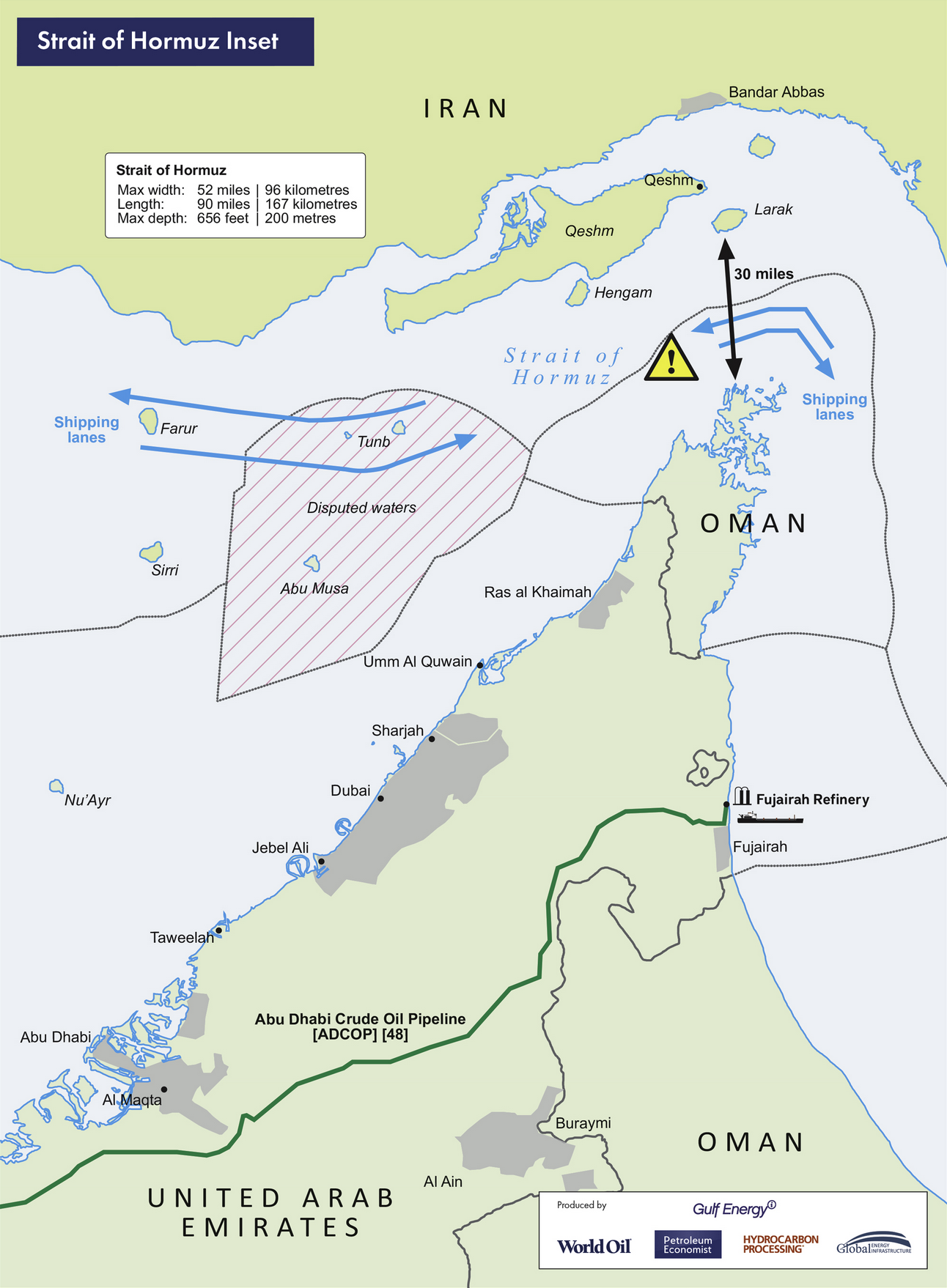
A March 13, 2026 article by Sarah Young and John Irish in Independent details how Iran is able to shut down the Strait of Hormuz:
Shipping lanes are just two nautical miles wide and ships must make a turn opposite Iranian islands and a mountainous coast that provides cover for Iranian forces, according to shipping broker SSY Global.
Iran's conventional navy has largely been destroyed but the Guards still have plenty of options including fast attack craft, mini submarines, mines and even jetskis packed with explosives, said Tom Sharpe, a retired Royal Navy commander.
Tehran has the capacity to produce around 10,000 drones a month, according to the Centre for Information Resilience, a non-profit research group.
Escorting three or four ships a day through the strait would be feasible in the short-term using seven or eight destroyers providing air cover, and would depend on whether the risk from mini submarines has been reduced, but doing so sustainably for months would require more resources, Sharpe said.
Even if Iran's capacity to deploy ballistic missiles, drones and floating mines were destroyed, ships would still face a threat from suicide operations, said Adel Bakawan, Director of the European Institute for Middle East and North African Studies.
Members of the International Energy Agency (IEA) have agreed to release 400 million barrels of oil from their strategic reserves, but as Tsvetana Paraskova reports on, yes, OilPrice.com, "The IEA-coordinated release will take weeks and possibly months to reach the market", and the amount being released by IEA members is only about one-third of the approximately 10 million barrels per day that has been cut from oil production in the Persian Gulf, so the supply of oil will still be less than it was in February 2026.
On March 15, 2026, President Trump stated that other countries should assist the U.S. in opening the Strait of Hormuz. From an Associated Press article on Politico:
"I'm demanding that these countries come in and protect their own territory, because it is their own territory," Trump said about the strait, claiming the vital shipping channel is not something the United States needs because of its own access to oil.
Trump said China gets about 90% of its oil from the strait, while the U.S. gets a minimal amount. He declined to discuss whether China will join the coalition.
"It would be nice to have other countries police that with us, and we'll help. We'll work with them," Trump said. Previously he had appealed to China, France, Japan, South Korea and Britain.
Needless to say, this territory isn't owned by those countries, the United States didn't consult countries beyond Israel before attacking Iran, and Trump does not have a stellar record on either keeping his word or working with other countries. That same article includes this Iranian response:
Iran's Foreign Minister Abbas Araghchi told CBS that Tehran has been "approached by a number of countries" seeking safe passage for their vessels, "and this is up to our military to decide." He said a group of vessels from "different countries" had been allowed to pass, without providing details.
Iran has said the strait is open to all except the United States and its allies.
Germany won't be one of those allies, as reported in a March 16, 2026 Politico article by Nette Nöstlinger:
"This war has nothing to do with NATO. It's not NATO's war," Stefan Kornelius, a spokesperson for German Chancellor Friedrich Merz, told reporters in Berlin on Monday. "NATO is a defensive alliance, an alliance for the defense of its territory," he added.
And this explains McNair's expectation for an industry freakout. We've previously seen huge spikes in shipping costs in 2020 due to COVID shutting down the world, leading to a shortage of shippers, containers, manufacturers, truckers, custom workers, and more, then again in 2025 due to the U.S. government applying unnecessary, arbitrary, and illegal tariffs that cost U.S. families and business hundreds of billions of dollars.
We're seeing a similar situation develop in March 2026 regarding shipping costs, but luckily(?) those costs might not spike immediately, which means publishers have a bit of lead time to make plans. As was already made clear in 2025, for the most part game manufacturing will not be possible in the U.S., which means U.S. publishers will continue to import games from Europe, China, and elsewhere, so how will they respond to this situation? I'm reaching to publishers to survey their plans, but I thought I'd lay out the situation they — and all the rest of us — face in the foreseeable future.


