

Designer Alan R. Moon is best known today for the game Ticket to Ride, but prior to that game's debut in 2004 he had already released other "network" games, that is, games in which points on a map are connected by pre-determined paths and players need to either build or travel on those paths. Those games include Airlines in 1990, Santa Fe in 1992, Elfenroads in 1992, Elfenland (a re-working of the previous game that won the Spiel des Jahres) in 1998, and Union Pacific in 1999.
Union Pacific was a streamlining of Airlines, with players building interlocking networks of railroad track across the United States while trying to earn dividend payouts that go to whoever owns the most or secondmost of a company's shares when a dividend occurs. (If you've played Sid Sackson's Acquire, you can spot elements of that design in Union Pacific and the earlier Airlines.)
Union Pacific was nominated for the Spiel des Jahres in 1999, losing out to Tikal, but despite that critical success, the game disappeared from the market after printings in 1999 in German by the originating publisher AMIGO (which had previously released Elfenland), in Dutch by 999 Games, and in English by Rio Grande Games.
Nearly thirty years later, a new edition of Union Pacific will hit the market courtesy of a crowdfunding campaign run by Sean Brown of Mr. B Games, a brand purchased in 2023 by Webbed Sphere, which also owns Mayfair Games.
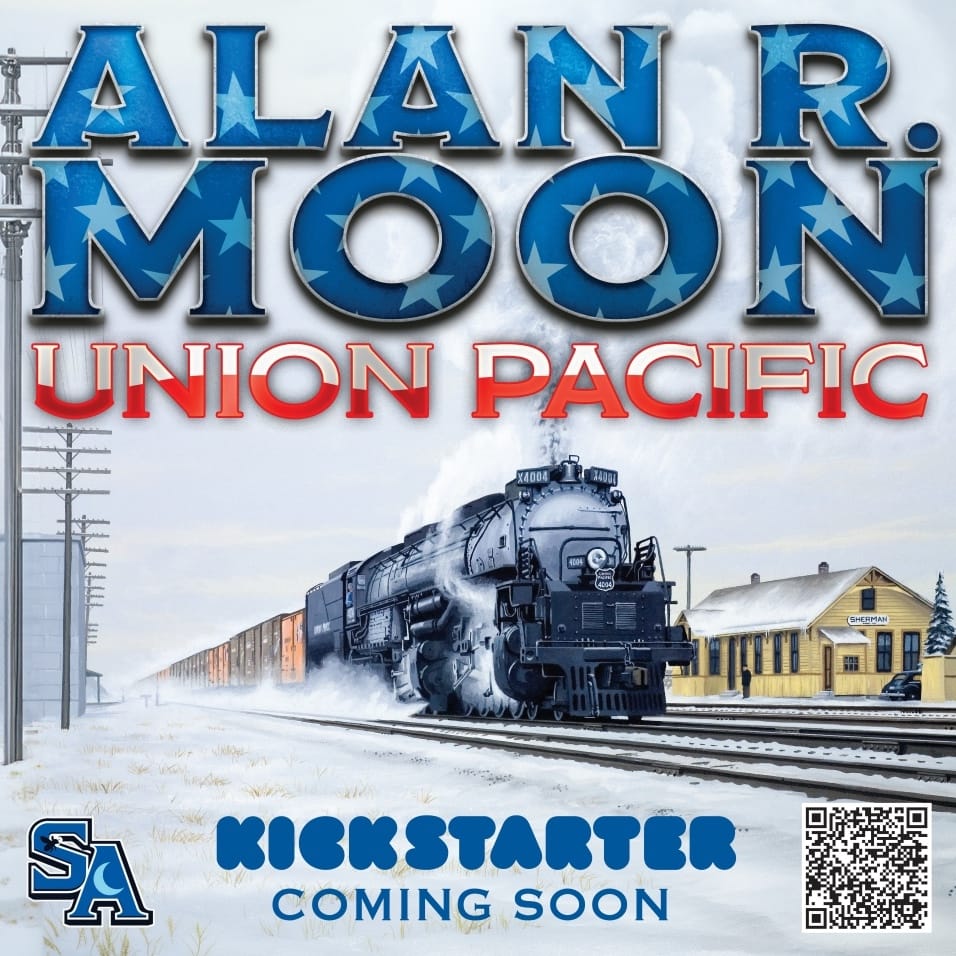
Brown describes this new edition of Union Pacific as a "kitchen sink" edition: "This is Alan's vision of everything he's ever wanted to do for the game all at once, all in one box, one last time." This edition will be a single printing, with all of the copies serial numbered to 1000, with the only stretch goal for the crowdfunding campaign being the addition of numbered copies up to 2,000 (3,000, etc.) if demand warrants.
"Union Pacific was the first train game I really fell in love with that blended Euro mechanics", says Brown. "This oddly was a grail game for me when I started in the industry back in 2005, and it's incredibly difficult to track down to this day." (I'll note that while the Rio Grande edition of the game is scarce, secondhand Dutch and German copies seem relatively easy to acquire.)
Brown says that Moon had approached him about developing an all-in edition years ago. "Alan and I have been working on this together as a project for awhile now", he says. "We are working on the game as long as needed until it's crowdfunding ready. Without a deadline, we can go when we are ready or have enough interest, and in the meantime we can continue to pile up cool components in the sink visually and graphically until the vision is ready to print."
As for what's changed in this edition, Brown says that the initial seeding of dividend cards in the deck has changed, a variant many players have adopted as the only one to play.
More substantially, the game will feature a re-balanced map of the United States on one side of the game board, with a UK map on the reverse side. Says Brown, "Alan had had a GWR [Great Western Rail] expansion — a new railroad with trains and cards — ready for years, but it never saw the light of day, nor did the 'Black Market' for the UK map." Those modular expansions have been placed on their own game board, and they can now be used with either map.
"We have literally gone over everything in the original game", says Brown, "re-editing the rules and taking the time to obsess over deluxified components and trains."
One element you might notice in the image of the new edition is the difference in typeface size of the designer's name and the game's name. Years ago, while talking with Alan, he brought up how the book industry champions authors and makes them a selling point. Look at new releases from Stephen King and Tom Clancy, he told me, and you'll see that their names take up the top third of the book cover. Why isn't it the same for game designers?
I know that some people argue that a game's designer isn't a selling point for most players, but Moon's counterargument is that publishers don't do enough to champion the creators of the games they sell, so many players don't associate a creator with a particular game — but by promoting a designer, a publisher would encourage a long-term relationship with them, and as gamers become more cognizant of that creator, they would look for games from them, thereby encouraging more sales for that publisher. AEG, for example, should be blasting John D. Clair's name on each new release given how successful and long-lasting that relationship has been. By promoting Clair, AEG will help itself through that marketing.
For this new edition of Union Pacific, Moon has been able to carry out this vision.
Like this kind of coverage?
Get Board Game Beat’s free posts by email — original reporting, designer interviews, and industry news, with no tracking, no ads, and no spam.


