

While I enjoy plenty of multiplayer designs, two-player games tend to hold more appeal because no matter what’s going on in the game, it’s all about me versus you. The experience feels more direct. You’re trying to take me down, and I have to anticipate that with every move I make.
With that in mind, here’s a handful of new and upcoming two-player games that caught my eye:
The Mire is the debut title from designers Shadoe Konicek and Sydney Whalen of new U.S. publisher Waterbear Workshop, and the name suggests what you’re trying to do in the game: Trap your opponent so they can’t move.
The game has a 6x6 grid of tiles, with each tile showing one of three symbols and one of three backgrounds. Each player removes a tile from the perimeter for their “health” tile, then in reverse order they place their figure on a tile on the perimeter that matches their health tile in symbol or background. Players then alternate turns in which they:
- Move their figure to an adjacent space that matches their health tile, then flip the tile they departed from face down.
- Swap two adjacent tiles (with one of those tiles matching their health tile) or swap their health tile for another one in the grid.
- Place a blocking cube on — wait for it — any tile that matches their health tile.
Keep taking turns until someone can’t move and sinks into the mire, with the winner earning the right to dance on their boggy grave.
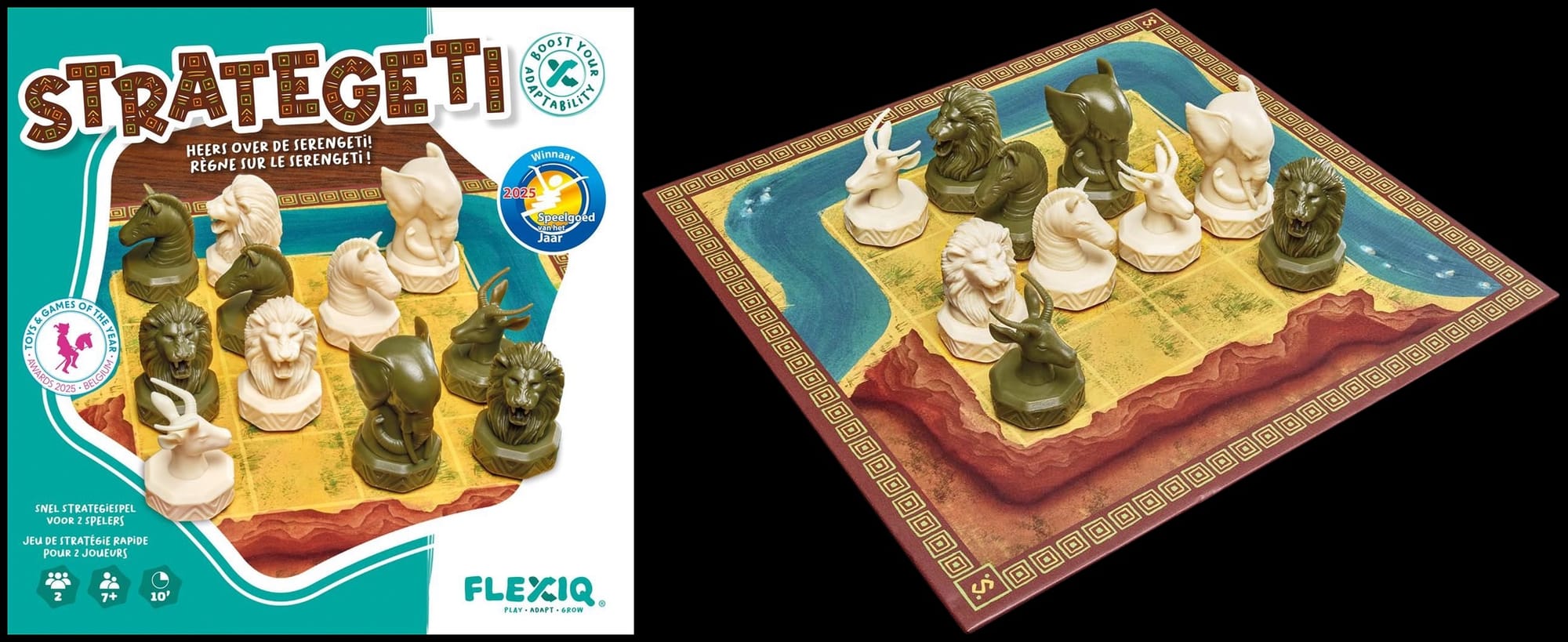
Blocking your opponent from moving also drives the gameplay in Ignasi Ferré’s Strategeti, which Belgian publisher FlexiQ released in September 2025, but you can also win by either getting four of your animals in a row on the 4x4 grid or capturing five of your opponent’s pieces, thus ensuring that they can’t get four in a row themselves.
Each turn, you either add one of your animals to an empty space on the game board — you have two of each animal in four types, and only certain spaces can be placed on depending on which side of the game board you use — or move one of your animals already on the board:
- Elephants move one space orthogonally, but only if they can push an adjacent animal. Other animals in line are pushed as well, and if one goes off the board, it’s eliminated.
- Lions move one space orthogonally, but only if they can eat an adjacent gazelle or zebra. You can now guess the other two animal types...
- Gazelles move in a diagonal or orthogonal direction, but only if they can jump one or two animals in a line to land on a free space. A gazelle can make multiple jumps on the same turn.
- Zebras move in a diagonal or orthogonal direction as many spaces as they wish as long as those spaces are empty.
Keep taking turns until one of the victory conditions is met, after which the winner can stampede across the Serengeti trumpeting in victory.
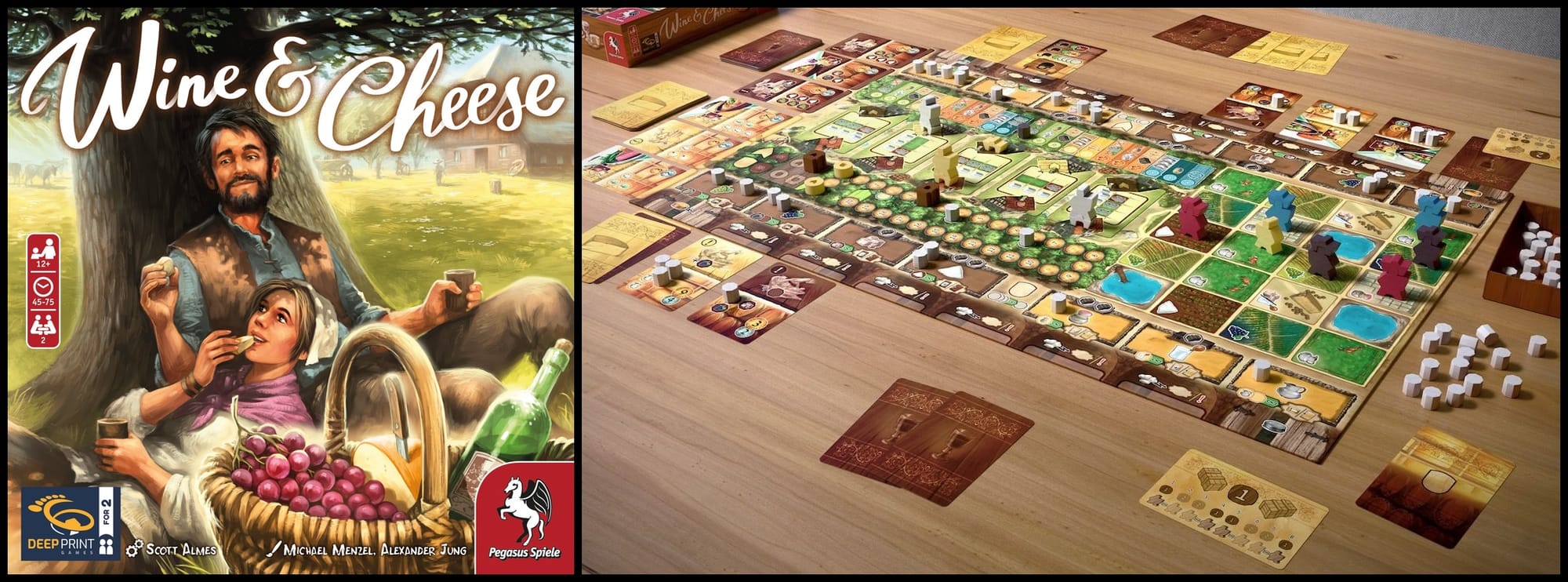
In 2022, designer Scott Almes and publisher Deep Print Games partnered on the two-player game Beer & Bread, and for 2026 they’re bringing us another tasty pairing, one that’s more complex than that earlier design. Here are the minimal details available currently for Wine & Cheese, a 45-75 minute game that’s due out in Q2 2026 via German distributor Pegasus Spiele and other licensing partners around the world:
In the heart of Burgundy, you and a neighbor each run a traditional farm that produces both wine and cheese, and while as neighbors you share vineyards, pastures, and labor, you’re still in direct competition with one another.
Over two years, you must prove that you can master the demanding tasks of wine and cheese production. Procuring the ingredients requires considerable skill, with workers being sent out in pairs to the plots in spring and brought back in autumn. (Don’t ask how they survive in the meantime. They’re probably eating up your profit margin.) Good timing is essential, not only to produce and mature the wine and cheese to the best of their quality, but to sell them at the right moment.
What’s more, you need to earn from both wine and cheese equally to claim victory because in the end you’ll compare whichever product has earned you less money, with the loser being forced to toast the winner with every glass of wine they consume for the rest of their lives.
Thinking of two-player games might bring classics like Chess and Go to mind — and if you're a designer, you might decide to put a twist on those classics, which is what Konstantin D at Pathbind Games has done in Pathbind: Setch.
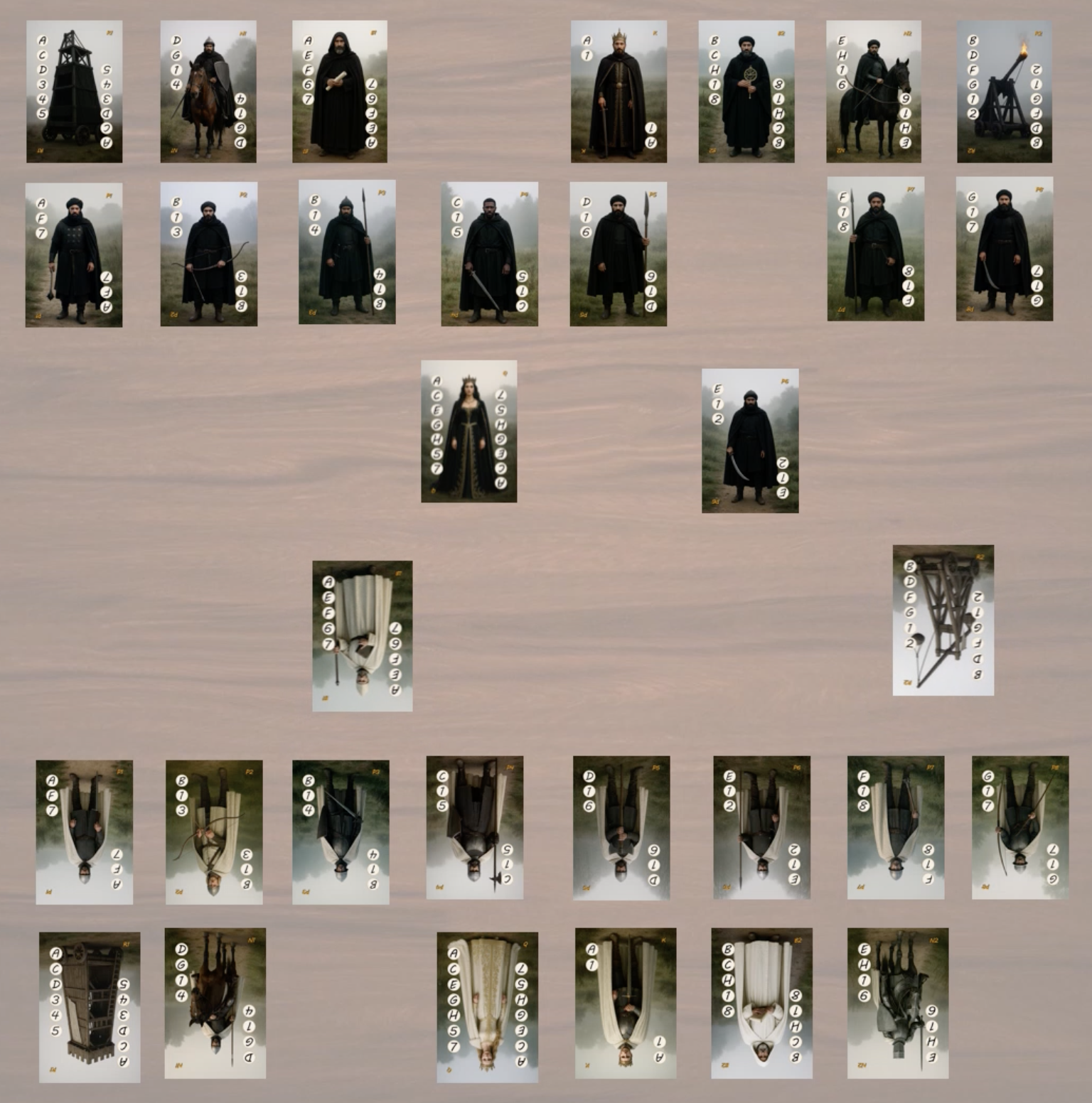
Each player has a set of sixteen cards that match the traditional chess roles — king, queen, rook, etc. — and each card has one or more letters (A-H) and one or more numbers (1-8), with these values somewhat representing the strength of that role. Each player starts with their cards visible in a private camp, with an empty battlefield between the camps. On a turn, you can:
- Move one of your cards into the battlefield (with the exact position not being relevant).
- Retreat a non-pawn card from the battlefield to your camp.
- Attack an enemy card. To do this, you need to have on your cards in the battlefield all of the letters and numbers on the card you want to attack, whether it's on the battlefield or in the opposing camp. If you attack a card, you remove it from play, and if you attack a card in the opposing camp, you must remove one of your attacking cards as well. Think of it as sneaking into enemy lines and sacrificing itself in the action.
In the image above, for example, the white bishop and rook collectively have E-1-2 on them, so they can attack the black pawn on the battlefield and remove it. However, if the opponent also has these values in the same zone — the battlefield, in this case — then you cannot attack that card.
Essentially you start with a comprehensive web of defense in your camp that protects all of your cards, then as you send cards into the battlefield to attack, you weaken that web, making cards both in your camp and on the battlefield vulnerable and open to attack themselves.
As in Chess, you can't fully retreat from the battlefield in order to defend yourself. Once advanced, pawns must stay in the battlefield, although if you sacrifice a pawn on a successful attack in the opponent's camp, you can return a previously removed non-pawn card to your camp. Sound familiar?
In addition to the actions above, you can also Pass for your action, and if both players pass in a row, the game ends in a draw.


