What would a week’s worth of game news be without a post devoted to trick-taking games? Someday we will discover the value of that game news, but not this week thanks to the titles featured here:
Lobby Snacks is a trick-taking game for 2-5 players from designer Paul Salomon that publisher 25th Century Games will crowdfund at the same time as its new edition of Reiner Knizia’s Tigris & Euphrates. Yes, that game is a classic design, but I’ve already written about it elsewhere, so let’s move on to what’s new.
Your challenge in Lobby Snacks is to use your buying power to get as many goodies from the lobby as you can, but without spending more than everyone else — shades of High Society here, which is another Knizia design...
In each of three rounds, players start with a hand of ten cards, which come in three suits with positive and negative values. Ten cards from a prize deck are splayed face-up, and the top card of this splay shows the trump suit for this trick (which might be none), along with a dollar value.
The lead player in a trick lays down a card, but players don’t have to follow this lead suit. After everyone has played, the highest-valued trump — or if no trumps are played, the highest-valued card of the lead suit — wins the trick. The winner places their played card in a personal “spent” pile, and the prize card and all other played cards in their score pile. After all cards have been played, players count the dollar signs on cards in their spent pile; whoever has spent the most scores nothing for this round, while everyone else tallies the dollar signs on cards in their score pile.
For the second and third rounds, before dealing out the cards, each player who has busted in previous rounds receives a random reward card for each bust. Reward cards count as a supertrump, and the first reward played in a trick wins it.
After three rounds, whoever has spent the least over those three rounds receives 5 bonus points for being a thrifty theatergoer, then the player with the most points wins.
Cardner and Alex Babakitis’ four-player-only trick-taking game Hot Dog originally appeared in March 2025 in a small edition from Gotcha Gotcha Games, but now the couple has released a new edition under their own brand: Odd Candy. ("I'm a huge proponent for getting my friends who are disposed to game design to get their designs out there", says Taylor Reiner, who normally self-publishes under Gotcha Gotcha Games. Reiner was running Indie Market Vegas at Dice Tower West in 2025 and wanted to encourage first-timers, so he published both the couple's Hot Dog and Numberwang ahead of them starting their own imprint.)
The Hot Dog hook comes from the odd packaging practices of manufacturers of hot dogs and hot dog buns, with hot dogs typically coming ten to a pack, while buns are eight to a pack. Eating a hot dog on its own is fine, but only the rarest of birds would be satisfied chomping on an empty bun. (Literally, yes, you would have to be a bird to enjoy this.)
Hot Dog comes with a semi-standard 54-card deck, with cards numbered 1-13 in four suits and two jokers. Each regular card, however, has two values on it: a dog value and a bun value, with the two values summing to 14. In essence, the ratio of bun to dog varies across a suit. The jokers are the super dog (with a 14-0 value split) and super bun (0-14), with these cards counting as all suits.
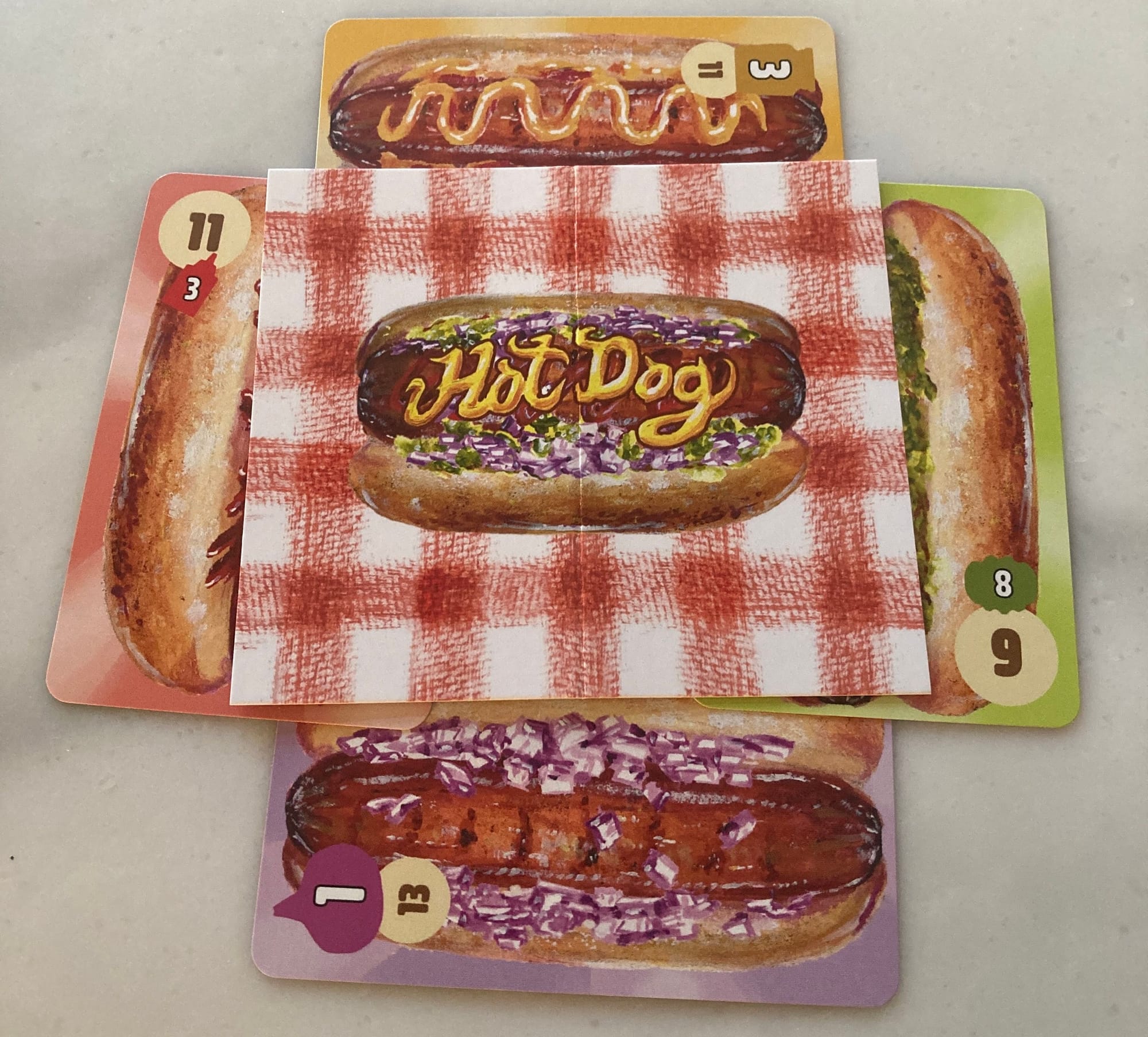
Each player gets a hand of thirteen cards, and whoever leads a trick sets the suit that others must follow...but the first and third cards played count only their dog value, while the second and fourth cards count only the bun value. (The game includes a “table” so that you can tuck cards and see only the dog or bun side as appropriate.) Whoever played the highest value wins the trick and leads the next one, but note that dogs can win only if they’re played on suit. Buns, on the other hand, overwhelm dogs and can win even if played off suit, in addition to winning ties.
You track whether dog or bun won on claimed tricks, and at the end of the hand you score 3 points for each dog/bun pairing. Extra dog-won tricks are worth 1 point, while extra bun-won tricks are garbage because you are not a bird.
After four hands, whoever has the most points wins.
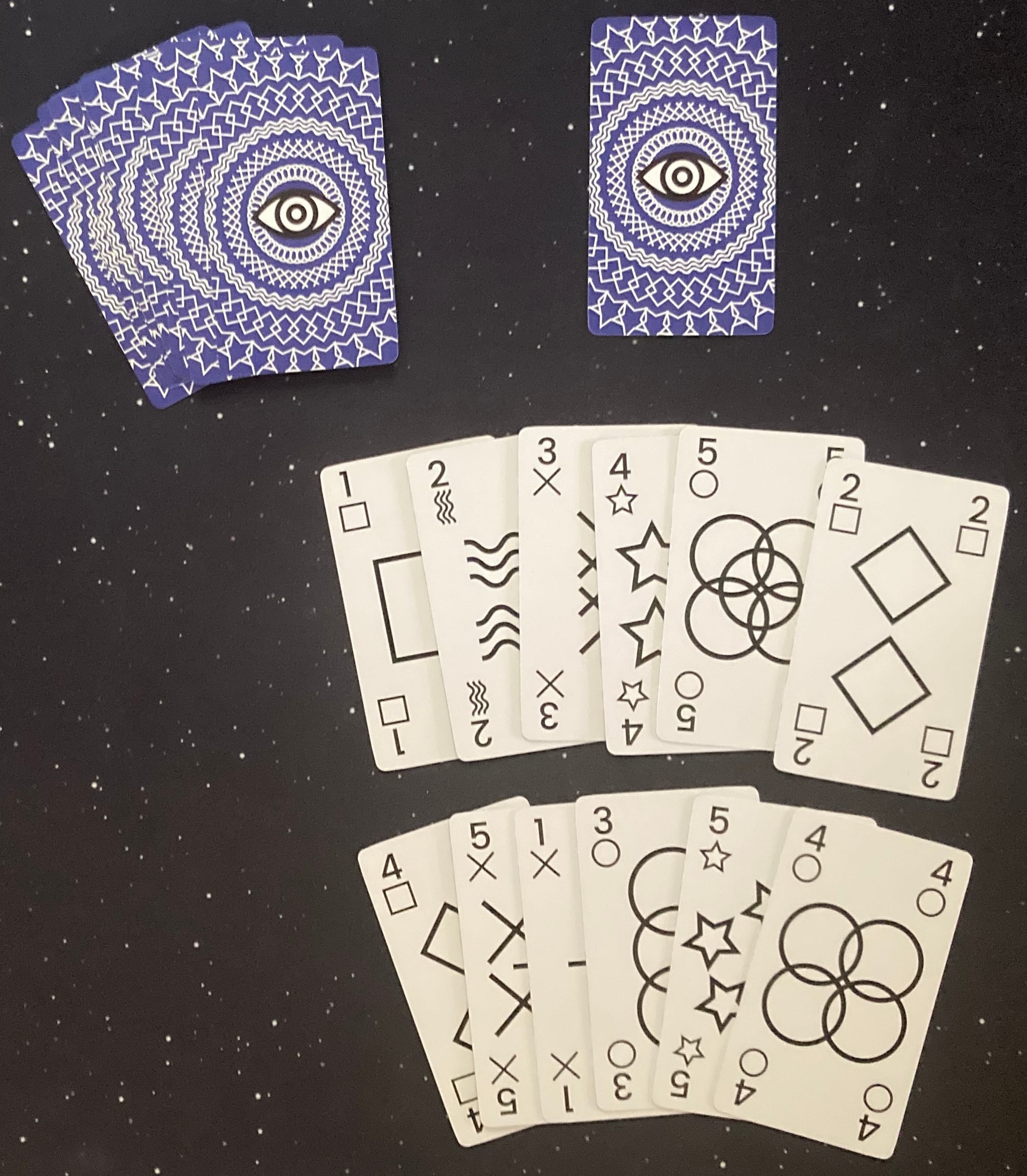
To step away from tricky snacks for a bit, in Q2 2026 the Babakitises will run a crowdfunding campaign for ESP: Experiment in Supersensory Perspicacity, a trick-taking game for 3-4 players that cleverly ties the predictive powers associated with ESP to players predicting both trump for the round and how many tricks they will take.
The deck consists of 25 cards, with cards being ranked 1-5 in five suits. Each player receives a hand of six cards, with one card being placed face down in the center of play. Each player in turn predicts either the rank or suit of the center card, with no duplication allowed. Whoever guesses correctly earns 1 point, but more importantly a correct guess will make that rank or suit trump for this hand — and if no one guesses correctly, the round has no trump.
Players then place cards from their hand face down in front of them, with the number of such cards increasing from two to five over the game's four rounds. Players then play tricks from their hand, following suit if possible, then tricks from their face-down cards, with you not needing to follow suit at that point. After five tricks, the final card that remains is your bid for how many tricks you've taken, with each card having a bid value for both rank and suit: circles = 1, cross = 2, etc. (If the card's rank and suit have the same bid value, you can use the card for a 0 bid.)
If the number of tricks you've taken matches either bid value, you score 3 points, along with 1 point for each trick. After four hands, players can compare their psychic rankings...although whoever scores highest should have already known those rankings beforehand.

Let's now turn from ESP to actual science, with designer Adam B. West of CrossCut Games merging trick-taking, set-collecting, and tableau-building in Dr. Science, a game for 2-4 players that will be crowdfunded in Q1 2026.
Each player takes the role of one of the scientists shown on the cover, with each scientist treating cards of its color as trump...sometimes. Cards come in four suits valued 1-5, with wild cards having all four suits and a value of 0 and with the researcher having a variable X value. Each player takes their researcher and eleven cards in hand, with two cards being face-up from the remaining deck in a market.
Each turn you play a card to the current trick, either from your hand or your hypothesis — that is, cards on the table in front of you — then you optionally play cards to your hypothesis, then you draw a face-up or face-down card to refill your hand.
When playing to a trick, you don't have to follow suit, and the first player who plays their personal color (which includes playing a wild card) sets the trump suit for this trick. Whoever plays the highest-valued card wins the trick, but note that only 3s, 4s, 5s, and researchers are worth a point.
After playing to a trick, you can play 1-4 cards into your hypothesis, with this being similar to Rummikub in that after you do so, all cards in front of you must be part of sets or runs. (You cannot take cards from or give cards to other players.) If you have played 2-4 cards, you take the highest-valued validation card from the table that matches the number of cards played. Your researcher's X value can change as needed to help make sets and runs, and you can play cards in front of you into future tricks, breaking up valid combinations.
When the market runs out, ditch your hand and move all cards in your hypothesis to your score pile, then score 1 point for each 3, 4, 5, and researcher in that pile. Finally, add your validation points to this total to see which doctor of science gets to keep their PhD.